Buyer Fit Snapshot
| Best fit | Ecommerce Packaging Bulk Order projects where brand print, material claims, artwork control, MOQ, and repeat-order consistency need to be specified before quoting. |
|---|---|
| Quote inputs | Share finished size, material target, print colors, finish, packing count, annual reorder estimate, ship-to region, and any compliance wording. |
| Proofing check | Approve dieline scale, logo placement, barcode or warning zones, color tolerance, closure strength, and carton packing before bulk production. |
| Main risk | Vague material claims, crowded artwork, missing packing details, or unclear freight terms can make a low unit price expensive after revisions. |
Fast answer: Ecommerce Packaging Bulk Order: Costs, Specs, and Process should be specified like a repeatable production item. The safest quote records material, print method, finish, artwork proof, packing count, and reorder notes in one written spec.
Production checks before approval
Compare the actual filled-product size with the drawing, then confirm tolerance on folds, seals, hang holes, label areas, and retail display edges. Reserve space for logos, QR codes, warning copy, and material claims before decorative graphics fill the panel.
Quote comparison points
Review material grade, print process, finish, sampling route, tooling charges, carton quantity, and freight assumptions side by side. A quote is only useful when the supplier can repeat the same color, closure quality, and packing count on the next order.
An ecommerce packaging bulk order can cut unit cost in a way that actually matters on a P&L, but the biggest savings usually show up in freight, storage, labor, and damage reduction rather than in the carton price alone. I have seen brands trim a few cents off the box and then spend that money right back in extra void fill, slower pack-out, and returns. That kind of waste is kinda invisible until the invoice lands.
That is why an ecommerce packaging bulk order should be treated like a production system, not a shopping cart. The packaging has to protect the product, fit the fulfillment line, stack cleanly in storage, and still look branded enough that the customer does not think it was packed in a rush by someone having a bad day.
Ecommerce Packaging Bulk Order: Where the Real Savings Show Up
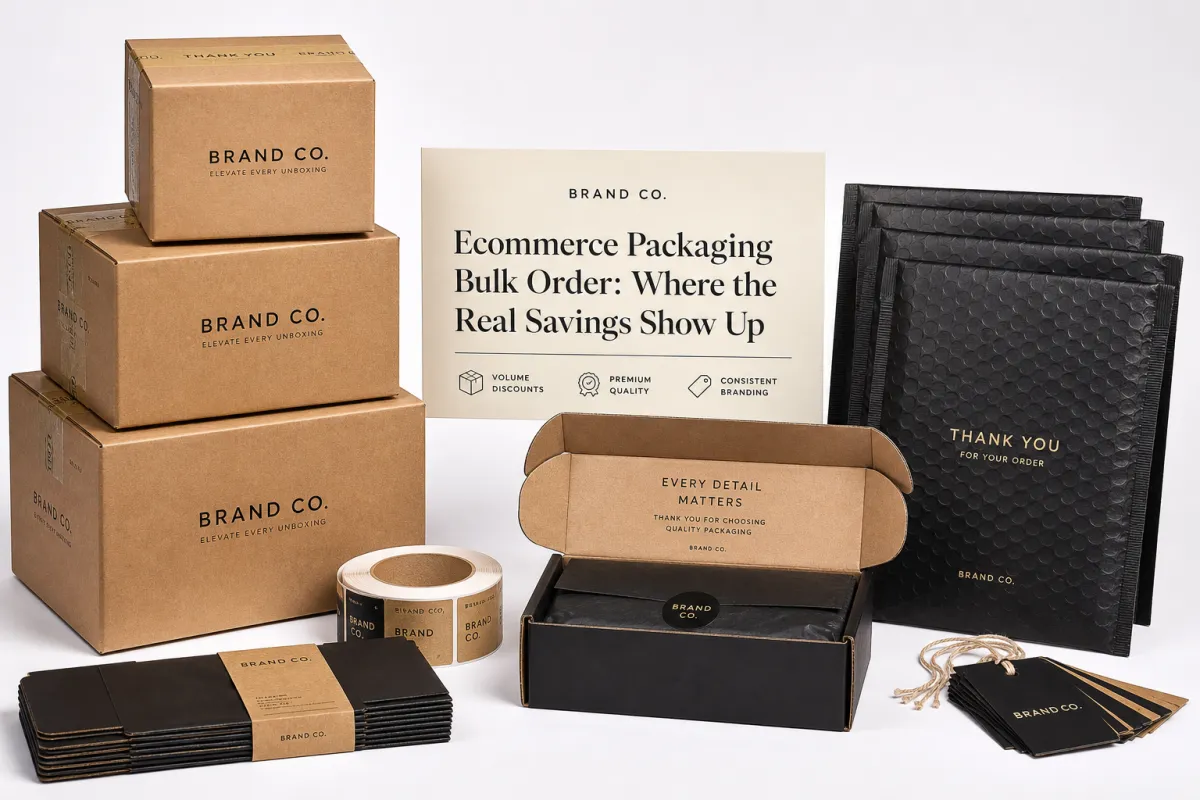
The most meaningful savings from an ecommerce packaging bulk order usually come from locking in a stable spec and avoiding repeated setup, last-minute reorders, and bad fit decisions that create downstream costs. A small shift in box depth can change pallet count, dunnage usage, and even shipping class if the finished pack ends up bulkier or heavier than planned. That is not theory. It is the kind of detail that quietly changes monthly spend for teams shipping at scale.
Here is a simple example from the kind of work I see all the time. A beauty brand ships a three-piece skincare set in a box that is just a touch too deep, so the fulfillment team adds tissue, a tray, and extra filler to keep the bottles from moving. The box itself may look inexpensive, but the total cost keeps climbing because every unit takes longer to pack and uses more material. Tightening the structure at the start of an ecommerce packaging bulk order usually saves more than chasing a prettier print finish ever will.
Bulk ordering matters because it creates consistency. Instead of placing a handful of small runs every few weeks, a brand can hold enough inventory to get through promotions, seasonal spikes, and product launches without scrambling. That means fewer interruptions for purchasing teams and fewer moments where packaging shortages threaten the schedule. A well-managed ecommerce packaging bulk order also improves repeatability, which matters for brand presentation and for fulfillment teams that need the same carton to behave the same way every time.
The smartest way to compare quotes is to focus on total landed cost, not just the quoted unit price. That total should include setup, tooling, freight, warehousing, handling, and the cost of damage if the package is underbuilt. A quote that looks higher on paper can still win if it reduces returns, lowers breakage, or cuts assembly time at the warehouse. A lot of buyers miss that part. The cheapest line item is not always the cheapest program.
A strong ecommerce packaging bulk order starts with fit, protection, and repeatability. Print matters, sure, but structure usually decides whether the program saves money or quietly bleeds it.
It helps to think in systems. Outer carton size, insert style, void fill, label placement, and pallet configuration all work together. If one part is oversized, the rest pays for it. A well-planned ecommerce packaging bulk order lowers the risk of running out of packaging, reduces rework, and gives operations teams a spec they can trust from one production cycle to the next.
For brands still comparing options, it can be useful to review broader packaging capabilities through Custom Packaging Products and, if volume is high enough to justify it, check how Wholesale Programs can support repeat purchasing without starting from scratch each time.
Packaging Formats That Work Best for Ecommerce Bulk Orders
The best format for an ecommerce packaging bulk order depends on what the product needs to survive transit and how the brand wants the customer to feel when the box is opened. Corrugated Mailer Boxes are common for direct-to-consumer shipping because they offer solid protection and a clean presentation. Shipping cartons are a better fit for heavier items, while branded mailers work well for lighter goods that still need a polished opening experience. Inserts, tissue, and labels all add control, but each one needs to justify its cost.
Apparel, light accessories, and subscription kits usually do well with a branded mailer or a folding mailer box. Those formats provide enough structure for the product, support branding, and keep the pack light enough to protect freight efficiency. Beauty products need a more careful mix of board strength and inserts, especially if the product includes glass, pumps, droppers, or mixed components. A smart ecommerce packaging bulk order should reflect those differences instead of forcing every product into the same box and hoping for the best.
Consumer goods with sharp edges, irregular shapes, or fragile parts usually need custom printed boxes with better internal support. That might mean a die-cut insert, a partition, or a tuck structure that keeps the item in one position. A subscription pack may care more about presentation and unboxing, while a hardware kit may care more about stackability and speed on the pack line. The right ecommerce packaging bulk order is the one that supports the actual workflow, not just the design mockup.
Here is the practical split most buyers should consider:
- Corrugated mailer boxes for shipping protection plus branded presentation.
- Shipping cartons for heavier, denser, or multi-item orders.
- Branded mailers for light products where visual impact matters.
- Inserts and partitions for fragile, mixed, or premium packaging.
- Tissue and labels for low-cost branding layers that improve presentation.
Custom print adds the most value when the package is seen by the customer and handled enough times to justify the upgrade. If the box is only acting as a transit shell inside another shipper, full coverage print may not be worth the spend. In that case, a plain stock box with a branded label or a one-color mark can be a smarter choice for an ecommerce packaging bulk order. That is especially true when the brand is still testing demand or expects design changes soon.
Unboxing matters, but transit performance matters too. A box that photographs beautifully and crushes in the first sorting lane is not a good package. Stackability matters as well, because fulfillment centers and smaller warehouse teams both benefit from packaging that nests cleanly and stores efficiently. A thoughtful ecommerce packaging bulk order should support protection, presentation, and practical handling at the same time.
For brands comparing packaging families, one question usually gets to the truth fast: does the design reduce labor or create it? If the answer is create it, the savings can disappear in a hurry. I have watched teams choose a restrained print approach on an ecommerce packaging bulk order and put the money into better board strength, a cleaner die-line, or a more reliable insert. That choice tends to age well.
Materials, Sizes, and Print Specifications to Confirm Before Ordering
Before any ecommerce packaging bulk order moves into quoting, the material and size details need to be tight enough that everyone is talking about the same thing. Kraft corrugated is a common choice for shipping strength and a natural look. White corrugated works better when the customer-facing surface needs a brighter, cleaner print result. SBS paperboard can work for lighter retail packaging and insert components, but it is not a substitute for corrugated strength when the product needs real transit protection.
Flute selection matters more than many first-time buyers expect. E-flute is thinner and prints well, which makes it popular for branded presentation boxes and smaller mailers. B-flute is thicker and often gives better stacking performance. Some projects call for double-wall construction if the load is heavy or the route is rough. A solid ecommerce packaging bulk order starts with matching the board grade to the product weight and the shipping environment, not just the artwork idea.
Size tolerance deserves attention too. Even a few millimeters can affect fit, friction, and presentation. If a product moves around in the box, the team may add filler, which increases cost and slows pack-out. If the box is too tight, assembly can become harder and the product may scuff during insertion. For a repeat ecommerce packaging bulk order, tolerance should be discussed early so the first sample lands close enough to production that it does not force a messy correction later.
When requesting a quote, send the following information:
- Inside dimensions of the product or finished pack.
- Product weight and whether the item is fragile.
- Material preference, such as kraft corrugated or white corrugated.
- Finish preference, including matte, gloss, or no coating.
- Artwork details, including color count and print coverage.
- Insert requirements, compartments, or special fit concerns.
- Target quantity and delivery ZIP code.
That level of detail helps shorten the quote cycle and lowers the chance that a sample comes back with the wrong feel, the wrong fold, or the wrong inner clearance. It also helps a manufacturer judge whether a simpler structure could work just as well. A good ecommerce packaging bulk order often comes down to asking for enough information before production starts, not after everything has already gone sideways.
For buyers who care about industry validation, the testing and sustainability side of packaging should not be ignored. ISTA test standards are widely used to evaluate shipping performance, and that matters when a package is expected to survive drops, vibration, and compression. On the material side, FSC certification is worth considering when sourcing board from responsibly managed forests is part of the brand story.
A detailed spec sheet also makes repeat ordering easier. Once a ecommerce packaging bulk order is documented properly, the next run can be quoted faster, approved faster, and produced with fewer surprises. That is one of the clearest signs that the packaging program is mature rather than improvised.
Ecommerce Packaging Bulk Order Pricing, MOQ, and Cost Drivers
The price of an ecommerce packaging bulk order is driven by several forces at once, and quantity is only one of them. Material grade, print complexity, die-cut tooling, finishing, and shipping method all influence the final number. A buyer who compares only headline pricing often misses the larger picture: setup costs can be spread more efficiently across a bigger run, but only if the spec is stable enough to justify the volume.
Minimum order quantity, or MOQ, varies by format. A stock-style mailer with simple print may allow a lower entry point than a fully custom die-cut structure with multiple colors and special finishing. In general, higher quantities reduce per-unit cost because tooling, plates, and setup labor are amortized over more pieces. That is the basic logic behind an ecommerce packaging bulk order, and it is why 5,000 units often price differently from 10,000 even if the design looks identical.
It helps to evaluate quotes like-for-like. If one vendor quotes an E-flute box with one-color exterior print and another quotes a B-flute box with two-color print plus lamination, those are not the same item. An honest comparison for an ecommerce packaging bulk order should line up board type, dimensions, print coverage, insert count, finishing, and freight terms before anyone decides which quote is truly lower.
| Packaging Option | Typical MOQ | Common Price Range | Best Use Case |
|---|---|---|---|
| Plain stock mailer box | 250-1,000 units | $0.70-$1.40 per unit | Early-stage launches, low print needs, fast replenishment |
| Custom printed E-flute mailer | 1,000-5,000 units | $0.45-$1.10 per unit | Branded shipping and light-to-medium products |
| Custom corrugated shipper with insert | 2,000-10,000 units | $0.90-$2.25 per unit | Fragile goods, mixed sets, premium packaging |
| Printed SBS carton or sleeve | 3,000-10,000 units | $0.35-$0.95 per unit | Lightweight retail packaging or secondary packaging |
Those numbers are only directional, because artwork coverage, board market conditions, freight mode, and dimensional changes can move them quickly. Still, they give a buyer a realistic frame for planning an ecommerce packaging bulk order instead of guessing blindly. If the order is large enough, a small spec change may save more than a unit-price negotiation ever could.
Here are some cost levers worth watching:
- Print coverage - full-bleed print usually costs more than one-color or limited-area print.
- Size standardization - one shared box size can reduce tooling and simplify inventory.
- Insert complexity - partitions and die-cut trays add labor and material usage.
- Finish choice - specialty coatings can add value, but they should justify the increase.
- Freight mode - ocean, air, and domestic truck all change the landed cost picture.
Where can buyers save without hurting the package? Standardize where possible, especially if several product variations fit into one common box with a simple insert. Reduce heavy ink coverage if the design can still look strong with a restrained layout. Consider a two-stage ecommerce packaging bulk order plan: one spec for high-volume core SKUs and a simpler stock format for occasional items. That split often lowers cost while keeping quality where it belongs.
A useful benchmark is to ask whether every part of the package is doing a job. If a premium coating does not improve shelf appeal or customer perception, it may be unnecessary. If a custom insert prevents returns on fragile items, it is usually worth it. The best ecommerce packaging bulk order balances cost against actual business risk, which is a much better lens than comparing quotes line by line in isolation.
Ordering Process and Timeline for a Bulk Packaging Run
A smooth ecommerce packaging bulk order follows a fairly predictable path: quote request, spec review, proofing, sample approval, production, quality checks, packing, and shipment. The fewer gaps there are in the information at the start, the less back-and-forth the team will need later. That saves time, and in packaging, time usually shows up directly as money.
The quote stage moves faster when the buyer sends dimensions, quantity, artwork files, delivery location, and any special requirements in one pass. If a product requires an insert or a set of compartments, that should be stated up front. If the packaging will run through fulfillment equipment or automated packing, that matters too. A clean request for an ecommerce packaging bulk order helps the supplier identify the right material and production method before a sample is even made.
Once the quote is approved, proofing usually comes next. That proof confirms artwork placement, fold lines, bleed, and any copy that sits near the trim area. A sample follows when fit or print placement needs validation. For a fragile product, the sample is not optional in my view; it is insurance against a costly mistake. An ecommerce packaging bulk order with a bad fit can create much more expense than the sample ever would have cost.
Lead times vary by complexity and by how quickly approvals move. Simple stock-style packaging can sometimes move in roughly 10-15 business days after proof approval if materials are available and freight is straightforward. More complex custom runs, especially those with inserts, multiple print colors, or special finishes, may need closer to 15-25 business days or more. A well-planned ecommerce packaging bulk order should include a buffer for final approval, packing, and transit, especially if the product launch date is fixed.
Quality checks should happen at multiple points. That includes confirming board grade, checking print alignment, verifying dimensions, and making sure folding and gluing are consistent across cartons. On larger programs, it is smart to ask how the run will be packed for shipping so the boxes do not arrive scuffed or warped. A stable ecommerce packaging bulk order is not only about what comes off the machine; it is also about how those finished cartons survive the trip to your dock.
Planning reorder timing is another detail that gets overlooked. If a product sells strongly during promotions, the packaging should be reordered before inventory gets low enough to cause panic. Many teams keep at least one production cycle ahead, especially when transit time is long or demand is seasonal. That is the difference between orderly replenishment and emergency sourcing, and a well-managed ecommerce packaging bulk order makes that gap much easier to control.
For buyers comparing print performance and shipping durability, packaging guidance from the EPA packaging and materials guidance is a useful reference point when sustainability goals also matter. It helps frame how material use, recovery, and waste reduction fit into a broader sourcing plan.
Good planning also keeps product packaging aligned with operations. If the pack line only has a narrow opening for inserts or a strict folding sequence, the structure should reflect that. If the warehouse prefers cartons that palletize tightly, the dimensions should be selected with stack efficiency in mind. A well-executed ecommerce packaging bulk order respects the real workflow, not just the rendering.
Why Choose Custom Logo Things for Ecommerce Packaging Bulk Orders
Custom Logo Things is a practical fit for buyers who want packaging advice grounded in production reality. For an ecommerce packaging bulk order, that means more than quoting a size and a price. It means helping the buyer match material strength, print approach, and insert strategy to the actual product and the actual shipping path. That kind of support reduces friction for purchasing teams because it cuts down on guesswork.
The value is in clear communication. When a packaging partner understands how corrugated behaves, how print coverage affects cost, and where tolerances can cause trouble, the whole process becomes easier to manage. A good ecommerce packaging bulk order should not feel like a series of surprises. It should feel like a controlled production plan with specs that make sense and a schedule that can be trusted.
Custom Logo Things also fits brands that need repeat runs and want consistency across reorders. Once a box style, insert layout, and finish are approved, repeatability matters as much as creativity. Packaging design is only useful if the next run looks and performs like the last one. That is especially true for retail packaging, subscription products, and Product Packaging That sits at the center of package branding.
Here is how a buyer benefits in real terms:
- Clear quoting that ties the price to the actual specification.
- Material guidance that helps match board type to product weight.
- Print support that keeps artwork realistic for the chosen structure.
- Bulk-order planning that makes reorders easier to schedule.
- Process clarity that helps purchasing, operations, and marketing stay aligned.
For teams that want to compare options or confirm what is possible before placing an ecommerce packaging bulk order, the FAQ page is a good place to start. If the buyer is already thinking about repeat volume or multi-SKU programs, Wholesale Programs can also make the order structure easier to manage over time.
There is no need to oversell what packaging can do. It should protect the product, present the product clearly, and support efficient fulfillment. If it does those three things well, the business usually feels the difference quickly. A disciplined ecommerce packaging bulk order can do exactly that, especially when the spec is built around the product instead of around assumptions.
Next Steps Before You Place an Ecommerce Packaging Bulk Order
The fastest way to move an ecommerce packaging bulk order from planning to production is to lock the basic inputs first. Confirm the product dimensions, decide whether the package needs to ship alone or inside another carton, estimate monthly usage, and determine whether branding belongs on the first run or a later phase. Those choices shape the whole project, and they should be settled before the quote goes out.
Gather the artwork files, delivery ZIP code, target quantity, and any insert drawings before requesting pricing. If there are two likely size options, ask for both. If the package might need a stronger board or a different print finish, compare those as separate specs rather than trying to force one quote to cover every possibility. That approach gives a cleaner view of what an ecommerce packaging bulk order really costs and where the tradeoffs sit.
If you are unsure about board thickness, box style, or insert structure, compare two or three specification paths instead of guessing. One option may be cheaper but weaker; another may cost a little more but reduce damage and labor. That is the kind of comparison that makes an ecommerce packaging bulk order easier to justify internally because the decision is tied to performance, not just appearance.
Before you approve production, review these points one more time:
- Does the package fit the product without filler overload?
- Will the structure survive the route and the handling method?
- Is the print coverage worth the added cost?
- Do the quantities match realistic replenishment needs?
- Have freight and storage been included in the cost view?
If those answers are clear, the order usually moves much more smoothly. The strongest ecommerce packaging bulk order is not the one with the most decoration; it is the one that fits the product, protects the shipment, and stays efficient across the whole run. That is how a packaging program becomes dependable instead of reactive, and that is what most brands need once order volume starts to climb.
For a buyer ready to move, the next step is straightforward: confirm the spec, request the quote, and make sure the packaging is sized for the real product and the real shipping environment. A well-planned ecommerce packaging bulk order pays back in fewer mistakes, steadier inventory, and a more professional customer experience from the first carton to the next reorder.
What is the usual MOQ for an ecommerce packaging bulk order?
MOQ depends on the packaging type, material, and print method, but a bulk run is usually structured so the setup cost gets spread across enough units to make the pricing practical. Custom die-cut or printed formats often carry higher minimums than stock-style packaging because tooling, press setup, and finishing all need enough volume to work economically.
How long does an ecommerce packaging bulk order usually take?
Lead time depends on proof approval, tooling needs, print complexity, and freight method, so faster approvals usually shorten the schedule. Simple stock-style packaging can move faster than fully custom printed packaging, while more detailed runs may need extra time for sampling, quality checks, and transit planning.
What information should I send for a bulk packaging quote?
Send product dimensions, estimated quantity, packaging style, material preference, print details, and the delivery ZIP code for a more accurate quote. If you can also share product weight, finish preferences, and any insert or compartment needs, the quote will reflect the real production setup instead of a rough estimate.
How can I lower cost on an ecommerce packaging bulk order without hurting quality?
Standardizing sizes, reducing print coverage, and choosing materials that match the product weight can lower cost without weakening performance. Buyers can also save by approving artwork quickly, limiting size variations, and ordering enough volume to reduce the setup impact per unit.
Should I order samples before placing a full bulk order?
Yes, sampling is helpful when fit, print placement, or insert performance matters, because it reduces the risk of costly corrections later. A sample is especially useful when the packaging must protect a fragile item, align with branding, or meet a specific retail or shipping requirement.