If electronics embroidered Beanies Bulk Order Planning starts with a polished mockup instead of a production spec, the first problem usually appears at sample time. A logo that looks crisp on a screen can turn fuzzy once it lands on knit fabric, especially after the cuff folds, the yarn stretches, and the stitch count climbs higher than the body can handle. The design did not fail in theory. It failed in the material.
That gap catches electronics buyers more often than fashion buyers because the use case is practical. These beanies are usually ordered for field staff, warehouse teams, trade show kits, holiday giveaways, customer gifts, or retail promo drops. The order has to arrive on time, stay on brand, and survive rough handling. Buyers often begin by asking for a price, but the quote is only useful once the body style, decoration method, pack-out, and approval path are already clear. Otherwise every supplier is pricing a different product.
A logo that depends on fine type, hairline strokes, or multiple tiny color breaks is usually too detailed for a knit beanie unless the artwork is simplified or moved to a patch.
That is the central discipline in this category: the fabric leads, the artwork follows. The fastest orders are rarely the fanciest ones. They are the ones with a body that fits the decoration, a placement that reads from a distance, and a sample process that closes before the schedule starts slipping.
Why electronics embroidered beanies bulk order planning fails at sample time
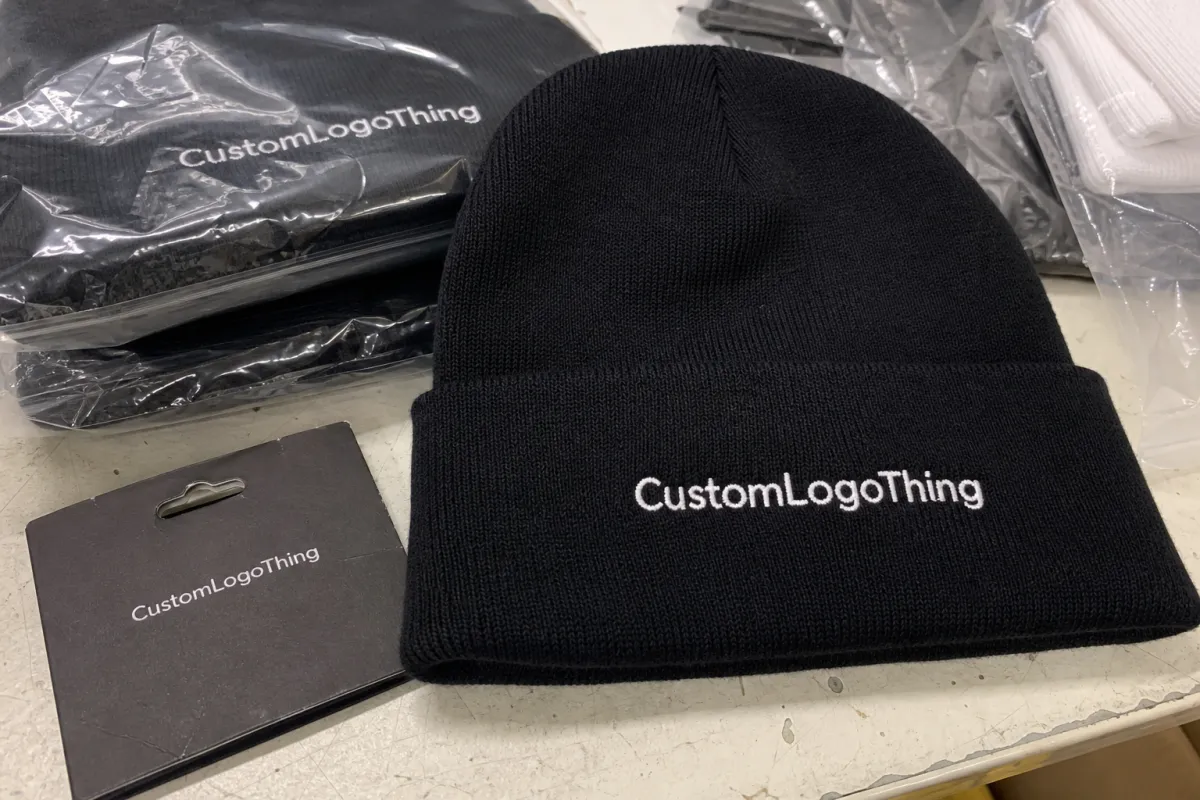
Sample time exposes the real limits of knitwear. On a flat art file, a logo can carry thin lettering, gradients, and tight spacing without complaint. On a beanie, the surface moves. Ribbing stretches, crown seams interrupt the layout, and the cuff may compress the embroidery area by a full inch or more once it is folded. A design that measures 3 inches wide in a proof may only have 2.25 inches of usable space on the actual body. That is enough to ruin readability if the logo is text-heavy.
The hidden variables are easy to miss if the order starts from marketing language instead of production language. Stitch count changes price. Cuff height changes placement. Knit gauge changes how much detail the fabric can hold. Yarn content changes thread behavior. Acrylic gives a predictable base, while wool blends and recycled blends can introduce slight texture differences that affect the final look. None of that is mysterious; it is just what happens when a plan leaves the spreadsheet and enters the machine.
Electronics teams also tend to have mixed goals in one order. One department wants a rugged beanie for field use. Another wants a cleaner version for customer-facing events. A third wants the logo to feel premium enough for holiday gifting. One body can often cover more than one need, but only if the spec is controlled early. If not, the project turns into a string of revisions: new placement, new thread colors, new sample, new quote, new delay.
Four decisions should be fixed before pricing comes back: body style, decoration method, quantity breakpoints, and approval steps. Without those, comparison shopping is meaningless. One supplier may quote a light acrylic cuffed beanie with direct embroidery, while another prices a heavier body with a woven patch and retail folding. The numbers will not match because the products are not the same.
Choose the right beanie body before you request pricing
Cuffed, slouch, fisherman, and fleece-lined beanies all behave differently under decoration. A cuffed beanie is the most predictable option because the fold creates a stable panel for embroidery. That is why it remains the default for bulk logo programs. A slouch style has more visual movement and a softer silhouette, but the logo area can drift once the crown hangs. Fisherman beanies sit shorter and work better for compact marks. Fleece-lined versions are warmer, yet the extra bulk can make embroidery less crisp and the final hand feel thicker than some buyers expect.
Material choice is just as practical as silhouette. Acrylic is still the workhorse for bulk orders because it is affordable, easy to source, and available in a broad color range. A 100% acrylic body is often the safest choice when the budget matters and the quantity is high. Wool blends feel more elevated and usually hold shape well, but they can raise cost and sometimes require a gentler decoration spec. Recycled yarn makes sense when sustainability is part of the brief, though buyers should expect more limited stock colors and tighter shade tolerances. If a paper hangtag or insert is required, FSC-certified stock is a sensible ask; the standard reference is at FSC.
Cuff depth and gauge should be checked before the artwork is frozen. A cuff around 3 inches high usually gives enough room for a logo between about 2.5 and 3 inches wide. Narrower cuffs can force the design down to 2 inches or less, which is risky if the mark includes small text. Gauge matters because a tighter knit generally holds embroidery more cleanly, while a looser knit can pucker if the stitch density is too heavy. That is one of the first quality gaps buyers see in samples: the logo itself is fine, but the fabric around it ripples.
Color planning deserves more attention than it usually gets. One body color and one thread color is easier to control than a three-shade logo with a custom yarn request attached. If the brand needs Pantone matching, that instruction has to come early, and the buyer should ask which parts can be matched from stock yarn and which require a custom run. A supplier can only match what the production method allows. That is not a dodge; it is the difference between a stable order and a moving target.
- Cuffed beanie: best logo visibility, easiest approval, broadest use.
- Slouch beanie: softer appearance, but the decoration zone can shift.
- Fisherman beanie: compact and retail-friendly, less room for detail.
- Fleece-lined beanie: warm and premium, but bulkier around stitching.
Stitch, patch, and decoration specs that hold up on knit fabric
Simple artwork usually performs best. Tiny text, hairline strokes, and delicate gradients are common in brand files, but they are not friendly to knit. For direct embroidery, a logo around 2.25 to 3 inches wide is common, yet the safe size depends on the cuff, the gauge, and the shape of the icon. Anything that needs to be smaller than about 2 inches across should be questioned. If the design is still important at that size, a patch often gives a cleaner result than stitches alone.
Direct embroidery gives the most durable finish and the cleanest feel for field use. It is the right answer when the logo is simple and the buyer wants the decoration to last through wear and washing. Woven patches handle finer detail and sharper type, which makes them useful for logos that would collapse in embroidery. Faux leather patches create a more retail-facing look and work well with debossed or engraved marks. They are less suitable when the brand needs multiple colors or very fine detail. Sewn labels can support small secondary branding or size information, but they should not carry the main logo if visibility matters.
The cost difference between these methods is real. Direct embroidery is usually the lowest-cost premium decoration, but it becomes more expensive as stitch count rises. In many orders, a simple logo stays in the lower range, while anything with dense fill, multiple colors, or fine outlines starts to add noticeable cost once the stitch count moves into the several-thousand range. Woven patches and faux leather patches carry more setup but can save the design from looking crowded or muddy.
| Decoration method | Typical added cost per unit | Best for | Tradeoff |
|---|---|---|---|
| Direct embroidery | $0.60-$1.50 | Durability, simple logos, field use | Small text can fill in on knit fabric |
| Woven patch | $0.80-$1.80 | Sharper detail, thin lines, retail merch | Requires sew-on or heat application steps |
| Faux leather patch | $0.90-$2.00 | Premium appearance, minimalist branding | Less detail, fewer color options |
| Sewn woven label | $0.40-$1.00 | Small marks, budget runs, secondary branding | Not ideal for a primary logo |
A mockup only proves placement. It does not prove stitch behavior. For any logo with small type or a tight icon, a strike-off or pre-production sample is the better test because it shows how thread lays on the actual fabric. The buyer should ask for thread color confirmation, stitch direction, density, and backing method before bulk approval. Stabilizer choice matters more than many non-textile teams realize. A soft backing can reduce puckering on knits, while a heavy backing can flatten the body and make the beanie feel less comfortable.
That matters more in electronics programs than in some other categories because these orders often move through several approvers. Marketing cares about appearance. Operations cares about schedule. Procurement cares about cost. A sample that answers all three is worth more than a pretty rendering.
If the shipment has to survive parcel networks or store transfers, asking about carton testing that aligns with ISTA methods is sensible. It does not change the beanie itself, but it reduces damage claims once the order leaves the production floor.
Cost, pricing, MOQ, and quote variables to lock down
Most weak quotes start with weak inputs. “Beanies with logo” is too vague to compare. A clean request should name the body style, body color, decoration method, logo size, estimated stitch count, packaging, shipping term, and any labeling or kitting requirements. Without those details, one supplier prices a basic acrylic cuffed beanie, another prices a fleece-lined version with a woven patch, and the numbers become useless as a basis for decision-making.
For planning purposes, unit pricing usually improves at the standard breakpoints: 100 pieces, 250 pieces, and 500 pieces. A simple embroidered cuffed beanie often falls around $4.20-$7.50 per unit at 100 pieces, $3.30-$5.80 at 250 pieces, and $2.80-$4.80 at 500 pieces, depending on yarn content, decoration size, and whether the body is stock or custom. Patch builds typically add about $0.40-$1.20 per unit over comparable embroidery. Sampling often runs $35-$75, though more complex artwork or multiple revisions can push that higher. Freight is separate and should be treated that way from the beginning.
MOQ is not fixed across the category. A simple embroidery run may start around 50 to 100 pieces if the body is in stock and the artwork is straightforward. Custom yarn colors, specialty packaging, or patch construction can push the floor higher. The useful question is not just “What is your MOQ?” It is “What MOQ gives me the best balance between setup cost, unit price, and quality control?” That question produces a more honest answer.
To compare quotes without getting fooled by formatting, line them up in the same order:
- Product spec: body style, yarn content, cuff depth, and decoration area.
- Decoration spec: embroidery, patch type, thread colors, and backing method.
- Packaging: polybag, hangtag, barcode, size sticker, and master carton count.
- Logistics: freight terms, carton dimensions, split delivery, and customs handling.
- Risk terms: sample charge, remake trigger, rework policy, and delivery window.
That process is dull. It also prevents the most common budget surprises: an extra charge for reproofing, a packaging upcharge that appeared late, or a freight line that was never included in the original comparison. Quote clarity is not decorative. It is the difference between a real number and a polite guess.
Production steps, lead time, and approval milestones buyers must track
A good production plan follows a fixed sequence: artwork sign-off, sample approval, bulk production, quality check, packing, and final shipping. If a supplier cannot explain that order clearly, the schedule is already at risk. Each stage has a different failure point. Artwork stalls when the vector file is missing or the color reference is vague. Samples stall when the buyer keeps changing placement or thread colors. Production stalls when the deposit is late. Shipping stalls when the ship-to list is incomplete. None of this is dramatic. It is just paperwork being asked to do its job.
A realistic timeline for a standard order is often 3-7 business days for mockup and sample coordination, 7-14 business days for a physical sample if one is required, and 12-20 business days for bulk production after approval. Shipping time is separate. Rush jobs can happen, but only when the body is in stock, the artwork is simple, and the production line already has the right setup. If any of those pieces is missing, the rush premium grows quickly. Electronics teams planning for seasonal launches, tradeshow deadlines, or internal giveaways should build in buffer time instead of assuming the calendar will cooperate.
Multiple colorways slow the process more than buyers expect. Two beanie colors are manageable. Four colors with two decoration variations create a scheduling puzzle, especially if the order also includes split shipping. Each destination needs the right carton count, the right labels, and the right packing instructions. If the beanies are going to offices, warehouses, or event sites, that information belongs in the production file and on the PO, not buried in an email thread.
For strict brand orders, a pre-production sample is often worth the extra time. It is the best way to catch a logo that is too small, a thread color that is too bright, or a placement that sits too low on the cuff. Reworking 500 units after bulk production starts is far more expensive than waiting a few more days for a proper approval.
Work backward from the in-hand date, not the production-complete date. Those numbers are different, and missing that distinction is how event orders miss the event.
Packaging, labeling, and QC for multi-location shipments
Packaging sounds secondary until the wrong cartons arrive at the wrong site. Then it becomes the main issue. Before production begins, confirm whether the order needs individual polybags, hangtags, barcode labels, size stickers, or master cartons with destination marks. A retail promo run may need one label format. An internal electronics giveaway may need another. If the order is split across offices or warehouses, the factory should receive a carton map before packing starts. Otherwise the receiving team becomes the sorter.
For kitting and sorting, decide whether the beanies should be packed by color, department, location, or recipient list. The answer changes labor time and carton count. A PO that simply says “ship to three offices” is not enough if the order contains two colors and multiple size stickers. The more the pack-out has to be interpreted, the higher the chance of error. A little more detail upfront usually saves a lot of chasing later.
A solid QC checklist should cover stitch tension, logo placement, color accuracy, fabric defects, and carton condition. For knitwear, stitch tension deserves special attention because too much density can pull the fabric and make the logo warp. Thread ends should be trimmed cleanly. Loose fibers should be checked around the embroidery field. When patches are used, the edge finish and sewing line should be reviewed as closely as the logo itself. A patch can hide a lot of detail, but it cannot hide sloppy attachment.
Carton integrity matters more than many buyers expect. Beanies are light, but retail packaging, inserts, and multi-destination labeling create enough handling points for damage or confusion. A recognized transport standard such as ISTA methods is a sensible benchmark for these shipments. If paper components matter, ask for FSC-certified stock. If the order will move through several hands, ask how the factory tests cartons and whether the labels are printed clearly enough to survive transit.
Split shipments need extra precision. The destination, quantity, contact person, and carton count should be written into the PO, repeated in the production file, and confirmed again before freight booking. That may feel repetitive. It is also what prevents one office from receiving half the order while another office waits.
Next steps for a clean PO and faster reorder
The cleanest orders start with the most practical input: vector artwork, target quantity, body color options, logo placement, delivery date, and ship-to list. If the logo is detailed, ask for both a digital proof and a physical sample. If the order has to match brand standards closely, include Pantone references and acceptable size variance before production begins. That gives the supplier fewer opportunities to guess and gives procurement a tighter record to approve against. Good electronics embroidered beanies Bulk Order Planning is not about chasing the lowest quote. It is about making the right quote easy to produce.
A useful approval path looks like this: quote review, mockup approval, sample sign-off, deposit, bulk production, inspection, and final shipping. Keep each step documented. If something changes after approval, write it down before production continues. Reorders move faster when the original file is complete, which is why the final artwork, thread colors, packaging notes, and carton counts should be saved together rather than scattered across emails and PDFs.
Before releasing the PO, check these items one more time:
- Artwork: vector file, logo size, placement, and color references.
- Product: beanie body style, yarn content, cuff depth, and size.
- Decoration: embroidery, woven patch, or faux leather patch, plus stitch count target.
- Commercials: unit price, setup fee, sample cost, freight, and rework terms.
- Operations: packing method, carton count, delivery date, and ship-to list.
That level of control keeps the project from turning into a rescue job halfway through production. It also makes the next reorder faster, because the supplier can work from a real spec instead of reconstructing one from memory. In this category, the best result is rarely the flashiest. It is the one that reads clearly, fits well, and arrives where it should on the day it was promised.
What MOQ works best for electronics embroidered beanie orders?
One hundred pieces is usually the most practical floor if you want the unit price to behave. Simple embroidery can go lower, but setup and sampling consume a larger share of the budget. Breakpoints at 100, 250, and 500 pieces make the pricing structure much easier to evaluate.
Can small logos work on bulk embroidered beanies for electronics teams?
Only if the artwork is bold and simplified for knit fabric. Tiny text and thin lines often fill in or lose clarity once the beanie stretches on the head. If the logo needs fine detail, a woven patch or faux leather patch usually produces a cleaner result than direct embroidery.
How long does beanie bulk production usually take after approval?
Expect roughly 12-20 business days for bulk production after sample approval on a standard order, with shipping time added on top. A physical sample may take another 7-14 business days if the design needs proofing. Rush timelines are possible, but only if the body, artwork, and production capacity are already aligned.
What files should I send for a custom embroidered beanie quote?
Send vector artwork in AI, EPS, or PDF format if possible. Include Pantone references, logo size, placement, quantity by color, packaging needs, and the delivery deadline. The cleaner the brief, the fewer quote revisions you will need.
How do I compare two beanie quotes without missing hidden costs?
Match setup fees, sample charges, packaging, freight, and rework terms before looking at the unit price. Make sure stitch count, decoration size, and material specs are identical across both quotes. A lower number means little if the back end is padded with extras.

