If a pallet box crushes a carton of finished electronics, the cheaper quote stops being cheap. That is the trap buyers fall into when they judge electronics pallet boxes cost by the number on the invoice instead of the full route from packout to delivery. I am not gonna pretend the lowest line item always wins; in packaging, it usually does not.
Packaging buyers usually learn this the hard way. A build with stronger board, cleaner fit, and better pallet stability can carry a higher unit cost and still lower the landed cost once breakage, repacking, and freight waste are counted. A 2% damage rate on a $250,000 shipment is $5,000 gone before anyone starts arguing about board grade.
I once reviewed a shipment of power supplies that looked fine on paper and kinda ordinary on the floor. The cartons were intact, the labels were clean, and the pallet still failed after a couple of warehouse moves because the box design did not match the way the load was being handled. That job is why I always tell buyers to look past the quote and trace the whole trip.
The useful question is not which pallet box is least expensive on paper. It is which design keeps electronics moving without claims, rework, or pileups on the dock. That is the lens used here: what drives electronics pallet boxes cost, how quotes are built, and which details help Custom Logo Things return a clean number quickly.
Why Electronics Pallet Boxes Cost More Than Standard Cartons
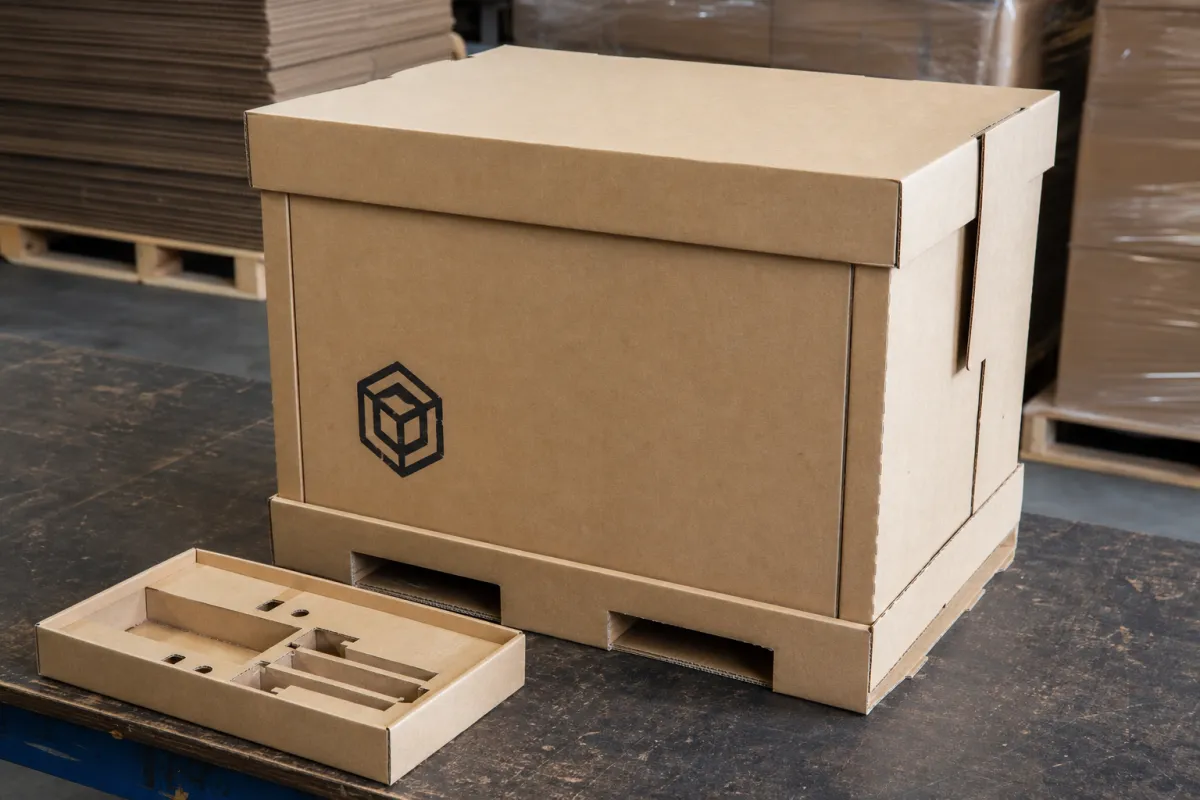
The difference shows up the moment a load leaves the bench and heads toward a trailer. A standard carton may hold a light retail item without much drama, but a palletized electronics load needs shape retention, stacking strength, and enough compression resistance to survive movement by forklift, pallet jack, and sometimes several days in transit. That extra structure is one reason electronics pallet boxes cost more than ordinary corrugated cartons, even before inserts or print are added.
Electronics packaging is rarely just a box. It works as part of a protection system, with the outer shell, pallet base, closure method, and internal blocking each carrying part of the load. Match those pieces correctly and the shipment moves less, corners stay intact, and the warehouse crew spends less time fixing problems. Viewed that way, electronics pallet boxes cost is not money spent on board alone. It is payment for a packaging system that protects product value.
The cheapest box on the spreadsheet is often the most expensive box in practice. A low quote can look appealing until the first pallet leans, the tape fails, or the corner crushes and the receiving team starts opening claims. One extra handling step per pallet can erase any material savings very quickly.
Electronics programs also ask for tighter dimensional control than general bulk packaging. Finished devices, replacement parts, circuit boards, power supplies, and mixed assemblies all behave differently in transit, so the box has to hold consistent tolerances and stack cleanly. That calls for better board quality, better converting, and a build that can be repeated without drift from one run to the next.
"The cheapest pallet box is usually the one that causes the most trouble after it leaves the dock."
That line sounds blunt because it is true. If the load is dense, fragile, or oddly shaped, electronics pallet boxes cost should be measured across the whole shipment path: packout, warehouse storage, line handling, transit, and final delivery. The box is part of the logistics chain, not an isolated purchase.
Test standards help keep that chain honest. Groups such as ISTA publish transit-test methods for vibration, shock, and compression. A buyer does not need to turn every project into a laboratory exercise, but those standards matter when the shipment is valuable enough that a failure would sting.
Product Details: What Goes Into a Custom Electronics Pallet Box
A custom electronics pallet box usually starts with an outer corrugated shell, then adds a pallet base, a lid or cover, and internal inserts that stop the load from shifting. Depending on the shipment, that structure may be a sleeve-and-base build, a telescoping shipper, or a heavy-duty box with die-cut flaps. Each version affects electronics pallet boxes cost because each one uses different board volume, different converting time, and different assembly labor.
The internal packout matters just as much as the outer shell. Electronics may ship in trays, small cartons, foam nests, partitions, or layered pallets with compression pads. Loose-packed products need more blocking and more structure. Products that are already cartonized can often be organized around a standard footprint, which helps control cost per piece without weakening protection.
Protection features can change the spec in a hurry. Moisture resistance may call for coated board, liners, or bagging. Dust control may demand tighter closure methods. Sensitive assemblies may need anti-static materials, conductive components, or separate interior wrapping. Tamper-evident tape or straps may be part of the answer for higher-value shipments. Each choice nudges electronics pallet boxes cost, sometimes a little, sometimes a lot, depending on how many functions the box has to handle at once.
Print is often functional first and branded second. A logo can matter, especially for customer-facing deliveries, but handling marks, SKU IDs, orientation arrows, and pallet labels usually matter more once the boxes hit the floor. Good print reduces sorting errors and helps warehouse teams move faster. Simple artwork with moderate coverage tends to have a smaller effect on price than structural changes do.
These boxes suit finished devices, replacement parts, assemblies, and mixed-component packs that need stable stacking over a longer transit window. They also help when a buyer wants one outer format for several SKUs, because a shared pallet footprint simplifies inventory and reduces the number of packaging parts to stock. Standardization like that often improves bulk pricing on repeat programs.
Material selection deserves close attention. A well-chosen double-wall board can outperform a heavier-looking but poorly matched structure, and the reverse can happen too. For programs that need certification or traceability, FSC-certified board may be part of the sourcing brief. If that matters to procurement, state it before the quote is built so the number reflects the right supply chain from the start. More information is available through the Forest Stewardship Council.
Specifications That Move Electronics Pallet Boxes Cost
Board grade and flute profile usually matter first because they have the biggest effect on strength and price. Compression resistance, puncture resistance, and stacking performance do not always move together. A design that looks acceptable on a spec sheet can still fail once pallets start stacking in a warehouse lane. For that reason, electronics pallet boxes cost should always be tied to the actual board spec, not only the outside dimensions.
Dimensions are the next major driver. A pallet footprint that fits standard handling equipment usually costs less to produce and ship than an oversized custom footprint. Overall height matters too, since taller boxes use more corrugated area and can run into freight or stacking inefficiencies. Wall thickness changes the picture again. If the load needs double-wall or triple-wall board, electronics pallet boxes cost rises because material use and converting difficulty rise together.
Product weight and stack pattern matter just as much as the box itself. Heavy loads may need stronger bottom panels, more rigid corners, or a pallet base that supports weight without sagging. If the contents stack in layers, the box must tolerate compression from the layers above. If the load is top-heavy, the design may need tighter sidewall support or a more secure closure method. That is why a quote built only from length, width, and height is often incomplete.
Finishes and extras add cost in small increments that can pile up. Print coverage, moisture barriers, corner protection, straps, labels, anti-slip features, and reinforcement pads all change the final number. None of those additions is wasteful by default. The real question is whether each one has a job to do. Buyers sometimes assume the board is the main cost, yet the accumulated extras can be just as influential on electronics pallet boxes cost as the base material.
A simple rule keeps the math honest: if a spec change alters material usage, tool size, production speed, or freight density, it will usually move the quote. Small changes in flute selection or pallet footprint can create real differences in unit cost once a job moves from sample stage to production stage.
For buyers comparing options, the table below shows how structure often shapes the price discussion. The ranges are representative, not universal, because actual numbers depend on the exact spec, order quantity, and print requirements. That disclaimer matters; anyone promising a fixed price without seeing the load is guessing.
| Option | Typical Structure | Typical Electronics Pallet Boxes Cost | Best Fit For |
|---|---|---|---|
| Light-duty custom pallet carton | Single-wall corrugated shell with basic print | $6.50-$11.50 per unit | Lighter electronics, lower stack height, domestic moves |
| Heavy-duty sleeve-and-base system | Double-wall sleeve, pallet base, optional lid | $9.75-$17.50 per unit | Mixed assemblies, repeat shipments, moderate protection needs |
| High-compression export build | Double-wall or triple-wall with inserts and reinforcement | $14.00-$28.00 per unit | Long transit windows, heavier loads, stack-critical shipments |
Those ranges also explain why tooling fees and setup charges should never be ignored. A custom die, a special print layout, or a new insert design may create upfront costs that do not appear in a simple unit-price comparison. If the order is large, those charges are spread across the run and become less noticeable. If the order is small, the first invoice can look much higher than expected.
Ask whether the price includes standard tooling, sampling, and production setup. If those items are missing, electronics pallet boxes cost may look attractive at first glance and then jump once the job is released. A better quote shows the full picture early.
Pricing, MOQ, and Quote Structure for Electronics Pallet Boxes
Pricing is usually built from a handful of core variables: material grade, box size, insert complexity, print requirements, and order quantity. There is no honest flat rate for every job because electronics pallet boxes cost changes with each one of those inputs. A plain printed outer shell is not priced the same way as a pallet unit with inserts, moisture control, and reinforced corners.
MOQ matters too. For many custom projects, the first order needs enough quantity to justify design time, sample prep, and conversion setup. Smaller runs are still possible, but the unit price is often higher because the fixed costs are spread across fewer boxes. Repeat programs are where electronics pallet boxes cost often improves, since the spec is already proven and the run can move with less friction.
A proper quote should be readable. At minimum, it should separate unit price, tooling if needed, sampling charges, freight assumptions, and any special packaging or testing requirement. If the quote is bundled into one line with no detail, comparison becomes guesswork. Buyers end up trying to infer which box is stronger, which is how price-only comparisons go off track.
The fairest way to compare two quotes is to check that the board spec, dimensions, print coverage, and delivery terms match exactly. A lower number may simply mean lighter board, a smaller print area, or a different freight assumption. If one supplier is quoting a pallet-ready sleeve-and-base system and another is quoting a simpler carton with the same outside dimensions, the quotes are not equivalent, even if the figures look close.
To speed accurate pricing, send the product dimensions, weight, pallet count, target ship date, shipping destination, and print art. If you need a sample or a structural test, mention that too. The better the input, the more confident the quote. That applies whether you are buying a few hundred units or trying to secure bulk pricing for a repeat supply program.
Here is a useful rule of thumb for first-time buyers: if the packaging spec keeps changing every other day, the price will not settle cleanly. If the footprint, load weight, and handling route are known, the estimate sharpens quickly. That stability is where electronics pallet boxes cost stops feeling like a guess and starts looking like a planning number.
For teams that want a broader look at custom packaging options, Custom Packaging Products can help line up the structure, print, and closure style before you Request a Quote. If the box is part of a larger branded shipment plan, it also helps to compare the pallet unit against smaller shipping cartons so the whole pack system feels consistent.
Process and Timeline: From Spec Sheet to Shipment
The first step is discovery. The buyer shares product details, handling requirements, storage conditions, and target order quantity so the package can be designed around the actual use case. Fragile, top-heavy, moisture-sensitive, and export-bound loads all need to be identified early. Good discovery keeps electronics pallet boxes cost tied to reality instead of forcing redesigns later.
Design and approval come next. CAD layout, dieline development, and material recommendations get checked against product dimensions and load behavior. If the structure needs revision, that usually happens here, before sampling or production release. A few careful adjustments at this point can save material, improve fit, and reduce wasted labor downstream.
Sampling is worth the time when the load is new, the product is fragile, or the stack performance has to be verified before a full run is released. A sample lets the buyer confirm fit, closure, pallet footprint, and handling behavior. It is also the right moment to test whether the inserts actually hold the electronics in place. In many programs, that one step protects the buyer from larger correction costs later.
After approval, production begins with material procurement and converting, then moves through inspection, pallet build-out, and shipment prep. Quality control should check dimensions, print placement, compression-relevant features, and overall consistency. If the order includes special handling marks or serialized labels, those checks matter too. A box that looks right but stacks poorly is not a good box.
Timeline depends on complexity, print, sampling speed, current production load, and whether the build uses standard components or custom tooling. A simple job with straightforward print can move quickly once the spec is set. More complex builds, especially those with inserts or special protection features, need a longer runway. In practical terms, many straightforward orders can run in about 12-15 business days after approval, while more involved builds often need more time.
That timeline matters because packaging delays can stall outbound freight and product launches just as easily as a machine issue can. If the ship date is fixed, say so early. If the design has to fit a dock schedule or a customer receiving window, state that as well. The clearer the timeline, the easier it is to keep electronics pallet boxes cost from creeping up through rush changes and last-minute revisions.
For recurring programs, the most efficient path is usually to lock the spec after the first sample run. Once the fit is proven, the next reorder becomes faster, cleaner, and more predictable. That is one of the easiest ways to bring down cost per piece over time without cutting the protection the load actually needs.
Why Custom Logo Things Is a Fit for Electronics Pallet Boxes
Custom Logo Things fits this kind of work because the focus stays on practical packaging decisions, not guesswork. For electronics, the right answer usually comes from matching the board grade, fit, closure method, and pallet efficiency to the product, then pricing the result honestly. That is the right lens for electronics pallet boxes cost because it keeps the design tied to performance.
Specification-based recommendations matter. If a load does not need triple-wall, it should not be priced as though it does. If a sleeve-and-base unit gives better warehouse handling than a one-piece carton, that should be discussed plainly. That kind of approach protects the buyer from overspecifying by habit and under-specifying by accident.
Clear communication carries real value too. Buyers need reliable numbers, realistic timing, and packaging choices they can explain internally. A quote that explains board grade, print scope, and freight assumptions is easier to approve and easier to defend. That clarity helps especially when procurement is comparing electronics pallet boxes cost across several vendors.
It also helps to think beyond the box itself. The pallet unit load has to fit the broader logistics system, including warehouse movement, staging, stacking, and outbound freight. A design that looks fine on a desk can still be awkward on a dock if the footprint misses the handling equipment or the closure method slows the pack line. Good packaging respects the people who have to move it.
For first-time projects, revisions, and repeat orders, continuity matters. Buyers should not have to restart the conversation every time a reorder is needed. Once the spec is documented correctly, the next round can move faster and with fewer surprises. That consistency is often the quiet reason electronics pallet boxes cost improves over the life of the program.
If you are building a broader packaging line, you can pair the pallet box with other branded formats from Custom Packaging Products so the whole shipment feels connected from the outer shipper down to the smaller pack units. Electronics shipments benefit from that kind of coherence because presentation and handling logic often need to work together.
How to Get an Accurate Electronics Pallet Boxes Cost
Send exact dimensions, product weight, pallet footprint, and whether the contents are boxed, bagged, tray-loaded, or foam-protected. Those four details form the backbone of an accurate quote. If the load has irregular voids or stack-sensitive areas, include that too, because internal fit changes electronics pallet boxes cost more than many buyers expect.
Include the shipping route and handling expectations. Domestic freight, export moves, and warehouse-to-warehouse transfers create different pressure points. A box that works well on a short local route may need stronger compression performance for a longer transit path. If the shipment will be cross-docked or stored for a period before delivery, say that in the design brief.
Photos help a lot. Current packout photos, any failure points, and existing box specs give the quote a real-world anchor. Without those details, the estimate rests on assumptions, and assumptions can be expensive. A clean photo set often exposes corner crush, loose fill, or poor pallet utilization before they become budget surprises.
It also helps to ask for two numbers: one for the lowest-cost build that still meets the load, and one for the best-value build with stronger protection or easier handling. That comparison gives procurement context. It shows whether the extra cost buys a real benefit or just adds margin. In many cases, the better build raises electronics pallet boxes cost only slightly while lowering the chance of claims or repacking.
Think of the request this way: the more complete the brief, the more accurate the quote. Dimensions, weight, route, quantity, print art, and timing are the essentials. If there is a sample, a test requirement, or a compliance need, add it to the same request so nothing gets missed.
When you are ready, send the spec package and ask for a quote that breaks out board grade, print scope, and any setup charges. That makes electronics pallet boxes cost easier to compare, easier to approve, and easier to defend internally. It also shortens the back-and-forth that tends to slow Custom Packaging Orders.
For the fastest path, send the dimensions, weight, pallet count, destination, and a photo of the current packout. If your goal is lower electronics pallet boxes cost without giving up protection, say that clearly, along with your target ship date and whether you need a sample before production release.
Frequently Asked Questions
What information do I need to quote electronics pallet boxes cost accurately?
Share the product dimensions, total load weight, pallet footprint, and target stack height so the structure can be sized correctly. Include photos of the current package, print requirements, and any protection concerns such as moisture, dust, or ESD sensitivity. State the destination, quantity, and desired delivery date so pricing and lead time reflect the actual shipment plan.
Do electronics pallet boxes cost more if I need anti-static or moisture protection?
Yes, added protection usually increases cost because it changes the material stack, insert design, or closure method. The increase depends on whether the protection is built into the board, the liner, the internal packout, or the outer wrap. A good quote should separate protection upgrades from the base box price so you can see where the extra cost comes from. That clarity matters because anti-static packaging helps only when the product actually needs it; otherwise, it is just extra spend.
What is the typical MOQ for custom electronics pallet boxes?
MOQ depends on size, structure, and whether the design uses standard materials or custom tooling. Smaller runs may be possible, but unit cost is usually higher because setup and conversion time are spread across fewer boxes. If you plan repeat orders, mention forecast volume so the quote can reflect better pricing tiers.
How long does production take after approval for electronics pallet boxes?
Timeline depends on whether a sample is required, how complex the box is, and how quickly approvals are returned. Simple builds move faster than custom structures with inserts, print, or special protection features. Ask for both standard lead time and expedited options if your shipping window is tight.
Can I lower electronics pallet boxes cost without reducing protection?
Often yes, by standardizing the pallet footprint, simplifying print, or reducing unnecessary material thickness where the load allows it. Improving fit can also save money because it lowers damage risk and can reduce freight waste from poor cube utilization. The best savings usually come from redesigning the package around the product instead of trimming material at random.
For the cleanest quote, send the product dimensions, finished weight, pallet footprint, handling route, print art, and one photo of the current packout. If you also flag moisture, ESD, stack-height limits, or any freight deadline, the first number you get will be much closer to the real electronics pallet boxes cost instead of a placeholder that needs fixing later.


