Electronics twisted handle paper bags Bulk Order Planning should start with the load, not the logo. A bag for a phone, tablet, headset, router, or accessory kit has to carry the real pack-out without sagging, tearing, or making the customer juggle a loose box on the way out.
That is why the bag belongs in the procurement conversation, not just the design review. The right spec protects the product handoff, keeps the customer experience clean, and avoids the hidden cost of reprints, complaints, or secondary packaging. Once the bag is built to carry the actual item, the artwork and finish can do their job.
Start with the carry test, not the artwork
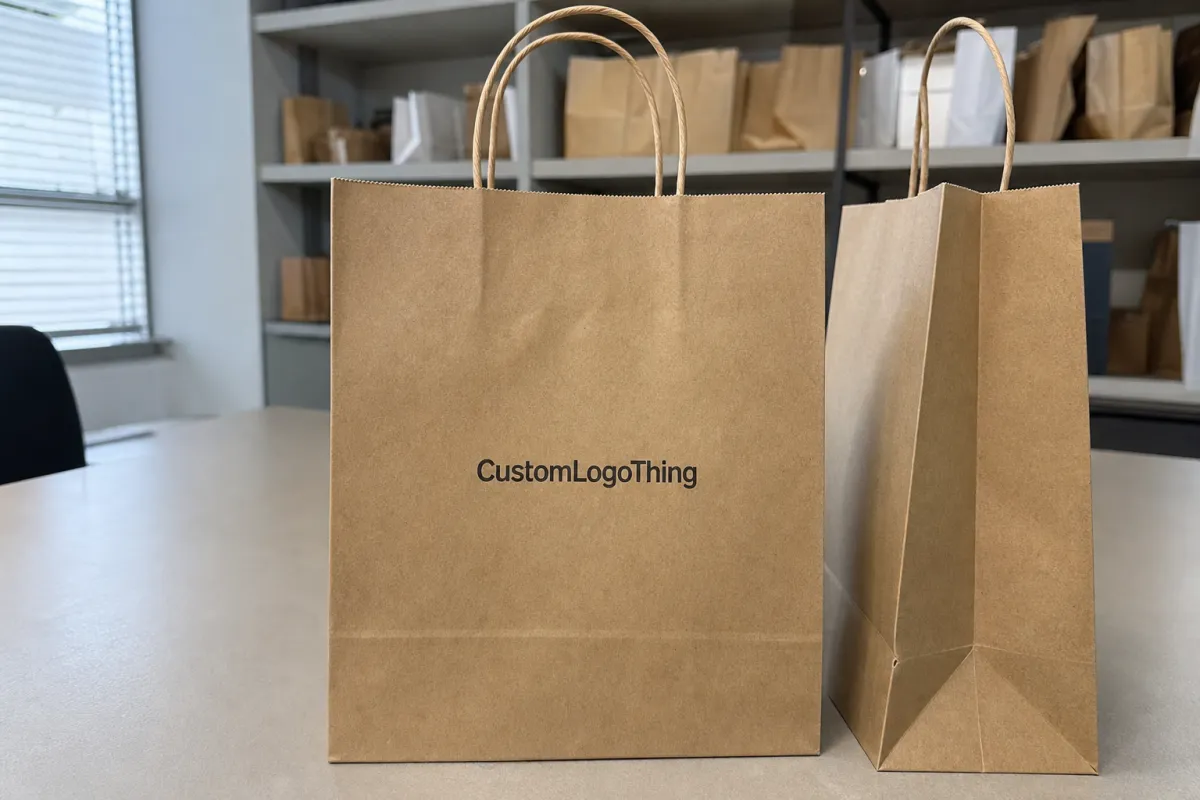
The first question is simple: what exactly goes inside the bag, and how far does it need to travel? A service desk replacement is different from a flagship sale with a boxed tablet, charger, warranty card, and tissue wrap. A demo-event bag carrying accessories has a different load path again.
That is where many programs miss. The mockup fits, the logo looks good, and the order still fails when the bottom fold bows or the handle digs into the shopper's hand. The fix is to test the real load, not a best-case sample. Fill the bag with the heaviest typical electronics kit, carry it a realistic distance, and see what fails first.
Useful use cases to separate early:
- Storefront sale: short carry, comfort, and clean branding matter most.
- Service desk: room for paperwork and replacement parts matters more than display impact.
- Event booth: strength for brochures, demo units, and inserts is the priority.
- Replacement shipment: tighter pack-out and internal protection may be needed.
A slightly stronger bag can be the lower-risk choice if it prevents rework or damage claims. For planning, think of the bag as a light-duty carrier that still has to survive repeated handling, not as a decorative sleeve around the box.
Match paper grade, handle style, and print format to the device mix
Paper grade sets the first impression before anyone notices the artwork. Kraft usually signals practical durability and works well for accessory kits or mid-market programs. Premium white paper gives cleaner contrast for phones, tablets, and higher-ticket devices. Coated paper can sharpen graphics when the bag needs a more polished retail finish.
Twisted handles are a strong default for electronics because they balance cost, comfort, and strength. Flat handles can work for lighter loads, but twisted handles are usually better when the customer may carry the purchase through a parking lot, lobby, or event floor.
Print format matters too. One well-placed logo often looks better than a crowded full-coverage design fighting folds, gussets, and handle anchors. Matte finishes usually feel more restrained; gloss adds pop but can show handling marks sooner. If the device box already has a strong visual identity, the bag should support it, not compete with it.
Check these features early:
- Reinforced tops: useful for heavier carry-outs.
- Gusset depth: important when cables or printed inserts are included.
- Opening clearance: prevents the bag from forcing the top open.
- Security seals: help staff close the bag cleanly.
- QR or support cards: useful for setup help, warranty, or app downloads.
| Option | Typical use | Strength and print profile | Indicative bulk pricing |
|---|---|---|---|
| Brown kraft with twisted handle | Accessories, lighter boxed items, service handoffs | Good carry strength, natural look, solid for simple print | $0.22-$0.38 per unit at 5,000 pieces |
| Premium white paper with twisted handle | Phones, tablets, premium accessories | Cleaner print clarity, more controlled retail presentation | $0.28-$0.46 per unit at 5,000 pieces |
| Coated paper with reinforcement | Launch kits, event handouts, high-visibility programs | Sharp graphics, stronger visual finish, higher setup sensitivity | $0.34-$0.62 per unit at 5,000 pieces |
Those numbers are planning ranges, not firm quotes. Final cost moves with size, paper availability, print coverage, finish, and freight destination. The useful part is comparison: buyers can see whether they are being quoted a light accessory bag or a more robust retail bag with added structure.
Paper consistency matters if the bag will be reordered. Ask whether the caliper, whiteness, or kraft shade can be held across runs. Small source changes show up quickly at bulk volume.
Set dimensions, GSM, and reinforcement so the bag survives retail and transit
Bag size should be based on the full pack-out, not the device box alone. A box may measure one thing, but the final bundle can also include a charger, cable, tissue, warranty sheet, and accessory carton. If the bag is too tight, the handles take stress early; if it is too loose, the product shifts and the presentation feels sloppy.
The practical workflow is to measure the widest, deepest, and tallest packaged unit, then add enough clearance for inserts and easy loading. A little breathing room is better than a spec that forces staff to compress the top just to make the item fit. Compression usually shows up later as wrinkled corners, split seams, or a bag that loses shape after a short carry.
GSM matters. Lighter accessories may not need much structure, but boxed devices usually benefit from reinforced kraft or premium paper in a stronger GSM range. The exact number depends on geometry, handle attachment, and bottom construction. The rule stays the same: higher load means stronger paper and better reinforcement.
Three details are easy to miss and expensive to ignore:
- Bottom patching: improves stability when the load sits flat and heavy.
- Handle attachment style: affects comfort and tear resistance at the top fold.
- Safe print zone: keeps logos and barcodes away from seams, folds, and glue lines.
Before bulk approval, ask for a load test on the actual sample. Fill it with the real electronics assortment, then walk a normal distance with it. A desk lift tells you very little; a realistic carry test exposes weak handle adhesion, gusset bowing, and bottom fatigue much faster.
Documentation helps as well. A spec sheet with dimensions, GSM, reinforcement notes, handle type, and tolerances reduces misunderstandings during repeat orders or regional rollouts. It also fits the traceability mindset used in FSC-oriented paper sourcing; see FSC for the broader standards framework.
Pricing, MOQ, and the quote drivers that move a bulk order
Unit price is only part of the decision. For electronics twisted handle paper bags Bulk Order Planning, the real cost includes paper grade, size, print coverage, handle type, setup charges, packing method, freight, and any inspection or sample requirements. A quote that looks cheaper at first can become the expensive option once the goods land.
MOQ matters just as much. Smaller runs help when artwork is still changing or only a few stores need bags. Larger runs usually lower per-unit cost and reduce stockout risk, but they increase storage needs and tie up cash. If the device line changes often, a large run can become dead inventory faster than expected.
Tiered pricing is the cleanest way to compare options. Ask for 3,000, 5,000, and 10,000 pieces so the price curve is visible. Sometimes the jump is small; sometimes it is large enough that a higher MOQ makes sense if the program repeats often or spans several product groups.
The usual quote drivers are straightforward:
- Size: larger bags use more paper and often more reinforcement.
- Print coverage: one-color branding costs less than full-coverage artwork.
- Handle style: twisted handles usually sit in a favorable cost band.
- Finish: matte, gloss, and special coatings add setup and material variables.
- Quantity: higher volume usually reduces unit cost.
Make every supplier quote the same specification, artwork version, and destination. Otherwise you are comparing different products, not different prices. The best quote package includes dieline confirmation, artwork files, freight assumptions, and the replacement policy if a batch misses the agreed spec.
Buyers should also ask whether artwork changes can be absorbed later. Electronics packaging often shifts by region, campaign, or language. A supplier that can keep the structure stable while adjusting print details usually saves time and reduces requalification work.
Production steps, lead time, and delivery checkpoints that protect launch dates
Lead time is usually a chain, not a single number. Spec confirmation, artwork proofing, sample approval, bulk production, packing, and freight all sit in the path. If one step slips, the launch slips with it.
The sequence should be simple. First, confirm dimensions, paper grade, handle style, and print method. Second, approve a sample or pre-production proof. Third, release the purchase order. Fourth, book freight against the actual production schedule instead of a hoped-for date. Teams that skip sampling often pay for it later in reprints or rushed shipping.
Typical timing depends on complexity. A straightforward one-color bag with standard paper may ship faster than a premium coated version with heavier reinforcement. After artwork approval, a simple run is often around 12-15 business days for production, plus freight. Special finishes, added inspection, or seasonal congestion can extend that window.
The launch does not care how clean the mockup looked. It only cares whether the bags arrived on time and could carry the actual product.
Before shipment leaves the facility, these checkpoints reduce risk:
- Pre-production photos: confirm artwork placement and construction.
- Carton counts: verify packing configuration and unit quantity.
- Pallet setup: protect edges and reduce freight damage.
- Final inspection notes: document color, handle attachment, and seam quality.
Work backward from the store date. Lock artwork first, approve the sample next, and then release the order. That leaves room to fix issues before the bag becomes the reason a launch feels late even when the device itself is ready.
Why a manufacturing-first partner lowers risk on repeat programs
Repeat programs expose weak suppliers quickly. The first run may look fine, but the reorder is where fuzzy dielines, color drift, or thin documentation show up. A manufacturing-first partner usually has the advantage because quoting, construction, and quality control sit closer to the production floor.
That matters when the same bag has to be repeated across stores, regions, or launch waves. A broker can still be useful, but more handoffs usually mean more delay when a fit issue or strength issue appears. If the electronics package changes and the bag needs adjustment, a direct production team can usually respond faster.
Good suppliers keep the basics organized:
- Spec sheets with size, GSM, handle style, and print notes.
- Color references so repeated runs stay visually consistent.
- QC records showing what was checked before shipment.
- Reorder history that shortens future approvals.
That recordkeeping matters because electronics packaging often changes around the bag, not the bag structure. A new support insert, a different QR code, a revised promotion, or a language update should not force a full engineering reset. The more stable the supplier, the easier it is to keep the bag consistent while the message changes.
For buyers managing multiple launches, repeatability is worth more than it sounds. A bag that reorders cleanly reduces approval time, protects brand consistency, and avoids small differences that customers notice even if procurement teams do not.
Lock artwork, sampling, and reorder triggers before buying
Before the order is placed, get the essentials onto one page: product dimensions, estimated quantity, target weight, delivery location, artwork files, and launch date. If those items are not clear, planning drifts into approval loops and small mistakes become expensive.
Ask for a sample, especially if the order includes a new size, a heavier device, or a multi-location rollout. Ask for tiered pricing too, so the effect of volume is visible. If the supplier cannot explain what changes the price, that is a warning sign. Real quoting should be traceable.
A simple acceptance checklist helps when the first shipment arrives:
- Color match: does the logo match the approved proof?
- Handle strength: does the bag carry the actual electronics load?
- Print placement: are folds and seams clear of critical artwork?
- Pack-out: do the boxed devices and inserts fit without distortion?
- Carton quality: are counts and packing methods aligned with the order?
Then set a reorder trigger. That can be a remaining stock threshold, a seasonal date, or a launch milestone. The point is to avoid last-minute scrambling. Once the spec, price, and schedule are locked, the bag becomes a controlled procurement item instead of a fire drill.
FAQ
How do I size electronics twisted handle paper bags for boxed devices?
Base the bag on the full package footprint, not just the device box, and include room for inserts, cords, tissue, and warranty paperwork. Leave enough clearance for a comfortable carry so the top does not gape open or stress the handle attachment points.
What MOQ should I expect for custom electronics twisted handle paper bags bulk orders?
MOQ changes with size, print coverage, paper grade, and handle type, so a simple one-color bag can qualify at a lower minimum than a fully finished premium version. Ask for tiered pricing so you can compare pilot-run quantities against production quantities before committing to a larger order.
Which material works best for heavier electronics retail bags?
Reinforced kraft or premium paper in the right GSM range usually gives the best mix of strength, printability, and cost control for boxed electronics. For heavier items, prioritize reinforced bottoms and handle patches so the bag stays stable during carry-out and transit.
How long does production usually take after artwork approval?
Lead time depends on paper availability, print complexity, handle sourcing, and whether samples or pre-production proofs are required. Lock artwork early and confirm the delivery window before the PO, because last-minute approvals are the most common source of delays.
What should I compare in a bulk quote besides unit price?
Compare landed cost, setup fees, freight, packing method, QC expectations, and any replacement policy so you are not judging quotes on price alone. Make sure every supplier is quoting the same size, material, print method, and delivery terms before you decide.

