Stationery Embroidered Baseball Caps Bulk Order Planning
For onboarding packs, trade-show desks, distributor kits, school stores, and internal merch programs, stationery embroidered baseball Caps Bulk Order planning is what turns a mixed assortment into a coordinated set. A pen is useful. A notebook gets used. A cap keeps showing up in hallways, on commute platforms, at events, and in photos long after the rest of the kit has been opened and filed away. That longer wear cycle is the reason buyers keep putting caps near the top of the order list.
The practical point is simple: recipients judge the stack, not each item in isolation. A cap paired with notebooks, folders, inserts, or desk supplies reads as a planned system. A random mix of promo pieces reads as leftover stock. That difference affects how polished the kit feels, how much value it appears to carry, and how confidently it can be distributed across branches, campuses, or dealer networks.
There is another reason caps belong in stationery bundles. They protect brand visibility without asking the user to do anything. No recharge. No activation link. No extra instruction. If the stationery carries the information, the cap carries the signal. That split matters more than many buyers expect, especially when the goal is to keep a program tidy rather than loud.
Why cap kits work better than loose stationery giveaways
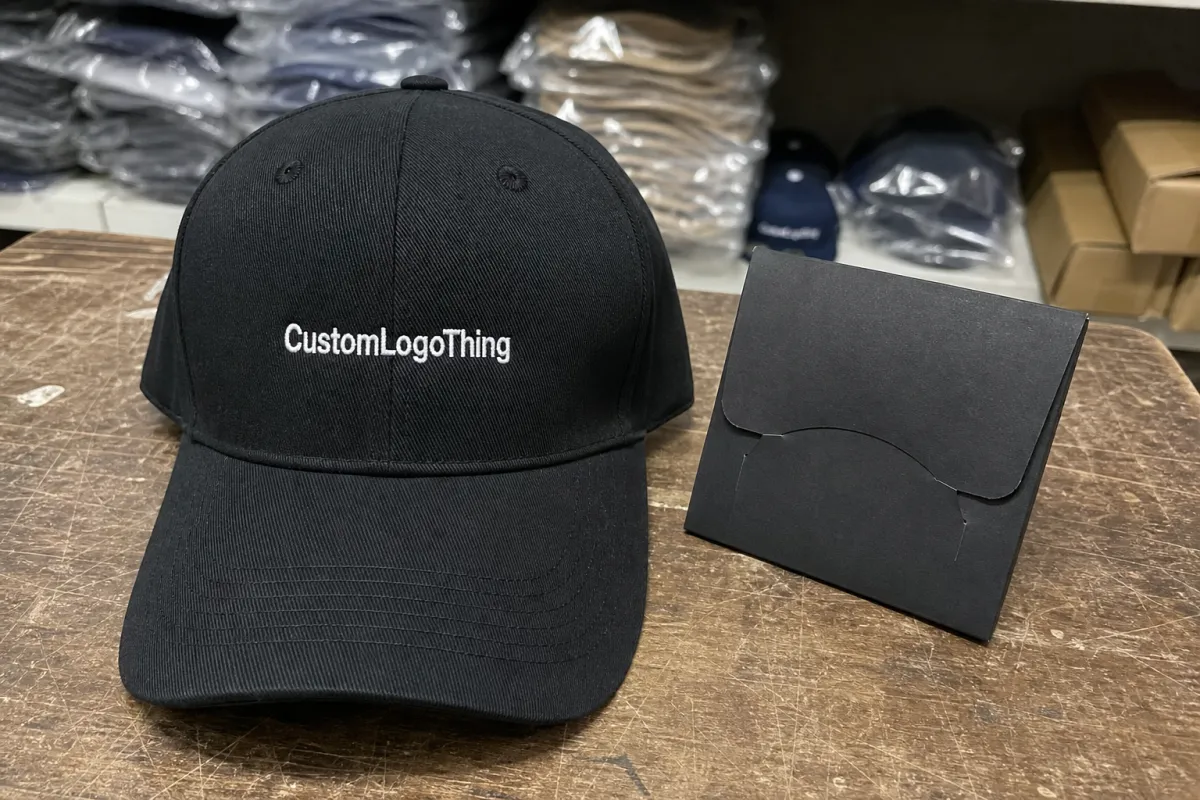
Loose giveaways are consumed one item at a time, often with no relationship to each other. A cap kit changes that rhythm. Once the cap sits beside a branded notebook, a folder, and a simple insert card, the entire package reads as one decision. The perceived value rises before anyone has a chance to compare individual unit costs.
The wear profile also helps. A notebook may be used up in a quarter. A pen may walk off in a week. A cap can stay in circulation for months, sometimes longer if the fit is right and the decoration holds up. For bulk planning, that matters because the item with the longest visible life becomes the one doing the most brand work.
From a procurement angle, the best bundles are the ones that create order without adding clutter. One cap, one notebook, one insert, and one outer carton usually present better than a pile of unrelated items. That sounds like a design choice, but it is also a logistics choice. Fewer moving parts usually means simpler assembly, cleaner packing, and fewer questions at the receiving end.
One detail buyers tend to miss: the cap is often the first item people try on. The notebook gets read later. That makes front-panel embroidery a high-value placement zone, because it influences the tone of the whole kit before the stationery is even opened.
For teams balancing budget and presentation, the cap can handle the visible logo while the stationery carries the details. That division keeps the package from becoming overdesigned. It also avoids the common mistake of forcing every item to do the same job.
There is a comparison worth keeping in mind. A notebook is functional for information capture. A cap is functional for repeat visibility. Put them together and the kit covers both memory and motion. That is why the pairing works so well in bulk programs that need to feel useful rather than promotional.
Decoration choices that change the final result
Cap structure changes the whole read of the order. A structured 6-panel cap gives a cleaner front panel and a more formal silhouette. An unstructured cap feels softer and more relaxed. A low-profile cap sits closer to the head and usually looks less promotional, which can help when the stationery bundle is meant to feel refined instead of loud.
The decoration method matters just as much. Flat embroidery is the most dependable option for clean logos, small text, and fast approvals. 3D puff embroidery adds volume and shelf presence, but it is less forgiving with fine detail. Woven patches handle more intricate artwork, while stitched emblems can give a more retail finish. Each method changes the visual weight, the cost, and the approval path.
Most orders look better with one primary decoration location. Front panel first. Side or back placement only if the program truly needs it for team identification, sponsor separation, or multi-brand distribution. Extra placements often feel tempting because the blank space is there, but more decoration can quickly move the cap from planned to crowded.
The stationery palette should guide the cap choice too. If the notebooks and inserts are already bold, a restrained cap body can keep the bundle balanced. If the stationery is understated, an accent thread color can echo the rest of the set and pull everything into the same visual lane. The goal is not for the cap to outshine the notebook. The goal is for both items to look like they were approved together.
Here is a practical comparison buyers can use before requesting mockups:
| Cap option | Visual effect | Best use case | Typical impact on production |
|---|---|---|---|
| Structured 6-panel, flat embroidery | Sharp, clean, uniform | Onboarding kits, distributor packs, team programs | Usually the easiest version to approve |
| Low-profile, flat embroidery | Soft, modern, less formal | Retail-style stationery bundles, school stores | Good balance of detail and speed |
| Structured, 3D puff logo | Bold, dimensional, high visibility | Front-facing merchandise and premium drops | More sensitive to logo size and stitch density |
| Unstructured cap with woven patch | Relaxed, textured, lifestyle-oriented | Casual programs and gift sets | Often adds setup steps and longer approval time |
Fit, fabric, and artwork specs to confirm first
Spec sheets prevent expensive mistakes. Before a supplier quotes, confirm crown height, closure type, visor curve, panel count, and sizing range. Those details decide whether the cap reads athletic, retail, or corporate. They also affect how the order can be distributed. A snapback, a hook-and-loop closure, and a buckle-back cap do not fit the same audience or the same storage plan.
Fabric choice deserves the same attention. Cotton twill gives a familiar retail feel and usually stitches cleanly. Brushed cotton can feel slightly softer but may show wear faster on high-contact programs. Polyester blends often hold shape well and can be useful for staff or event use, especially if the kit may be handled a lot. None of these choices is universally better; the right one depends on the expected wear, price target, and the look of the stationery bundle around it.
Artwork is the next pressure point. Send a vector file, not a screenshot, and include logo placement measurements, thread-color references, and any Pantone targets you want protected. For text-heavy embroidery, ask for stitch-safe type size guidance early. Small letters can close up on curved front panels, especially on dark fabrics or on logos with tight spacing.
Packaging details belong in the same spec sheet. Include polybagging, hangtags, carton labels, master carton counts, and whether kits ship as loose items or pre-packed bundles. Those decisions change labor and freight density. A buyer who leaves packaging vague often discovers the real cost only after production has started.
Visual checks matter too. Stitch density, logo contrast on dark materials, seam interference, and how the cap reads under retail lighting can all change the result. A design that looks crisp on a monitor may feel cramped once the front panel curve and seam lines are real. Request a proof that shows actual placement, not just a floating logo on a flat mockup.
If the order will pass through multiple handling points, ask about transit testing for the cartons. The International Safe Transit Association publishes widely used packaging test frameworks, and they are worth referencing when caps travel with notebooks, inserts, or other mixed media. For paperboard inserts or outer wraps, FSC-certified stock may also matter; see FSC for chain-of-custody information.
A cap order rarely falls apart because the logo was attractive. It fails because the approved front-panel size was too ambitious, then the team tried to rescue the job with smaller type and more thread colors.
Pricing, MOQ, and unit-cost drivers
Pricing is shaped by more than the cap blank. The main drivers are total quantity, stitch count, number of thread colors, decoration method, rush timing, and packaging add-ons. A simple flat-embroidered cap at 1,000 units can land at a very different price than a low-run patch style at 100 units, even if the body color looks almost identical.
MOQ is more method-dependent than many buyers expect. The base cap may be available in small quantities, but embroidery setup, patch production, and packaging labor can push the minimum higher. That is why one version of the same cap can look easy to buy and another version can feel expensive before production has even started.
For stationery teams, the number that matters most is landed cost per kit. Cap price alone does not tell the whole story. A bundle may also include printed inserts, polybags, custom cartons, barcode labels, and pre-assembly labor. If those items are missing from the quote, the invoice can drift upward quickly.
Quote bands help because they show where the unit cost starts to settle. Most buyers see the strongest price relief once they move past the smallest setup tier and into mid-volume production. After that, the setup fee becomes less visible. The material cost still matters, but it stops dominating the math.
| Quantity | Flat embroidery | 3D puff / patch styles | Packaging add-on range | What usually changes |
|---|---|---|---|---|
| 100 units | $7.50-$11.00 | $9.50-$13.50 | $0.60-$1.50 per kit | Setup cost still weighs heavily on each unit |
| 250 units | $6.20-$8.80 | $8.20-$11.80 | $0.45-$1.20 per kit | Better spread of embroidery and proofing costs |
| 500 units | $5.40-$7.20 | $7.10-$10.00 | $0.30-$0.95 per kit | Most buyers begin seeing stable per-unit savings |
| 1,000 units | $4.20-$6.10 | $5.90-$8.60 | $0.20-$0.75 per kit | Setup matters less; freight and packaging become more visible |
Those are practical ranges, not fixed promises. Stitch complexity, fabric choice, carton configuration, and proof revisions still move the final number. But they give buyers a solid framework for stationery embroidered baseball caps Bulk Order Planning before the first quote lands.
Production timeline and checkpoints
The production flow is usually straightforward: quote request, artwork proof, sample or virtual mockup, production, quality control, packing, and shipment. The catch is that delays usually appear in the middle, not at the start. A clean quote does not guarantee a clean schedule.
Most slowdowns come from a small list of corrections. Spelling changes. Logo placement changes. Thread-match approvals. Carton label revisions. Late sign-off on the final proof. Each one sounds minor on its own. Together, they can move a schedule by days, sometimes longer if the order is waiting on a revised approval chain.
Turnaround depends on order size, decoration complexity, and packaging requirements. Flat embroidery on stocked cap bodies is often faster than patch-heavy or multi-location decoration. Add custom cartons, kitting labor, or retail-style inserts, and the calendar stretches. That is why rush orders should be confirmed before artwork is finalized, not after.
For many buyers, a realistic planning window is roughly 12-15 business days after proof approval for simpler embroidered runs, with more complex builds stretching closer to 15-25 business days. Freight is a separate variable. Domestic carriers, customs clearance, and seasonal congestion can all add uncertainty after production ends.
Buffer time is not a luxury. A cap kit that arrives three days early feels organized. A kit that lands on the morning of the event creates risk for the entire stationery program. If a launch date is fixed, the order schedule should move backward from that date, not forward from the day the quote is approved.
There is also a hidden timing issue with mixed-material kits. The cap may be ready, but the inserts, cartons, or labels may still be in motion. That is why coordination matters as much as decoration. One delayed component can hold up the whole bundle.
Supplier checks that protect large orders
Supplier selection should start with proof quality, not sales polish. Clear spec sheets, fast revision handling, and documented quality checks matter more than a smooth presentation. If a supplier cannot repeat the spec back accurately, the order is already at risk.
Look for a vendor that can coordinate cap colors, cartons, and inserts with the stationery program so the full kit lands with one visual standard. That does not mean every part has to match exactly. It means the colors, label system, and packing method should feel deliberate. A messy mix of cap shades and random insert stock can make a decent product look inconsistent.
Ask for production photos or pre-ship inspection details. That matters especially when the order will be distributed across branches, campuses, dealers, or event locations. A buyer who sees one approved photo set has far fewer surprises than the buyer who only sees a final invoice.
Communication speed should be judged alongside price and sample accuracy. A cheap quote can become expensive if the supplier is slow to clarify mockups or reluctant to flag a problem early. Small spec errors multiply fast in volume production. By the time the order is on the line, every revision costs more.
Quality control on the cap itself should include a few concrete checks: stitch coverage, placement consistency, thread tension, color alignment, and seam interference on the front panel. For bundled stationery, add carton count verification and insert placement checks. A program can look polished from a distance and still fail in the details if one of those steps is skipped.
These questions help separate a good fit from a risky one:
- Can the supplier show how the logo will sit on the front panel before production starts?
- Will they confirm carton counts, labeling, and kitting details in writing?
- Do they use a documented quality check process before shipment?
- Can they support repeat orders without redoing every proof from scratch?
There is a useful reference point from packaging professionals as well. The Institute of Packaging Professionals publishes material that helps buyers think more clearly about package design, transport, and fulfillment. That perspective is useful here because the cap rarely ships alone. It ships as part of a system.
Order-ready steps for stationery teams
Start with three inputs: artwork, target quantity, and in-hands date. Those are enough to get a realistic quote, and they keep the discussion grounded in production reality rather than guesswork. Once those are set, decide on cap style, decoration method, and packaging before asking for pricing. Otherwise, the quote will reflect a rough idea instead of the actual buy.
If the program will repeat across locations, dealers, or school accounts, a test order is often worth it. Small pilot runs expose fit problems, weak thread contrast, and packaging issues long before a larger rollout. That matters even more when the stationery line is already locked and the cap has to match the tone of the rest of the bundle.
For buyers comparing suppliers, the best next move is usually a short checklist instead of a long email chain:
- Confirm the cap style and logo placement.
- Attach vector artwork and Pantone references.
- State the quantity break you want quoted.
- List packaging, labeling, and kitting requirements.
- Lock the delivery date before proof approval.
That approach keeps stationery embroidered baseball caps Bulk Order Planning practical, not theoretical. It also gives the supplier enough detail to price accurately, reduce revision rounds, and schedule production without guesswork. For quick reference, the FAQ can answer common questions about artwork, minimums, and turnaround before the order moves to approval.
In a strong kit, the cap is not an afterthought and it is not the loudest item in the box. It is the anchor. That is where the value sits, and that is why buyers notice the difference between a rushed bundle and one that was built with a clear plan.
How do I choose the right cap style for a stationery bulk order?
Use structured caps when you want a sharper logo face and a more uniform team look. Use unstructured or low-profile caps when the stationery set needs a softer, retail-style finish. Pick one body color first, then match thread or patch colors to the rest of the brand kit.
What information do I need for a bulk quote on embroidered baseball caps?
Send the target quantity, cap style, artwork file, logo placement, and needed delivery date. Include thread colors, packaging requirements, and any labeling or insert needs. The more exact the spec sheet, the fewer revision rounds you will need before pricing is locked.
How does MOQ change with embroidery, patches, or extra packaging?
More complex decoration usually raises the minimum because setup and stitching time increase. Extra packaging like hangtags, polybags, or custom cartons can also push MOQ higher. Simple designs with limited thread colors usually give buyers the most flexible entry point.
What is a realistic turnaround for a stationery embroidered baseball caps bulk order?
Expect the schedule to depend on proof approval, order size, decoration type, and packaging needs. Rush orders need early confirmation because artwork changes and freight timing can extend the timeline. Build buffer time before launches, conferences, and onboarding dates to reduce delivery risk.
Can you match cap colors to existing stationery branding?
Yes, but the best match depends on whether the cap fabric is stock, custom dyed, or limited by supplier inventory. Provide Pantone references or physical swatches when you want the closest possible match. Thread colors can often be matched more precisely than the cap body itself.