Buyer Fit Snapshot
| Best fit | Embossed Poly Mailers with Logo projects where brand print, material claims, artwork control, MOQ, and repeat-order consistency need to be specified before quoting. |
|---|---|
| Quote inputs | Share finished size, material target, print colors, finish, packing count, annual reorder estimate, ship-to region, and any compliance wording. |
| Proofing check | Approve dieline scale, logo placement, barcode or warning zones, color tolerance, closure strength, and carton packing before bulk production. |
| Main risk | Vague material claims, crowded artwork, missing packing details, or unclear freight terms can make a low unit price expensive after revisions. |
Fast answer: Embossed Poly Mailers with Logo: Film, Print, MOQ, and Carton Packing should be specified like a repeatable production item. The safest quote records material, print method, finish, artwork proof, packing count, and reorder notes in one written spec.
Production checks before approval
Compare the actual filled-product size with the drawing, then confirm tolerance on folds, seals, hang holes, label areas, and retail display edges. Reserve space for logos, QR codes, warning copy, and material claims before decorative graphics fill the panel.
Quote comparison points
Review material grade, print process, finish, sampling route, tooling charges, carton quantity, and freight assumptions side by side. A quote is only useful when the supplier can repeat the same color, closure quality, and packing count on the next order.
Embossed poly mailers with logo do one thing very quickly: they make a shipping bag feel deliberate instead of ordinary. That sounds modest until you remember how often a customer meets the package before the product, and how much a raised mark, a firmer edge, or a subtle texture can change the mood of that first touch. I have watched a basic mailer get set down on a counter and then picked up again just because the finish felt better in hand; that little pause matters more than most teams expect.
From a packaging buyer’s perspective, embossed poly mailers with logo are not just “nicer bags.” They sit at the intersection of finish choice, budget control, and brand presentation. Pick the wrong artwork or the wrong film, and the result can look flat, awkward, or more expensive than it deserves to be. Pick the right combination, and the package does some of the branding work before a label is even scanned.
Smart buyers treat embossed poly mailers with logo the same way they treat carton specs, insert cards, or closure systems: as a production decision with real tradeoffs. You gain texture, depth, and a more refined unboxing cue. You also accept tooling, lead time, and limits on how detailed the artwork can be. That balance is the whole story, and it is where a lot of first-time orders go a little sideways.
For fashion, beauty, gift, and direct-to-consumer shipments, embossed poly mailers with logo can be an excellent fit when the package needs a tactile lift without the weight of a box. Dense graphics, tiny type, and busy illustrations usually belong elsewhere. The finish works best when the mark is clean and confident, because the emboss needs breathing room to actually read as premium.
What Embossed Poly Mailers With Logo Actually Change
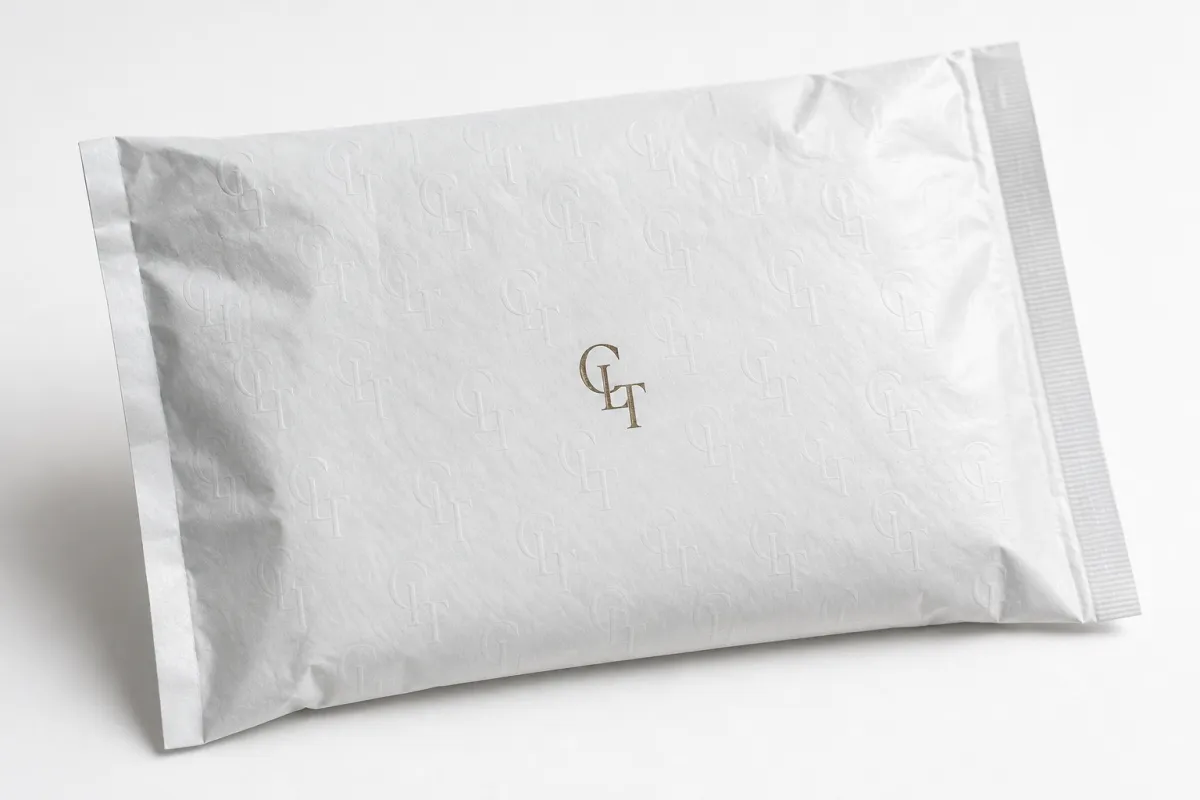
Embossed poly mailers with logo change the surface story before they change the visual story. A printed mailer tells the eye what the brand is. An embossed mailer tells the hand that the packaging has been thought through a little more carefully. That difference is subtle on paper and obvious in person, which is exactly why buyers keep coming back to this finish after they have tried cheaper options.
In plain language, embossing means raising or pressing the logo into the film so the mark has visible depth and a tactile edge. The exact method can use pressure, heat, or a combination of finishing steps, depending on the factory setup. The machinery matters less than the result: embossed poly mailers with logo create texture, and texture changes perception almost immediately. Even a small logo can feel more intentional if the impression is crisp.
This is not the same thing as full-color printing. Printing lays ink on the surface. Embossing changes the surface itself. It is also not just a decorative flourish for brands trying to look premium without earning it. Used well, embossed poly mailers with logo strengthen memory, especially for products that depend on repeat orders and social sharing. A customer may not say, “That was a great emboss,” but they do remember that the package felt nicer than the rest.
That said, they are not the right answer for every design. A complicated illustration with fine lines usually belongs on Printed Poly Mailers, not embossed poly mailers with logo. The emboss needs room to breathe. Bold letters, strong marks, and simple icons usually read better than dense artwork that turns soft once the film is pressed. If the art is trying to do too much, the emboss is gonna lose its punch.
For apparel, skincare, small accessories, candles, gifts, and subscription shipments, embossed poly mailers with logo often make the most sense because the packaging is part of the experience. A soft-touch box can deliver a similar mood, but poly mailers keep shipping weight and cost lower. That is the useful middle ground: lighter than cartons, more polished than plain shipping bags.
A mockup can look elegant in five seconds. The sample decides whether embossed poly mailers with logo actually read as premium or just read as “we spent money on a finish.”
Think about the moment of use, not just the render. A shopper opening a mailer on camera, at a desk, or in a hallway tends to notice texture before they notice a clever slogan. In those settings, embossed poly mailers with logo can do more work than a busy printed pattern ever could. I have seen a plain single-color mailer outperform a louder design simply because the emboss gave it a cleaner, more honest presence.
How Embossed Poly Mailers With Logo Are Made
The basic production idea behind embossed poly mailers with logo is simple: the design is transferred through a die or plate so the logo becomes raised or pressed into the film. The exact workflow depends on the supplier, but tooling sits at the center of it. No tooling, no clean emboss. There is no shortcut hiding behind that, even if a sample photo makes it look easy.
Most factories begin with artwork, then build a tooling file or metal die that defines the shape and depth of the embossed area. Pressure, heat, and registration accuracy all matter here. If the alignment is off by even a small amount, embossed poly mailers with logo can look crooked or weak, especially on smaller mailers where the branding area is tight. A clean-looking logo on a screen can still fail once it meets a thin film and a real production press.
The film itself matters a great deal. Thicker material usually holds a sharper impression than flimsy film because it resists deformation better. Thin film can still work, but the emboss may look soft or shallow if the bag flexes too much. For many custom mailers, buyers look at film thickness in the 2.5 to 4 mil range, though the right spec depends on bag size, product weight, and seal strength. I have seen a slightly heavier film make the final logo look twice as intentional, just because the raised edges stayed cleaner after filling.
Embossing is not the same as debossing, foil stamping, or textured lamination, even though those terms get mixed together constantly. Embossing pushes the logo outward. Debossing presses inward. Foil adds a metallic layer. Texture changes the whole surface feel. If a supplier treats those as interchangeable, it usually means the conversation needs more precision. Good vendors will slow down here and make sure you are talking about the actual finish, not just the vibe.
Printed artwork and embossing can work together, but they solve different problems. Printing gives you color, small type, gradients, and broader graphic storytelling. Embossed poly mailers with logo give you tactile emphasis and a cleaner premium read. Some brands use both: a restrained embossed mark on the front, plus shipping copy or compliance information in print on the back. That combination works because each finish has a clear job, and neither one has to carry the entire package on its back.
Quality issues tend to show up in a few familiar places. The logo edges look soft. The impression is too shallow. The panel stretches under pressure and throws off registration. Or the proof looks crisp while the finished bag comes out flatter than expected. Embossed poly mailers with logo can look sharp, but only when tooling and film selection are handled with enough care to preserve detail.
For buyers who want a technical reference point, shipping-package performance should not be judged by appearance alone. Ask whether the bag has been validated for handling and transit in a way that resembles common shipping test logic, such as the procedures discussed by the International Safe Transit Association. Pretty mailers that split in transit are not premium. They are a replacement order waiting to happen.
That is also why suppliers who think in packaging terms, not just decoration terms, tend to be easier to trust. Good embossed poly mailers with logo are designed around both the finish and the shipping use case. The idea sounds obvious until you see how often it gets missed in quoting and sampling.
Key Factors That Affect Finish, Strength, and Brand Read
If the goal is to make embossed poly mailers with logo feel premium, the first question is not the logo. It is the film. Material thickness, seal quality, puncture resistance, and surface finish all shape the final result. A beautiful emboss on a weak bag is still a weak bag.
Thickness is the quiet hero here. A bag with enough body holds the logo better and usually gives a cleaner raised effect. For lightweight apparel shipments, a lighter film may be fine. For heavier or sharper contents, a thicker structure gives you more confidence in the seal and less risk of the logo looking washed out once the mailer is packed.
Logo size matters more than many buyers expect. Small text and thin strokes often get lost on embossed poly mailers with logo because the raised area does not have enough room to define each shape cleanly. Bold sans-serif type, clean icons, and open spacing usually emboss better than script lettering or intricate line art. Fancy is nice. Readable is better.
The surface finish changes the read as well. Matte film can make embossed poly mailers with logo look more subtle and refined. Glossy film can add shine, but it may also create reflections that compete with the raised mark. Frosted finishes sit somewhere in the middle, softening the look without flattening the brand completely. If the identity leans understated, matte is often the safer path.
Color contrast matters too, even when the logo is embossed rather than fully printed. Some designs rely on a tone-on-tone effect, where the logo is intentionally quiet. That can work beautifully if the spacing is generous and the lighting does the rest. Other designs need sharper contrast to avoid looking muddy. The wrong combination of color, sheen, and emboss depth can make embossed poly mailers with logo feel accidental instead of intentional.
Brand read is not only about aesthetics. It is also about how the package behaves in real use. If the bag is stuffed too full, the embossed logo can distort. If shipping labels cover the front panel, the logo loses visibility. If the film creases across the brand area, the finish looks less clean. Real packaging is a contact sport, and the warehouse usually has the final say.
This is where buyers need to accept tradeoffs. Embossed poly mailers with logo usually deliver the most value when the design stays simple and the bag has enough print real estate to let the texture breathe. If the artwork has to do too much, the result can look crowded, which defeats the point of paying extra for a premium finish.
A useful rule of thumb holds up well in practice: the more your packaging depends on tactile impression, the more you should simplify the artwork. The more your packaging depends on visual storytelling, the more you should consider Printed Poly Mailers or a mixed-finishing approach. If you need a broader sourcing menu, start with Custom Packaging Products and compare the finish against other formats before locking in a spec.
Some buyers also ask about sustainability. That is a fair question, and it deserves an honest answer. Poly mailers can be efficient because they are light and use less material than boxes for many shipments, but recycling guidance varies by location. For general recycling information, the EPA recycling resources are a sensible place to start. A premium finish does not erase disposal concerns, and it should not be treated that way.
Embossed Poly Mailers With Logo: Cost, MOQ, and Quote Basics
Cost is where embossed poly mailers with logo start separating serious buyers from the “just send me the cheapest thing” crowd. Premium finishing requires setup, and setup costs money. The final price depends on film grade, size, finish, artwork complexity, tooling, and order quantity. That is not a vague answer. That is the answer.
For a common custom order, the tooling or die fee might land somewhere around $80 to $300, sometimes higher if the artwork is large or unusually detailed. Unit pricing can range widely, but a realistic ballpark for embossed poly mailers with logo at around 5,000 pieces might be roughly $0.22 to $0.45 each before freight. Smaller runs often cost more per unit, and heavy print coverage or extra finishing can push the number upward.
MOQ matters because tooling does not scale down kindly. A supplier can only spread setup cost across so many bags, which is why a 1,000-piece order usually looks expensive next to a 10,000-piece order. If you are comparing embossed poly mailers with logo across multiple vendors, ask whether the quote is based on the same film thickness, same bag size, same emboss depth, and same packaging count. Otherwise you are comparing apples to plastic pretzels.
Here is a practical comparison buyers can actually use:
| Mailer Type | Typical Look | Setup Complexity | Approx. Unit Cost at 5,000 pcs | Best Use Case |
|---|---|---|---|---|
| Plain printed poly mailers | Bold visual branding, flat surface | Low to moderate | $0.12-$0.28 | Color-heavy branding, tight budgets |
| Embossed poly mailers with logo | Raised texture, premium tactile feel | Moderate to high | $0.22-$0.45 | Fashion, beauty, gifts, DTC unboxing |
| Embossed plus print | Texture plus graphic detail | High | $0.28-$0.55 | Brands needing both texture and color |
| Foil-accented mailers | Shiny highlight, visual pop | High | $0.30-$0.60 | Promotion-driven packaging, gift sets |
The table is only a starting point, but it shows the real logic. Embossed poly mailers with logo make sense when the tactile effect supports your margin and the product value justifies the finish. If the bag is shipping low-margin goods where every cent matters, a simpler printed mailer may win. That is not a downgrade. That is disciplined purchasing.
A usable quote should include more than a single unit number. You want dimensions, film thickness, emboss depth or finish notes, color count if print is involved, packing quantity, production time, shipping terms, and sample cost. If a supplier sends only one line that says “custom mailer price,” they are asking you to trust a napkin.
It also helps to clarify whether the quote is ex-works, FOB, or delivered. Freight can swing the total materially, especially on bulk orders. A bag that looks cheap at the factory can become much less attractive once packaging, transit, and import charges land. That is exactly why embossed poly mailers with logo should be evaluated on landed cost, not fantasy cost.
Buyers sometimes over-focus on whether the embossing adds a few cents and under-focus on whether it changes brand perception enough to justify the spend. That is the real question. If the packaging supports a high-consideration purchase, a neat tactile finish can improve the unboxing moment without needing full-color coverage. If the shipment is purely utilitarian, the upgrade may be wasted.
For brands comparing mailer families, a focused product page can save time. You can review Custom Poly Mailers against the embossed option and judge where your budget gets the strongest return. That is the practical move, not the romantic one.
Process and Timeline: From Artwork to Production Steps
The production workflow for embossed poly mailers with logo is straightforward on paper and mildly annoying in real life, which is to say: normal packaging work. You request specs, submit artwork, confirm the material and finish, approve a sample, and then move into mass production. Fewer surprises at each step usually means a better final result.
Artwork is usually where the calendar starts slipping. Clean vector files speed things up. Raster logos, tiny type, or half-finished branding systems slow things down. If the emboss needs a die, the supplier may also need a simplified version of the art so the raised edges stay readable. Do not send a logo file that only behaves well in a slide deck and expect the factory to rescue it.
Sampling matters more than many teams want to admit. A digital proof can show placement, but it cannot tell you how embossed poly mailers with logo will feel in the hand, how high the logo will stand out, or whether the seal line looks clean once the bag is filled. A sample is not extra bureaucracy. It is the step that keeps you from discovering the problem after 10,000 bags are already in motion.
Typical turnaround depends on complexity, supplier capacity, and approval speed. A simple custom run may take around 12 to 18 business days after sample approval. More complex embossed poly mailers with logo orders, especially those with custom print, special film, or multiple revisions, can stretch to 20 to 30 business days or more. Freight sits on top of that. So yes, plan early.
If your mailers support a launch, seasonal drop, or subscription cycle, build buffer time into the schedule. I usually tell buyers to work backward from the ship window, not from the approval date they wish they had. If the goods need to be ready for a product reveal or a sales event, leave room for sample back-and-forth and packing logistics.
There is also a strong reason to ask how the supplier handles quality checks. Better vendors inspect alignment, emboss depth, seal performance, and film consistency before mass output. That matters because embossed poly mailers with logo can look flawless on the first sheet and still drift if the process is not controlled. Packaging is full of those charming little traps.
For buyers who care about the broader category language, the packaging industry has useful terminology references and standards-oriented resources. A neutral starting point is the Packaging Institute, which helps frame packaging as a technical buying category rather than a decoration project. That mindset saves money more often than people expect.
Here is a clean working timeline you can actually use:
- Day 1-2: send artwork, dimensions, and target quantity.
- Day 3-5: review specs, confirm material thickness, and approve a mockup or tooling plan.
- Day 6-10: receive and review sample photos or a physical sample.
- Day 11-15: confirm revisions, sign off, and release production.
- Day 16-35: production, QC, packing, and shipment depending on order complexity.
That timeline is not universal, because nothing in custom packaging is universal except delays. Still, it gives buyers a realistic frame. Embossed poly mailers with logo are not instant goods, and treating them that way is how teams end up paying expedite fees they never wanted.
Common Mistakes When Ordering Embossed Poly Mailers With Logo
The biggest mistake with embossed poly mailers with logo is choosing artwork that is too fine, too busy, or too small to emboss cleanly. Tiny taglines, hairline borders, and dense icons often disappear once the film is pressed. Buyers sometimes insist on keeping every detail because the logo looks perfect on a screen. The screen is not the production line, and it never has to survive heat, pressure, and a warehouse shift.
Skipping the sample stage is another classic error. A digital proof can hide plenty of sins. It will not show you whether the emboss depth is enough, whether the bag feels premium in hand, or whether the logo gets lost once the mailer folds around a product. If a supplier says the mockup is enough, they are saving time at your expense.
Low-price chasing causes a lot of pain here too. A quote that looks 10% cheaper may be hiding thinner film, weaker seal strength, looser QC, or a simplified emboss that does not match the proof. Embossed poly mailers with logo should be judged on the actual spec sheet, not on the headline number. Cheap bags become expensive when they fail in transit or arrive looking tired.
Overdesign is the quieter problem. Some brands stack too many finishes into one bag: embossing, foil, multiple colors, glossy accents, and oversized messaging. The result is visual noise. Embossed poly mailers with logo usually work best when the logo can breathe and the rest of the bag stays disciplined. Less drama. Better read.
Another miss is ignoring how the bag will be used in the warehouse and by the carrier. If the front panel must carry a shipping label, return label, or handling sticker, the embossed area may be partially covered. If the logo sits too close to the seal or fold lines, the finish can distort. Design for the actual shipping path, not the marketing render.
Some buyers also forget to ask about bag opening method, seam strength, and how the mailer behaves once packed. A prettier embossed surface does not help if the adhesive strip is weak or the material stretches poorly. That is why embossed poly mailers with logo should be ordered as shipping packaging first and brand touchpoint second. Those two things can work together, but one cannot excuse the other.
Finally, make sure the sample reflects the final production size and artwork. A small prototype with simplified graphics can fool people into approving a finish that will not translate to the real bag. If the supplier sends a placeholder version instead of your actual artwork size, stop and ask for the right sample. That is not being difficult. That is being attentive.
For brands that want to avoid the usual mistakes, the best habit is simple: ask for the spec, ask for the sample, and ask what changed from proof to production. If the answers are fuzzy, embossed poly mailers with logo are not the place to gamble.
Next Steps: How to Spec, Sample, and Place the Right Order
If you want embossed poly mailers with logo that actually help your brand, start with a tight brief. You need the final logo file, target bag size, preferred finish, expected order volume, shipping timeline, and budget range. If you have those pieces ready, the rest of the process becomes much easier to compare and quote.
Then ask for at least two sample approaches. One can be a straightforward embossed version. The other can be a simpler printed or alternative finish so you can judge whether the tactile effect is worth the premium. That comparison is useful because embossed poly mailers with logo are not automatically the right answer; they are the right answer when the finish improves the customer’s first impression enough to justify the cost.
Use a simple decision rule. If the emboss reads clearly, the bag seals well, and the landed cost supports your margin, the order is ready to move. If the logo is muddy, the seal feels weak, or the quote forces you to overprice the product, back up and adjust the spec. Pretty packaging should not rescue a bad buy.
If you are ordering for a launch or a seasonal drop, lock the calendar before you lock the artwork. Production delays on embossed poly mailers with logo usually come from approval drag, not from the raw making itself. Leave room for one revision, one sample review, and one buffer. That is usually enough to stay sane.
Brands that already know they want a more premium shipping experience should compare embossed poly mailers with logo against other custom mailers in the same size class. The best option is rarely the fanciest option. It is the one that matches product value, shipping weight, brand position, and reorder cadence without creating a cost headache later.
One more practical point: think about reorder behavior. If you expect to reorder regularly, make sure the supplier can repeat the same emboss depth, film spec, and print alignment without drifting. Consistency matters more than one dramatic sample. Nobody wants a brand system that changes personality every time the warehouse places another order.
If you are still deciding, go back to the three questions that actually matter: does embossed poly mailers with logo improve the tactile impression, does the quote fit the margin, and does the schedule hold up? If the answer is yes across all three, move forward. If not, simplify. Good packaging should earn its place.
Practical takeaway: embossed poly mailers with logo work best when the artwork is bold, the film has enough body to hold the impression, and the landed cost still makes sense after tooling and freight. Lock the spec, request a real sample, and compare it against a plain printed option before you approve the run. If the embossed version feels better in hand and still protects your margin, you have the right mailer; if not, trim the finish and keep the package honest.
Are embossed poly mailers with logo better than printed mailers?
Embossed poly mailers with logo usually feel more premium because the logo has texture and depth. Printed mailers are better if you need bold color, finer detail, or lower setup cost. The better choice depends on whether tactile finish or visual complexity matters more for your product line, and that answer changes from brand to brand.
What logo style works best on embossed poly mailers with logo?
Simple, bold artwork with thicker lines usually embosses cleanly. Tiny text, thin strokes, and dense detail can blur or disappear in production. If the logo is complex, simplify it before asking for a quote on embossed poly mailers with logo. A cleaner mark almost always gives you a cleaner bag.
How much do embossed poly mailers with logo usually cost?
Cost depends on size, thickness, finish, artwork complexity, and order quantity. Higher MOQs usually lower the unit price because setup costs spread across more pieces. Any quote for embossed poly mailers with logo should separate tooling, unit cost, and freight so you can compare it properly and avoid false savings.
How long does production usually take for embossed poly mailers with logo?
Most timelines depend on sample approval speed, tooling setup, and factory capacity. Custom embossed poly mailers with logo usually take longer than standard printed mailers because there is more setup and quality control. Build in extra time if the order is tied to a launch date or seasonal shipment, because last-minute changes can add days fast.
What should I ask before approving embossed poly mailers with logo?
Ask for material thickness, sample photos, emboss depth, and sealing strength details. Confirm MOQ, unit cost, turnaround, and shipping terms before paying a deposit. Make sure the factory uses your final artwork size and not a simplified placeholder version for embossed poly mailers with logo. If any answer sounds vague, ask again before the run starts.


