embroidered beanies Material and Sizing guide buyers usually start with color, then regret it later. Color is the easy part. The real decision is whether the blank can hold embroidery without turning the logo into a fuzzy little compromise. Too much stretch, too much loft, or the wrong crown depth, and the finished hat stops looking intentional. It still keeps a head warm. It just does it with a weak logo.
A beanie is harder to spec than a flat garment panel. The fabric wraps around a curved surface, stretches during wear, and then gets punched by a machine that wants stability. That means the blank matters as much as the artwork. If the knit is loose, the stitches sink. If the fit is off, the beanie rides up, slouches awkwardly, or squeezes the forehead after the embroidery adds structure.
The practical order of operations is simple: pick the material, check the fit range, then test the embroidery on a real sample. Everything else is noise. A premium retail launch needs cleaner stitch definition than a promo giveaway. A team order needs a better fit range than a single-size swag run. Obvious, yes. Still the place where a lot of orders go sideways.
For most buyers, the decision breaks into four use cases:
- Retail merch: cleaner stitch detail, better recovery, better handfeel.
- Team gear: reliable fit across mixed head sizes and repeated wear.
- Uniforms: stable sizing and consistent logo placement.
- Giveaways: cost control without making the logo look cheap.
Embroidered Beanies Material and Sizing Guide: Start Here
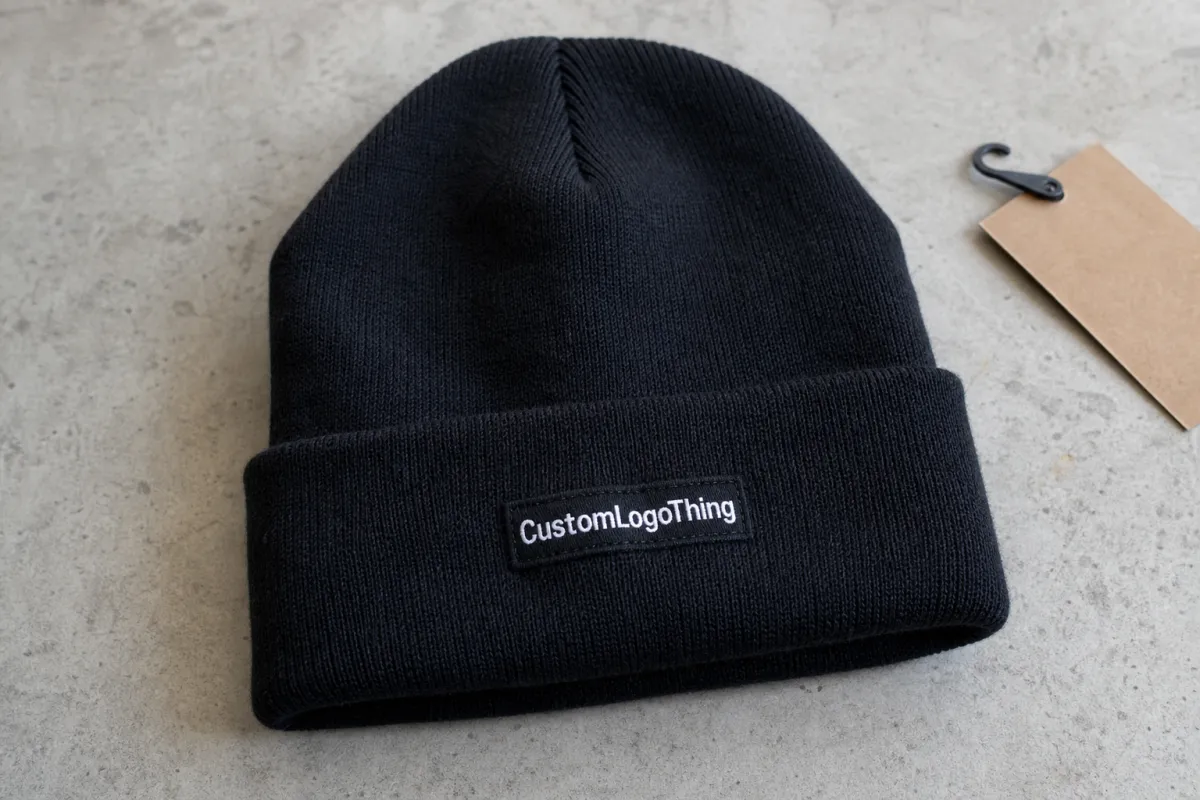
Material and Sizing are not separate decisions. They affect each other the second embroidery enters the picture. A knit that feels soft in the hand can behave badly once thread and stabilizer get involved. A tighter knit may feel less plush but usually gives the needle a firmer surface and keeps the design readable. That tradeoff decides most of the outcome before the first sample is even stitched.
The usual material options are predictable, but the differences matter in production:
- Acrylic: the most forgiving for embroidery, usually stable, warm, and cost-effective.
- Acrylic-wool blend: richer handfeel and better warmth, though it needs tighter stitch control.
- Cotton: breathable and comfortable, but less common for heavy cold-weather use.
- Recycled yarns: useful for sustainability goals, with quality that can vary more than the sales sheet suggests.
For embroidery, compact rib knit usually wins. It gives the thread a consistent surface and keeps small details from disappearing into the fabric. A chunky or very loose gauge can look good unbranded, but it makes the needle work harder and the design look rougher. Fine text is usually the first casualty. Then borders. Then the clean outline that looked so good in the mockup.
Backing matters too. Stabilizer is not optional. It keeps the knit from stretching out of shape under the needle and helps the logo sit on top of the fabric instead of sinking into it. Underlay matters just as much. Without it, tension gets messy and the edges of letters start to round off. On a textured blank, that tiny change is enough to make a logo feel unfinished.
A useful buyer shortcut: choose the knit that supports the logo, not the one that just feels nicest on a shelf. A softer yarn can be a fine choice if the artwork is simple and the fit range is generous. It is a poor choice if the design depends on sharp edges, tiny type, or a dense fill.
How the Knit and Stitch Structure Change the Final Look
Rib knit beanies are popular because they behave well. The vertical channels give controlled stretch and a decent amount of recovery, which helps embroidery stay legible after the hat is worn a few times. Jersey-knit styles can work too, but they are less forgiving if the logo is large or packed with detail. The looser the structure, the more the stitches have to fight for visibility.
Yarn choice changes the final read. Acrylic is usually the safest path because it behaves consistently across runs and holds shape well enough for standard embroidery. Wool blends can feel more premium, but the surface texture is less forgiving if the design has thin outlines or tight lettering. Cotton breathes better, which is useful for milder climates or indoor wear, yet it does not always give the same winter feel or stretch recovery. Recycled yarns can be excellent, but the lot-to-lot consistency has to be checked. That part gets glossed over in marketing copy all the time.
Thread selection matters more than most buyers expect. Polyester thread gives strong color and good durability. On darker beanies, it can pop cleanly. On soft or loose knits, very glossy thread can exaggerate every small pull in the fabric. Matte-leaning thread often reads better on premium pieces because it looks less shiny and less synthetic. Neither is automatically right. The blank decides a lot of that.
Stitch density is the final balancing act. Too dense, and the embroidery turns stiff. Too open, and the logo looks thin and unfinished. The sweet spot depends on fabric weight, logo size, and placement. A simple icon can usually take a cleaner, lighter sew-out. Small text and fine borders need more control, or they will fill in faster than anyone wants to admit.
A good embroidered beanie should read clearly from a few steps away and still feel comfortable after a full wear. If it only works in a polished mockup, the spec is not finished.
The practical rule is plain: use tighter knits for smaller logos, use heavier blanks for larger stitched areas, and avoid ultra-plush or very loose yarns unless the sample proves they can hold detail. That one test saves a lot of expensive disappointment.
Size, Fit, and Stretch: What Buyers Need to Measure
Head circumference matters more than the size label. A generic unisex fit sounds convenient until the order lands on real heads. Then the truth shows up fast. Measure around the head about one inch above the eyebrows and ears. That gives a much better picture than the phrase one-size-fits-most, which usually means one-size-fits-some.
As a general benchmark, many adult beanies are built for roughly 21.5 to 23.5 inches of head circumference, with extra stretch depending on the knit. Youth fits often sit closer to 19 to 21.5 inches. Oversized or slouch styles can run wider, sometimes up to 23 to 25 inches, but they need more crown depth and better recovery or they start hanging badly after a few wears.
The shape matters as much as the circumference. Check these details:
- Cuffed beanies: usually sit more securely and give a stable panel for embroidery.
- Cuffless beanies: look cleaner, but placement has less room to breathe.
- Crown depth: determines whether the hat sits shallow, standard, or slouchy.
- Stretch recovery: shows whether the beanie springs back or stays bagged out.
A beanie that looks perfect laid flat can still fit badly on a head. That is the trap. The embroidery adds structure, which can make a soft blank feel tighter at the front than the buyer expected. Some blends relax after washing. Some recover well and stay neat. If the order is tied to a launch, season start, or uniform rollout, a washed and worn sample is worth more than another polished mockup.
For buyers building a real embroidered beanies material and sizing guide, the right question is not just “Will this fit?” It is “Will this still fit after decoration, wear, and one wash?” That is the question that keeps returns down.
Embroidery Process, Lead Time, and Turnaround
The production sequence usually stays the same. First comes digitizing, where the artwork is converted into a stitch file. Then the placement is checked with a proof or mockup. After that comes a sample or stitched photo for approval. Only then should the full run begin. Final inspection belongs at the end, and it needs more than a quick glance. Thread breaks, tension issues, and off-center placement tend to show up when the checks get rushed.
Stitch count affects timing more than buyers usually expect. A simple one-color logo with 4,000 to 6,000 stitches can move fairly quickly. A multi-color crest with 10,000 to 15,000 stitches takes longer, especially if the design includes small text or tight borders. More colors mean more thread changes and more chances for minor misalignment. That is not drama. It is just production.
Typical timing, assuming blank stock is available:
- Digitizing and proof: 1 to 3 business days.
- Sample approval: 3 to 7 business days.
- Production run: 10 to 15 business days for straightforward orders.
- Rush turnaround: sometimes 5 to 7 business days, if the queue and stock line up.
Most delays happen in predictable places: proof approval, low stock, or a logo file that needs to be redrawn because the source image is too small. None of that is glamorous. All of it is normal. If the order ships in retail packaging, ask for packout expectations early. Transit testing standards from ISTA are useful when cartons, mailers, or inserts need to survive real handling. If the packaging uses paperboard and sustainability claims matter, FSC certification is worth checking.
Beanies are often packed in kraft tissue, folded into corrugated cardboard cartons, or bundled with hang tags and insert cards. Recycled materials are easy to specify if the brand wants less plastic. Biodegradable options can work, but they should be chosen because they protect the product and fit the run, not because the label sounds better in a pitch deck.
Cost, Pricing, MOQ, and Unit Cost
Pricing breaks into pieces that are easier to control than most quote sheets make it look. Blank cap cost. Embroidery setup. Stitch count. Thread colors. Packaging. Once those items are separated, the quote stops feeling random. Small orders cost more per unit because the setup is spread across fewer pieces. That applies to hats, boxes, sleeves, and most other decorated products. The machine does not care that the order is small.
MOQ matters because embroidery setup takes real time. Even a simple run needs digitizing, thread setup, test tension, and machine loading. If the order is only 24 pieces, the supplier still has to do most of the same work as if the order were 200. That is why tiny runs can feel expensive. The unit cost usually drops once the volume is large enough to spread setup across the run.
| Tier | Blank / Material | Typical Stitch Count | MOQ | Typical Unit Cost at 100 | Typical Unit Cost at 500 |
|---|---|---|---|---|---|
| Budget | Basic acrylic rib knit | 4,000-6,000 | 50 | $4.00-$5.50 | $2.20-$3.20 |
| Mid-tier | Heavier acrylic or acrylic-blend | 6,000-8,000 | 50 | $5.00-$6.75 | $3.00-$4.25 |
| Premium | Wool blend or recycled yarn beanie | 8,000-12,000 | 100 | $7.50-$10.50 | $4.75-$6.75 |
If the order includes folded inserts, belly bands, or mailer boxes, add roughly $0.20 to $0.80 per unit depending on paper stock and print coverage. Kraft paper sleeves are usually cheaper than full-color presentation boxes. A simple FSC-certified insert can sit in the middle. For low-impact packouts, corrugated cardboard and paper-based wraps are usually easier to execute than mixed-material packaging. That kind of simplicity tends to survive production without turning into a headache.
The fastest way to keep cost under control is to simplify the spec before asking for quotes. Choose a stable blank, keep the stitch count reasonable, and avoid unnecessary thread changes. If the beanie is a premium retail piece, spend more on the yarn and fit. If it is a giveaway, keep the embroidery clean and the packout plain. If it is a uniform, prioritize consistency. The best price usually follows the clearest spec.
Common Material and Sizing Mistakes to Avoid
The first mistake is choosing the softest yarn in the lineup and assuming embroidery will sort itself out. It usually does not. Lofty, plush, or oversized knits can look rich in a photo and still swallow the logo once the stitches land. Buyers often fall for handfeel first, then wonder why the mark looks fuzzy. The fabric was always the problem. It just waited until production to say so.
The second mistake is lazy sizing. One-size-fits-all can work if the audience is narrow and the knit has real recovery. It is a poor choice for youth programs, mixed retail groups, or staff uniforms with different head sizes. In an embroidered beanies material and sizing guide, fit is not an extra detail. It decides whether the hat stays wearable after embroidery adds structure to the front panel.
Other misses show up again and again:
- Oversized logos: too much thread can stiffen the front and distort the knit.
- Poor placement: crowding the cuff makes the design look cramped.
- No sample: skipping the test run is the fastest way to create avoidable mistakes.
- No wash check: some fabrics relax, pucker, or shift after laundering.
Packaging can create problems too. If hats are packed too tightly in cheap mailers, the embroidery can pick up pressure marks. A properly sized shipper or a corrugated cardboard carton gives the finished product room to breathe. Packaging is part of the product experience, but it is also part of the protection plan. Ignore that, and the hats arrive looking tired before anyone wears them.
Expert Tips for Better Fit, Finish, and Readability
Use thread contrast with restraint. Strong contrast helps the logo read from a distance, but neon-on-neon is not a strategy. A deep navy beanie with white thread usually reads better than a barely visible tone-on-tone combo. If the brand wants subtlety, choose a slightly darker or lighter thread rather than a near-invisible match. On knitwear, the eye needs help more than most designers expect.
Placement matters more than people think. Front-centered embroidery is still the standard because it is clear and easy to wear. Cuff-edge placement gives a cleaner retail look and keeps the logo visible even when the beanie is folded. Side placement works for understated merch or when the front needs to stay open for a label or patch. Pick one intention. Mixing them usually makes the piece look undecided.
Ask for a digitized proof or a stitched photo sample before full production. That one request saves money and time. It shows whether the text is too small, the border fills in badly, or the artwork needs to be widened a few millimeters. A good supplier should be able to flag when the design needs a larger sew-out area, a simpler font, or a denser underlay. If they cannot explain that, the order is already under-managed.
Tiny lettering is where most beanies fail. Make it bigger. Reduce density on stretchier blanks. Most embroidery issues are fixable before production. After production, they are just expensive.
There are four checks I would keep in front of any buyer:
- Audience: premium retail, staff, team, or giveaway.
- Climate: cold weather, mild winter, indoor wear, or outdoor use.
- Fit tolerance: strict sizing, mixed heads, or flexible one-size.
- Brand goal: subtle, classic, or highly visible.
That framework clears up most decisions quickly. A premium retail drop can justify a better yarn, deeper crown, and more polished packaging. A corporate giveaway should stay simple and durable. A sports team needs stretch and recovery before anything else. The right answer is the one that matches the actual use, not the mood board.
Next Steps: Spec the Order and Lock the Right Fit
If the order still needs to be written, keep the spec tight. Choose the material. Confirm the size range. Define the embroidery placement. Approve the proof before production starts. That is the job. Everything else is decoration on top of the decision. If the order is important, expensive, or tied to a launch date, ask for a sample swatch or stitched photo before you sign off.
For packaging, use the same practical standard. Kraft paper tissue, an FSC-certified insert card, and corrugated cardboard shipping cartons made from recycled materials are usually enough for most runs. If the brand wants lower-impact packaging, ask exactly which materials contain post-consumer waste content and which parts are just branded paper. That question separates real sustainability choices from decorative claims pretty fast.
Three clean paths usually cover most orders:
- Budget-friendly: acrylic blank, modest stitch count, simple packaging.
- Balanced: better knit, cleaner embroidery proof, branded insert.
- Premium: upgraded yarn, tighter fit spec, polished sleeve or presentation box.
That is the practical version of an embroidered beanies material and sizing guide: choose a blank that supports the stitch, verify the fit on a real head, and confirm the finish before the run starts. Once those pieces are locked, the order tends to behave. Before that, it is just guesswork with a purchase order attached.
What is the best material for embroidered beanies?
Acrylic and acrylic-blend beanies usually give the best balance of warmth, stretch, and embroidery stability. Wool blends can feel more premium, but they need tighter stitch control and are less forgiving on small logos. Very loose knits and ultra-soft yarns often look good on a hanger but can distort the embroidery after wear.
How do I choose the right size in an embroidered beanie sizing guide?
Measure head circumference and compare it to the supplier's fit range instead of assuming one-size-fits-all will work. Check crown depth and cuff style, because those details change how the beanie sits far more than the label does. For mixed groups, choose a style with better stretch recovery or request size samples before a larger order.
Does embroidery make a beanie tighter?
It can, especially if the logo is large, dense, or placed on a tighter knit with limited recovery. Proper stabilizer, stitch density, and placement help keep the beanie from feeling stiff or pulling out of shape. If fit is critical, test one sample before committing to full production.
What affects embroidered beanie pricing the most?
The biggest drivers are material quality, embroidery stitch count, logo complexity, and order quantity. Setup costs matter more on small runs, while larger runs usually lower the unit cost. Special packaging, rush production, and extra thread colors can push the price up fast.
How long does production usually take for embroidered beanies?
Simple orders often move faster, but proof approval, stock checks, and embroidery queue time still control the schedule. Complex logos and larger quantities usually need more lead time than buyers expect. If the delivery date matters, ask for the full timeline in writing before you approve the order.


