Boutique Paper Bags Material and Sizing Guide for Buyers
A Boutique Paper Bags material and sizing guide is useful because the bag has to do more than look polished. It needs to fit the product, hold its shape, carry comfortably, and survive real handling at checkout and in transit from store to customer.
The main decisions are practical: size, paper stock, handle type, reinforcement, decoration, and price. A bag that looks right in a mock-up can still fail if the gusset is too tight, the top fold is weak, or the handle placement is off by even a little.
Good bag buying is usually about fit and durability first, then finish. That order helps buyers avoid spending on details that do not improve the actual user experience.
Why Half an Inch Can Change the Whole Bag Feel
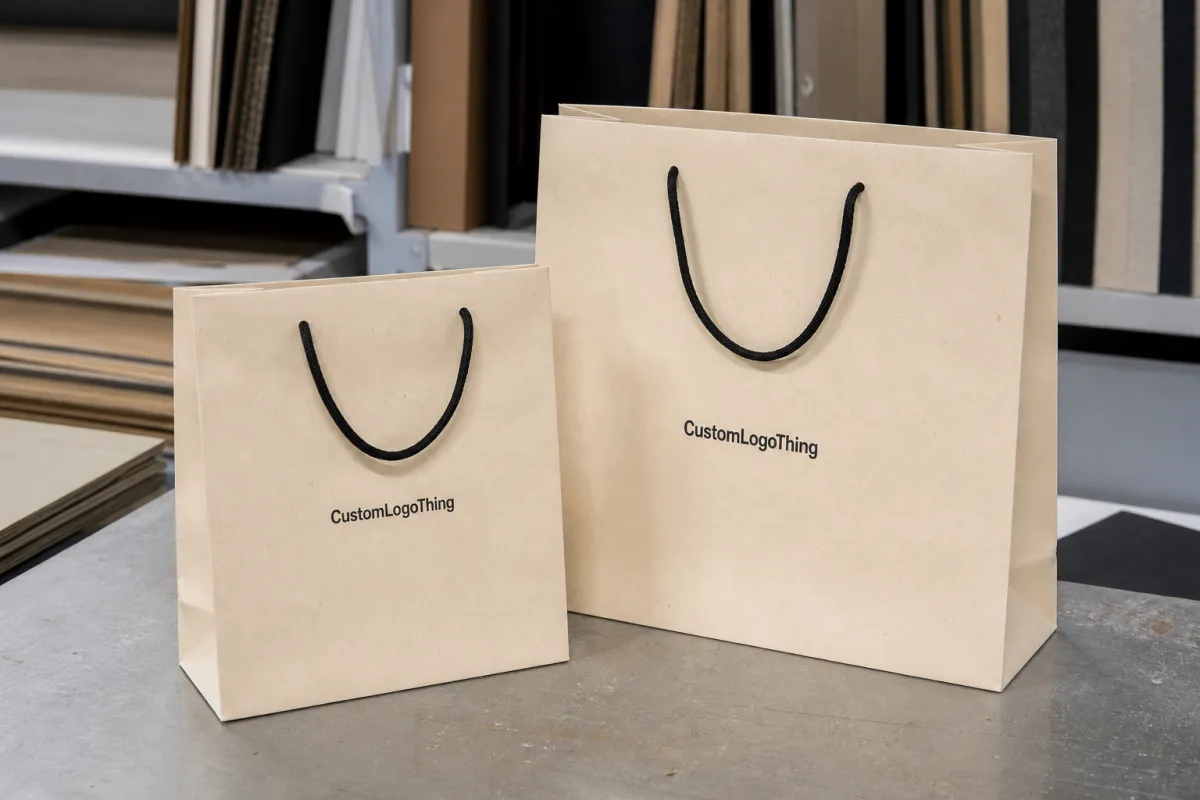
A bag can look spacious on paper and still feel cramped once the product goes in. A bottle needs vertical clearance. A rigid box needs side room. Folded apparel needs width more than height. Add tissue, and the available space disappears fast.
That is why small dimension changes matter. A wider gusset can stop a gift set from bowing the side panels. A slightly taller bag can keep the handle from cutting into the product. A little more paper weight can keep the top edge from curling after a few packing cycles.
Premium finishes help presentation, but they do not fix a poor structure. If the bag collapses on the counter or leans under load, the finish does not rescue it.
A good boutique bag does not announce itself. It just makes the product feel more expensive before the customer even opens it.
Boutique Paper Bags Material and Sizing Guide Basics
At the production level, the core dimensions are face width, gusset, height, paper stock, and handle style. Sizes are usually written as width x gusset x height. So a 10 x 4 x 12 bag has a 10-inch front panel, a 4-inch side depth, and a 12-inch height.
That is only the starting point. Folds, top turns, handle patches, board inserts, and glue seams all reduce usable space. Two bags with the same printed size can behave differently once they are loaded.
Paper stock changes more than many buyers expect. Kraft paper gives a natural look and works well with simple print coverage. Coated art paper delivers cleaner color, sharper typography, and stronger contrast. Recycled board supports a visible material story, but brightness and texture can vary more than virgin fiber stock.
If sustainability language matters, be precise. FSC certified paper supports sourcing claims. Recycled content supports a material story. Neither automatically makes the finished bag recyclable everywhere, especially if you add heavy lamination, foil, plastic windows, or coatings that complicate recovery.
For customer-facing boutique bags, corrugated cardboard is usually the wrong structure. It belongs in the shipper, not the shopping bag. The boutique bag should feel refined and easy to carry, while the transit carton does the heavy lifting.
Paper weight should match the load. Light accessory bags often work around 150 to 180 gsm. Boxed cosmetics and gift sets often need 200 to 250 gsm with reinforcement. Premium retail bags can move into 300 gsm and above when the base, top fold, and handles all need to stay crisp.
What Material Choices Do to Strength and Print Quality
Material affects more than look and feel. It changes how the bag stands, how the ink sits, and how well the finish hides scuffs. A stiffer board helps a bag hold its shape. A smoother surface improves print detail. A coating can make colors richer, but it can also add cost and complicate recycling if the build gets too layered.
Print quality follows the stock. On kraft, dark solids and simple logos usually look best because fine detail can disappear into the texture. On C1S or C2S art paper, color blocks, linework, and small typography stay cleaner. Recycled stock works well for brands that want a visible environmental story, but expect a little more variation from run to run.
Handle style matters just as much as the sheet itself. Twisted paper handles are common for lighter bags. Rope handles feel more substantial in the hand and can improve comfort for midweight loads. Ribbon handles read as premium, but they need clean attachment and strong top reinforcement.
The weak point is often not the print. It is the handle fold, glue line, or base. For boxed products, glass, or multi-item sets, ask for handle patches, top reinforcements, and a base board. Those details often do more for performance than moving to a heavier stock alone.
Testing should match real use. Many teams borrow from ISTA distribution thinking and pair it with simple burst or tensile checks to catch weak points early. A bag that survives the counter should also survive a car ride and a day of carrying around.
If the handle attachment is weak, the bag is weak. The surface finish does not change that.
How to Measure the Right Bag Size for Your Product Mix
The cleanest way to size a bag is to start with the actual product, not a generic bag chart. Measure the widest point, the deepest point, and the tallest point. Then add room for tissue, inserts, closures, and enough breathing space so the sides do not bulge.
For folded apparel, use the garment or box dimensions first. For bottles, height matters, but gusset depth usually causes the biggest problems. Too narrow and the bottle tilts or pinches the neck. Too wide and the bag wastes paper and looks oversized. For gift sets, the goal is balance: enough room for the items to sit centered, not lean into one side.
A practical spec process looks like this:
- Heaviest item: size the bag for the heaviest product first.
- Most common item: make sure the everyday seller fits cleanly with tissue or inserts.
- Presentation standard: leave enough room for the bag to close neatly and stand up straight at checkout.
A good Boutique Paper Bags material and sizing guide becomes more useful when you test it against the real mix. A 9 x 4 x 12 bag might work for a single folded sweater. Put a boxed candle in it with tissue, and it can feel tight fast. A 12 x 5 x 16 bag solves the fit problem, but it may cost more and look oversized on the sales floor. The best bag spec usually comes from the hardest case, then gets checked against the everyday one.
Boutique Paper Bag Cost Factors, MOQ, and Unit Cost
Paper bag pricing is driven by a small set of levers: paper stock, size, print coverage, finish, handle type, reinforcement, packaging format, and freight. A simple kraft bag with one-color print and twisted handles sits in a very different cost band from a heavy artboard bag with soft-touch lamination, foil, ribbon handles, and a reinforced base.
MOQ usually lands around 1,000 to 3,000 pieces for custom boutique runs, though some suppliers quote lower or higher depending on the build. Higher volume usually lowers unit cost because setup, plates, and press time get spread across more bags. The jump between 1,000 and 5,000 pieces can be meaningful if the structure is already settled.
| Build Type | Typical Spec | Best Use | Approx. Unit Cost at 3,000 pcs |
|---|---|---|---|
| Natural kraft bag | 150-180 gsm kraft, twisted paper handles, limited print | Light apparel, accessories, simple retail kits | $0.24-$0.40 |
| Coated boutique bag | 200-250 gsm C1S, matte lamination, rope handles | Beauty, gifts, boxed merchandise | $0.45-$0.80 |
| Premium gift bag | 300-350 gsm artboard, soft-touch finish, ribbon handles, reinforcement | Luxury retail, seasonal gifting, heavier items | $0.85-$1.40 |
Those numbers are starting points. Artwork coverage, spot UV, foil, embossing, custom handle imports, and special inserts can move pricing quickly. Freight matters too. Flat-packed bags ship more efficiently than bulky builds. Oversized or highly finished bags can add cost before they reach the shelf.
The lowest quote is not always the best project. A slightly higher unit price on a better-fitting size can save money by reducing sampling rounds, packaging waste, and complaints from store staff who have to work around a poor fit all day.
Artwork, Sampling, and Production Timeline
A clean timeline usually starts with a one-page spec sheet, then moves to a dieline, proof, sample, approval, press setup, finishing, and final packing. If the build is standard and the artwork is straightforward, the process moves quickly. If the bag uses a new size, unusual handle type, or special finish, expect more back-and-forth.
This is another place where a Boutique Paper Bags material and sizing guide helps. Better specs mean fewer revisions. Fewer revisions mean less time between proof approval and full production. In a typical run, sampling can take about 5 to 10 business days, and production after approval often lands around 12 to 15 business days, not counting freight. Special coatings or custom structural changes can add time.
The safest schedule works backward from the in-store date. Leave room for design review, sample handling, and one or two rounds of adjustments. A screen proof is not enough. The first physical sample is usually where sizing issues show up, especially around gusset depth, handle placement, and top fold height.
If sustainability claims matter, verify them during approval. Confirm the exact paper content. Check whether the stock is actually FSC certified. If the line will be marketed as recyclable or biodegradable, make sure coatings, laminations, adhesives, and decorative elements do not conflict with that claim. Marketing language moves faster than materials do, so the paperwork has to keep up.
Common Sizing and Material Mistakes to Avoid
One common mistake is sizing to height and forgetting the gusset. That creates a bag that looks right on paper and fails in use. The side walls push out, the product sits crooked, and the bag stops looking premium the second it gets packed.
Another mistake is choosing paper that looks good in a sample but cannot hold a real load. Thin stock can carry print. It cannot always carry a brand experience. If the bag will hold boxed goods, glass, or multiple items, the top fold and handle attachment need enough strength to survive repeat use.
Overbuilding causes trouble too. Buyers sometimes assume heavier paper and more finishes automatically mean better quality. Not always. If a 200 gsm coated bag with reinforcement already handles the load, moving to 350 gsm may only make the bag stiffer, more expensive, and harder to fold cleanly.
Operational mistakes show up later. Bags that are too tall may not fit storage cubbies. Bags that are too narrow may slow packing during rush periods. Bags that are technically strong but uncomfortable to carry still create complaints, because customers notice handle feel every time they leave the store.
The easiest fix is boring, but it works: treat the Boutique Paper Bags material and sizing guide as a working spec, not a sales sheet. Measure the product. Test the actual build. Check comfort, fit, and stackability before placing the order.
Expert Tips for Specing Your Bags
Start with one page: product dimensions, target quantity, print coverage, handle style, finish, reinforcement needs, and the environment the bag will live in. A bag for a quiet jewelry counter does not need the same build as a bag that will carry boxed goods across a busy pop-up floor.
Then ask for a physical sample or mock-up against the real product mix. That check tells you fast whether the gusset is wide enough, whether the top fold stays straight, whether the handles feel comfortable, and whether the bag still looks premium once tissue or inserts go in.
A simple decision path keeps the project moving:
- Confirm the heaviest item and the most common item.
- Choose the paper stock based on weight, print quality, and brand feel.
- Set the bag size around the product with room for tissue or inserts.
- Compare pricing at your target quantity and the next tier up.
- Review sample, timeline, and freight before final approval.
That process cuts out a lot of guesswork. The best bag is not the loudest one on the mock-up sheet. It is the one that fits correctly, holds its shape, carries comfortably, and stays within the cost target.
That is the point of a boutique paper bags material and sizing guide: it turns a decorative packaging buy into a practical spec. One that can support kraft paper for a natural brand story, FSC certified stock for sourcing alignment, or a more finished coated build for premium retail presentation.
FAQ
How do I choose the right paper weight for boutique paper bags?
Match paper weight to the heaviest item, not just the average item. For boxed goods, glass, or multi-item sets, heavier stock or added reinforcement usually performs better than a decorative finish alone.
What size boutique paper bag works best for folded apparel?
Size the bag around the folded garment plus tissue or inserts, then check the gusset so the fold stack sits flat instead of forcing the panels open. If the apparel is boxed or bundled, use the box dimensions as the main reference.
Which handle style is most durable for boutique retail bags?
Twisted paper handles work well for lighter to midweight loads, while rope or ribbon handles can feel more premium and improve carrying comfort. For heavier products, the attachment point and top fold need reinforcement.
How does MOQ affect the unit cost of custom paper bags?
Higher quantities usually lower unit cost because setup, plates, and press time are spread across more bags. If cash flow is tight, ask where the price breaks occur so you can compare a smaller run against the next volume tier.
How long does sampling and production usually take for boutique paper bags?
Sampling often takes 5 to 10 business days, and production after approval often takes around 12 to 15 business days, not counting freight. Add buffer time if the project needs a new dieline, special coating, or custom hardware.


