If the brief is winter visibility, an event merch Jacquard Knit Beanies quote is usually the right first move. Jacquard knitting puts the logo into the fabric itself, so the artwork does not sit like a sticker or a patch waiting to peel, crack, or fray. That matters for game days, festivals, sponsor giveaways, staff uniforms, and holiday drops, where the beanie has to survive packing, folding, and repeat wear.
What separates a decent promo piece from one that actually stays in circulation is usefulness. A beanie solves a cold-weather problem, which gives it a better shelf life than many event items that look good on a table and disappear by Monday. The price, however, is only part of the story. The quote will shift based on yarn type, stitch density, cuff height, finishing details, and how much visual complexity the artwork asks the machine to carry.
That is why buyers who know what they want tend to get cleaner pricing. A vague brief invites a vague response. A tight spec gives the supplier enough information to price the knit correctly, separate the decoration from the product cost, and avoid the awkward back-and-forth where everyone discovers the missing details after the clock has already started.
Why event merch jacquard knit beanies work for winter activations
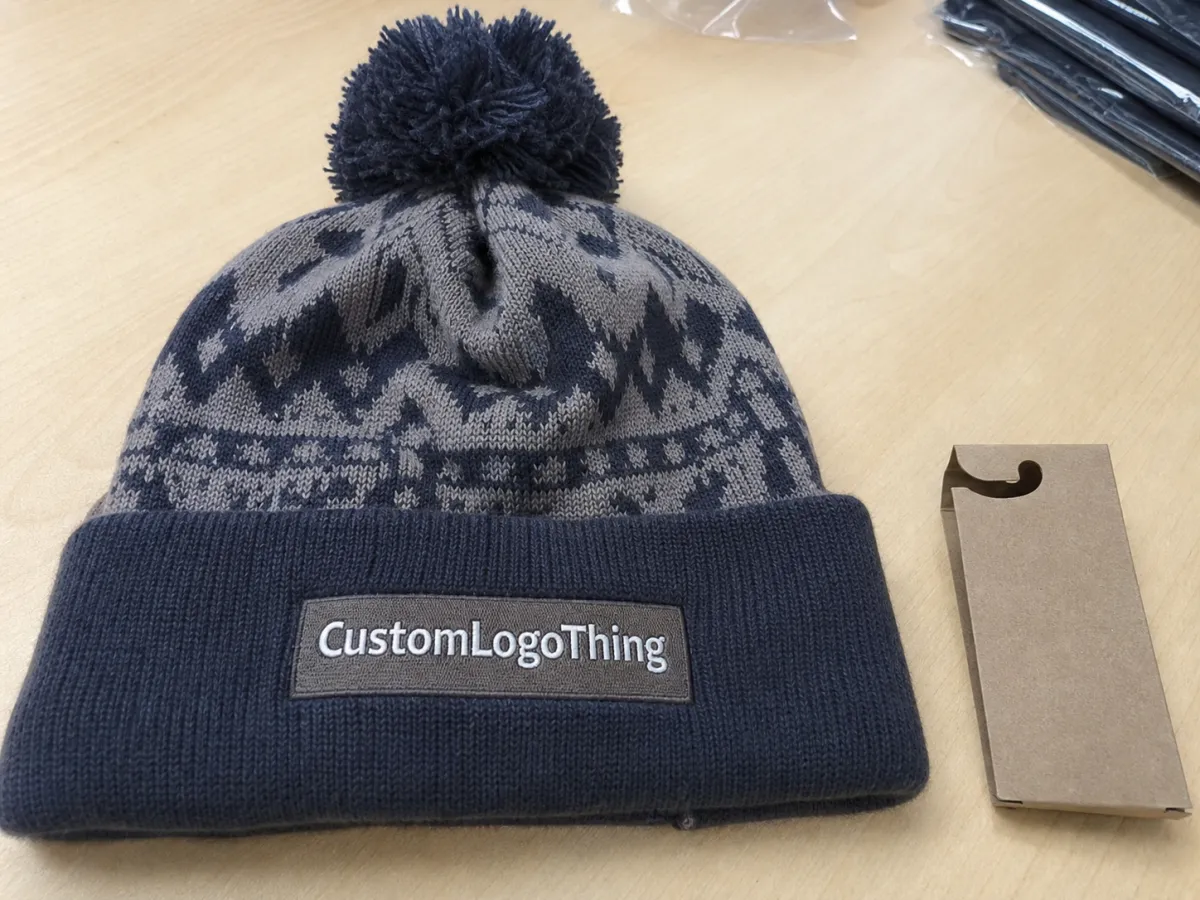
Jacquard knit is not decoration on top of the beanie; it is part of the structure. That difference sounds small until you look at how event merchandise gets used. Beanies get stuffed into bags, stretched over hair, folded into pockets, and worn in bad weather. A knitted-in logo tends to hold up better than surface decoration because it flexes with the garment instead of sitting apart from it.
The other advantage is control. Jacquard can carry a clean logo, a repeated motif, a date-free graphic, or a stripe system without turning the beanie into a walking banner. Good knit design has range. From far away, it can read as a strong brand block; up close, it can show a texture and pattern that make the piece feel more considered than a standard giveaway.
That matters for event merch because the item is often photographed more than it is examined. Attendees post it, staff wear it in recap content, and sponsors use it as proof the activation reached the street. A flat patch can work, but a knit pattern usually photographs with more depth and less glare. It also avoids the common problem of embellishment that looks crisp in a mockup and slightly awkward on a real head.
There is a practical retention angle too. People keep winter accessories because they have a use beyond the event. That alone raises the odds of repeat impressions. A giveaway that leaves the venue and returns on later mornings is more valuable than one that gets retired as soon as the program ends.
For buyers comparing product types, the benefit is not just perception. Cuffed jacquard beanies give you a clear decoration zone, a built-in place for a primary mark, and enough structure to hold shape in transit. That balance is hard to replicate with cheaper knit caps that sag, twist, or lose the logo once they are worn.
Material and decoration choices that shape the finished look
Yarn choice drives more of the final result than many first-time buyers expect. Acrylic is still the default workhorse because it is relatively affordable, easy to source, and forgiving during production. It holds color well, which makes it the common starting point for budget-conscious event programs. In the price bands below, the basic acrylic build is usually the lowest entry point.
Wool-blend yarn changes the feel immediately. It usually reads warmer, softer, and more premium in hand, although it also tends to push the unit cost up. On the sample table, that upgrade adds roughly $1.50 to $2.00 per piece at 500 units compared with a basic acrylic cuffed jacquard. For some briefs, that is worth it. For a large attendee giveaway, it may be more than the budget can justify.
Recycled yarn can be a smart middle ground when sustainability language is part of the event story. It often pairs well with paper-based hang tags, recycled packaging, or FSC-certified inserts. The result is not only a greener material claim; it also gives the brand a cleaner explanation for why the piece was made the way it was. Buyers should still check the fiber blend, because “recycled” can describe different inputs and hand feels depending on the mill.
Knit gauge is the other piece that changes how the design lands. Finer gauge knits handle small lettering and thin lines better, but they can feel a little denser. Looser gauges look more relaxed and heritage-inspired, though they are not the best choice if the logo depends on crisp edges. A 6-color pattern that looks tidy on a mockup may become busy on a loose knit, while the same art can feel sharp on a tighter structure.
Cuff height deserves more attention than it usually gets. A tall cuff creates a bigger decoration zone and keeps the logo in view when the beanie is worn properly. A shorter cuff feels lighter and more casual, but it can bury the mark if the placement is not set carefully. For staff wear, cuff height should be judged against how the logo sits on a moving head, not just how it looks laid flat on a spec sheet.
Finishing details add polish, but they also change the production math. Woven labels, sewn-in care tags, pom-poms, custom hang tags, and branded packaging each add a step. Some are worth it. Some are just extra noise. A woven label can clean up the presentation on a premium order; a pom-pom can help a retail-style design feel complete; a bulky tag on a low-cost giveaway may only add expense without improving the item.
A quote that separates yarn, stitch density, decoration, packaging, and freight is worth far more than a single bottom-line number. If those pieces are bundled together, you are comparing estimates, not actual pricing.
Shipping and carton prep matter too, especially when the beanies are going out with other promo items. If the order is part of a bigger activation, ask how the cartons are packed, whether the supplier can stage multiple drops, and whether transit protection has been tested against common freight handling standards such as those described by ISTA. That is not overkill. It is how you avoid arriving with a perfect product and crushed presentation.
Feature comparison for common builds
| Build | Typical MOQ | 500 pcs | 1,000 pcs | Best fit |
|---|---|---|---|---|
| Basic acrylic cuffed jacquard | 100-300 | $4.20-$5.80 | $3.40-$4.90 | Large giveaways, staff wear, budget programs |
| Acrylic-wool blend with woven label | 200-500 | $5.80-$7.90 | $4.60-$6.80 | Premium event merch, retail-style presentation |
| Recycled yarn with custom trim and hang tag | 300-500 | $6.40-$8.50 | $5.10-$7.20 | Brand programs with sustainability requirements |
Those ranges are useful only if they are read as a pattern, not a promise. More colors usually mean more machine time. Higher stitch density can push the labor up. Custom packaging and extra trim are small individually, but they add up fast once the order becomes a full event kit. The real lesson is that the visual brief and the price are tied together from the beginning, not after the fact.
Fit, sizing, and specification details to lock before ordering
The first question is not the color. It is who wears the beanie and how often. Adult one-size fits most event merch programs, but not every audience behaves the same way. Staff wear usually wants a dependable, stay-put fit. Attendee giveaways may need more stretch and a less restrictive crown. Youth sizes, oversized fits, and fashion slouch models all change the production approach.
Body height, cuff depth, and crown shape should be locked before proofing starts. These dimensions affect both comfort and brand placement. A shallow cuff can crowd the logo; a taller crown can make the beanie sit slouchy even if the art is correct. Buyers often focus on color first, yet a 3 mm or 5 mm change in cuff structure can matter more than one extra yarn shade.
Placement should be settled with equal care. Cuff placement is the most common because it is clean, readable, and easy to align with a logo. Side-panel placement can feel more fashion-driven and less like standard promo merchandise. Crown placement can work, but it tends to reduce readability when the design is too detailed or the knit tension varies across the cap. All-over repeats can look excellent, though they require more stitch planning and usually cost more.
PMS references help, but yarn is not print ink. The match will be close, not identical, and heathered yarns or marl effects introduce even more variation. That is normal. Knit color reads by contrast, texture, and light rather than by flat surface coverage. In practice, the safest route is to favor strong pairings and simple combinations if the logo has to stay legible in photos from a distance.
There is also a use-case difference that gets missed in early quoting. A crew beanie for staff should be easy to reorder, simple to inspect, and durable enough to survive long shifts. A VIP beanie can justify better yarn hand feel, a woven label, or a more refined presentation. A giveaway for a cold-weather crowd needs comfort and volume control more than luxury details. Matching the spec to the audience keeps the budget from drifting into the wrong feature set.
Pricing, MOQ, and quote variables that change unit cost
MOQ is usually tied to setup time, yarn sourcing, stitch programming, and the number of color changes in the design. A low minimum is not automatically a bargain. Sometimes it simply means the supplier has simplified the build, reduced the decoration, or pushed the design into a narrow spec that no longer matches the original idea. If the order looks unusually cheap, ask what was removed to get there.
Unit cost usually drops as quantity rises because the setup burden is spread across more pieces. That is why it makes sense to request several breakpoints in the same event merch Jacquard Knit Beanies quote. A 250 / 500 / 1,000 comparison can reveal whether a modest increase in volume unlocks a better cost position. On knit goods, those changes can be meaningful enough to alter the whole order plan.
Five variables tend to move the price most:
- Color count - more yarn changes usually mean more machine time and more chances for complexity.
- Stitch density - tighter knits can improve detail but take more programming and production time.
- Yarn type - acrylic, wool-blend, and recycled options rarely land at the same cost level.
- Finishing details - labels, pom-poms, hang tags, and packaging add both labor and materials.
- Rush and freight - compressed schedules or split delivery plans can increase the total quickly.
Good quoting makes those variables visible. If a supplier gives only one number and no breakdown, it is hard to know whether the price is genuinely competitive or just incomplete. Clear line items also make it easier to compare vendors without getting tricked by a low headline rate that grows once packaging, setup, or shipping is added later.
Freight deserves its own line because it changes the story. A beanie quoted at $4.80 before shipping may cost more than one quoted at $5.10 with freight, labeling, and carton prep already included. Comparing like with like is less glamorous than chasing the lowest unit price, but it prevents bad decisions.
Process, proofing, and lead time from art to delivery
Start with a clean vector file. A knit machine cannot make sense of a fuzzy screenshot, and small type can disappear fast once it is converted into stitch notation. Thick outlines, simple shapes, and strong contrast survive knitting far better than delicate details. If the logo depends on tiny serifs or a thin tagline, it may need to be simplified before production can hold it cleanly.
The proof should confirm placement, color choices, dimensions, label treatment, and any packaging element that affects the final presentation. This is where preventable mistakes get caught. Once the knit map is programmed and production starts, even a small change can ripple into yarn allocation, machine time, and finishing. A digital mockup is not decoration. It is the checkpoint that keeps the order from drifting.
Lead time is more than machine time. Yarn sourcing, sample approval, stitch programming, knitting, finishing, inspection, carton prep, and freight all sit in the chain. Simple, stock-yarn programs can sometimes move in roughly 12-15 business days after proof approval if the schedule is clean and the supplier already has the materials on hand. More complex designs, custom yarn matching, or overseas freight can stretch that into 3-5 weeks or more. A buyer who assumes one calendar fits every build usually ends up with a problem.
That buffer matters for launches, conferences, festivals, and tour dates. Approvals stall. Shipping slips. A label revision that sounds tiny can still cost a day or two. The safest schedules build in a margin for normal friction, because custom knit production is rarely perfect from day one.
If branded inserts, care cards, or swing tags are part of the package, ask whether the stock can be FSC-certified. That does not change the beanie itself, but it strengthens the overall presentation and keeps the paper component aligned with the brand story. You can review FSC standards at fsc.org.
What makes a reliable custom knit supplier worth choosing
A reliable supplier gives practical answers before the order is placed. That means clear MOQ guidance, realistic timing, and spec advice that does not pretend every idea is equally easy to make. For event merch, that honesty is useful because the delivery date is usually fixed by an external moment: a game, a launch, a conference, a winter activation, a sponsor reveal.
The better quotes also explain cost differences in plain language. A basic acrylic jacquard beanie should not be priced the same as a wool-blend version with a woven label and custom packaging. The supplier should be able to point directly to the choices that move the cost: yarn, stitch density, color changes, finishing, freight, and any special handling. If the explanation is thin, the quote probably is too.
Quality control is where knit programs can quietly succeed or fail. A decent inspection pass should catch loose threads, uneven cuff tension, off-center placements, color mismatch, and trim issues before the goods are packed. The details sound small until they show up across 500 or 1,000 units. A tiny defect rate on a bulk run can still create a real headache if it lands across multiple event stops.
It also helps when the supplier thinks in systems rather than isolated products. A beanie that looks polished but misses the delivery window is a failure. One that arrives on time but feels flimsy is not much better. The right partner treats audience use, brand visibility, and schedule pressure as connected pieces of the same order.
Reorder readiness is another quiet sign of a mature knit program. If the original spec, yarn references, and proof history are documented well, a second run should not require rebuilding the project from scratch. That is the difference between a one-off production job and a repeatable merchandise program.
How to request an event merch jacquard knit beanies quote and keep the order on schedule
Send the core information together if you want a useful quote quickly. Include the logo file, quantity, target delivery date, color count, cuff preference, and any add-ons such as woven labels, hang tags, or custom packaging. The cleaner the brief, the fewer clarification rounds the supplier needs before pricing.
State the actual use case too. Staff wear, attendee giveaways, and VIP merch are not the same job, even if the logo is identical. The audience tells the supplier whether to prioritize comfort, presentation, or cost control. That single detail often changes the recommended yarn, cuff size, or finishing approach.
Request a mockup that shows placement, cuff height, and yarn colors before production is approved. If you are comparing suppliers, ask for at least two quantities so you can see where the price curve bends. Sometimes the difference between 500 and 1,000 pieces is large enough to justify the bigger run; sometimes it is not. The comparison tells you more than a single number ever will.
Ask for the quote to separate product cost, decoration, packaging, and freight. That one request makes comparisons cleaner and helps avoid surprise charges later. If the order is going to more than one location, say so up front, because distribution planning can alter carton configuration and delivery timing.
The fastest path is still the most organized one: artwork, quantity, date, and use case in the same brief. That gives the supplier enough information to price the beanie accurately, proof it cleanly, and keep the order on schedule without improvising around missing context.
How many event merch jacquard knit beanies should I order?
Order to the size of the audience, then add a buffer for replacements, sizing surprises, and last-minute additions. If the beanies are split across staff, guests, and VIPs, ask for separate quantity lines so the quote reflects each use case clearly.
What do you need to quote custom jacquard knit beanies accurately?
Provide the logo file, target quantity, color references, desired size, delivery date, and any add-ons like labels or packaging. Clear artwork and a simple spec sheet speed up both pricing and proofing.
Can a jacquard knit beanie match my brand colors closely?
Usually yes, but knit yarns are matched to available stock and production tolerance, so the result is a close visual match rather than a print-perfect one. PMS references help, and high-contrast color pairings generally read best in knit construction.
How long does production usually take after proof approval?
Timeline depends on yarn sourcing, knit programming, finishing, and shipping. Simple builds often move faster than complex designs with multiple colors or custom accessories, but it is best to confirm the schedule before approving the art.
What affects the price of event merch beanies the most?
Quantity, color count, knit complexity, yarn type, and added decoration features are the main cost drivers. Rush timing and special shipping requirements can raise the total, so a line-item quote is the easiest way to see where the money is going.


