This guide helps event merch teams judge Clear Garment Bag Samples without getting fooled by a clean product photo. A bag can look fine on screen and still fail in hand: the zipper sticks, the film clouds under bright venue lights, or the garment inside looks crushed instead of ready to present. Sample approval is where those problems get caught before they become rework, rush freight, or a late-night packing problem.
For buyers, the sample is a practical checkpoint. It should answer whether the bag fits the item, protects it, presents it clearly, and speeds up handling. If the sample does not prove those basics, the spec is not ready for bulk production.
Clear Garment Bag Sample Approval Basics
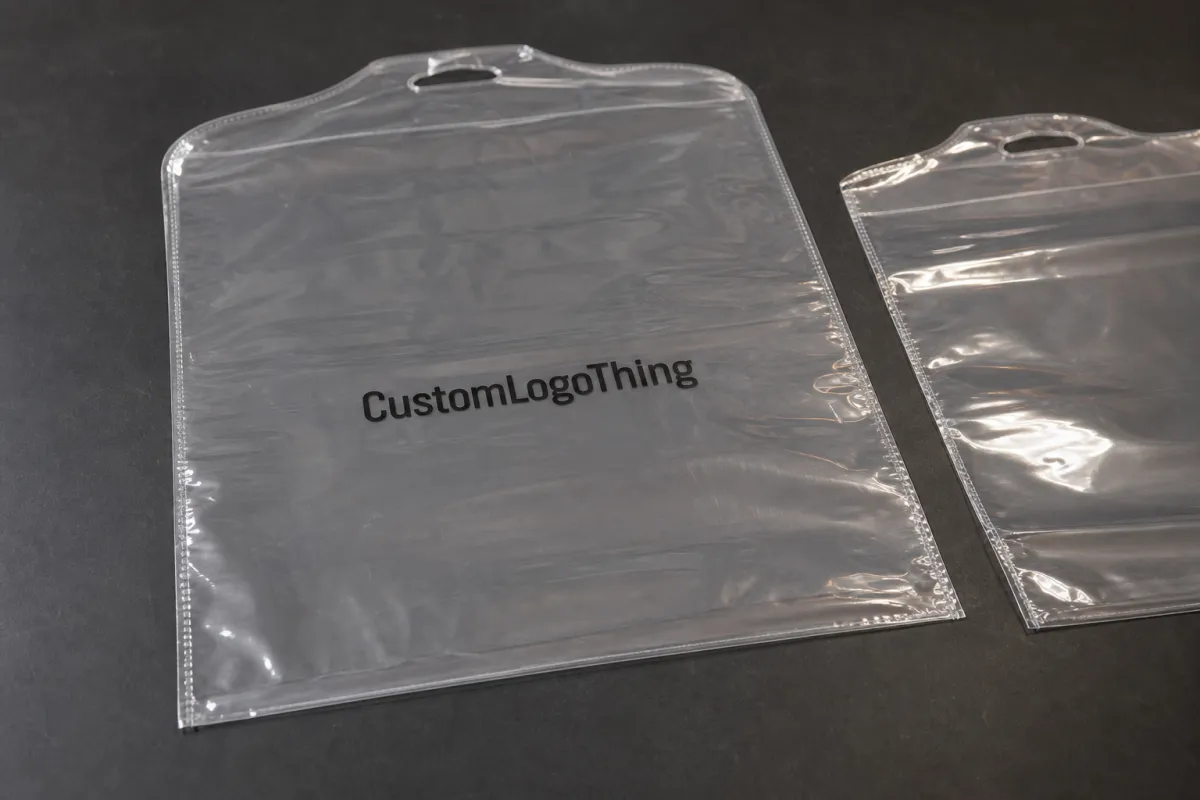
A Clear Garment Bag has to do three things at once: protect the garment, show it clearly, and stay easy to use in a real packing flow. That is why sample approval should focus on function, not just appearance. A bag that looks acceptable in isolation can still fail once the actual garment is inside and the crew starts moving quickly.
Start with visibility. The item should read correctly through the film, with logos, seams, and silhouette still looking intentional. If glare, haze, or rippling makes the merch look distorted, the material or thickness may need to change. Then check handling. The crew should be able to open, load, close, and hang the bag without snagging trim or fighting the closure.
Approve the sample under the same conditions it will face in production: real garment, real hands, real lighting.
Material choice also affects approval. PVC, EVA, PEVA, and similar transparent films each behave differently. Thinner film often improves clarity and lowers cost, but it may scuff faster. Thicker film adds structure and durability, though it can increase glare and shipping weight. The right choice depends on garment weight, handling frequency, and whether the bag is for staging, travel, or repeated reuse.
How Sample Approval Works From First Pull to Sign-Off
The cleanest review starts with the spec pack. Compare the sample to the approved dimensions, material callout, closure style, print placement, and packing plan before making any judgment. Then put the actual garment inside. That sequence matters because a bag can seem fine on its own and still fail once the intended item is loaded.
Lighting changes the outcome more than many teams expect. Clear film that looks crisp in an office can reflect harshly under expo lighting or stage wash. If the merch will be seen on a retail rack, backstage, or on camera, review the sample in at least two environments. The goal is to know how the bag behaves where it will actually be used.
Input should come from the right people, but it needs one owner. Merchandising may care most about visual presentation, operations about pack speed, creative about print placement, and fulfillment about line efficiency. One person should collect those notes and convert them into a single revision list. Without that, sample rounds drift and decisions get repeated.
Transit is part of the test too. A bag that passes a bench review may still lose shape after carton compression, humidity changes, or rough sorting. If the finished units will travel far, ask whether the pack-out and carton plan align with common transit-test expectations, including standards used in the ISTA environment. A simple package still needs a realistic shipping plan.
Approval is strongest when the sample is treated as a working package, not a mockup.
Key Specs That Affect Fit, Visibility, and Durability
Size is the first number to lock. Width, drop length, gusset depth, and hanger opening must match the garment type with enough room to avoid compression. A fitted polo, a hoodie, and a structured jacket do not need the same profile. If the bag is undersized, the item wrinkles and the presentation suffers before the event starts.
Thickness is the main tradeoff between cost and durability. Lightweight clear film often sits around 0.08-0.12 mm, while sturdier reusable bags may move into 0.12-0.18 mm or more. Thinner film can be cheaper and more transparent. Thicker film improves body and reusability, but it can add glare and raise freight because of extra weight and bulk.
Closure style affects speed and protection. Zippers are common because they secure the garment and look finished, but low-cost tracks can snag or split. Hook-and-loop closures are quick and simple, though they may catch lint and feel less premium. Open-top bags are best reserved for short-term staging or internal movement. For repeated handling, test the closure as carefully as the film.
Construction details are easy to overlook and expensive to fix later. Reinforced seams reduce failure at stress points near the hanger opening. Venting can keep the bag from ballooning during packing. Handles, if included, should not twist the garment. If the sample includes a label window or printed panel, confirm that it stays readable without overpowering the item inside.
Here is a simple comparison for planning and quoting:
| Option | Typical Use | Indicative Unit Cost at 5,000 pcs | Main Tradeoff |
|---|---|---|---|
| Basic clear bag, open-top | Short-term staging or internal transport | $0.18-$0.28 | Lowest cost, least protection |
| Clear bag with zipper closure | Event merch and repeated handling | $0.28-$0.45 | Better containment, more parts to test |
| Reinforced bag with custom print | Branded approvals and premium merch | $0.42-$0.75 | Stronger presentation, higher setup cost |
| Special-size or gusseted bag | Bulky apparel or mixed-size kits | $0.55-$0.95 | Better fit flexibility, higher material use |
These numbers are directional. Print coverage, zipper quality, film thickness, and carton configuration can move a quote quickly. If the order also includes inserts or outer cartons, ask about those components early so the final pack-out does not force a change later.
Clear Garment Bag Cost, MOQ, and Quote Drivers
Unit price is only one part of the decision. Setup fees, custom sizing, reinforcement, labeling, carton counts, and freight can matter as much as the headline quote. A low per-unit price can become the expensive option once labor and rework are included.
MOQ usually rises with customization. Stock sizes with simple closures may be available in smaller runs, sometimes a few hundred units depending on the supplier. Once the order becomes a custom width, a special zipper color, or a printed panel, the minimum often moves into the 1,000-3,000 range. That is why buyers should approve the sample before locking into a quantity that is larger than the real need.
Freight can quietly change the economics. A slightly larger bag may improve presentation, but if it increases carton size enough to raise shipping and warehouse costs, the savings disappear. Ask for landed cost, not just factory cost. If the quote leaves out sample freight, carton dimensions, or pack-out assumptions, it is incomplete.
A quote review should separate five buckets:
- Material cost: film type, thickness, clarity, and any anti-scuff treatment.
- Labor cost: seam construction, closure installation, and print setup.
- Packaging cost: inner packing, carton size, and label requirements.
- Freight cost: sample shipping, production shipping, and destination handling.
- Risk cost: reorders, slower packing, and replacement units if the first run misses spec.
That last bucket is easy to ignore and hard to recover from. A bag that slows packing or does not survive handling can cost more than the cheaper spec ever saved.
Process and Timeline From Artwork Review to Final Production
The production path is straightforward when the inputs are clean: brief the supplier, confirm dimensions, review artwork, make the sample, inspect it, approve revisions, and release the run. Delays usually come from missing measurements, unclear art placement, or late comments that force another round of changes.
Sample timing and production timing are different. A prototype may arrive quickly, but the factory still needs a slot for full manufacturing. Simple samples can move in a few days, while custom production often takes 10-25 days after approval, depending on complexity and queue position. Tooling changes or a special zipper can extend that timeline.
The fastest approvals usually come from one decision maker, one version of the spec, and one written log of changes. That keeps creative, merchandising, and operations aligned without turning the sample thread into a scattered debate.
For tight schedules, separate must-fix issues from preferences. "Increase width by 2 inches" is actionable. "Feels off" is not. Specific feedback shortens the approval loop and reduces the risk of a late-stage revision.
Step-by-Step Approval Guide for Event Merch Teams
Start with the use case. Is the garment traveling across the country, hanging backstage, staying in storage, or going into a display rack? That answer shapes the bag spec more than most teams expect. A piece used only for backstage transport can be simpler than one used for sponsor gifting or executive presentation.
- Collect the spec pack: garment measurements, bag dimensions, material preference, closure style, print or label needs, quantity, and pack-out method.
- Inspect the first sample: check fit, transparency, seam quality, and whether the garment hangs naturally inside the bag.
- Test real handling: open and close the bag several times, move it on a hanger, and simulate the packing motion your crew will repeat.
- Track revisions in one place: keep the notes together so email, chat, and call feedback do not split the record.
- Sign off in writing: confirm the approved version, tolerance, and release date before production starts.
A short checklist works well. Five checks are usually enough: clarity, fit, closure, seam strength, and presentation. If the sample passes those under the right lighting, the team can approve with confidence instead of hoping the bulk order matches the prototype.
Keep one physical approved sample on file. It becomes the reference for reorders and for any future vendor discussion. Memory fades; a sample does not.
Common Mistakes That Slow Approval or Inflate Reorders
Photos are the biggest trap. Screens hide glare, seam tension, and the way a bag behaves when handled. A picture may make the film look clear while the physical sample still clouds the garment or reflects so much light that branding becomes hard to read.
Undersizing is another repeat issue. If the garment is compressed, it wrinkles, stresses the seams, and looks less premium on arrival. Always test with the actual item, not a similar one or a size estimate pulled from memory.
Vague feedback also slows the process. "Looks cheap" is not a production note. "The zipper sticks at the lower corner" is. "The bag is too narrow once the jacket is inside" is. Exact language reduces sample rounds and helps the supplier correct the right issue.
Teams also miss the handling flow. A bag can look polished on a table and still slow packing, hanging, or cart loading. If the final motion feels awkward, the event schedule will feel it too. The sample should be tested in the same way the fulfillment crew will use it on launch day.
Another common miss is not checking the final resin, zipper, or seam method against the approved sample. A supplier may substitute a close version if the order is rushed. That kind of substitution can change haze, odor, or pull strength, and it is easy to miss in a quick review.
Expert Tips and Next Steps for a Clean Sign-Off
Keep the approval standard stable. If every sample introduces a new rule set, speed drops and everyone starts guessing. A repeatable checklist gives the team a clear approval process that can be used again for the next event, the next sponsor drop, or the next reorder.
Separate must-haves from nice-to-haves. Must-haves are size, clarity, closure function, and seam integrity. Nice-to-haves might include printed branding, reinforced handles, or upgraded labeling. That split keeps the review focused and prevents every sample from becoming a design debate.
Ask for a quote that matches the approved sample, not a placeholder sketch. Once the spec is locked, confirm MOQ, timeline, and landed cost. If the job includes cartons or inserts, check whether those components align with your packaging standards before the order is released. It is easier to change those details before production than after units are already boxed.
The value of the process is simple: fewer surprises, less labor friction, and a sample trail that tells the truth about what the finished order will actually be. That is what a good approval guide should do.
What should event merch teams check on a clear garment bag sample before approval?
Check garment fit, bag dimensions, closure function, seam strength, and transparency under real lighting. Place the actual item inside the bag and look for glare, haze, or compression that changes the presentation. Also test how quickly the crew can open, close, and hang it.
How do clear garment bag specs affect price and MOQ?
Larger sizes, thicker film, custom printing, and reinforced construction usually raise unit cost. MOQ often increases with customization because the factory needs setup time and a dedicated run. Ask for an itemized quote so material, labor, and freight are visible instead of bundled together.
How long does the sample approval process usually take for clear garment bags?
Simple samples can move in a few days, while full production usually takes 10-25 days after approval, depending on complexity and factory queue. Revision cycles add the most delay. One decision maker and one written feedback log usually shorten the timeline.
Can clear garment bags be used for printed event merch presentations?
Yes, if the transparency, print area, and glare control are right. The sample should prove that the garment remains visible and the branding stays readable in the lighting where the merch will be seen. If the venue is bright or reflective, test it there before releasing the run.
What information should be in a sample request from an event merch team?
Include garment measurements, target bag size, closure style, material preference, print or label details, quantity, and pack-out method. Add photos or a tech pack when possible. Visual references reduce misunderstanding and shorten revision cycles.


