Event merch woven label beanies Bulk Order Planning is mostly a specs exercise: fit, label size, MOQ, lead time, freight, and how the finished hat will actually look in hand. The cheapest quote is rarely the best one if the logo does not fit, the cuff is wrong, or the delivery date slips past the event.
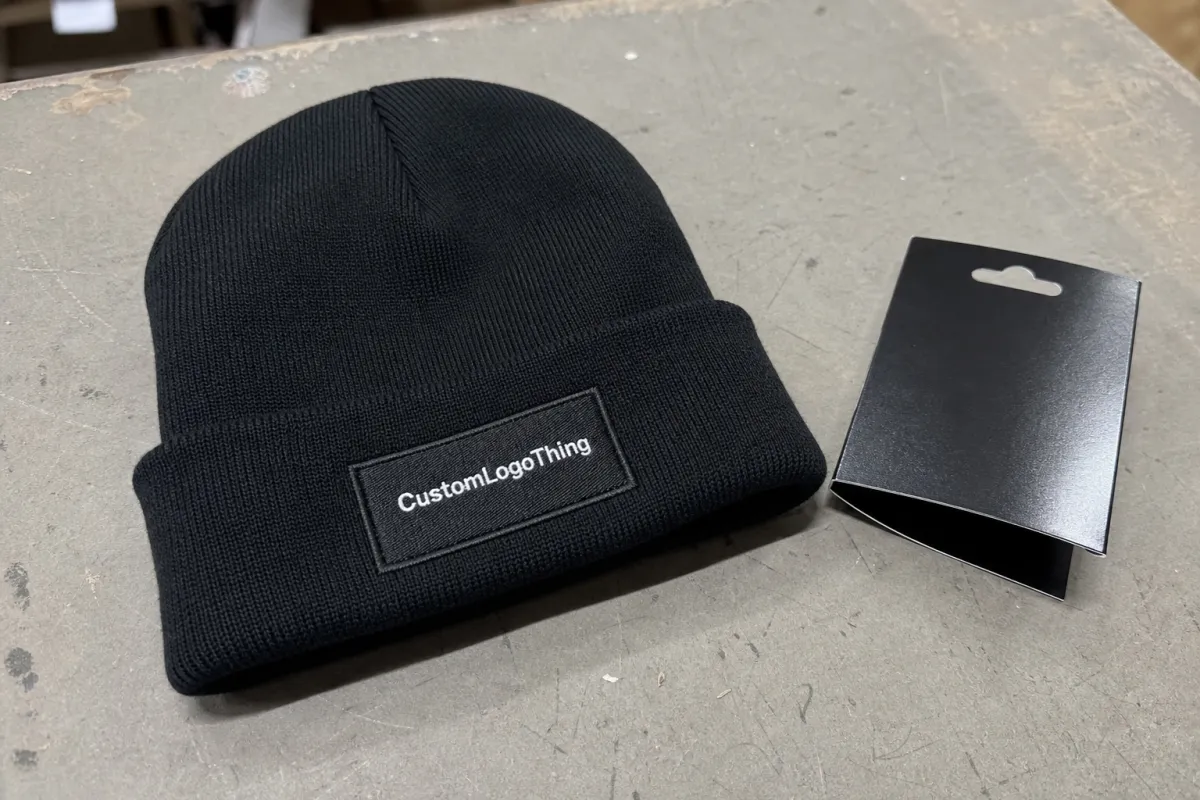
A woven label usually gives knit headwear a cleaner, more retail-ready look than a large print on stretch fabric. It also holds up well in normal wear, which matters if the beanie is for staff, sponsors, customers, or resale. The key is to decide early whether the project needs a simple promo piece or something that can pass as seasonal retail.
Buyers get the best results when they start with a clear spec sheet, a realistic approval window, and landed cost in mind. That means checking the beanie body, decoration method, packout, and freight before the first proof is approved.
Why woven-label beanies outlast the event itself
A beanie has a longer life than most event handouts. People wear it on commutes, errands, and cold-office days, so the item keeps carrying the brand long after the booth is gone. That makes it more useful than a disposable giveaway when the goal is repeat visibility.
Woven labels work well on knit goods because they read cleanly against texture. They feel more finished than a large surface print and usually age better under stretch and repeated wear. If the plan is to make something people will actually use, the label format is a sensible default.
"If the logo only looks good in the mockup, that is not a product spec. That is a problem waiting to happen."
There is also a perception issue. A well-sized woven label makes the piece look closer to retail and less like a rushed promo item. That does not automatically make it premium, but it does improve the first impression in hand and in photos.
For teams trying to keep trim and branding consistent across apparel and inserts, the Custom Labels & Tags page is a useful reference for formats that transfer well to knitwear programs.
Choose the right beanie build for your audience
The beanie body matters as much as the label. A cuffed style gives the most stable branding zone because the folded edge creates a visible panel. Slouch styles feel softer and more fashion-driven, but the label can get lost if the drape is too loose. Pom-pom styles skew seasonal, while rib-knit and double-layer builds usually wear comfortably and hold shape better.
Placement should match how the hat will be seen. Front cuff placement is the safest choice when the logo needs to read in photos or from a distance. Side placement works when the branding should feel quieter or when room is needed for a secondary mark, flag, or care tab. Hem placement can work, but it disappears quickly on shallow cuffs.
Construction changes the final look. A fold-over label gives a little structure. A center-fold label works when the artwork needs to wrap over the cuff edge. Sewn-on patches add body and make a simple mark feel more retail-ready, but they also increase cost and bulk. None of these options is universally better; each solves a different problem.
Color blocking can change the read of the piece even if the artwork stays the same. A contrast yarn makes a small label pop. A higher cuff usually gives more room for the logo and tends to look better on adult heads. If the order will be worn by mixed audiences, check samples on the actual knit profile instead of assuming all beanies fit the same way.
For recurring seasonal programs, Wholesale Programs can help keep body style, label format, and color story aligned across reorders. That matters once the first run is approved and the second run has to match it.
Specs that change comfort, fit, and brand perception
The yarn blend affects comfort, warmth, and price. Acrylic is the standard value choice and usually works for most event use. Wool blends cost more and feel denser. Recycled blends support sustainability claims, but Buyers Should Ask about hand feel and color consistency early, not after the proof is approved.
Gauge and stretch recovery are what separate a decent fit from a weird one. Most promo beanies land in the 7- to 9-gauge range, which usually gives enough stretch for adult heads without pinching. If the crown is too shallow, the hat sits awkwardly. If it is too tall, it slouches in the wrong way. A tolerance of about +/- 0.5 inch on circumference is normal for knit goods, but the spec sheet still matters more than the sample alone.
Label size needs enough room for stitch detail and legibility. Too small, and the logo blurs. Too large, and the label fights the knit. For a cuffed beanie, 1.5 x 2.5 inches is a practical starting point, but final size should follow the stitch count, icon detail, and the amount of negative space the art can carry. Thin type needs more room and tighter stitch density.
Color accuracy should be discussed in terms the factory can actually deliver. Knit yarn does not behave like printed paper. Dye lots shift and lighting changes the read. If the brand color is sensitive, ask for the closest-match strategy in writing and expect a tolerance discussion rather than a promise of perfect parity.
Packout changes both presentation and cost. Bulk packing is cheapest. Individual polybagging makes more sense for gifts or resale. Paper hangtags and inserts can improve presentation, but they add labor and should be decided before production starts. If cartons will move through multiple hubs, it is worth checking the packout against ISTA transit testing guidance so the order arrives in good shape.
Sustainability claims should stay specific. If the yarn is recycled, say what is recycled. If the insert stock is certified, keep the paperwork. For paper components, FSC documentation is the kind of support a serious buyer should ask for before final approval.
Pricing, MOQ, and unit cost drivers
Price moves with a small set of variables: body choice, yarn blend, label complexity, color changes, and packing steps. The fastest way to control cost is to decide which of those choices actually matter to the project.
MOQ is where buyers are often surprised. Some factories set it by style, some by color, and some by artwork version. Those are not the same thing. A vendor may quote 200 pieces as a minimum for one body, then require 100 pieces per color if the run is split. Ask that early so the order does not need to be redesigned later.
Unit cost is usually pushed by three things: how custom the body is, how much the label costs to produce, and how much packing labor is added. A standard cuffed acrylic beanie with a woven label is usually the lowest-cost route for most event programs. Wool blends, recycled yarns, and specialty trims raise the price quickly, as do oversized labels or extra decoration.
| Beanie option | Typical MOQ | Unit price range | Best use case |
|---|---|---|---|
| Standard cuffed acrylic with woven label | 100-300 pcs | $2.10-$3.85 | Staff gear, event giveaways, simple resale |
| Recycled blend rib-knit with label and hangtag | 150-300 pcs | $2.60-$4.90 | Sustainability-focused merch, premium kits |
| Wool blend double-layer beanie with structured label | 200-500 pcs | $3.25-$6.20 | Cold-weather markets, higher-end sponsor gifts |
| Pom-pom or specialty silhouette with custom label work | 300+ pcs | $3.80-$7.50 | Seasonal campaigns, fashion-forward drops |
Those ranges are normal, not guaranteed. The landed cost can still climb once freight, sampling, and packout are included. Compare the full delivered cost, not just the factory quote.
A clean way to keep pricing in range is to stay with a standard cuffed body, limit color changes, and avoid oversized label constructions unless they solve a real design problem. If the order needs volume breaks for a recurring campaign, the Wholesale Programs page is the right place to start instead of guessing at scale.
Production steps and lead time from approval to delivery
The normal sequence is quote, art review, mockup, sample approval, production, quality check, and shipping. Delays usually come from approvals, not knitting. A logo revision, a color debate, or a late shipping change can add days in small pieces.
For in-stock bodies with a standard woven label, production is often 12-15 business days after approval. Add 3-5 business days for domestic freight if the receiving window is normal. If the order is going to multiple destinations or the event date is fixed, build in more margin.
Custom knit bodies, special yarns, or unusual label shapes take longer. A 20-30 business day production window is more realistic for those jobs, and that does not include revisions or freight delay. Rush orders exist, but they cost more and leave less room for correction.
Common delay points are predictable:
- Artwork is sent as a low-resolution file instead of vector.
- Color matching gets debated after the quote is already issued.
- Sample revisions take longer than expected.
- Freight is booked too late for the real delivery window.
If the order needs retail-ready packout, say so in the first round. Individual polybags, inserts, and barcode-ready setups all add labor time. Split shipments do too. One order with multiple delivery points and a narrow event date can turn into a scheduling problem fast.
What a dependable supplier should show before you approve
A good supplier should show a clear mockup, confirm label placement, and provide either a sample photo or a physical sample when the order size justifies it. If the proof is fuzzy or the label is shown at the wrong size, the spec needs more work before approval.
Quality control should cover label alignment, loose threads, color consistency, and size drift across the run. If the logo sits crooked on the cuff, the beanie looks careless. If the knit shade shifts from carton to carton, the set no longer looks consistent. A dependable supplier will flag risky specs early and suggest a fix instead of nodding at a bad file.
Reorder consistency matters when the first run performs well and the second run has to match it. Ask whether the label construction, yarn blend, cuff height, and body fit can be repeated without changing the final look. If the answer is vague, keep asking.
Also ask what happens if the factory substitutes anything in production. Good answers are specific. Bad answers rely on soft language and no ownership. Buyers do not need a sales pitch here; they need accountability and a paper trail.
For larger programs, ask how the factory handles shade matching between lots. Yarn dye lots are one of the boring details that separate a decent result from a headache. If the supplier cannot explain lot tracking, they probably do not track it well enough.
Common mistakes that burn time and budget
The biggest mistake is treating the beanie like a flat surface instead of a knit product. Knit goods move, stretch, and recover. A logo that looks fine on paper can become unreadable if the label is too small or too close to a seam.
Another common problem is splitting the run into too many colors too early. One body color with one label version is simpler and cheaper. Two or three body colors can create inventory fragmentation, higher MOQ pressure, and more setup cost. If the audience does not need variety, skip it.
Buyers also underestimate packout. A beanie shipped loose in bulk is not the same thing as a beanie in a retail polybag with an insert. If the product will be handed out at a booth, bulk packing is fine. If it will be boxed for VIPs or sold online, the presentation should be planned from the start.
Do not approve the order from the mockup alone. Mockups do not show how the label sits on a cuff, how the knit stretches around the head, or whether the thread count is enough for small type. The sample is where those questions get answered.
Next steps to lock quantities, artwork, and ship dates
Start by locking the quantity split by color and deciding whether the project needs a standard cuff or a more retail-looking body. That choice affects the rest of the order. Then prepare the logo in vector format, confirm label placement, and settle the exact Pantone plan or closest-match strategy before asking for final pricing.
After that, build in buffer time for proofing, sample review, freight delay, and receiving. The order should land before the event, not during it. Finish with a signed spec sheet and an approved proof. Those documents are boring, and that is why they matter.
If the beanie is part of a recurring brand program, document the final yarn blend, cuff height, label size, packing method, and shipping notes so the next reorder does not start from zero. That is the simplest way to keep the project predictable from quote to dock.
For file prep, shipping questions, and common setup details, the FAQ is the practical place to check before the art team starts guessing.
FAQ
What MOQ should I expect for event merch woven label beanies?
A practical MOQ is often 100 to 300 pieces, but the real minimum depends on whether the factory counts by style, color, or artwork version. Ask for tiered pricing so you can see the difference between a test run and the quantity that drops the unit cost.
How far ahead should I place a bulk beanie order for an event?
Work backward from the delivery window and leave room for quoting, proofing, production, and freight. For in-stock bodies, 12-15 business days after approval is common. Custom builds need more time, especially if you want a sample before production starts.
Which woven label placement works best on cuff beanies?
Front cuff placement is the safest choice when you want the logo seen quickly and cleanly in photos. Side placement works better when the branding is quieter or when you want room for a second label, flag, or size mark.
Do woven labels hold up better than printed logos on beanies?
Yes. Woven labels usually handle stretch and repeated wear better than large surface prints on knit fabric. They also keep the logo readable after washing, which matters when the beanie is treated like real apparel instead of a throwaway promo item.
What files do I need for a quote on custom beanie bulk orders?
Send a vector logo file, target quantity, color request, label placement note, and your delivery date. If you have a budget range, include it. That helps narrow the body style, label size, and packaging without wasting rounds of back-and-forth.