Event merch Woven Label Beanies quote requests usually start with a simple question: do you want a giveaway that gets worn after the event, or one that only looks good in a presentation? Beanies usually fall into the first group. They are useful, seasonal, and easy to distribute because sizing is forgiving and the item has everyday value.
The best orders are not the loudest ones. A woven label gives a clean logo treatment that usually looks sharper than a bulky patch on a rib knit cap and more refined than heavy embroidery on a small front panel. That matters for conference kits, staff programs, sponsor drops, and retail-style merch where the cap needs to feel finished without adding unnecessary cost.
The main buyer questions are straightforward: unit cost, MOQ, lead time, label placement, and how the cap behaves once it stretches on a head. If a quote does not break those pieces out clearly, the buyer has to guess. Guessing is expensive when the event date is already locked.
Why woven label beanies beat cheap event swag
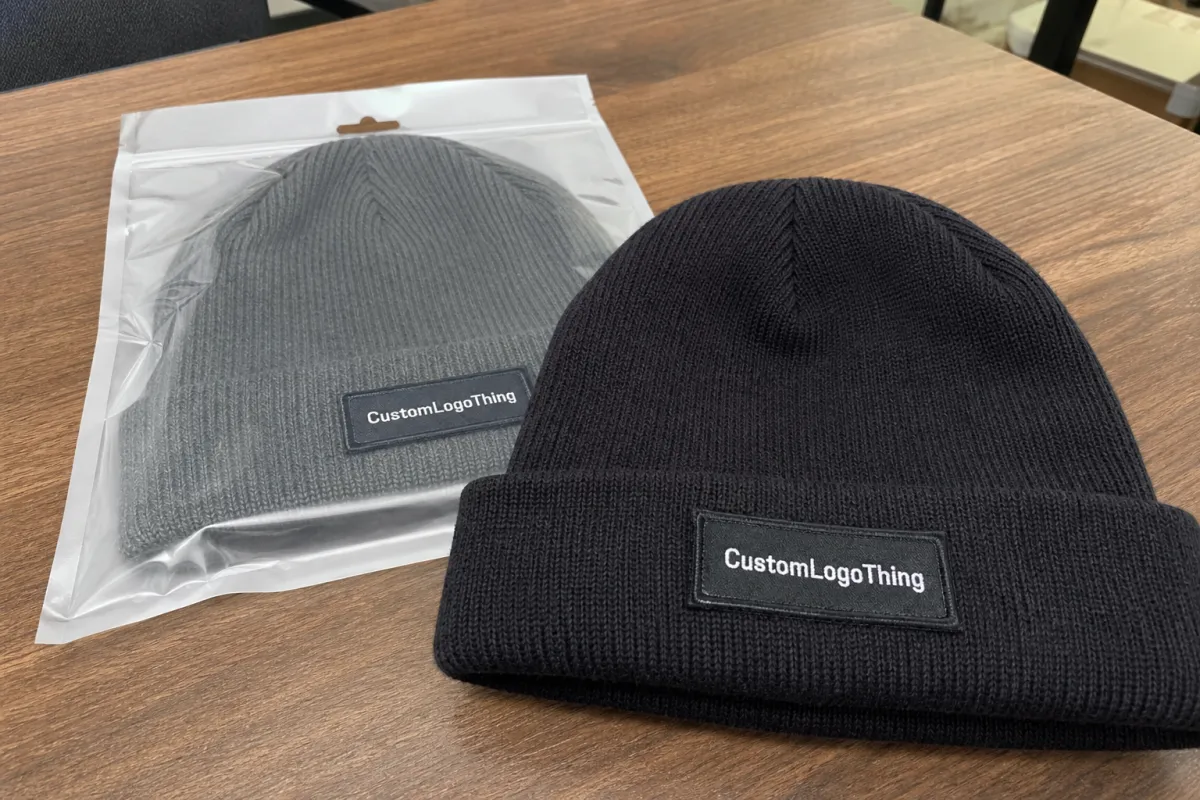
Most event merch fails for the same reason: it looks fine in a mockup and awkward in real life. A beanie has to survive that jump. The knit stretches, the cuff folds, the label shifts a little with wear, and any weak design choice becomes obvious. A good quote should be judged on value per wear, not just the lowest line item.
Woven labels fit knitwear well because they hold detail without fighting the texture of the hat. Embroidery can work, but on smaller placements it often gets dense, especially if the logo includes thin lines or small text. Woven labels usually keep the mark more readable from arm's length, which matters on a crowded booth floor or in a busy registration line.
There is also a durability angle. A beanie that feels scratchy or overbuilt tends to get worn once and forgotten. A softer hand feel and a cleaner front mark improve the odds that it stays in rotation through winter. That is the real value test for event merch: how often it gets used after the handoff.
For event teams, consistency matters too. A well-made woven label beanie can sit beside tees, jackets, lanyards, and tote bags without looking like a budget afterthought. That is useful when the merchandise needs to feel like one program instead of a pile of separate purchases.
Beanie styles, label placement, and build options
Cuffed, slouch, rib knit, pom-pom, and double-layer beanies behave differently in production and wear. Cuffed styles are the easiest to brand cleanly because they create a stable front panel. Slouch beanies feel softer and more casual, but the label has to sit where the drape will not hide it. Rib knit is common and affordable, though stretch can change how the label sits after a few wears. Pom-pom hats are popular for winter events, but the extra build detail adds labor and can push the quote higher. Double-layer builds feel more substantial and usually cost more, but they also give a sturdier form and better warmth.
Placement matters as much as style. Center-front cuff placement gives the simplest read and the lowest approval risk. Side-seam placement looks more fashion-driven and can work well on slouch hats. Lower-edge placement is subtle, but it only works if the buyer wants restrained branding. Interior labels are useful for care or size information; they do not replace a visible logo. A sewn patch can look premium, though it can also crowd the front of the cap if the patch is too large for the knit gauge.
Material choice changes both hand feel and label clarity. Acrylic is still the most common choice because it is affordable, easy to knit, and holds shape well. Acrylic-wool blends usually feel warmer and a bit more substantial. Recycled yarns are worth considering when the brief calls for lower-impact materials, but a physical sample matters more there than on standard acrylic. Recycled content can soften stitch definition, so a label that looked sharp in a mockup may need stronger contrast in production.
Optional add-ons are not only cosmetic. Hang tags help with resale or sponsor attribution. Size stickers make distribution easier when orders are sorted across teams. Folded polybags protect the hats in transit and keep warehouse handling cleaner. Belly bands sit in a useful middle ground: they add branding without the cost of full retail packaging. Each extra touch changes the quote, but each one also changes how the beanie feels when it is picked up.
| Beanie style | Best label placement | Typical quote impact | Buyer note |
|---|---|---|---|
| Cuffed | Center front cuff | Lowest to moderate | Best for clean branding and fast approval |
| Slouch | Side seam or lower edge | Moderate | Casual look, but placement needs more care |
| Rib knit | Front cuff or side seam | Moderate | Stretch can shift the final label position |
| Pom-pom | Front cuff | Moderate to higher | Popular for winter events, with extra build cost |
| Double-layer | Front cuff or woven wrap | Higher | Heavier hand feel and better structure |
Specs that matter before you request a sample
A useful quote starts with hard specs. Beanie size, crown height, cuff depth, knit gauge, yarn blend, woven label dimensions, and placement all change the build. A 22 cm cuffed hat with a 6 cm woven label is a different job from a slouch beanie with a lower-edge label and a looser body. If those details are missing, the quote will be vague or padded.
Color matching on knitwear has limits, and buyers should expect that up front. The body yarn, the label yarn, and the sewing thread behave differently. PMS matches can be close, but not exact, especially if the body color is tied to mill stock rather than a custom dye lot. A clean quote should say what can be matched tightly and where a near-match is the realistic outcome.
A useful approval file usually includes the following:
- Vector logo file in AI, EPS, or a clean PDF
- Label copy, including any size or care text
- Placement markup on the beanie artwork
- Color targets for body, label, and thread
- Packaging needs, such as hang tags or polybags
Before sample approval, check three things carefully: stitch density, logo legibility at arm's length, and edge finish. A woven label can look perfect in a flat render and still curl or distort after stretch testing. The sample should be treated as a functional test, not only a design preview. If the front mark is too small, the logo will disappear once the hat is worn. If it is too large, it can dominate the cuff. Both errors are common and avoidable.
Packaging and transit standards matter too. Carton quality, fold consistency, and whether the hats are packed individually can affect how the order arrives. If the order is shipping to multiple event sites or mixed with other merchandise, the shipping plan should be explicit. Groups such as ISTA help define packaging and transit expectations, while FSC certification is worth checking when paper belly bands or recycled packaging are part of the order. Claims are easy. Documentation is what holds up.
Pricing, MOQ, and quote ranges that make sense
Quantity tiers usually tell the real story. A 100-piece run almost always costs more per hat than 250 pieces, and 250 is usually more expensive per unit than 500. That is what happens when knitting setup, label production, and packing labor are spread over more units. If a supplier gives one flat number without tiering the price, the buyer is missing the best comparison point.
For simple custom Beanies With Woven labels, the MOQ often starts around 50 to 100 pieces. That floor moves depending on yarn availability, label complexity, and whether the beanie is stock knit or fully custom. A single-color woven label on a standard cuffed hat is easier to support than a multi-color label on a custom slouch build with packaging extras. More variables usually mean a higher floor.
Realistic buyer ranges often look like this:
- 50-100 pieces: higher unit cost, common for small sponsor teams, pilot runs, or internal gifts
- 250 pieces: a better balance of price and flexibility for conferences or multi-stop events
- 500+ pieces: stronger unit pricing and lower setup pain, especially for repeat campaigns
The largest cost drivers are predictable: beanie style, yarn blend, woven label complexity, packaging, sample quantity, and freight. Freight becomes more noticeable when timing is tight or the order needs to move across regions quickly. A quote that hides shipping until the end is not a clean quote. Ask for sample cost, production cost, setup fees, and freight as separate lines so procurement can compare the same basis across suppliers.
There is another pricing trap worth watching: decoration versus product sourcing. Some buyers judge the label cost in isolation and miss that a softer yarn or better knit gauge changes the feel of the whole hat. Others overpay for packaging they do not actually need. The cleanest buying process separates the hat, the label, and the packout so each item can be reviewed on its own merits. That makes the order easier to defend internally and easier to repeat later.
Production steps and turnaround from proof to delivery
The production path is usually simple: inquiry, artwork review, digital mockup, sample or proof approval, production, quality check, packing, and shipping. The trouble starts when the brief is thin. If the artwork is unclear or the placement is undecided, the schedule slips before production even begins. That is not a factory mystery; it is a missing-information problem.
For straightforward orders, a 2 to 4 week window after proof approval is common, though custom yarns, special label constructions, or peak-season freight can stretch that. If the labels are produced separately from the hats, add a little buffer. If the buyer wants to revise the label size after the first proof, add more. The calendar is not flexible just because the event date is fixed.
The most common delays are easy to predict: missing vector artwork, uncertain label placement, unresolved color choices, and packaging changes that arrive late. Buyers often ask for a quote before deciding whether the logo should sit center front or on the side seam. That slows everyone down. A strong quote request includes the logo file, target quantity, preferred color, delivery ZIP, and in-hand date from the start. That is enough for a real answer.
Shipping method is part of the production plan, not an afterthought. Standard carton packing works fine for most beanies, but orders going to multiple event sites or bundled with other merchandise need better labeling and carton logic. Otherwise the team receiving the shipment has to sort color, size, or style by hand. A clean packout saves time that would otherwise be spent fixing avoidable warehouse mess.
What makes our event beanie orders easier to approve and reorder
Fast approvals come from consistent specs, not louder promises. If the logo size, label position, and color expectations are documented before production starts, the proof gets approved faster and the reorder path gets simpler later. That is especially useful for annual conferences, winter sponsor kits, and staff programs that need the same item made again with minimal friction.
The most useful proof shows the label in context: exact placement, approximate finished size, and how it sits against the knit texture. That matters because a woven label that looks proportional on a flat template can look oversized once the hat is stretched. Buyers should not have to guess that. They should be able to see it before production begins.
Quality control on beanies is practical. Check for even knit tension, clean label stitching, and consistent cuff shape across the lot. Small variation is normal in knitwear. Drift in placement from unit to unit is less acceptable, especially on orders with a tight front logo. If the hats are supposed to read as a matched set, they need to look matched when stacked on a table, not just in a digital mockup.
Reorderability comes from documentation. A clear spec sheet makes repeat orders faster because the product does not need to be reinvented every time. The same yarn blend, the same label size, the same placement, and the same packing method create a predictable result. For buyers managing recurring winter merch, that predictability is often more valuable than a slightly lower first-run price.
What to send for an accurate event merch woven label beanies quote fast
Quantity should be the first line item. 50, 100, 250, or 500 units produces a much clearer quote than “a few hundred.” Pricing changes by tier, and a loose number invites a loose answer. If the order is split by color, include the breakdown. A 150-piece run in one color is not the same as 150 pieces divided across three shades.
Next, send the logo file, beanie color, label placement, packaging needs, and delivery ZIP. Those five details cover most of what changes landed cost. If the order needs folded polybags, belly bands, hang tags, or retail-style packing, say so up front. Packaging affects labor, carton weight, and freight, so leaving it out only creates revision later.
The deadline needs to be explicit too. Include the event date, the target in-hand date, and whether the order can use standard production or needs rush handling. “Soon” is too vague to be useful. A supplier can plan around a real date. They cannot plan around a feeling.
Separate the quote into sample, production, setup, and freight if you want a clean comparison. That makes it easier to spot where one supplier is cheaper and where another is padding the back end. A good quote should read like a production plan with numbers attached, not a mystery with a logo on top.
How do I get a woven label beanie quote for an event order?
Send quantity, beanie style, logo file, label placement, and delivery date so the pricing reflects the actual build. Ask for sample, production, and freight as separate line items if you need a true landed cost.
What is the usual MOQ for custom woven label beanies?
Many suppliers start around 50 to 100 pieces, but the exact minimum depends on yarn availability, decoration details, and packaging. Simpler builds usually support lower minimums; custom colors or extra label work can push the floor higher.
Can I put a woven label on both cuff and slouch beanies?
Yes, but cuffed beanies usually give the cleanest front placement and the easiest read. Slouch styles often work better with side-seam or lower-edge placement so the label does not fight the drape.
What changes the unit cost the most on event beanies?
Quantity, yarn blend, label complexity, and packaging have the biggest impact on per-piece pricing. Shipping is usually separate, so compare quotes on the same landed-cost basis or the numbers will not line up.
How long does production usually take after approval?
Simple orders often land in the 2 to 4 week range after proof approval, but custom specs can extend that. Rush timing depends on stock availability, decoration steps, and how quickly artwork gets approved.


