Merino Blend Beanies with Woven Labels: Wholesale Quote Guide
Beanies look simple, but the quote is shaped by small details: yarn blend, fit, cuff depth, label size, packing method, and the amount of handwork involved. If those points are unclear, the price usually comes back broad or has to be revised. A useful request should describe the product, not just the idea of the product.
Merino blends sit in a practical middle ground. They deliver a softer feel and a more premium look than basic acrylic, while staying more stable and cost-controlled than pure merino. Add a woven label, and the beanie moves from generic winter stock toward branded retail headwear. That only works if the construction is planned carefully.
A woven label on a merino blend beanie should feel integrated into the garment, not added as an afterthought.
For wholesale buyers, the value is straightforward: a premium enough material story, a clear brand surface, and a cost structure that can still work at scale. The key is to define the spec before asking for numbers.
Why merino blend beanies with woven labels work in wholesale
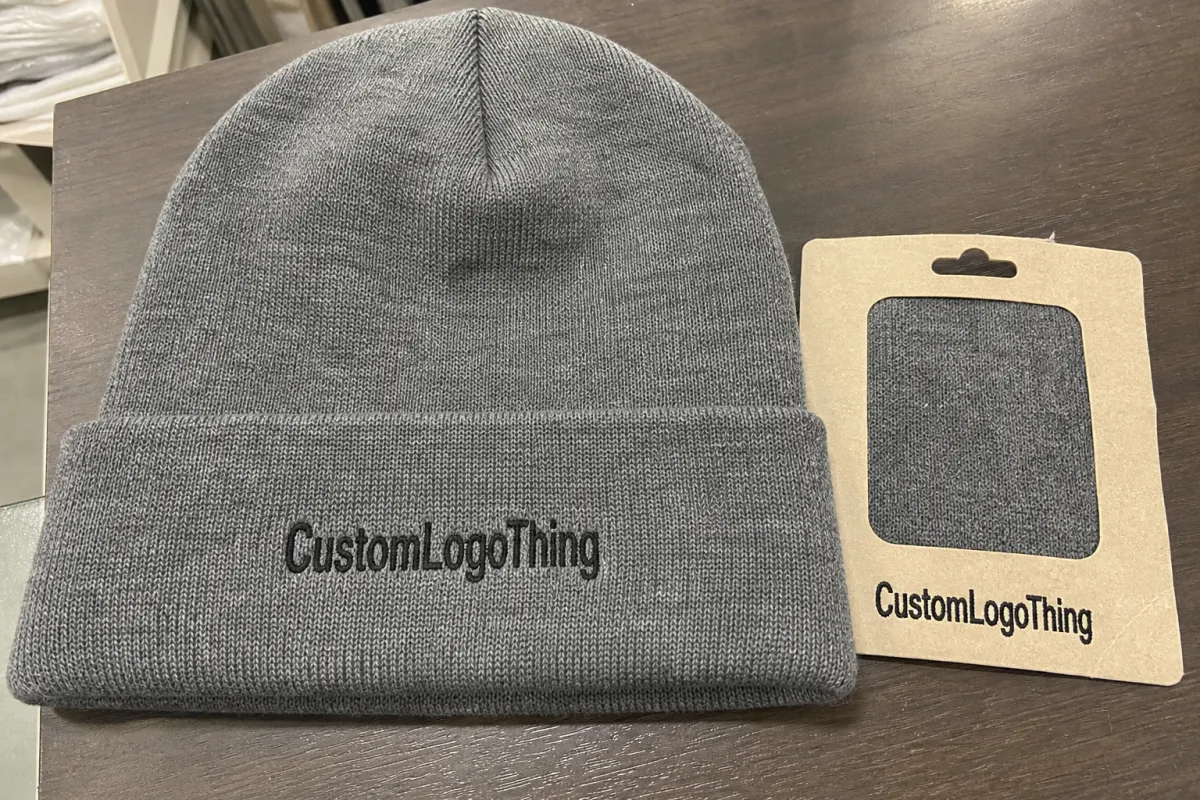
Merino adds softness, warmth, and a better handfeel than standard synthetics. In wholesale, that matters because the customer usually decides quickly from texture, drape, and perceived quality. A merino blend keeps that premium feel while reducing some of the cost and handling risk of full merino.
The blend ratio is one of the first pricing and performance levers. More merino generally improves comfort and thermal value, but it also raises yarn cost and can tighten tolerances. Adding acrylic or nylon can improve shape recovery and wear life. That is why many bulk programs choose a blend instead of chasing the highest wool content available.
The woven label gives the beanie a cleaner retail identity than a plain sew-in tag or a bulky patch. It works especially well when the artwork includes small type, fine borders, or multiple colors. On a cuffed knit, a well-made woven label usually looks sharper than embroidery and uses less bulk on the front of the piece.
This combination also sells into different channels without major redesign. Retail orders often want a polished label and controlled color matching. Uniform or event orders may care more about comfort, repeatability, and simple branding. A merino blend with woven branding can support both, as long as the fit and decoration are defined early.
Compared with a basic acrylic beanie, the product can justify a stronger shelf price. Compared with a pure merino hat, it is easier to keep the unit cost and MOQ within reach. That balance is why these programs work well when the buyer wants premium positioning without premium-only economics.
Material and fit details that keep bulk orders consistent
Consistency starts with the yarn. Common wholesale builds use merino blended with acrylic, sometimes with a small amount of nylon for recovery. The right ratio depends on the use case. A retail beanie, a gift program, and a workwear order do not need the same balance of softness, durability, and cost control.
Knit structure matters just as much. Rib knit is popular because it stretches and fits a wide range of heads. Gauge changes the look and feel: tighter gauges create a smoother surface and a neater label zone, while looser knits feel softer but can look less refined. If the beanie includes brushed lining or another finishing step, that should be specified because it changes both cost and timing.
Fit is where many bulk programs drift. Total length, crown shape, and cuff depth all affect how the beanie reads on head. A cuff that is too shallow can crowd the label; one that is too tall can make the piece look bulky. The best way to approve shape is on a head form or worn sample, not just a flat image.
Color selection creates its own risks. Dark shades such as black, navy, and forest can make a label disappear if contrast is weak. Light shades like oatmeal or heather gray can expose imperfections in stitching or edge finish more clearly. The label should be checked against the actual yarn, under natural light, before bulk production starts.
Recovery and stretch are easy to overlook but important for wholesale. A beanie that grows after a few wears will look tired quickly. One that is too tight may fit poorly and sell less well. The blend, gauge, and dimensions should be chosen together so the final shape stays stable after wear and packing.
If you are comparing branding methods across knit accessories, our Custom Labels & Tags page is useful for reviewing placement and finish options before locking the beanie spec.
Specs to confirm before you request a merino blend beanies woven label quote
A useful quote request should leave little room for interpretation. If you want a real merino blend Beanies Woven Label Quote, send the finished size, blend target, label details, color reference, artwork, and packing method. Those items drive the labor, material, and handling cost.
For the beanie, confirm total length, cuff depth, crown shape, and whether it is single-layer or includes an inner finish. If you want a snug fit, a relaxed fit, or a slouchier profile, say so. These are different builds even when the logo stays the same.
For the woven label, define the dimensions, fold style, edge finish, backing, border treatment, and color count. A center-fold label behaves differently from an end-fold label. If the logo has small text or thin lines, ask what the minimum readable size is. Fine art can become illegible if the weave is too dense or the label is too small.
Packaging should be included in the request because it changes both labor and freight handling. A loose bulk-packed beanie quotes differently from one folded in a polybag with a sticker and insert. If you need carton counts, retail folds, barcode labels, or master pack rules, say that upfront.
- Quantity: list total pieces and break out by color.
- Blend: state the ratio or the performance target.
- Fit: provide length, cuff depth, and desired silhouette.
- Label: include size, fold, backing, placement, and color count.
- Artwork: send vector files and Pantone references.
- Packaging: note polybag, insert, band, or carton-only packing.
If this is a reorder, include the original approved sample or the prior spec sheet. Repeat production is much easier to quote when the factory can match the old build instead of reconstructing it from memory.
Cost, pricing, and MOQ factors that change unit price
Unit price is shaped by a few predictable variables: yarn selection, knit complexity, label construction, finishing, packing, and quantity. Buyers often focus on the logo artwork, but labor and setup are usually what move the number most.
MOQ matters because fixed costs do not shrink much on a small run. A 300-piece order carries more setup per unit than a 3,000-piece order. Once quantity increases, the cost of knitting setup, label weaving, and packing labor spreads out, which is why pricing usually improves at 1,000 pieces and again at higher tiers.
| Order size | Typical unit price | What usually drives the cost | Best fit |
|---|---|---|---|
| 300-499 pcs | $6.20-$8.50 | High setup burden, more manual handling | Sampling, pilot retail drops |
| 1,000 pcs | $4.10-$5.90 | Balanced setup and production efficiency | Brand launches, seasonal promo runs |
| 3,000 pcs | $3.25-$4.70 | Better spread of knitting and label costs | Wholesale programs, uniform programs |
| 5,000+ pcs | $2.85-$4.10 | Lower per-piece setup load, stronger yarn buying power | Repeat retail, nationwide promotions |
Those are typical wholesale ranges, not fixed quotes. Thicker yarn, denser knit, more label colors, or extra packing steps can raise the price quickly. Freight, duties, and carton charges should be quoted separately so you can compare suppliers without mixing product cost and shipping cost.
A lower unit price is not always the better landed cost. Loose QC, rework, or weak packing can create damage and replacement expense later. A slightly higher quote with better finishing may save money overall if it reduces defects and transit losses.
For packaging and transit, external standards can help keep the order intact. Guidance from ISTA packaging test standards can reduce crushed cuffs and scuffed labels, while FSC-certified paper options can support cleaner sourcing choices for inserts, bands, and carton cards. Neither changes the beanie itself, but both affect how the order arrives.
Production workflow, lead time, and delivery expectations
The usual workflow is artwork review, label proof, sample approval, bulk knitting, label attachment, trimming, inspection, and packing. It sounds simple, but every step depends on the one before it. If the label changes after the sample is approved, the work may need to be checked again. If yarn is delayed, the schedule moves with it.
Lead time depends most on yarn availability, order size, and whether a pre-production sample is needed. A straightforward order with ready files moves faster than one that needs multiple proof rounds or unusual finishing. Sampling is often worth the time because it catches fit, color, and label placement issues before bulk production starts.
For planning purposes, a clean order may move through sampling and production in several weeks. Add brushed finishing, custom packaging, multiple colors, or a slow approval chain, and the timeline stretches. Freight booking and document preparation can matter as much as the factory timeline, especially if the shipment is waiting for vessel space or final paperwork.
Late approvals are one of the most avoidable causes of delay. Even a small change in label position or cuff depth can require new checks once bulk knitting is underway. The safest approach is to lock artwork early, confirm the physical sample, and keep instructions stable until the order ships.
Packing instructions should be as clear as the knit spec. A retail order may need individual polybags, size stickers, and exact carton counts. A warehouse or uniform program may not. Those decisions affect labor and schedule, so they should be included in the request from the start.
Quality checks that matter on wholesale winter headwear
Quality control should start with the knit. Check density, seam finish, cuff recovery, and how the beanie sits after folding and stretching. A hat can look fine on a table and still twist or lose shape when worn, so a head form is more useful than a flat lay for approval.
The woven label needs its own inspection. Review alignment, border sharpness, backing, and stitch tension. If the label edge feels scratchy or the label pulls the knit, the piece loses value quickly. The decoration method should respect the softness of the fabric rather than overpower it.
Color control is another frequent issue. Shades like charcoal, heather gray, navy, and forest can vary from lot to lot, and those differences become visible once the label is attached. For repeat orders, ask how dye lots are matched and whether the approved sample will be used as the control standard.
A good sample is not just the one that photographs well. It is the one that still looks right after stretching, folding, packing, and wear.
Packaging should be checked too. A neatly folded beanie with protected branding ships better than a loose piece sliding around in a carton. Minor scuffing can dull a woven label fast, especially on darker colors. Transit damage still counts as damage, even if the knit itself was made correctly.
Consistency across the run is the final check. The first piece may look great, but the middle and end of the order need to match it. Ask for in-line checks and final inspection photos, not just one approved sample. The sample proves the concept; the run proves whether the factory can repeat it.
How to choose the right production partner
The best partner usually speaks in specifics. They should be able to explain the yarn ratio, knit method, label construction, and packing sequence without vague language. If the answers stay broad, they may be quoting a category rather than a finished product.
Ask how they handle reorders. A strong supplier can reproduce the same label placement, knit standard, and carton spec without starting from scratch. That matters because seasonal headwear is usually a repeat item, and repeatability is where the program becomes efficient.
It also helps if the supplier separates sample cost, bulk cost, freight, and packaging. Clean quoting makes comparison easier and avoids hidden assumptions. A factory that gives one blended number may still be fine, but it is harder to see where the cost comes from.
Communication around timing is part of quality. A useful partner can tell you where the schedule is likely to tighten, how long sampling adds, what happens if yarn stock is short, and how approval edits are handled. That kind of clarity is often more valuable than polished sales language.
The real test is repeatability after the first shipment. A clear quote is helpful, but the partner only works if the second order matches the first: same fit, same label position, same finish, same packing. That is what makes the product dependable.
FAQ
What details should I include in a quote request?
Include quantity by color, finished measurements, blend ratio or performance target, label size and placement, artwork files, and packing requirements. The more exact the brief, the fewer assumptions the supplier has to make.
Are woven labels better than embroidery on merino blend beanies?
Woven labels usually suit small type and fine artwork better than embroidery, especially on soft knit cuffs. They add less bulk and often look cleaner for retail use, though embroidery can work when the logo is bold and simple.
How does MOQ affect pricing?
Lower quantities carry more setup cost per piece because knitting, label weaving, proofing, and packing do not scale down much. Larger runs spread those fixed costs out, which usually lowers the unit price.
Can I approve a sample before bulk production?
Yes. A pre-production sample is the best way to confirm fit, color, label placement, and finish before bulk knitting begins. It adds time, but it usually prevents more expensive corrections later.
What is the usual turnaround time?
Turnaround depends on yarn availability, the number of colorways, packaging needs, and how quickly artwork and sample approvals move. A straightforward order with ready files is faster than one that needs multiple revisions.
For winter headwear, the best buying decisions come from clear specs rather than broad style language. Merino blend yarn gives the beanie warmth and a more premium feel. A woven label gives it a sharper brand read and cleaner retail presentation. The quote only works when the build is defined well, the sample is checked carefully, and the production path is stable enough to repeat.


