The Five Panel Caps reorder planning guide is really a control document in disguise. The expensive mistake is rarely the first production run. It is the reorder that looks identical on a screen, then arrives with a different crown shape, a firmer front panel, or a logo that sits a few millimeters off center.
That kind of drift is common because repeat orders rely on memory more than most buyers admit. Someone says, "make it the same." The old sample is buried in a storage box, the artwork file has been renamed three times, and the last purchase order is missing one critical line. By the time production starts, the order is already vulnerable.
Five-panel caps are especially sensitive to small changes. The front panel is usually a single uninterrupted surface, which makes decoration easier but also makes errors more visible. A one-piece front can look clean and sharp when the structure is right. If the support, curve, or trim shifts, the difference shows immediately.
Five Panel Caps Reorder Planning Guide: Where Reorders Fail
The first sample usually gets the attention. The reorder is where the trouble starts. Buyers assume the factory can copy the last run from memory, while factories often assume the buyer only wants something "close." Those two ideas are not the same, and the gap between them is where most repeat orders go wrong.
Common failure points are easy to miss on paper. A crown depth changes by 3 to 5 mm. The brim comes back with a slightly flatter curve. The closure switches from one snap supplier to another. Individually, those changes look minor. Combined, they change fit, silhouette, and the way the cap photographs in hand or on head.
Material substitutions are another trap. A cotton twill shell does not behave like washed cotton canvas, and neither behaves like nylon or recycled polyester in the same way under embroidery. Even when the fiber content stays similar, finishing can alter stiffness, shrinkage, and how the front panel holds a patch. If the spec is not written clearly, the factory will fill in the blanks with whatever is easiest to source.
That is why the five panel Caps Reorder Planning guide starts with documentation, not price. The approved sample, the final spec sheet, the last PO, the artwork file, and the production notes should all agree. If any one of those records is missing, the buyer has to decide which version is the truth. That is a bad place to be before a production slot is booked.
A repeat order is only "repeat" if the measurable details repeat too. Memory is not a spec.
The most common issues show up in a few predictable places:
- Crown depth changes fit and the way the cap sits above the ears.
- Front panel support changes whether the crown stands upright or softens over time.
- Peak curve changes the profile and how much shade the brim actually gives.
- Closure hardware changes both the size range and the perceived quality.
- Decoration placement changes the visual balance more than most buyers expect.
If the reorder is tied to a retail drop, a team issue, or event merchandise, even a small change can be expensive. A cap that sells on the strength of its shape does not tolerate "close enough" the way a generic blank might. The safest reorder is the one that keeps the structure stable and limits changes to the few variables the buyer actually intended to change.
Five-Panel Construction Details That Must Stay Consistent
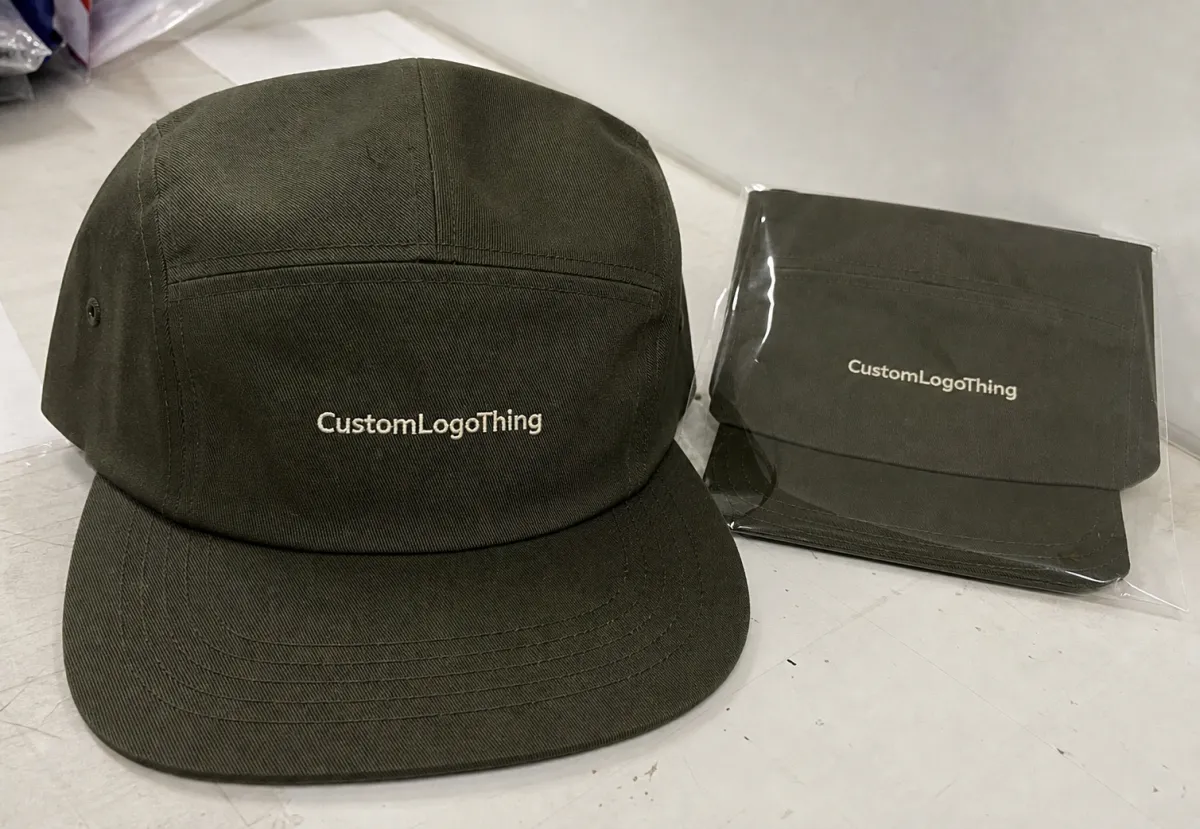
A five-panel cap is built differently from a six-panel cap. The front is usually one larger piece, which gives a cleaner surface for logos and patches. That design also puts more pressure on the front structure because there are fewer seams to hide uneven stitching or poor shaping.
Structured and unstructured versions are not interchangeable. A structured front often uses buckram or a similar support insert to hold shape. That gives a sharper profile and a more retail-ready look. An unstructured cap feels softer and breaks in faster, which can be the right choice for outdoor brands, lifestyle programs, or lower-cost promotions. The point is to choose one and keep it consistent across reorders.
These construction details should stay locked from one run to the next:
- Panel height and overall crown depth, which drive fit and silhouette.
- Front support type, including buckram weight or equivalent reinforcement.
- Peak construction, whether flat, lightly curved, or pre-curved.
- Ventilation details, including stitched eyelets or hidden ventilation.
- Closure style, such as snapback, strapback, buckle, or hook-and-loop.
Decoration method can also change the result even when the base cap is unchanged. Embroidery with a dense stitch count sits differently than a small woven label or a rubber patch. Heat transfers can look crisp at first but may not age like sewn applications. Patch backing matters too: a stiff backing can pull the front panel flatter, while a softer backing may let it drape more.
There is a useful distinction here. Cosmetic changes include thread color, label text, or a packaging update. Spec changes include panel depth, closure hardware, brim construction, or decoration method. Cosmetic changes may fit inside the same quote. Spec changes often require a revised price, new artwork proof, or a fresh sample round. Confusing the two is how projects slip.
For buyers who manage multiple product lines, the same discipline applies across orders. If the cap is part of a broader merchandise or packaging program, keep the base structure stable and only change the elements that truly need to move. If the supply program includes multiple drop points or quantities, the site's Wholesale Programs page can sit alongside that planning, but the reorder file itself should stay focused on the cap spec.
Spec Sheet Checks, Measurements, and Artwork Locks
The spec sheet is the memory of the product. When the original sample is gone, the spec is what keeps the reorder from turning into guesswork. A good sheet does not need to be long, but it does need to be precise.
Before approving a repeat order, confirm the measurements that affect both fit and appearance:
- Panel height and crown depth.
- Peak width, peak length, and brim curve.
- Front panel firmness and the type of support insert used.
- Sweatband width, binding method, and inside finish.
- Closure dimensions and hole count if a strap is used.
Artwork needs the same level of attention. An embroidery file that looks correct on a proof can still stitch out differently if the density, underlay, or pull compensation changed. That is why digitized files should be stored with stitch settings, not just saved as a final graphic. If the previous run used Pantone references, keep those references with the order file rather than relying on a screen color match.
Patch orders deserve extra care. A woven patch with a merrowed edge, a leather patch with debossing, and a rubber patch with a raised logo all behave differently during attachment. Patch size, border width, backing adhesive, and sewing allowance should be written down. Even a 5 mm shift in placement can look accidental on a small front panel.
A clean reorder process usually follows the same order:
- Pull the last approved sample and compare it with the current spec sheet.
- Check measurements, decoration placement, and closure details side by side.
- Confirm artwork files, thread numbers, patch construction, and label position.
- Release production only after all changes are written down and acknowledged.
That sequence matters because production follows the latest instruction, not the one someone remembers from the previous season. When the proof is approved first and the details are checked later, the factory builds to the newest note. That is how logo height shifts, label placement wanders, and the order quietly stops matching the earlier run.
Documentation also matters when the cap sits inside a packaging or sustainability claim. If recycled paper inserts, FSC paperboard, or transit testing are part of the order, keep those records separate from the cap spec but linked to the same job. FSC is the reference point for responsibly sourced paper and board claims, and ISTA testing is useful when cartons need to survive rough handling. Those references help buyers ask better questions about the full order, not just the cap itself.
Cost, Pricing, MOQ, and Unit Cost Triggers
Five-panel cap pricing is usually determined by a short list of inputs. Fabric, structure, decoration, finishing, and packaging do most of the work. Buyers often focus on the cap body price alone and miss the extras that drive the final number. That is where quote comparisons become misleading.
MOQ matters because setup cost has to be spread over the order. A 100-piece reorder with a fresh digitizing file, a custom patch, and individual bagging will almost always cost more per unit than a 500-piece reorder built from an existing setup. That is not a penalty. It is just overhead divided by fewer pieces.
Watch for the charges that often hide inside a clean-looking quote:
- Digitizing for embroidery, often around $20-$60 per logo depending on complexity.
- Patch tooling or mold fees, commonly $40-$150 for sewn or molded applications.
- Sampling, which may be free, credited later, or billed separately.
- Packaging upgrades, including polybags, inserts, tissue, or custom hangtags.
A useful quote separates one-time setup from recurring piece pricing. If those items are blended together, ask for a breakdown before comparing vendors. Otherwise it is impossible to tell whether one supplier is genuinely more expensive or simply front-loading the setup. That distinction matters when you are planning a reorder at a different volume than the first run.
| Order Type | Typical MOQ | Typical Unit Price | Lead Time | Main Cost Drivers |
|---|---|---|---|---|
| Stock blank with small embroidery | 100-300 pcs | $4.20-$6.80 | 7-12 business days | Thread count, placement, carton pack |
| Standard custom logo cap | 300-500 pcs | $3.80-$5.90 | 12-18 business days | Digitizing, stitch count, closure choice |
| Patch or woven label build | 500-1000 pcs | $4.90-$7.50 | 15-22 business days | Patch tooling, backing, extra sewing |
| Custom fabric or special trim | 1000+ pcs | $6.50-$10.50 | 20-30 business days | Material sourcing, wash effects, sampling |
There is a practical tradeoff that buyers run into often: lower quantities tend to preserve flexibility, but they push the unit cost up. If the order needs to stay close to a target price, the easiest place to simplify is usually decoration density, packaging, or a premium trim. Trying to keep the same price while adding complexity rarely works unless the volume goes up too.
Ask for tiered pricing at 100, 300, 500, and 1000 pieces if those are realistic volumes for your program. A single price is not enough to plan around. The breakpoints show where the economics improve and where the order starts to absorb more setup cost than expected.
Process and Turnaround: How a Repeat Order Moves
A repeat order should move in a predictable sequence. If the process feels improvised, the supplier probably does not have the records needed to protect the order. The clean workflow is simple: inquiry, spec review, quote confirmation, artwork check, production, inspection, and shipment.
Timing depends on the construction. Stock-based reorders with light embroidery can often move in 7 to 12 business days after proof approval. Standard custom orders usually need 12 to 18 business days. If the order includes custom fabric, specialty washing, a new patch type, or heavier packaging, plan for 20 to 30 business days. Shipping time sits outside that window unless the supplier states otherwise.
Most delays come from the buyer side, not the production floor. The two common ones are slow proof approval and missing reference files. Another frequent problem is the "small update" that was never written down, then surfaces after the quote has already been accepted. By then, the change may affect cost, timing, or both.
Inventory timing matters too. A reorder should be placed before the stock line goes dry, not after the last carton leaves the warehouse. When the order is placed with only a narrow buffer, every step becomes urgent and rush charges creep in. The freight plan may also change if production finishes later than expected.
A practical timeline looks like this:
- Day 1-2: the supplier reviews the old PO, sample photos, and current requirements.
- Day 3-4: pricing is confirmed and any setup costs are made visible.
- Day 5-7: artwork proof or revised sample is approved.
- Day 8 onward: production, in-line checks, packing, and final inspection move forward.
Not every rush is worth paying for. A factory that compresses proofing too aggressively can miss a logo shift, a color mismatch, or a closure issue, and then the buyer ends up paying for a second run. One extra day spent on approval often costs less than one extra week spent correcting a mistake.
For a broader view of ordering questions, the site FAQ can help frame the first call. For the cap itself, the rule stays simple: lock the details first, then release production.
What a Reliable Five-Panel Supplier Should Document
The best supplier is not the one that sends the fastest reply. It is the one that can reproduce the cap six months later without guessing. That requires records. Without them, every reorder becomes a new project, even if the buyer thinks it is a simple repeat.
A reliable supplier should keep archived specs, approved color references, prior artwork files, and notes on any revisions from the last run. If the previous order used a specific thread chart, patch backing, or panel height, that should be easy to retrieve. If the supplier has to rebuild the product from memory each time, the risk rises quickly.
Quality control on repeat orders should compare the new run to the previous approved run, not just to a generic tolerance sheet. The check should cover panel alignment, logo placement, stitch balance, brim shape, closure function, and inside finishing. A cap can pass a basic defect inspection and still fail to match the original order closely enough for a buyer who cares about consistency.
The difference between a fast vendor and a dependable one often shows up in how they handle the file trail:
- Fast vendor: answers quickly, but stores little detail and relies on recall.
- Dependable vendor: may move more deliberately, but can repeat the cap accurately and explain any changes.
Communication style matters too. Clear lead-time updates are worth real money because they let buyers manage inventory with less padding. Sample retention is even better. Revision notes matter most when there is pressure to reorder the same product after a long gap. If the supplier hides bad news until the last stage, the problem is not tone. The problem is control.
Good records also reduce cost on later orders. A supplier that already knows your stitch count, trim choices, and packaging setup does not need to rediscover the job every time. That is where the real efficiency comes from. The five panel Caps Reorder Planning guide is less about chasing the lowest quote and more about making the next run easier to repeat cleanly.
FAQ
How do I start a five-panel cap reorder if the original sample is missing?
Use the last PO, product photos, artwork files, and any size or color notes you still have. Ask the supplier for archived production records and compare them against a current blank or similar sample. If the crown depth, closure, or decoration placement is unclear, request a fresh reference sample before releasing the full order.
What MOQ should I expect for a five panel cap reorder?
MOQ depends on the cap base, decoration method, and whether the order needs custom trim or fabric. Smaller quantities usually carry a higher unit price because setup and handling are spread across fewer pieces. Ask for pricing at several volumes so you can see where the cost starts to improve.
How long does a five-panel caps reorder usually take?
Stock-based reorders with simple decoration can move in about 7 to 12 business days after proof approval. Standard custom orders usually need 12 to 18 business days, while custom fabric or special finishing can take 20 to 30 business days. Shipping time is separate, so confirm whether the quoted schedule includes freight or only production.
What changes can raise the price on a repeat cap order?
Fabric changes, larger embroidery, different stitch counts, alternate closures, and new packaging all affect pricing. New patch tooling, extra labels, or individual bagging can also lift the total cost even if the cap body stays the same. If you want the same unit price, keep the specification stable and avoid mid-order edits.
Can I update colors or branding without turning it into a new run?
Small artwork or label updates may be possible if the base cap, decoration method, and structure stay the same. New colors, a different crown shape, or a new closure usually require revised pricing and sometimes a fresh sample. The safest approach is to write the change into the spec before production starts, so the reorder stays controlled rather than improvised.