Buyer Fit Snapshot
| Best fit | Foil Stamped Kraft Boxes Wholesale for Premium Branding projects where brand print, material claims, artwork control, MOQ, and repeat-order consistency need to be specified before quoting. |
|---|---|
| Quote inputs | Share finished size, material target, print colors, finish, packing count, annual reorder estimate, ship-to region, and any compliance wording. |
| Proofing check | Approve dieline scale, logo placement, barcode or warning zones, color tolerance, closure strength, and carton packing before bulk production. |
| Main risk | Vague material claims, crowded artwork, missing packing details, or unclear freight terms can make a low unit price expensive after revisions. |
Fast answer: Foil Stamped Kraft Boxes Wholesale for Premium Branding should be specified like a repeatable production item. The safest quote records material, print method, finish, artwork proof, packing count, and reorder notes in one written spec.
Production checks before approval
Compare the actual filled-product size with the drawing, then confirm tolerance on folds, seals, hang holes, label areas, and retail display edges. Reserve space for logos, QR codes, warning copy, and material claims before decorative graphics fill the panel.
Quote comparison points
Review material grade, print process, finish, sampling route, tooling charges, carton quantity, and freight assumptions side by side. A quote is only useful when the supplier can repeat the same color, closure quality, and packing count on the next order.
Foil Stamped Kraft boxes wholesale can do a lot with very little surface area. Kraft gives the package a grounded, tactile base. Foil adds the kind of shine that tells people the box is intentional, not accidental. Put them together and the result feels premium without relying on full-color coverage, busy gradients, or a design that tries too hard.
Custom Logo Things works with buyers who need packaging to do three jobs at once: look good, survive shipping, and stay inside budget. That is the real brief. It is not glamorous, but it is the one that matters. Kraft stock with foil stamping fits that brief better than many first-time buyers expect, especially when the box has to photograph well and still move through fulfillment without getting beat up.
This combination keeps showing up in skincare, apparel, food gifts, candles, subscription kits, and promotional packs for a reason. Kraft already feels tactile. Foil gives the eye a clear focal point. Gold, silver, black, copper, and custom metallic tones each create a different mood, but the pattern is the same: the box stops reading as generic the moment the foil hits the right panel.
A premium package does not need more ink. It needs better contrast, cleaner structure, and a finish that still looks sharp after production.
Why foil on kraft makes a small box look premium fast
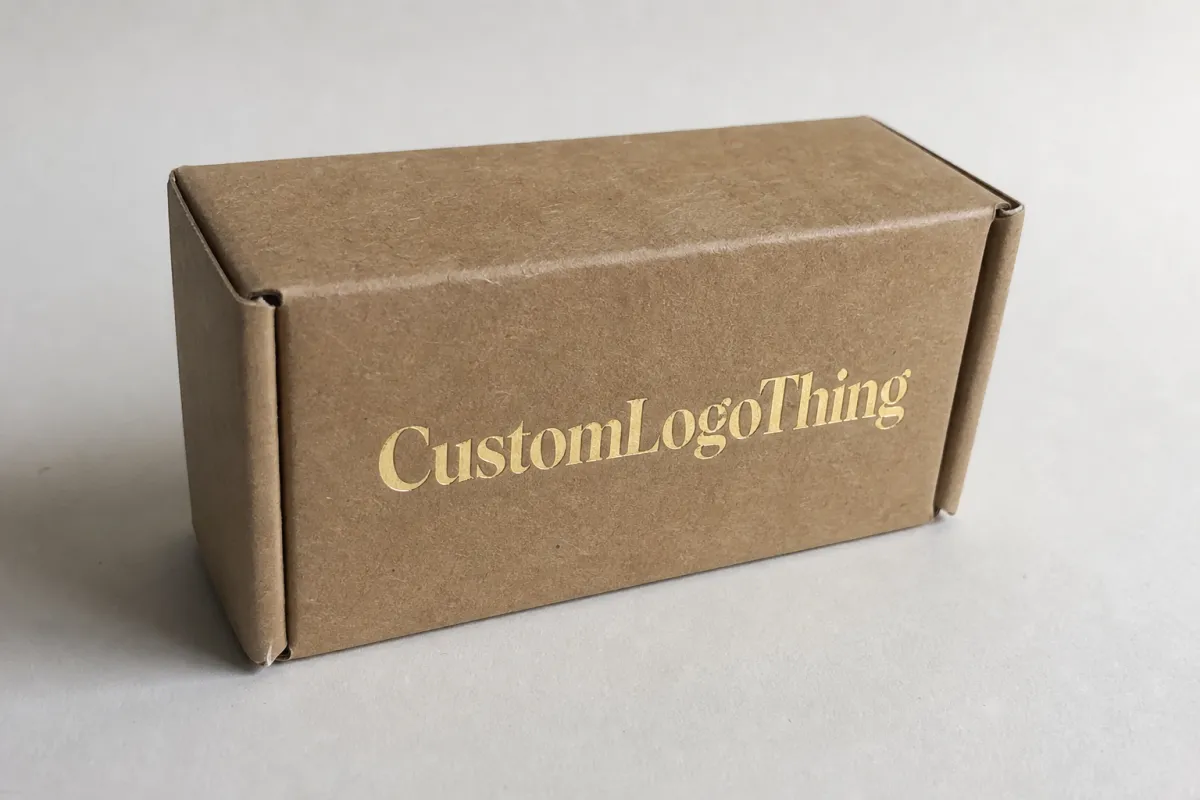
The appeal is simple. Brown kraft has warmth and texture. Foil has crisp reflection. That contrast does the heavy lifting. The box gets a brand signal right away, without depending on full-wrap artwork or expensive print coverage. That is why foil stamped kraft boxes wholesale keep winning in categories where the first glance matters more than a long brand story.
Most buyers do not need a giant canvas. They need a logo that reads cleanly, a product name that still holds up in a thumbnail, or a small mark that keeps the box from disappearing into the shelf crowd. A well-sized foil stamp can do that job. The press work has to be tight, and the art has to be built for the structure, but the payoff is immediate.
Retail makes the case quickly. Shoppers scan before they inspect. A box covered in dense art can still disappear if the graphics are muddy, crowded, or hard to read under store lighting. A kraft box with a metallic mark usually reads faster. It catches light in a useful way, photographs well, and keeps the package legible without a glossy flood coat trying to do the same job.
The business side matters too. Minimal branding usually means less ink, fewer color-matching headaches, and a cleaner setup. That helps with reorders. Subscription programs, seasonal launches, and direct-to-consumer shipments all benefit when the packaging is elegant but not overdesigned. You want premium. You do not want packaging that acts like a committee project.
Foil has a small visual durability advantage as well. Kraft hides handling marks better than slick printed stock. On a busy shipping route, that matters. Scuffs happen. A foil mark placed on a calm, open panel tends to hold its presence better than a crowded surface with edge-to-edge print. It is not magic. It is just less fragile visually.
What foil cannot fix is poor structure. If the board is flimsy, the lid wobbles, or the dimensions are off, the box will still feel cheap. Premium starts with fit. Foil only makes the right structure easier to notice.
Foil stamped kraft boxes: materials, finishes, and print options
Material choice changes the whole tone of the box. Brown kraft gives the strongest natural contrast because the foil sits against a warm surface. White kraft pushes the look cleaner and brighter, which makes metallic foil feel sharper. It also loses some of the earthy character many brands are after. For higher-end packaging, heavier board grades give the box a more substantial hand feel and a better base for detailed foil work.
For foil stamped kraft boxes wholesale, stock selection should match the brand position and the shipping method. A folding carton for light cosmetic items does not need the same board thickness as a rigid gift box or a mailer moving through parcel networks. Buyers often compare 12pt to 18pt folding board, then move up to rigid grayboard when the goal is more presence and better structure. Product weight, closure style, and crush resistance all matter here.
Foil color matters more than people expect. Gold is the classic premium cue. Silver feels cooler and cleaner. Black foil can be quiet but sharp, especially on white or lighter kraft. Copper works well for artisanal brands, food products, and seasonal packaging because it brings warmth without shouting. Custom metallic tones are possible on some runs, but they should be treated like a special request, not a default setting. Custom color matching adds setup complexity and can push cost up.
Surface finish fills in the rest. Matte lamination keeps things restrained and cuts glare. Gloss sharpens contrast but can fight the natural feel of kraft if you overdo it. Soft-touch creates a richer tactile impression, though it changes the hand feel and does not suit every sustainability story. A straightforward matte or uncoated look usually fits a material-forward brand better than layered finishes piled on top of one another.
Good design discipline is what keeps a foil box from looking noisy. A logo needs to be large enough for clean stamping, but not so large that the whole panel turns into a metallic slab. Thin line art is risky if the press cannot hold it. Borders need breathing room. Negative space is not empty space. It is what lets the foil read clearly from a few feet away and still look good in a phone photo.
Foil should stay away from folds, glued seams, and cut edges unless the structure was built for that placement. Put a stamp too close to a score line and it can crack or shift during assembly. The safest layouts usually place the logo on the front panel, keep side panels calmer, and reserve the back for copy, barcodes, or compliance details.
- Brown kraft: strongest natural contrast, good for earthy and artisanal branding.
- White kraft: cleaner visual read, brighter foil impact, less rustic character.
- Rigid board: stronger structure and a more premium hand feel for gift packaging.
- Matte finish: controlled sheen, low glare, strong fit for minimalist branding.
- Soft-touch finish: tactile and high-end, but not the right fit for every sustainability brief.
For sustainability positioning, many buyers ask about recycled content, FSC-certified fiber, or paper-based constructions that fit broader sourcing goals. That conversation should happen early. A box can still look premium and align with material targets. The FSC organization explains chain-of-custody and forest management standards clearly at FSC, which helps procurement teams keep the paper story straight.
Foil stamped kraft boxes wholesale specifications that affect fit
Packaging buyers move faster when the spec sheet is complete. The first thing any quoting team needs is inside dimensions, not a rough product size scribbled in a message thread. A box listed as 8 x 6 x 2 inches sounds simple, but the real build depends on whether those numbers are internal dimensions, external dimensions, or just a target. In wholesale packaging, that detail affects board thickness, fold allowances, and the space left for inserts or trays.
Box style matters just as much. Tuck-end cartons, sleeve boxes, mailers, rigid setups, and display cartons all behave differently in production and assembly. Tuck-end cartons work well for lighter items and retail packaging. Mailers handle shipping better because of the locking structure and side walls. Rigid boxes create a stronger unboxing moment and pair well with foam, molded pulp, or paperboard inserts. Sleeves let you use foil on the visible face while keeping the rest of the package calmer.
Closure type changes both the user experience and the durability. Magnetic closures, friction-fit lids, tuck flaps, crash-lock bottoms, and sleeve-and-tray setups all affect how the box opens, closes, and survives repeated handling. If the product is shipping, the closure should be chosen for transit pressure, not just shelf appeal. If the box is going straight to a retail customer as a gift package, presentation may matter more, but the structure still has to hold up in normal distribution.
Insert needs should be defined before the artwork is finished. A product that rattles around inside the box can wreck the premium feel faster than a bad logo placement. Paperboard inserts, molded pulp trays, corrugated dividers, and custom die-cut supports all change the internal geometry. If the foil mark sits on the lid and the insert lifts the product up toward that lid, the reveal gets stronger. If the insert crowds the lid, the box starts feeling cramped.
Foil coverage is another production constraint that should be agreed early. Small logos, single-panel marks, and limited borders usually run cleanly. Heavy coverage, full-panel foil, or multiple decoration zones can increase setup time and raise rejection risk if temperature or pressure drifts during stamping. Safe margins matter. Barcodes need clear contrast. Regulatory text should stay away from areas where foil might distort print or create glare that interferes with scanning.
Artwork has to be built around folds and seams. Dielines are not decorative files. They are manufacturing tools. A design that looks balanced in a flat PDF can fail once it wraps around a crease or lands beside glue. Good file prep leaves room for registration tolerance, especially on smaller cartons where a one-millimeter shift is visible. That is why buyers should request the dieline early and approve the structure before locking final art.
For products moving through parcel networks, shipping testing deserves attention. Packaging engineers often reference ISTA methods for distribution simulation, and ISTA publishes standards that help teams understand drop, vibration, and compression expectations. Not every branded carton needs formal lab testing, but the logic is useful: if the box cannot survive real handling, the finish will not save it.
| Box style | Best use | Typical foil area | Practical notes |
|---|---|---|---|
| Tuck-end carton | Light retail goods, cosmetics, small accessories | Front panel logo or small border | Cost-efficient, but thin line foil needs careful artwork control |
| Mailer box | E-commerce, subscription, direct-to-consumer shipments | Lid logo, inside message, corner mark | Good for unboxing; exterior surfaces should stay clear of seam-heavy art |
| Rigid box | Gift sets, luxury items, premium launches | Lid logo, spine mark, interior accent | Higher perceived value, usually higher unit cost and longer setup |
| Sleeve and tray | Products that need a refined reveal | Sleeve front panel or band | Strong brand presence with less total coverage |
If the packaging needs to support environmental claims, procurement teams usually ask about recycled content, recyclability, or certified fiber. Fair question. The EPA offers useful guidance on materials, waste reduction, and packaging-related sustainability topics at EPA recycling resources. The key is precision. “Eco-friendly” is not a specification. Fiber source, adhesive type, coating, and local recycling rules are.
Cost, pricing, MOQ, and quote factors for wholesale orders
Pricing for foil stamped kraft boxes wholesale comes down to a small set of variables buyers can actually control. Box size is the first one. Bigger boxes use more board and more finishing time. Board grade comes next. Heavier stock costs more, but it also resists warping and feels better in hand. Then foil coverage enters the picture. A tiny logo is not priced the same as a large stamped panel or multiple decoration zones.
Artwork complexity changes the bill too. A simple one-color foil logo with clean vector shapes is easier to run than a design with thin lines, tight typography, and multiple foil regions. If tooling is already on file, repeat runs can cost less because setup work is lighter. If the order needs new dies, new stamping plates, or several hits, the first run will carry more cost.
MOQ works the way most procurement teams expect in custom packaging: lower quantity usually means higher unit cost because setup gets spread across fewer boxes. For a straightforward foil box, smaller runs may start in the low hundreds. More complex structures usually need higher volumes to stay economical. The exact threshold depends on the style, the material, and whether the design uses one foil color or several. A buyer asking for a rigid luxury box with custom inserts should expect a very different MOQ profile than someone ordering a simple kraft mailer with one foil logo.
Quote comparison matters. A low unit price can hide extra charges if the estimate leaves out tooling, shipping, sampling, or packaging. The cheapest line item is not always the best landed cost. A proper quote should state whether setup is included, whether proofs are digital or physical, whether freight is separate, and whether the boxes ship flat or assembled. Those details move the real cost more than a few cents on the headline unit price.
Use this comparison when sourcing:
| Option | Typical MOQ pressure | Relative unit cost | Why buyers choose it |
|---|---|---|---|
| Single foil logo on kraft mailer | Lower | Lower | Clean brand look with controlled setup cost |
| Foil plus embossing | Medium to higher | Higher | Stronger tactile premium effect |
| Multi-panel foil decoration | Higher | Higher | Luxury presentation, but more setup and alignment risk |
| Rigid box with insert and foil lid | Higher | Highest | Best for gift sets and premium launches |
A simpler box with better structure usually creates more value than an elaborate box with weak engineering. If the product is fragile, if the box ships long distance, or if the item has to arrive presentation-ready, spend first on fit and protection. Spend second on branding finish. Reversing that order tends to show up later as damage, repacking, or a disappointing unboxing.
For brands comparing wholesale programs, our Wholesale Programs page is the best starting point, especially if the order has repeat volume or a multi-SKU rollout. For teams still narrowing the format, the broader Custom Packaging Products catalog helps lock in the structure before the quote stage.
Production process, timeline, lead time, and approval steps
Good packaging production follows a predictable sequence. It starts with spec review, because no factory can quote accurately without dimensions, style, and quantity. Next comes dieline confirmation. That step matters more than people want to admit. The dieline sets fold positions, seam locations, glue tabs, and the zones where foil or print can safely live. Once the structure is approved, artwork is adapted to the template, and the proofing cycle begins.
Approval is where schedules slip. A buyer may think the art is final, then the proof shows a logo too close to a fold or a foil mark too small to stamp cleanly. That is not failure. That is the point of the proof. Catch the problem before tooling starts. After approval, the production team creates plates or dies, pulls materials, and schedules the finishing run. Then come folding, packing, and freight coordination.
A realistic timeline depends on structure and complexity, but the range is not a mystery. Straightforward Foil Stamped Cartons move faster than rigid boxes with inserts and custom decoration. A clean file and a locked spec sheet protect lead time more than anything else. Delays usually come from three places: artwork revisions, material sourcing, and foil setup. More components mean more time.
Sampling deserves attention. Physical samples are not required for every order, but they are valuable when the box carries a high-value product or when the final look depends on color tone, foil reflectivity, or paper texture. Kraft shades vary. Foil finishes vary too. A digital proof can confirm structure, but it cannot fully show how metallic detail behaves on a natural paper surface.
Urgent orders can be handled, but not every part of the process should be compressed. The team may be able to speed up proofing or prioritize a repeat structure. What should not be rushed is the part that protects the final result: the dieline check, the file review, and a realistic view of what the chosen foil can hold. If a buyer wants a premium finish, speed cannot come at the expense of registration or structure.
Here is the order of operations most buyers should expect:
- Submit dimensions, style, quantity, and shipment destination.
- Confirm the dieline and structural spec.
- Review artwork placement, foil area, and safe margins.
- Approve digital or physical proof.
- Produce stamping tools and finishing setup.
- Run production, inspect, pack, and schedule freight.
Buyers who keep that sequence clean usually get better results and fewer surprises. That is especially true for first-time foil stamped kraft boxes wholesale orders, where the temptation is to obsess over the logo and ignore the mechanics that make the box usable.
Why choose us for custom foil stamped kraft boxes wholesale
Packaging buyers do not need promises. They need repeatable output. Custom Logo Things is built around that reality: the quote should match the spec, the proof should match the quote, and the delivered box should match the proof. Basic stuff, sure. Also the exact place where a lot of wholesale packaging projects fall apart.
Consistency matters most. If a foil mark lands in the right place on the first run, it should land there again on the reorder. If the kraft tone was chosen for a specific brand look, the next lot should stay close enough to protect that identity. Buyers with subscription programs or multi-location fulfillment cannot afford packaging that changes personality from one production cycle to the next.
Responsive quoting has real value too. Buyers often need to compare several box styles, adjust dimensions by a few millimeters, or decide whether to add embossing, a window, or an insert. Fast, accurate feedback helps teams move from concept to purchase order without burning a week on preventable revisions. That matters when the marketing calendar is already set and the packaging has to land on time.
Operational visibility matters as well. Wholesale buyers want to know where the order stands, what has been approved, and what is still open. Clear communication lowers risk on both sides. It also helps protect shipping schedules, which is a bigger deal than many teams want to admit. A late box can delay a launch. A wrong box can delay a campaign and force rework.
From a commercial view, the best packaging partner understands that unit cost, branding, and timeline are tied together. Push one without thinking about the others, and the project gets unstable. Keep them in balance, and the packaging becomes part of the product instead of just a container. That is the practical value of foil stamped kraft boxes wholesale done well: fewer surprises, better presentation, and a box that helps the sale instead of distracting from it.
A good wholesale packaging program does not just fill a carton. It protects margin, shortens approvals, and keeps the brand looking deliberate from the warehouse to the customer’s hand.
That is the standard we build toward, whether the order is a small promotional run or a larger recurring program tied to retail and direct-to-consumer fulfillment. For brands that need packaging to do real work, the details matter more than the loudest design choice.
Next steps: build your spec sheet and request a quote
The fastest way to get an accurate quote is to prepare a clean spec sheet before asking for pricing. Start with inside dimensions, box style, quantity, foil color, shipping destination, and deadline. Add product weight if you have it, because that helps match the board grade to the load. If the box needs an insert, note the insert type and whether the product should sit flush, recessed, or nested tightly inside the cavity.
Artwork files should be vector-based whenever possible. A PDF, AI, or EPS file is easier to evaluate than a flat image because line weight, spacing, and text quality are clearer. If the brand mark is delicate, send a version that shows the smallest line thickness and the smallest text size you plan to stamp. Foil is sharp, but it still has limits. Better files mean fewer surprises during proofing.
For high-value products, ask for a sample or proof. The extra step is usually worth it because foil behaves differently on screen than it does on kraft. The base paper tone, the reflectivity of the foil, and the pressure in the stamp all affect the final result. A sample can confirm whether the box feels as premium in hand as it looks in a mockup.
If the project has a launch date, say it plainly. Do not bury it in a note at the bottom of the email. Production planning depends on timing, and the more direct the brief, the better the quote and schedule will be. In many cases, the difference between a smooth order and a stressful one is simply how complete the first request was.
Once the specs are locked, compare options on the basis that matters: structure, finish, landed cost, and lead time. Then place the order with confidence. Foil stamped kraft boxes wholesale perform best when the brief is precise and the design stays disciplined. That is how you get the premium cue without drifting into waste or overcomplication.
FAQs
What is the difference between foil stamped kraft boxes wholesale and printed kraft boxes?
Foil stamping adds metallic contrast and texture without covering the whole surface with ink. Kraft stock keeps the natural, recycled look that many brands want for premium but restrained packaging. Foil usually works better when the goal is a sharp logo, a border, or a short line of text rather than full-color artwork.
What MOQ should I expect for foil stamped kraft boxes wholesale?
MOQ depends on size, box style, foil coverage, and whether custom tooling is needed. Simpler builds often start at a few hundred units, while more complex structures usually need higher quantities. Larger runs usually lower unit cost because setup and tooling are spread across more boxes.
What files do you need for a foil stamped kraft boxes wholesale quote?
Send the box dimensions, box style, and quantity first so the pricing team can match the structure. Provide vector artwork, foil color choice, and any special finishes so the proof is accurate. If possible, include a dieline, ship-to ZIP or country, and target delivery date to avoid quote gaps.
How long does production take for foil stamped kraft boxes wholesale orders?
Timeline usually depends on proof approval, material availability, and how much foil coverage is required. Sampling and setup can add time before mass production begins, especially for first-time artwork. A clean, approved file and a locked spec sheet are the fastest way to protect lead time.
Can you add embossing, debossing, or windows to foil stamped kraft boxes wholesale?
Yes, but each extra effect adds tooling, setup time, and often a higher MOQ. Those upgrades work best when the design stays focused on one strong logo or a small set of visual elements. Combining foil with embossing can create a premium tactile effect, but it should be planned early in the quote process.


