Buyer Fit Snapshot
| Best fit | custom foil stamped cartons supplier quote checklist for packaging buyers comparing material specs, print proof, MOQ, unit cost, freight, and repeat-order risk where brand print, material, artwork control, and repeat-order consistency matter. |
|---|---|
| Quote inputs | Share finished size, material target, print colors, finish, packing count, annual reorder estimate, and delivery region. |
| Proofing check | Approve dieline scale, logo placement, barcode or warning zones, color tolerance, and any recyclable or compostable wording before bulk production. |
| Main risk | Vague material claims, crowded artwork, or missing packing details can create delays even when the unit price looks attractive. |
Fast answer: Custom Foil Stamped Cartons Supplier Quote Checklist should be specified like a repeatable production item. The safest quote includes material, print method, finish, artwork proof, carton packing, and reorder notes in one written spec.
What to confirm before approving the packaging proof
Check the product dimensions against the actual filled item, not only the sales mockup. Ask for tolerance on folds, seals, hang holes, label areas, and retail display edges. If the package carries a logo, QR code, warning copy, or legal claim, reserve that space before decorative graphics fill the panel.
How to compare quotes without losing quality
Compare board or film grade, print process, finish, sampling route, tooling charges, carton quantity, and freight assumptions side by side. A lower quote is only useful if the supplier can repeat the same color, closure quality, and packing count on the next order.
Custom Foil Stamped Cartons Supplier Quote Checklist
If you need a Custom Foil Stamped cartons supplier quote, do not start with a guess. Start with the carton. Then the finish. Then the quantity. People love to ask for a premium box with no dieline, no board spec, and no finish target, and then act surprised when the estimate is all over the place. That is not a supplier problem. That is a missing-input problem.
Packaging teams see this all the time. Marketing wants the box to look expensive. Procurement wants the number to land inside budget. Operations wants the carton to survive shipping, stacking, and handling without turning into a sad little crushed rectangle. All three can be right, and all three can still miss the mark if the request is vague. A quote is only as clean as the brief behind it.
The practical goal is simple: get a Custom Foil Stamped cartons supplier quote that reflects the actual job, not the fantasy version. If you are sourcing cartons for cosmetics, gift sets, retail packaging, or any SKU where the box carries the brand story, small changes in structure or foil coverage can move the price more than people expect. Setup, tooling, proofing, and freight often matter more than the decorative foil itself. That surprises buyers who only look at the shiny part.
If you already have a carton size in mind but are still comparing finish options, our Custom Packaging Products page is a practical place to start. Better yet, use it as a reference and come back with an actual spec sheet. Much easier for everyone involved.
Why a Custom Foil Stamped Cartons Supplier Quote Pays Off
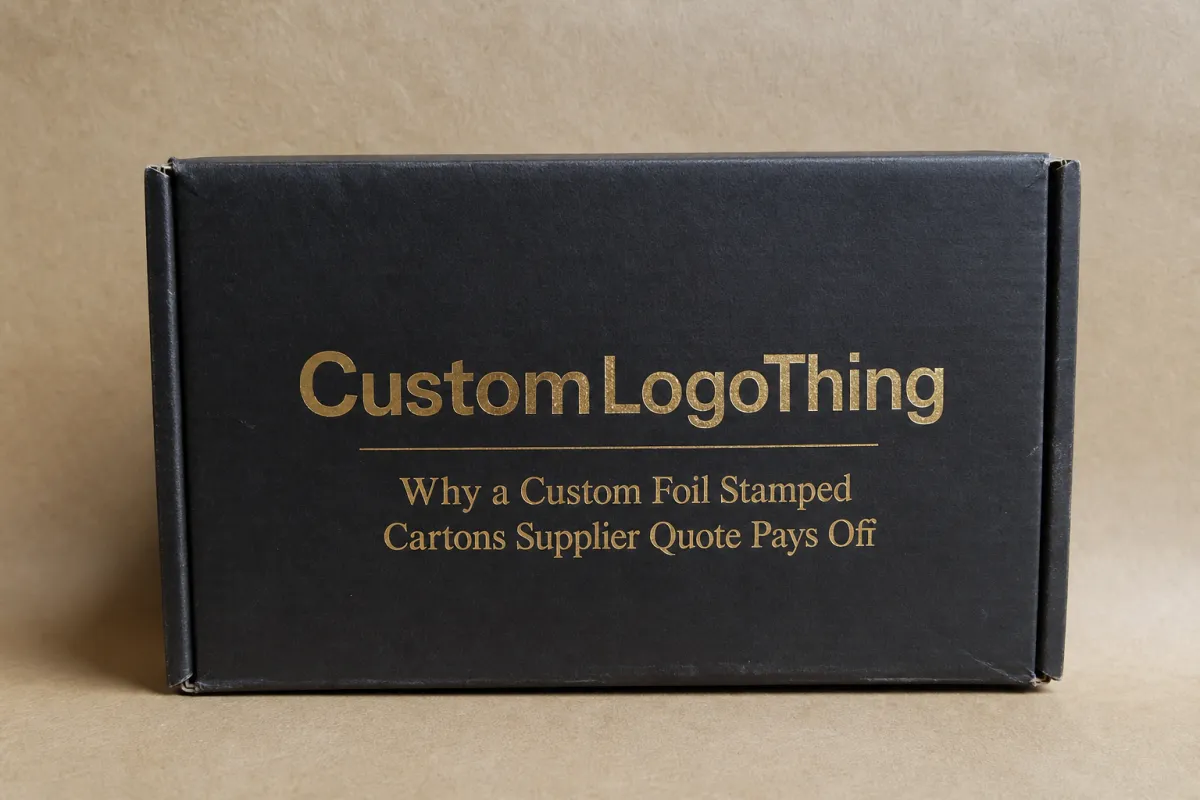
A proper quote does more than hand back a unit price. It shows whether your carton structure, foil area, and production path fit the budget and the timeline. Foil stamping is rarely just "foil." It affects tooling, plate prep, registration, press time, and sometimes the order of operations with lamination, embossing, or coating. A good quote surfaces those costs early. A weak one hides them until the project is already in motion.
Buyers sometimes assume the foil line is the expensive part and everything else is routine. Not quite. A small foil logo on a standard folding carton can be efficient and clean if the board is right and the artwork is disciplined. The price usually rises because of complexity: wide foil coverage, tiny reversed type, multiple foil hits, mixed finishes, or a carton style that needs extra setup. Ask for the custom foil stamped cartons supplier quote early enough, and you can see where the cost is actually coming from instead of guessing.
That early quote also helps internally. Finance wants a ceiling. Sales wants the launch to feel premium. Operations wants packaging that does not create a problem on the line or in transit. Those conversations go better when the supplier has enough detail to price the job properly. A quote based on a real dieline and actual finish spec is useful. A quote based on "something elegant" is not. Elegant is not a measurement.
Foil stamping earns its place when the carton has to do visual work. Luxury retail cartons, seasonal packaging, cosmetics, gift packaging, and launch boxes are obvious candidates. So are smaller runs where the carton itself has to carry the brand without help from a bigger display program. A clean carton with controlled foil often does more for shelf presence than a heavier board upgrade nobody notices. That tradeoff matters. Buyers should think in terms of impact per dollar, not just material weight.
There is another reason to quote early: it reduces surprises. A supplier can tell you before production starts whether the carton needs a special die, whether the foil coverage is too ambitious for the budget, or whether the target ship date forces rush production. That is where the real savings happen. Not in vague promise language. In actual numbers.
If a supplier cannot explain what is included in the quote, the number is not a buying number. It is a teaser.
Product Details That Affect the Quote
Cartons do not price themselves the same way. That should not surprise anyone who has spent time around packaging. A folding carton is not a rigid box. A sleeve is not a tuck-end. A mailer with foil decoration is not the same job as a cosmetics carton with full-panel finishing. The more precisely you define the carton type, the more accurately the supplier can price the right process.
Start with structure. Common options include folding cartons, tuck-end cartons, sleeve cartons, rigid-style cartons, and cartons with custom inserts. Each one changes material usage, setup, and finishing time. A simple tuck-end box on 16pt SBS or 18pt C1S artboard is usually faster to price than a sleeve with windows, inserts, and multiple finishing steps. If you are sourcing custom printed boxes for retail packaging, that structural gap matters more than most buyers realize.
Foil choice is the next big variable. Gold and silver are obvious, but holographic foil, matte foil, and subtle metallic accents show up more often now in branded packaging. Spot foil on a logo is usually easier to manage than full-panel foil. A small highlight line around a wordmark is not the same as flooding the entire face of the carton. More coverage means more press attention, more variation risk, and usually more cost. Straightforward enough.
Print and finishing stacks change the quote too. A CMYK carton with spot foil is one price. A carton with CMYK, foil, soft-touch lamination, and embossing is another. Add debossing, window patching, or specialty coatings and the number moves again. Those choices are not just cosmetic. They affect make-ready, machine time, and the number of steps needed to get the job out the door without defects.
Artwork complexity matters more than many buyers expect. Fine-line logos need tighter registration. Large solid foil areas can show scratches, dirt, or uneven transfer if the board surface is not right. Tiny reversed type is risky because foil fill can break down at small sizes. In packaging, the art file is not just a creative asset. It is production data, and production data needs to be clean.
Use case matters too. A launch carton for a prestige skincare item needs stronger visual impact than a plain shipping carton with a branded sleeve. A gift-ready box for seasonal packaging may justify a heavier finish stack because the unboxing moment is part of the sale. E-commerce packaging has a different job again: it has to look good and survive handling. If you know the use case, the supplier can recommend the right balance instead of pricing the most expensive option by default.
Specifications to Lock Before You Request a Quote
This is the part most buyers skip, then wonder why the quote is messy. The supplier needs more than a brand name and a rough idea. To price a carton correctly, lock the core specs before you send the request. Internal dimensions, board thickness, carton style, foil color, print sides, and closure method should all be clear. Leave one out and the quote turns into a guess.
Dielines deserve special attention. Without an accurate dieline, the supplier has to assume panel sizes, flap dimensions, and foil placement. That is how pricing gets distorted and tooling gets wrong. A dieline shows where the folds are, where the safe zones sit, and where the finish can actually live. No dieline, no real quote. You do not need design mythology here. You need measurements.
Artwork requirements should be equally clean. Send vector logo files where possible, not a low-resolution screenshot pulled from a sales deck. If the design uses foil, include a foil mask layer so the production team knows exactly what gets stamped. Confirm bleed, safe zone, and whether the foil sits on top of varnish, matte lamination, or soft-touch film. That detail changes the appearance and sometimes the manufacturing sequence. A good packaging buyer settles that up front.
Performance requirements matter too. How much does the product weigh? Will the carton travel through distribution, sit on a retail shelf, or ship direct to consumer? Does it need to survive handling in a warehouse, or is it display-only? If the box is part of product packaging that moves through multiple touchpoints, the material and finish choices should reflect that reality. A carton that only looks good in a rendering is not much help in the real world.
Sustainability and compliance notes belong in the request as well. If you need FSC-certified board, say so. If your retailer requires recycled content, note the percentage target. If the product has food-contact limitations or regulatory rules, state it plainly. For environmental sourcing guidance, the Forest Stewardship Council has useful information on certified materials at fsc.org. If your team cares about transit durability, shipping conditions, and drop-test planning, ISTA's testing resources at ista.org are worth a look. Standards do not exist for decoration. They keep a good quote from turning into a headache.
Short version: better inputs mean less interpretation. Less interpretation means fewer revisions, fewer surprises, and a cleaner path from quote to production.
Cost, Pricing, MOQ, and Quote Drivers
Pricing on foil stamped cartons comes down to a few basic levers. Carton size, board stock, foil area, print coverage, finishing steps, and total run quantity do most of the work. Change one and the quote changes. Change three and the number will probably move a lot.
MOQ exists for a reason. Tooling, plates, and press setup do not scale nicely on tiny orders. A supplier still has to mount the job, align the foil, check registration, and run samples. Those fixed costs are spread across fewer boxes on short runs, which pushes the unit price higher. That is not a penalty. That is arithmetic.
To make quote comparisons easier, it helps to think in order bands. Below is a practical way to read pricing, assuming a common folding carton, a single foil color, and standard print coverage. Real numbers move with size, board, and finish complexity, but the pattern usually looks like this:
| Order Band | Typical Unit Price Range | What Usually Drives It | Best Fit |
|---|---|---|---|
| 500-1,000 units | $0.85-$1.80 | Setup costs, smaller spread of tooling, limited foil coverage | Test launches, short seasonal runs, small branded packaging orders |
| 2,500-5,000 units | $0.42-$0.95 | Better setup efficiency, moderate print coverage, standard finishing | Market entry runs, gift sets, cosmetics, retail packaging |
| 10,000+ units | $0.18-$0.48 | Lower per-unit setup burden, higher press efficiency, repeatable specs | Core SKUs, scale production, ongoing product packaging programs |
Do not treat those ranges like gospel. A small box with simple one-color print and a tiny foil logo can sit near the lower end. A larger carton with soft-touch lamination, complex die cuts, and broad foil coverage can jump well above it. That is why a clean custom foil stamped cartons supplier quote should break down setup, material, and finishing, not just hand over one number and hope nobody asks anything else.
Watch the hidden line items. Tooling can be separate. Sampling can be separate. Plates can be separate. Freight can be separate. Rush fees can be separate too, and they rarely hide well for long. If the deadline is tight, the supplier may need to shift production blocks or prioritize your run over a larger order. That costs money. Better to know that before approval than after the PO is signed.
One useful habit: compare quotes only after the specs match exactly. Same board. Same dimensions. Same foil area. Same print coverage. Same shipping destination. If one vendor quotes a 16pt SBS carton with spot foil and another quotes 18pt board with lamination and freight included, you are not comparing the same thing. You are comparing confusion.
A cheaper quote is only cheaper if it includes the same work. Missing tooling, missing freight, and missing setup are not savings. They are future invoices.
Here is a simple comparison approach that saves time:
- Low-run pricing: judge setup charges and MOQ first, because unit cost will almost always look higher.
- Mid-run pricing: judge how efficiently the supplier handles finishing and whether the foil coverage is truly comparable.
- Repeat-order pricing: judge consistency, lead time stability, and whether the quote locks the same spec every time.
If a supplier can give you two or three finish options side by side, even better. A plain foil logo, a foil plus lamination version, and a more elaborate version with embossing can show you where the real spend sits. That is a buying decision, not guesswork.
Process, Timeline, and Lead Time for Production
The production path is usually simple, but only if the information is. First comes the inquiry. Then the supplier reviews the structure, artwork, and quantity. After that comes the quote, dieline check, and artwork prep. Sampling follows if the project is new or if the finish needs verification. Once the sample or proof is approved, production starts, then packing and shipment close the loop.
Time gets lost in predictable places. Missing specs are the biggest one. Unclear foil placement is another. Late artwork changes can push the entire schedule because foil masks and plates may need revision. Approval delays on samples or proofs show up all the time too. Teams send the quote request in a rush, then disappear for a week while operations, sales, and marketing argue over the same carton. The calendar does not care.
Lead times depend on complexity. A repeat order with approved tooling and final artwork can move faster, often around 10-15 business days after approval for production, depending on quantity and factory load. A new project with fresh tooling, sample approval, and multiple finishing steps often needs 15-25 business days or more. Add freight time after that. Domestic transit might take several business days. Ocean shipping takes longer. If the launch date is fixed, count backward and leave room for proofing.
Rush jobs are possible, but they are not magic. Some steps can be accelerated. Others cannot. Tooling still has to be made. Foil registration still has to be checked. Printing still has to dry or cure. If a supplier promises to rush everything without explaining the risk, that is not confidence. That is a reprint waiting to happen. Better suppliers tell you what can move faster and what should not be rushed.
For buyers managing branded packaging across multiple SKUs, the smart habit is to plan the quote request before creative lock. If the carton size, finish target, and launch window are known early, the supplier can flag cost-saving moves before production starts. Maybe you reduce foil coverage. Maybe you drop embossing. Maybe you simplify the structure and keep the premium look in the logo and one accent panel. That kind of adjustment is much easier before approval than after sampling.
Here is a practical backward plan:
- Set the in-hand date first.
- Subtract freight and receiving time.
- Subtract production time with a buffer for sampling.
- Subtract artwork and proof approval time.
- Request the quote before the project starts drifting.
That sounds basic because it is. It also happens to be the point where plenty of packaging programs go sideways. If the timeline is real, the quote has to be real too.
Why Choose Us for Your Foil Stamped Cartons
A good supplier does not win on drama. It wins on consistency. Sharp foil registration, stable color, honest communication, and clear prepress support matter more than fancy promises. In packaging, reliability is not boring. It is the whole job.
What should you expect from a serious quote process? First, the team should ask for the right inputs instead of pretending they can price a carton from a logo file alone. Second, they should flag risk points early. If the foil area is too large for the board, say so. If the requested finish stack is likely to make the carton expensive or brittle, say that too. Third, they should suggest practical alternatives. Maybe a smaller foil area gets you most of the visual impact for less money. Maybe a different board gives a cleaner stamp. Maybe a simpler structure supports better shelf performance.
That is where sourcing teams save time. Less revision churn. Fewer unclear emails. One point of contact who can actually answer production questions. If the supplier understands custom foil stamped cartons, the quote should feel like a roadmap, not a lottery ticket. And if you need support with samples or spec clarification, share the carton dimensions, quantity, and finish target through the same intake channel your supplier uses for production requests. That keeps the paper trail clean.
For buyers comparing suppliers, look for the practical stuff: sample support, QA checks, repeat-order consistency, and real packaging knowledge. A good partner can work across premium consumer categories without forcing every project into the same box style. Cosmetics are not supplements. Gift sets are not subscription mailers. Retail packaging has different demands than e-commerce packaging, and the quote should reflect that.
There is value in a supplier that understands the business side too. If your launch is small, a fair MOQ explanation matters. If your budget is fixed, a useful quote should show where to trim. If your product line will scale, the supplier should already be thinking about repeat production, not after the first PO. That is the difference between a vendor and an actual packaging partner.
We have seen too many buyers pay for glossy talk and get weak execution. Sharp foil, clean folds, and a carton that lands on time will always beat a sales pitch. Every time.
Next Steps to Turn a Quote Into Production
Once you have a quote, do not let it sit in a folder while the launch date drifts. The next move should be deliberate. Gather the core project data first: carton dimensions, quantity, finish target, artwork files, shipping destination, and desired delivery date. If the job has multiple SKUs, make that clear up front. If the order is a test run, say so. If it is a scale-up, say that too.
Before you send the inquiry, run a quick internal checklist. Confirm whether the project is for retail packaging, a mailer, a gift box, or a prestige carton. Confirm the budget range. Confirm whether the finish has to be exact or whether there is room for a lower-cost alternative. Confirm who approves artwork and who approves cost. Those are not glamorous questions, but they keep the order moving.
When the quote arrives, compare it on the same sheet. Look at unit cost, setup cost, MOQ, sampling terms, lead time, and freight assumptions. If one supplier includes setup and another does not, do not pretend those quotes are equal. If one supplier prices soft-touch lamination and another leaves it out, that is not a tie. It is a spec mismatch. This is basic purchasing discipline, and it saves money.
If the finish or structure is new, request a sample. A sample is cheaper than a full reprint. It also lets you check foil clarity, board feel, fold integrity, and how the carton performs under handling. If the sample is right, approve the dieline, lock the foil area, and move to production. If it is off, fix it before the run, not after the boxes are in transit.
For teams that want to move quickly, the cleanest path is simple: send precise specs, ask for a line-by-line quote, and keep the decision chain short. That is how a custom foil stamped cartons supplier quote becomes an actual order instead of a long email thread with no end.
The most practical takeaway is also the least glamorous: lock the carton size, board, foil area, and shipping target before you request pricing. If those four pieces are clear, the custom foil stamped cartons supplier quote becomes useful fast, and the odds of a clean first run go up with it. Everything else is just avoiding an expensive second round.
FAQ
How do I get an accurate custom foil stamped cartons supplier quote?
Send exact carton dimensions, quantity, board type, foil color, print coverage, and target ship date. Attach dielines and editable artwork so the supplier can price tooling and registration correctly. Ask whether the quote includes sampling, setup, freight, and any finishing charges.
What affects MOQ on foil stamped cartons most?
Tooling and setup costs are the biggest reason MOQ exists. More complex structures, heavier board, and larger foil coverage usually push the minimum order higher. If you need a lower MOQ, expect a higher unit cost.
Why do two foil carton quotes look so different?
One quote may include setup, plates, and freight while the other leaves them out. Different board grades, foil areas, and print methods can change the real cost a lot. Always compare identical specs before assuming one supplier is cheaper.
How long does foil stamped carton production usually take?
New projects usually take longer because of proofing, sampling, and approval steps. Repeat orders move faster when the dieline and artwork are already approved. Rush timelines are possible, but they usually cost more and leave less room for revision.
Can I reduce cost without ruining the premium look?
Yes. Reduce foil coverage, simplify the structure, or use a more efficient board spec. Keep the logo and key brand marks in foil, then remove decorative coverage that does not sell the box. Ask the supplier to quote two or three finish options side by side.

