Buyer Fit Snapshot
| Best fit | foil stamped kraft bags bulk for packaging buyers comparing material specs, print proof, MOQ, unit cost, freight, and repeat-order risk where brand print, material, artwork control, and repeat-order consistency matter. |
|---|---|
| Quote inputs | Share finished size, material target, print colors, finish, packing count, annual reorder estimate, and delivery region. |
| Proofing check | Approve dieline scale, logo placement, barcode or warning zones, color tolerance, and any recyclable or compostable wording before bulk production. |
| Main risk | Vague material claims, crowded artwork, or missing packing details can create delays even when the unit price looks attractive. |
Fast answer: Foil Stamped Kraft Bags Bulk: Pricing, Specs & Timeline should be specified like a repeatable production item. The safest quote includes material, print method, finish, artwork proof, carton packing, and reorder notes in one written spec.
What to confirm before approving the packaging proof
Check the product dimensions against the actual filled item, not only the sales mockup. Ask for tolerance on folds, seals, hang holes, label areas, and retail display edges. If the package carries a logo, QR code, warning copy, or legal claim, reserve that space before decorative graphics fill the panel.
How to compare quotes without losing quality
Compare board or film grade, print process, finish, sampling route, tooling charges, carton quantity, and freight assumptions side by side. A lower quote is only useful if the supplier can repeat the same color, closure quality, and packing count on the next order.
Foil Stamped Kraft Bags Bulk: Pricing, Specs & Timeline
If you are comparing Foil Stamped Kraft bags bulk options for a retail counter, trade show, boutique handoff, or gift presentation, the real question is not whether the bag looks premium. It is whether the structure, foil area, paper weight, and reorder math match the product, the brand, and the way your team receives inventory.
Kraft gives the bag a grounded, tactile feel. Foil adds the sharp highlight that makes a logo read from across a counter. Put them together at volume and you get Packaging That Ships flat, stores efficiently, and carries more visual weight than the material cost suggests.
"A good foil bag should feel firm at the bottom seam, read clearly from a few feet away, and still stack cleanly in a carton."
Why foil stamped kraft bags bulk orders punch above their weight
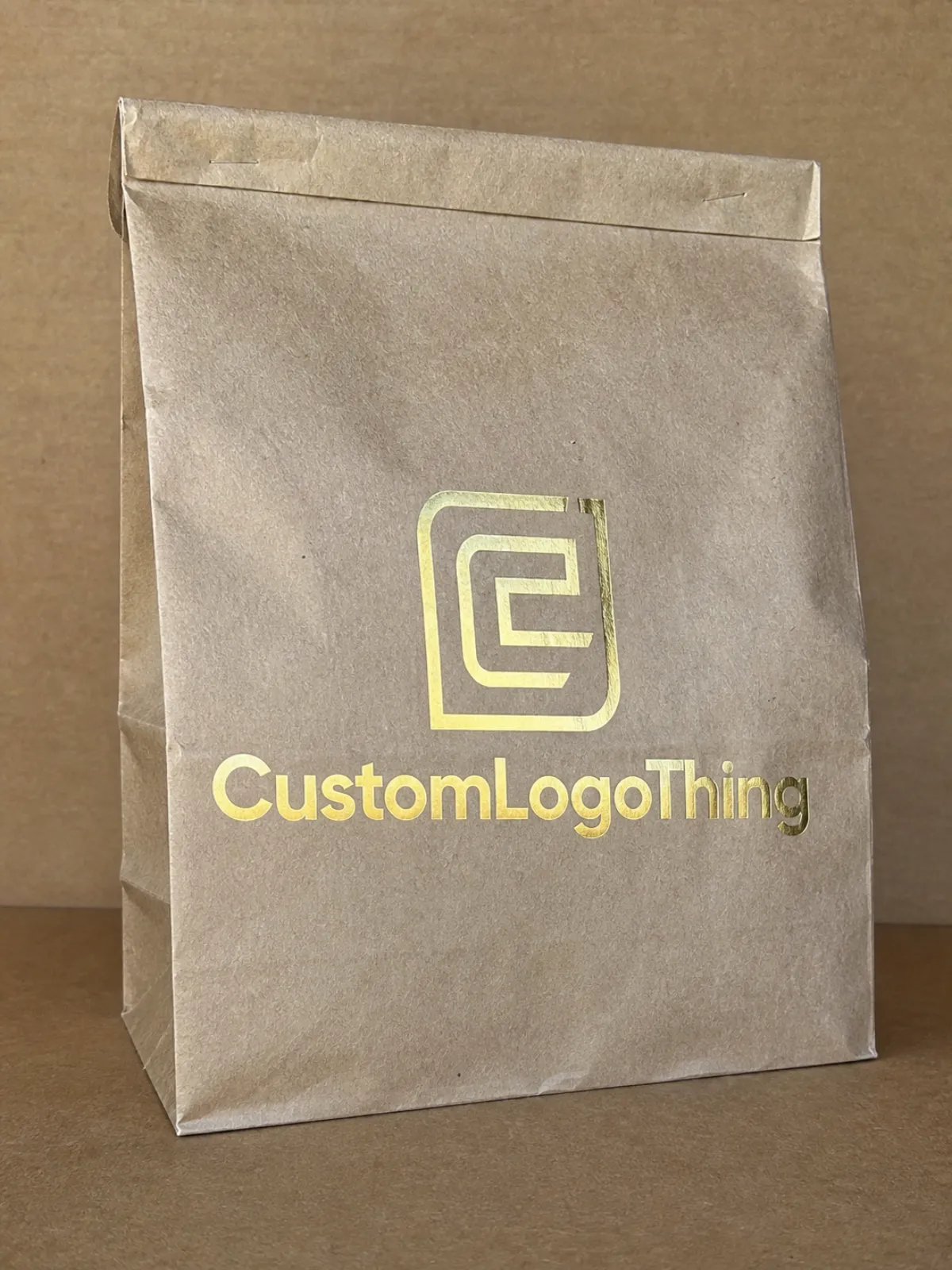
A plain kraft bag already does useful work. It protects the purchase, gives the customer a handle, and keeps your brand visible after the sale. Once foil hits the logo, the bag moves into a different category: still practical, but noticeably more polished. That is why foil stamped kraft bags bulk purchases show up so often at checkout counters, event booths, and gift handoffs where packaging is part of the experience, not just a carrier.
From a packaging buyer's point of view, this format is appealing because the structure stays uncomplicated. There is no heavy lamination, no full flood of ink, and no complicated finishing stack to manage. The bag can still ship flat, be counted by the carton, and tuck into a backroom rack or warehouse shelf without taking over floor space. That matters when you are buying for a chain of stores, a seasonal program, or a busy fulfillment operation where storage space is always under pressure.
The economics improve quickly once the fixed costs are spread across volume. A foil die, plate setup, and proofing round do add expense at the beginning, but those costs become easier to absorb when the same bag is used across recurring purchases. In practice, the buyer is usually balancing three things at once: the first-run setup, the per-unit cost, and the chance of reordering the same size before the season turns. That is where bulk buying earns its keep.
There is also a branding advantage that is easy to underestimate. Kraft has a tactile, familiar surface that feels honest and workmanlike, while foil brings in a controlled flash that catches light without turning the bag into a billboard. Gold foil on brown kraft feels warm and giftable. Silver reads cleaner and more modern. Copper sits between the two, with a softer retail look. A strong logo in the right foil color can make an otherwise modest bag feel intentionally designed.
The better question is rarely, "Does it look good?" The better question is, "Does it carry the product well, match the brand, and make sense at reorder time?" If the answer is yes, bulk Foil Stamping on kraft is often one of the more dependable packaging buys available.
Product details: kraft paper, foil stamping, and carry options
Kraft paper options
Kraft paper is not one material so much as a family of choices. Brown kraft made from recycled fiber gives a natural, earthy look and usually keeps costs in a comfortable range. Virgin kraft tends to have a cleaner surface and stronger tear resistance, which can matter if the bag holds heavier boxed goods or bottles. Bleached kraft offers a brighter base for foil contrast, although it reads less rustic and more refined.
A buyer looking at recycled content should also ask whether the supplier can document fiber sourcing. If sustainability claims need support, ask for FSC chain-of-custody paperwork and verify what is actually certified, not just what appears in a spec sheet. The FSC program explains the certification framework clearly at FSC. That matters if the bag is being used in retail, hospitality, or corporate gifting where environmental language is part of the brand promise.
Paper weight is another practical difference. Light kraft around 120gsm to 150gsm can work for apparel, brochures, and other low-load uses. Moving into 180gsm to 250gsm gives the bag more body and better resistance to creasing. For heavier retail items, the material alone is not enough; the bottom insert, side gussets, and handle attachment must all be considered together. The surface finish matters too, because rougher kraft can make very small foil details appear broken or irregular.
Foil stamping and carry builds
Foil stamping uses heat and pressure to transfer a metallic or pigment layer onto the paper surface. The result is a crisp logo with a reflective finish that sits on top of the bag rather than soaking into it like ink. On kraft, that contrast is the point. The logo becomes easier to read, but the paper still keeps its natural character.
The foil color should be chosen with the bag color in mind. Gold and copper tend to work well on brown kraft because the tones feel warm and intentional. Silver and white are usually stronger choices on darker or dyed kraft. Black foil can be surprisingly effective when the goal is restrained branding rather than shine. The key is contrast and line weight. Thin lines and tiny text can disappear into the rougher paper grain, especially if the design is crowded.
Carry style changes both the look and the load profile. Twisted paper handles are common for light to medium retail use and often keep the bag feeling coordinated and cost-effective. Flat paper handles can work for simpler runs, though they usually feel less upscale. Rope handles add a stronger hand feel and suit gift sets or heavier merchandise. Die-cut handles are useful for lower-profile gift bags and subscription packaging, especially when the bag is meant to sit flat in a box or bag insert.
If the bag will carry weight, the decoration cannot be treated as the main event. Reinforced top folds, handle patching, and bottom boards often do more to protect the customer experience than the foil does. A bag that looks beautiful but strains at the handle is a poor buy, no matter how clean the logo appears on the front panel.
Specifications that determine fit, durability, and print quality
Size and capacity
Bag sizing should start with the product, not the artwork. Width, gusset, and height must match the item being packed, leaving enough room for insertion and closure without creating a bag that swallows the product or collapses around it. A compact cosmetic set and a boxed candle need very different dimensions, even if the logo is identical. If the bag is oversized, the presentation feels loose. If it is too tight, loading slows down and the seams take more stress.
For most buyers, the first sizing question is practical: what is the largest item that must fit comfortably, and how much extra space is needed for tissue, inserts, or a receipt packet? A gusset depth that is too shallow can pinch the contents and make the bag look overstuffed. A bag that is too wide can shift in transit and lose the tidy silhouette that made it appealing in the first place. Good specification work keeps those problems out of the order before production begins.
It also helps to think about use case. A bag for a boutique jewelry counter can be lighter and smaller than one used for apparel, wine, or packaged gifts. A carryout bag for an event may need to be wider to handle odd-shaped inserts. If the same program will be used across multiple departments, standardizing on one or two sizes usually simplifies inventory and reduces the risk of running short on the wrong dimension.
Artwork and die rules
Foil stamping is forgiving in some ways and unforgiving in others. It handles bold type, simple marks, and solid shapes very well. It is less friendly to hairline strokes, tiny serifs, and crowded visual detail. As a rule of thumb, lines thinner than about 0.25 mm and text smaller than roughly 6 pt can start to lose clarity, depending on the paper surface and the foil color selected. Vector art is strongly preferred because it keeps the edges clean and makes the die-making step more predictable.
The foil die itself is one of the most important setup tools in the job. A simple one-color logo requires less die complexity than a large, detailed mark or a design with multiple separate elements. If the logo sits too close to a fold, handle patch, or gusset line, the impression can distort. If the design is centered too low, it may be hidden once tissue or product is loaded into the bag. That is why proof review should include not only the logo but also the final placement in relation to the bag construction.
Use the proof to check more than spelling. Confirm the live area, safe margins, and any knockouts or negative spaces that may print too delicately. If the design includes a fine script or a small tagline, ask whether it will still read after stamping on kraft. A strong production partner will flag risky artwork before the die is made, because fixing it later is always slower and more expensive.
Packing and storage
Most paper bags ship flat, which is a major advantage for freight and storage. Flat-packed cartons are easier to receive, count, and shelf than pre-opened bags. Carton counts vary by size and structure, but 100 to 250 bags per carton is common for many retail formats. Pallet configuration then depends on carton size, weight, and the receiving method at your warehouse or store.
Before approving the order, ask how many cartons the run will generate and whether the pallets will stack in your receiving area. A buyer who knows the carton count can schedule labor more accurately and avoid the scramble that often happens when a large shipment arrives all at once. If the bags will be used at several locations, split shipments may make more sense than sending every carton to one dock and asking the field team to redistribute them later.
For buyers who handle reorders frequently, it helps to keep the exact spec sheet, carton count, and approved artwork on file. That makes future replenishment much faster and reduces the risk of a subtle change sneaking into the next run.
Cost, pricing, and MOQ for foil stamped kraft bags bulk
Pricing is driven by a handful of variables that change the quote more than most buyers expect. Quantity is the biggest factor because setup costs get spread across more units as the run grows. After that, bag size, paper weight, handle type, foil coverage, and the number of foil colors all move the number up or down. A simple one-color logo on a standard stock size is a very different job from a custom-sized bag with reinforced handles and a large foil area on both sides.
It helps to separate one-time costs from recurring unit cost. The one-time side can include a foil die, setup labor, proofing, and any special cutting or converting work. The recurring side is the bag body, assembly, stamping time, inspection, and packout. Once those costs are clear, the buyer can see exactly what improves when the volume increases. That is usually the moment the order starts to make sense, because the spread between 500 pieces and 5,000 pieces can be dramatic.
Indicative pricing table below shows the kind of ranges buyers often use for planning. These are planning bands, not a firm quote, and freight is usually separate unless the supplier states otherwise.
| Order profile | Typical MOQ | Setup / die cost | Typical unit cost at 1,000 pcs | Typical unit cost at 5,000 pcs | Best fit |
|---|---|---|---|---|---|
| Standard kraft bag, one foil color, single-sided logo | 250-500 pcs | $180-$450 | $0.55-$1.20 | $0.32-$0.72 | Retail handoff, events, gifts |
| Custom size, one foil color, heavier paper | 500-1,000 pcs | $250-$700 | $0.85-$1.60 | $0.50-$1.05 | Apparel, boxed goods, specialty retail |
| Reinforced build, rope handles, larger foil area | 500-1,000 pcs | $300-$800 | $1.10-$2.25 | $0.70-$1.45 | Heavier products, premium gifting |
| Two-sided foil or complex artwork | 1,000+ pcs | $350-$1,000+ | $1.35-$2.80 | $0.85-$1.70 | Brand-forward retail programs |
MOQ is usually shaped by the amount of setup required and whether the order uses standard tools or custom tooling. Standard sizes often support lower minimums because the bag body is already established and the production line is easier to schedule. Fully custom dimensions, unusual handle builds, or multiple foil colors usually raise the minimum because the run takes longer to set up and verify. If the budget is tight, a standard size with a smarter artwork layout is often the quickest path to value.
There are also savings on the sourcing side that do not show up at first glance. A single foil color is usually easier to control than multiple finishes. A cleaner logo with fewer fine details stamps more reliably and reduces spoilage risk. A standard brown kraft stock often costs less than dyed or bleached options, while still giving the warm presentation many brands want. Most buyers can lower total cost more by simplifying the spec than by squeezing pennies out of the unit price.
Always ask for a landed-cost quote. That means production, packaging, freight, and any receiving charges are all considered together, not just the printed bag price. A lower unit cost can be misleading if the freight is heavy, the carton count is high, or the bag has to ship in multiple partials. From a purchasing standpoint, the cheapest line on the quote is not always the lowest total spend.
Process and timeline: from artwork approval to delivery
The order process usually starts with a spec check. Size, quantity, kraft color, handle style, foil color, and artwork format should all be confirmed before the quote is locked. If those details are left vague, the project tends to drift. Clear specs shorten the back-and-forth and give the production team a better shot at hitting the requested ship window.
Artwork review comes next. Files should be checked for resolution, stroke weight, outline status, and placement on the bag panel. Vector files are the safest path because they scale cleanly for die making. If the logo needs cleanup, that work should happen before approval, not after the die is already in motion. A careful proof stage is one of the easiest ways to avoid waste.
The typical production sequence is straightforward: die creation, proof approval, foil stamping, bag assembly, inspection, and final packing for shipment. On a repeat order, the timeline can move faster because the die and artwork are already on file. On a fresh order with a new size or more detailed artwork, the schedule usually stretches.
For planning purposes, many standard custom runs fall into a range of about 12 to 15 business days after proof approval, while more involved jobs can take 15 to 25 business days or more. Add shipping time on top of that. If the bags must arrive before a launch, trade show, or seasonal window, build in buffer time for proof revisions and freight delays. One extra revision round can easily add a day or two, and a custom die can add several more.
Some buyers overlook the delivery details and focus only on production. That can create avoidable headaches. Ask how cartons will be labeled, whether pallets need a dock for unloading, and if the shipment should go in one release or several smaller drops. If the bags are going to multiple stores or fulfillment centers, split delivery can save a lot of labor on the back end.
For transport validation, especially where the bags will be packed with other goods and reshipped, distribution testing standards such as ISTA are a useful reference point. The bag itself may not need laboratory testing every time, but the package chain around it often does, and that is where ISTA guidance becomes practical.
Why choose us for bulk foil stamped kraft bags
Buying foil stamped paper packaging is less about chasing flashy finishes and more about controlling the details that keep a program stable. Consistent paper sourcing, clean stamping pressure, accurate handle placement, and repeatable assembly are what keep the finished bag looking the same from the first carton to the last. That kind of consistency is what a bulk buyer needs.
Good production support also means honest feedback. If the artwork is too fine for the paper, it should be flagged. If the requested timeline is too tight for a new die and a custom size, that should be said early. If a heavier stock would prevent the bag from bowing at the gusset, the supplier should explain that tradeoff in plain language. Clear guidance saves money because it avoids preventable mistakes.
For recurring buyers, our Wholesale Programs page is a practical starting point because it helps organize larger purchase plans, repeat bag sizes, and reorder timing without forcing every project to begin from zero. That matters when the same packaging is used across multiple launches or store cycles.
Shipping and logistics are part of the job, not an afterthought. Bulk packaging often means carton counts, pallet planning, warehouse delivery windows, and careful labeling so the right store or distribution center receives the right quantity. A supplier that pays attention to those details is easier to work with and less likely to create a downstream issue for receiving staff.
The value here is straightforward: dependable foil stamped kraft bags, produced in sensible volumes, with realistic timing and no surprise cost jumps. If the bag has to look premium at point of sale, survive transport, and reappear on a customer's desk or counter after the sale, the spec needs to support that reality. That is where disciplined sourcing makes a visible difference.
Next steps to order foil stamped kraft bags bulk
The fastest quote starts with the right information. Gather the bag dimensions, quantity, kraft color, handle type, foil color, artwork file type, and the approximate weight or product category the bag will carry. If the product includes a box, bottle, or insert, mention that too. The quote gets more accurate when the supplier understands not just the logo, but the use case.
If you can, send the artwork and the packing scenario together. A logo that looks clean on a screen may still need a thicker stroke or a better placement on the front panel. A bag that looks fine for apparel may need a stronger bottom if it will carry boxed skincare, glass, or multiple items. The more context you provide, the better the spec can be matched to the job.
Before production begins, review the proof carefully. Check spelling, placement, foil color, and the relationship between the logo and the bag construction. Confirm the timeline in writing, and make sure the shipping destination, carton count, and delivery window are correct. That small amount of review prevents most of the avoidable problems that turn a simple packaging buy into a time sink.
It also helps to think about the reorder cycle now, not later. If the bags will be used for seasonal retail, recurring event packing, or subscription kits, leave room for a replenishment plan before stock gets tight. The most efficient bulk orders usually come from buyers who know how quickly they burn through the first run and place the next order early enough to avoid rush charges.
For a clean purchase decision, keep the spec simple, the numbers realistic, and the timeline honest. That is usually the shortest route to the right result for foil stamped kraft bags bulk orders, especially when the bag has to look good, carry properly, and arrive on time without forcing compromises in the final week.
Frequently Asked Questions
What is the MOQ for foil stamped kraft bags in bulk?
MOQ usually depends on bag size, foil coverage, handle style, and whether a custom die is needed. Standard sizes with one foil color often carry lower minimums than fully custom constructions, because the production setup is easier and the tooling is already familiar. If you need a tighter budget, ask whether a similar stock size can reduce the minimum order without hurting the fit.
How much do foil stamped kraft bags bulk orders cost per unit?
Unit cost drops as quantity increases because setup and die costs are spread across more bags. Paper weight, handle type, and foil area all influence the final per-bag price, and freight can change the landed cost more than buyers expect. Ask for a landed-cost quote so production, packaging, and shipping are compared on the same line.
Can foil stamped kraft bags bulk be shipped flat?
Yes, many kraft bags are packed flat to reduce freight cost and storage space. Flat-packed cartons are easier to receive, count, and store in a warehouse or backroom, which is why this format works well for bulk programs. Confirm carton quantities and pallet dimensions before placing a large order so the receiving team has a clear plan.
How long does production take for foil stamped kraft bags bulk?
Timeline depends on artwork approval, die creation, production scheduling, and shipment method. Custom sizes or revised artwork usually add time compared with repeat orders, and even a simple proof change can move the schedule. Build in extra time if the bags are needed for a launch, event, or seasonal window.
What artwork works best for foil stamped kraft bags bulk?
Vector files are preferred because they keep edges sharp and make die creation easier. Simple logos, bold type, and clean spacing usually stamp better than tiny details, which is why outlined fonts and thicker strokes are the safest choice for foil stamped kraft bags bulk.
For buyers, the clearest path is usually the simplest one: choose the lightest paper that still supports the load, keep the foil design bold enough to survive the kraft texture, and ask for a landed-cost quote before approving the run. That combination keeps the order grounded in real use, not just a pretty proof.

