Buyer Fit Snapshot
| Best fit | Foil Stamped Packaging Labels Supplier projects where brand print, material claims, artwork control, MOQ, and repeat-order consistency need to be specified before quoting. |
|---|---|
| Quote inputs | Share finished size, material target, print colors, finish, packing count, annual reorder estimate, ship-to region, and any compliance wording. |
| Proofing check | Approve dieline scale, logo placement, barcode or warning zones, color tolerance, closure strength, and carton packing before bulk production. |
| Main risk | Vague material claims, crowded artwork, missing packing details, or unclear freight terms can make a low unit price expensive after revisions. |
Fast answer: Foil Stamped Packaging Labels Supplier: Material, Adhesive, Artwork, and MOQ should be specified like a repeatable production item. The safest quote records material, print method, finish, artwork proof, packing count, and reorder notes in one written spec.
Production checks before approval
Compare the actual filled-product size with the drawing, then confirm tolerance on folds, seals, hang holes, label areas, and retail display edges. Reserve space for logos, QR codes, warning copy, and material claims before decorative graphics fill the panel.
Quote comparison points
Review material grade, print process, finish, sampling route, tooling charges, carton quantity, and freight assumptions side by side. A quote is only useful when the supplier can repeat the same color, closure quality, and packing count on the next order.
A foil stamped packaging labels supplier gets blamed for weak shine more often than it should. The real problem usually sits somewhere else: the adhesive was wrong, the substrate was wrong, or the finish looked great on a monitor and fell apart on the actual pack. If you are buying for branded packaging, retail packaging, or product packaging, the supplier matters because the label has to look premium and survive handling, storage, and shipping without turning into expensive scrap.
That is why a good foil stamped packaging labels supplier is not just a printer. The job includes design support, foil selection, print production, die-cutting, finishing, and quality control. The better vendors also help you avoid the classic mistake: approving a flashy sample that has nothing to do with the carton, jar, bottle, or sleeve you plan to use. For teams managing custom packaging, that kind of grounded decision-making saves money and keeps brand presentation consistent across runs.
If you are comparing options for Custom Labels & Tags alongside other Custom Packaging Products, the goal is not to chase the brightest surface. It is to match the label structure to the package surface, the storage conditions, and the brand budget. That is the line between a label that upgrades the pack and one that turns into a production headache.
Shiny is not the same as durable. A foil label that looks perfect on a flat sample can fail on a curved bottle, a textured carton, or a chilled jar if the spec is wrong.
What a foil stamped packaging labels supplier actually does
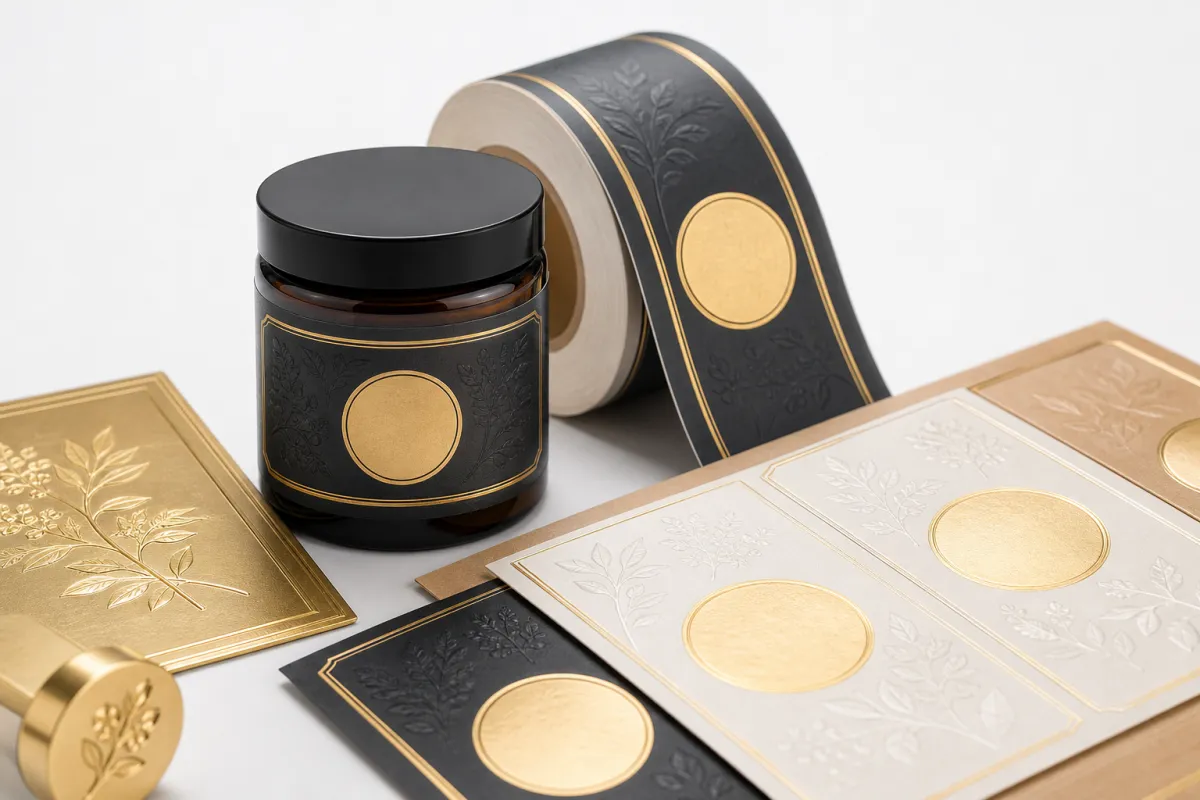
A foil stamped packaging labels supplier turns a visual idea into a label that can actually be produced and applied. That sounds simple. It is not. Most problems start before production begins, usually because the buyer brought artwork and a rough idea of “premium” without saying what the pack surface is, how the label will be applied, or whether the product sits in a warehouse, refrigerator, or humid retail environment.
The supplier’s role usually covers a few core steps. First comes artwork review and spec cleanup, including bleed, foil placement, line weight, and text size. Then comes foil selection, which can include silver, gold, holographic, matte metallic, or specialty pigment foils. After that comes print production, die-cutting, finishing, and inspection. A solid foil stamped packaging labels supplier will also flag details like minimum type size, foil coverage limits, and whether the design needs stronger contrast so the metallic area does not swallow important copy.
Brands use foil labels for cartons, jars, bottles, sleeves, and promotional packaging because foil adds perceived value without forcing a full custom box upgrade. That matters in beauty, supplements, gifts, candles, and limited-edition retail packaging where the box or container itself may stay simple, but the label has to carry the brand story. A smart supplier understands that package branding is not decoration for decoration’s sake. It is the first signal that the product was handled with care.
Sustainability matters here too. A better spec can cut overprinting, rework, and wasted inventory. If a foil stamped packaging labels supplier can recommend the right substrate for the actual package surface, you are less likely to reprint because labels curl, lift, or scuff during application. That is not glamorous. It is just operations that work. And from a packaging buyer’s point of view, that beats pretty promises.
There is also a real difference between foil stamped labels, hot-stamped labels, and digital metallic effects. The terms get mixed up constantly, and that confusion leads to bad comparisons. Hot stamping uses heat and pressure. Cold foil transfers metallic foil during printing through an adhesive process. Metallic inks create a reflective effect but are not the same as real foil. A foil stamped packaging labels supplier should explain which method fits the design, the quantity, and the package surface instead of pushing the fanciest-sounding option.
How a foil stamped packaging labels supplier makes labels
The production path is straightforward, but every step can go sideways if the details are vague. A foil stamped packaging labels supplier usually starts with artwork preparation, then moves into plate or digital setup depending on the method. If the job uses hot stamping, the supplier prepares a die or plate that transfers foil under heat. If the job uses cold foil, the metallic layer is applied during the print process with adhesive and pressure. Either way, setup is where the expensive mistakes get caught, or ignored if nobody asks the right questions.
Substrate choice changes everything. Paper, coated stock, textured stock, and film all behave differently under pressure and heat. Smooth coated paper generally gives the cleanest foil edge. Textured paper can look rich, but it may create small breaks in the metallic area. Film can be strong for moisture resistance, but it can also be more demanding during application. A knowledgeable foil stamped packaging labels supplier will tell you whether the foil edge will stay crisp, whether the adhesive will anchor properly, and whether the finish will survive the product’s actual life cycle.
Here is a practical example. A lotion label on a curved plastic bottle needs a different setup than a rigid candle jar label. The curved bottle may need a more flexible film, a different adhesive tack, and a tighter die-cut tolerance so the label does not wrinkle at the edges. The candle jar, by contrast, may allow more decorative coverage and a heavier tactile stock because the surface is flatter and the handling conditions are less punishing. The same artwork can be a clean win on one pack and a mess on another. That is why the right foil stamped packaging labels supplier starts with the package, not the mockup.
Proofing deserves more respect than it gets. Digital proofs are useful for layout, spelling, barcode placement, and general color checks. They do not show the real foil reflectivity, the edge sharpness, or the way light hits the label in a store aisle. Physical samples or press proofs are better when the metallic area is a major part of the design. A serious foil stamped packaging labels supplier should be willing to provide both when appearance matters.
For brands that care about measurable print quality, the supplier may also reference standards such as ASTM peel-adhesion testing for labels or transit simulation under ISTA methods. That does not mean every project needs a lab report stapled to it. It does mean a good supplier can speak the language of performance, not just the language of “looks nice.” If you want more background on packaging materials and format choices, the Packaging School / packaging.org resource library is a useful place to compare basics without the marketing fluff.
Hot stamping, cold foil, and metallic ink
These three get lumped together, which is lazy and expensive. A foil stamped packaging labels supplier should walk you through the tradeoffs instead of pretending they are interchangeable.
| Method | Best for | Typical setup | Cost signal | Watch-outs |
|---|---|---|---|---|
| Hot stamping | Premium cartons, rigid labels, small to mid runs | Die or plate setup plus press time | Moderate setup, higher detail precision | Less forgiving on textured surfaces and curved containers |
| Cold foil | Longer print runs, integrated metallic designs | Adhesive application in-line with printing | Better efficiency at volume | Needs tight process control for registration |
| Metallic ink | Budget-conscious designs, soft metallic effects | Standard print setup | Lowest setup, lower visual punch | Not the same reflectivity as real foil |
If the brand wants a true metallic flash, metallic ink will not fool anyone. If the volume is high and the design repeats, cold foil can be efficient. If the focus is a premium accent on a special label or limited batch, hot stamping may be the better fit. The right foil stamped packaging labels supplier should explain the practical difference without the sales fog.
Key factors that affect quality and sustainability
Quality starts with material compatibility. Recycled paper, FSC options, coated stocks, and specialty films all behave differently under foil pressure and heat. A foil stamped packaging labels supplier should know whether your project needs a stock that accepts crisp foil detail or a film That Holds Up better against moisture and abrasion. If the label has to survive cold-chain storage, oily handling, or repeated consumer contact, that decision matters more than the color of the foil.
Adhesive selection is just as important. Permanent adhesive is common for cosmetics and consumer goods, but removable or repositionable adhesive may make more sense for temporary promotions or refill systems. Cold environments, humidity, and oily surfaces can make weak adhesives fail fast. From a sustainability point of view, the adhesive can affect recyclability, removability, and whether the label contaminates the package stream. If you are chasing a lower-impact build, look at the full stack, not just the shiny surface. The FSC site is a decent reference if your packaging spec needs certified paper options.
Durability tradeoffs are real. More foil coverage can create a high-end look, but it can also raise cost, slow production, and increase the chance of waste if registration drifts. A label with huge metallic coverage is harder to keep consistent than a label that uses foil as an accent. That is one of the first things a practical foil stamped packaging labels supplier will tell you if they are thinking like a production partner instead of a brochure writer.
Compliance matters too, especially in food, cosmetics, and wellness packaging. Certain applications may need migration-safe materials, specific liner choices, or finishes that stand up to oil, water, or refrigeration. A foil stamped packaging labels supplier does not replace regulatory review, but the supplier should know enough to flag obvious risks. If a label touches a product that will be stored near heat, humidity, or direct skin contact, the wrong finish can create a lot of rework. Brands hate rework. Finance hates it even more.
Quality and sustainability connect in a boring but useful way: fewer reprints, tighter registration, and longer label life often matter more than chasing the flashiest finish. If your pack design is a little less dramatic but runs cleanly and survives the shelf, that is usually the smarter trade. You can still keep the premium effect. Just do it with restraint. A capable foil stamped packaging labels supplier will usually respect that kind of brief.
Foil stamped packaging labels supplier pricing and cost drivers
Pricing gets easier to read once you break it into pieces. A foil stamped packaging labels supplier usually quotes for setup, foil type, material choice, label size, quantity, die complexity, and finishing steps. On smaller runs, setup costs can make the per-label price look annoyingly high. That is normal. The setup work does not disappear just because you only need 1,000 labels instead of 25,000.
Small runs nearly always cost more per label, even if the design is simple. Why? Because the die, press setup, foil calibration, color checks, and inspection have to happen whether you order 500 or 50,000. A decent foil stamped packaging labels supplier should show you unit pricing at several volume breaks so you can see where the real savings begin. If they only give one price and hope you stop asking, that is a red flag wearing a tie.
Hidden costs show up in familiar places: proof rounds, color matching, special adhesives, rush fees, and shipping for heavy rolls or sheeted labels. Foil jobs can also require extra handling because the metallic layer needs inspection for scuffs, pinholes, or registration drift. That is why quotes vary so much across suppliers. You are not just buying material. You are buying process control. A solid foil stamped packaging labels supplier will spell that out instead of hiding behind a single per-piece number.
Here is a practical pricing framework you can use before you request bids:
- Ask for unit pricing at 1,000, 5,000, and 10,000 pieces.
- Separate setup, material, finishing, and shipping.
- Confirm whether the quote includes one proof or multiple proof rounds.
- Ask how much the price changes if you switch to FSC stock or a specialty adhesive.
- Check whether the supplier charges more for curved-pack or cold-chain use cases.
Sustainability can affect cost too. Recycled stocks, FSC papers, and specialty liners may add cost upfront, but they can cut waste, improve brand fit, and prevent cheap-looking labels that force a reprint. I would take a slightly higher quote for a build That Actually Works before I would chase the cheapest vendor and hope for the best. That logic is especially true for a foil stamped packaging labels supplier because the finish is visible enough that defects show immediately.
For buyers comparing broader packaging budgets, it helps to remember that label cost sits inside the full product packaging stack. Saving a little on labels but losing money on rework, spoiled inventory, or launch delays is a very expensive form of penny pinching. If you are also evaluating cartons, inserts, or retail packaging components, keep the label quote in context with the rest of the package.
Foil stamped packaging labels supplier process and timeline
The timeline usually follows a simple sequence: brief, artwork review, material recommendation, proofing, sampling, approval, production, and shipping. A foil stamped packaging labels supplier that cannot explain those steps clearly probably cannot protect your launch date either. The steps are not complicated, but missing information at any point can add days or weeks.
Simple repeat jobs can move quickly, especially if the artwork, tooling, and substrate already exist. New projects take longer because the supplier may need custom dies, foil matching, and approval on the exact material. As a practical range, repeat foil label runs may ship in about 5-10 business days after approval, while new builds often sit closer to 12-20 business days, depending on complexity and proof rounds. A reputable foil stamped packaging labels supplier will give you a range, not a fairy tale.
The biggest bottlenecks are boring ones: missing dielines, unclear substrate choice, approval delays, and late changes to foil coverage. If the design team keeps moving the logo three millimeters every other day, the schedule will slip. That is not the supplier’s fault. It is just project management in a cheap suit. The fastest way to speed things up is to send dimensions, surface photos, target quantity, and storage conditions before you ask for quotes. A good foil stamped packaging labels supplier can make better recommendations with fewer back-and-forth emails.
One more thing buyers often forget: the package itself can drive timing. A label that must wrap around a curved jar, survive refrigeration, or match a textured carton may need a sample test before the full run starts. If the supplier asks for a sample pack or a target substrate, they are not being difficult. They are trying to avoid costly rework later. That is usually a sign of a competent foil stamped packaging labels supplier, not a difficult one.
For shipping and performance planning, transit testing can matter. If your labels are part of a multi-component mailer or a premium retail shipper, checking against relevant ISTA methods can save a headache. You do not need to turn every label order into a laboratory project. You do need a supplier who understands that a label stuck to a box is still part of the shipping system. If you want a broad technical reference, ISTA is a sensible place to start.
Common mistakes when choosing a foil stamped packaging labels supplier
The first mistake is choosing on price alone and then discovering the label fails on the actual package surface. A foil stamped packaging labels supplier can look cheap on paper and expensive in practice if the adhesive lifts, the foil cracks, or the substrate does not match the container. Buyers who only compare unit price usually end up paying for redo work, rush freight, or launch delays.
The second mistake is approving a proof without checking foil legibility, registration, and contrast at real viewing distance. A design that looks elegant at arm’s length can turn muddy on shelf. Tiny serif type in a bright foil area is especially risky. A better foil stamped packaging labels supplier will tell you whether the metal layer is overpowering the typography, and they will usually suggest a larger type size or a darker contrast point if the copy matters.
The third mistake is ignoring the package environment. Moisture, refrigeration, handling, and friction in shipping can all affect performance. A label on a candle box does not face the same punishment as a label on a chilled cosmetic bottle. If a supplier does not ask about storage conditions, they are guessing. A foil stamped packaging labels supplier should want to know whether the product sits in a warm warehouse, a cold chain, a bathroom shelf, or a shipping carton for three weeks.
The fourth mistake is using a supplier who cannot speak clearly about recyclability, liners, or adhesive removal when sustainability matters. A lot of buyers say they want sustainable packaging, then approve a spec that makes recycling harder than it needs to be. That is not strategy. That is wishful thinking. A credible foil stamped packaging labels supplier should help you narrow the build to what actually makes sense for the package, not just what looks virtuous in a slide deck.
The fifth mistake is forgetting inventory math. Ordering too few labels creates rush charges. Ordering too many creates obsolete stock if the formula, dosage, branding, or carton size changes. That tradeoff hits especially hard with seasonal launches and branded packaging tied to promotions. A practical foil stamped packaging labels supplier should help you estimate a sensible reorder point instead of pushing a one-size-fits-all quantity.
- Check the surface. Flat, curved, coated, textured, and refrigerated packs all behave differently.
- Check the proof. Make sure the foil is readable, not just shiny.
- Check the environment. Moisture, oil, and friction can wreck the wrong spec.
- Check the supply plan. Too little stock costs money. Too much stock sits there and mocks you.
Expert tips for choosing a foil stamped packaging labels supplier
Start with the package, not the artwork. Ask the foil stamped packaging labels supplier what substrate and adhesive they recommend for the actual container or carton. Send photos of the package surface, not just the design file. That one step eliminates a lot of bad assumptions. If your packaging design team works in isolation from production, the result usually looks better on a screen than it does on a shelf.
Request side-by-side samples of foil coverage instead of one polished proof under ideal lighting. Light changes everything. A finish that looks high-end in a studio can look flat in a warehouse and too bright under retail LEDs. A practical foil stamped packaging labels supplier should be comfortable showing multiple options, including different foil shades, coverage levels, and substrate pairings. If they only want you to see the prettiest sample, ask for the less flattering one too.
Ask for a quote that separates setup, materials, finishing, and shipping. That makes supplier comparisons honest. It also gives you room to change one variable at a time without blowing up the whole estimate. A strong foil stamped packaging labels supplier will not hide behind an all-in number if you need to understand where the money is going. If they do, you are not comparing vendors. You are comparing mystery boxes.
Use a simple spec sheet before requesting bids. Include dimensions, quantity, application method, storage conditions, foil area percentage, and sustainability targets. If you have secondary packaging in the same launch, tell the supplier how the label needs to fit alongside cartons, inserts, or sleeves. The more context you provide, the better the recommendation. This is one of the easiest ways to save time: a complete brief lets a foil stamped packaging labels supplier quote accurately the first time.
Also ask about lead time in plain language. Not “how fast can you do it,” but “what can slow it down, and what must I approve before production starts?” That question tells you whether the supplier understands risk. A trustworthy foil stamped packaging labels supplier will identify the bottleneck before it becomes your emergency.
If you are still narrowing options, shortlist two or three suppliers, ask for samples and lead times, compare total landed cost, and pick the partner who can prove the label will perform on your packaging. That may sound basic, but the basics are where most label programs succeed or fail. A good foil stamped packaging labels supplier makes the process boring in the best possible way: predictable, clean, and on schedule.
What should I ask a foil stamped packaging labels supplier before ordering?
Ask which substrate and adhesive they recommend for your exact package surface and storage conditions. Ask for sample photos or physical samples that show foil registration, edge sharpness, and legibility. Ask for separate pricing on setup, production, finishing, and shipping so the quote is actually comparable. If the supplier cannot explain the build in plain language, keep looking.
Are foil stamped packaging labels supplier options suitable for sustainable packaging?
Yes, if the supplier offers recycled stocks, FSC options, and adhesives that match your end-of-life goals. Sustainability depends on the full build, not just the shiny layer, so ask about liner, adhesive, and waste reduction. A better spec can reduce reprints and scrap, which often matters more than one material claim on paper. The glossy finish is only part of the story.
How long does a foil stamped packaging labels supplier usually take?
Simple repeat jobs can move faster because the artwork and tooling already exist. New projects usually take longer because sampling, approvals, and setup all have to happen first. Lead time is mostly affected by proof rounds, custom dies, and how quickly you approve the spec. If timing matters, share the launch date early and be honest about what can move.
Why do foil stamped packaging labels supplier quotes vary so much?
Quotes change because foil type, quantity, substrate, and finishing method all affect production cost. A low quote may leave out setup or rush charges, so check what is included before comparing. The cheapest supplier is not always the best if the labels fail during application or shipping. I have seen that mistake turn into a second production run, and nobody calls that cheap.
Can a foil stamped packaging labels supplier help with small runs?
Yes, but small runs usually carry a higher unit cost because setup is spread over fewer labels. A good supplier should suggest the most efficient format for your volume instead of forcing an oversized order. If you expect repeat demand, ask where the price break starts so you can plan the next run smarter. A capable foil stamped packaging labels supplier should also tell you whether your next order should stay with the same spec or shift to a more efficient build.
If you are building a foil label spec this week, lock down four things before you approve art: the actual package surface, the storage environment, the adhesive, and a physical sample that shows the real foil finish. That one check removes most of the avoidable mistakes and gives any foil stamped packaging labels supplier the context they need to quote honestly and produce labels that hold up on the shelf.


