Buyer Fit Snapshot
| Best fit | Freight Packaging for Ecommerce projects where brand print, material claims, artwork control, MOQ, and repeat-order consistency need to be specified before quoting. |
|---|---|
| Quote inputs | Share finished size, material target, print colors, finish, packing count, annual reorder estimate, ship-to region, and any compliance wording. |
| Proofing check | Approve dieline scale, logo placement, barcode or warning zones, color tolerance, closure strength, and carton packing before bulk production. |
| Main risk | Vague material claims, crowded artwork, missing packing details, or unclear freight terms can make a low unit price expensive after revisions. |
Fast answer: Freight Packaging for Ecommerce: Quote Scope should be specified like a repeatable production item. The safest quote records material, print method, finish, artwork proof, packing count, and reorder notes in one written spec.
Production checks before approval
Compare the actual filled-product size with the drawing, then confirm tolerance on folds, seals, hang holes, label areas, and retail display edges. Reserve space for logos, QR codes, warning copy, and material claims before decorative graphics fill the panel.
Quote comparison points
Review material grade, print process, finish, sampling route, tooling charges, carton quantity, and freight assumptions side by side. A quote is only useful when the supplier can repeat the same color, closure quality, and packing count on the next order.
Freight Packaging for Ecommerce can protect margin or quietly erase it. Most damage does not come from some cinematic truck crash. It starts earlier, in bad pack-out decisions, weak pallet builds, loose unitization, and the kind of "good enough" choices that look harmless until the claims file starts growing. Ship bulky products, fragile goods, or mixed multi-box orders, and freight packaging for ecommerce stops being a side detail. It becomes part of the operating model.
Handled well, freight packaging for ecommerce reduces damage claims, keeps labor predictable, and gives the warehouse a spec it can actually repeat. Handled badly, it creates rework, wasted materials, missed appointments, and returns that swallow the margin you thought you had. That is the real task here: practical freight packaging for ecommerce fundamentals, with enough detail to Choose the Right build without turning every pallet into a monument to overpacking.
I have sat through more than one post-mortem where the carrier was blamed first and the pallet was blamed second. The order should usually be reversed. In a surprising number of cases, the package did not survive because it was never stable enough to begin with.
What Freight Packaging for Ecommerce Really Means
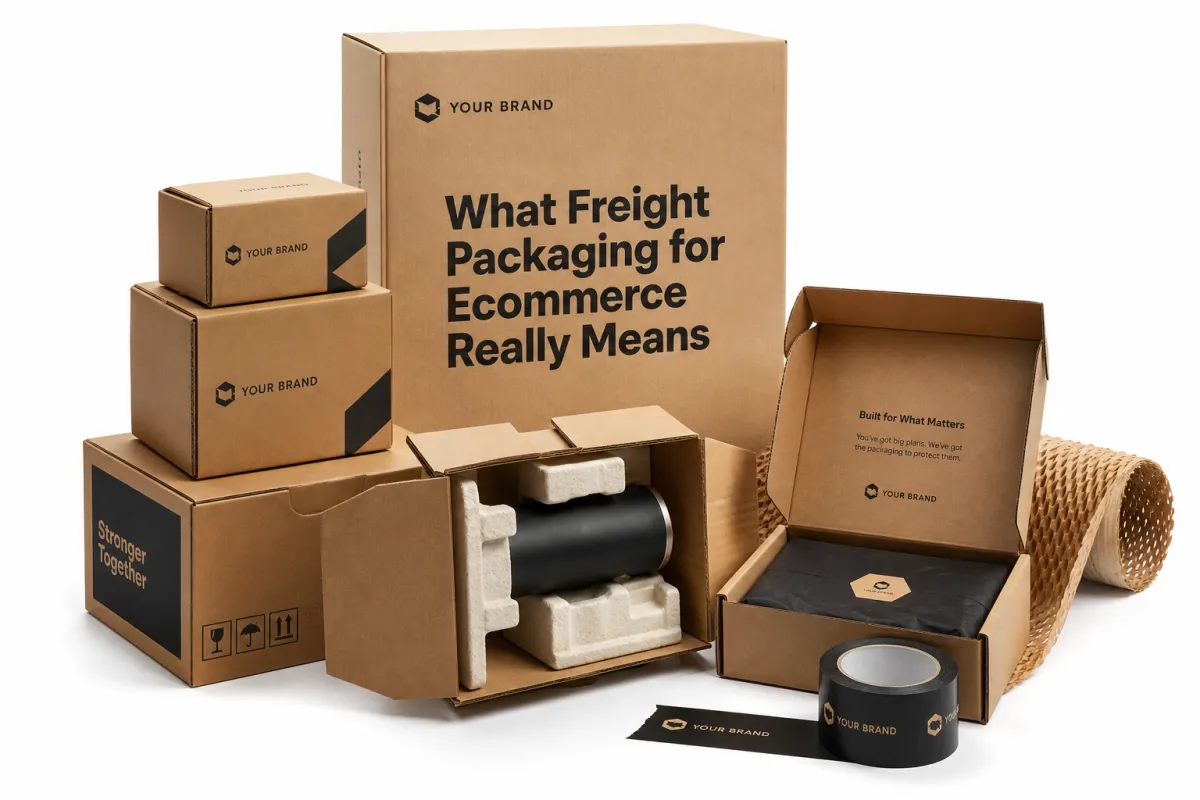
Freight packaging for ecommerce is the system that protects larger orders moving by pallet, crate, or another freight method instead of standard parcel. The distinction looks simple on paper. In practice, it changes everything. Parcel packaging usually protects one carton against conveyor drops, sortation pressure, and the occasional rough handoff. Freight packaging for ecommerce protects an entire load that may be stacked, forked, wrapped, transferred, and compressed several times before it reaches the customer.
The work starts long before the freight leaves the dock. Most failures begin with the pack-out, not with the carrier. If the load is uneven, the carton is too soft, or the wrap pattern leaves corners exposed, the shipment is already vulnerable. A pallet can look clean and still collapse once normal warehouse equipment touches it. That is why freight packaging for ecommerce is really load design, not just "put it on a pallet and hope the trailer behaves."
Think about the ecommerce scenarios that push brands toward freight packaging for ecommerce. There are bulky products like furniture, fitness gear, pet supplies, and display fixtures. There are fragile goods like glass, lighting, electronics, and printed retail kits. There are multi-box orders that would be chaotic if they shipped one carton at a time. There are also B2B-style direct-to-consumer hybrid orders, where a pallet may carry several packed units going to a storefront, office, or distribution hub.
The goal is simple and not always easy: protect the product and protect the load while keeping shipping cost under control. Freight packaging for ecommerce should reduce claims, reduce labor friction, and make freight spend more predictable. If it only makes the shipment heavier and uglier, that is not smart packaging. That is expensive overkill with better tape.
There is also a branding layer people overlook. Freight loads are not always hidden. Some arrive in retail backrooms, showrooms, or buyer warehouses where the appearance of the shipment affects trust. Clean palletization, clear labels, and consistent branded packaging can support product packaging and package branding even at the freight level. That does not mean putting logos on every surface. It means the freight package looks deliberate rather than improvised.
"A freight shipment is only as strong as its weakest corner, weakest strap, and weakest assumption. Usually one of those is the problem."
For brands that need a starting point, compare current pack-outs against the structural options in our Custom Packaging Products catalog and separate what is doing real work from what is only visual habit. That one distinction saves money surprisingly fast in freight packaging for ecommerce.
Freight packaging for ecommerce is not retail packaging, even when the same product sits inside both. Retail packaging is built to sell. Freight packaging for ecommerce is built to survive handling. Sometimes one box can do both jobs. Often it cannot. Pretending otherwise is one reason damage claims refuse to shrink.
How Does Freight Packaging for Ecommerce Work?
Freight packaging for ecommerce usually follows a clear sequence. First, the product dimensions, weight, and fragility are reviewed. Next, the packaging format is chosen. After that, samples or prototypes are built, tested, revised, and rolled out. The process sounds formal because it is. Good freight packaging for ecommerce moves from guesswork to a usable spec through a few disciplined steps.
The load is built in layers. The primary package protects the item itself. The secondary protection may be inserts, void fill, sleeves, foam corners, or corrugated partitions. The outer layer could be a box, tray, or crate. Palletization follows, then stretch wrap, strapping, corner boards, and labels. If any layer is weak, freight packaging for ecommerce loses strength fast.
Handling matters as much as the materials. Freight moves through warehouse floors, forklift tines, transfer docks, trailers, cross-dock points, and sometimes retail backroom receiving areas. Along the way it gets vibration, compression, edge hits, and stacking pressure. Freight packaging for ecommerce has to survive all of that, not just the tidy loading dock photo that looks good in a presentation.
Testing is where serious teams separate opinion from evidence. A practical freight packaging for ecommerce program usually checks compression strength, vibration resistance, corner impact, and tilt risk. Industry standards such as ISTA and ASTM methods give teams a repeatable way to compare options instead of arguing from instinct. The ISTA framework is a useful reference point for understanding how packaging is evaluated before it goes live.
Timeline depends on complexity. A straightforward freight packaging for ecommerce audit can happen in a few days if the SKU data is clean and the product is not finicky. Basic prototypes and a pilot lane often take a couple of weeks. More complex programs, especially fragile or high-value ones, can take longer because revisions and internal approvals take real time. That is not delay for the sake of delay. It is how avoidable claims get stopped before they start.
Warehouse execution is the handoff that decides whether the spec survives reality. A perfect freight packaging for ecommerce design is useless if the team cannot build it consistently at speed. If the instructions ask for six extra touches, three uncommon materials, and a prayer, the process is gonna drift. Good packaging design respects the people assembling the load. Standardization matters for exactly that reason.
In many operations, freight packaging for ecommerce sits beside branded packaging and product packaging decisions. The same brand may use custom printed boxes for parcel orders, then switch to palletized freight for larger B2B shipments. That split is normal. What matters is keeping the freight side disciplined so the team is not mixing retail packaging instincts with freight realities.
Key Factors That Shape Freight Packaging Decisions
Weight and cube come first in freight packaging for ecommerce. They affect pallet stability, carrier pricing, and how much protection the load actually needs. A light but tall shipment behaves differently from a dense compact one. A 28-pound box stack does not need the same build as a 280-pound mixed pallet. Treating those cases as identical is how freight packaging for ecommerce gets sloppy.
Fragility comes next. Glass fails differently from electronics. Liquids fail differently from printed goods. Irregular shapes fail differently from everything else. If a product has sharp edges, a high center of gravity, or sensitive surfaces, freight packaging for ecommerce needs to control movement, contact points, and compression zones. That often means better corner protection, more rigid corrugated structures, or custom inserts.
Route conditions matter too. A shipment moving a short regional lane with limited handoffs will not face the same abuse as one moving through several terminals in hot, humid weather. High humidity can weaken paper-based materials. Long transit lanes create more opportunities for stacking and vibration damage. Freight packaging for ecommerce has to account for the route, not just the product.
Retailer and marketplace requirements can change the spec quickly. Some buyers expect pallet labels in specific spots. Some require certain pallet dimensions. Others care about stack height, wrap quality, or truckload presentation. Freight packaging for ecommerce has to respect those rules or the load can be rejected even if it survives transit. That is an expensive failure because it is so avoidable.
Storage and return risk also matter. A load may sit in a warehouse before it ships. It may be reworked. It may be returned. Freight packaging for ecommerce has to survive more than one trip and more than one lift. If the load cannot stay stable while waiting in a staging area, it is not stable enough for the real world.
That is why a packaging spec should include the full picture: product weight, dimensions, fragility, humidity exposure, handling points, and customer receiving conditions. Freight packaging for ecommerce is not one material choice. It is a chain of decisions that either support the product or quietly weaken it.
If you are comparing packaged formats, look at the structural options in our Custom Packaging Products range and sort them by actual failure mode, not by how impressive they look in a mockup. Fancy freight packaging for ecommerce that fails at the edge is still a failure.
Freight Packaging for Ecommerce Costs and Pricing
Freight packaging for ecommerce costs money in pieces, not in one neat number. Materials are one part. Labor is another. Add pallet build time, storage space, freight class impact, damage claims, and returns, and the cheap option stops looking cheap very quickly. That is the trap. People focus on the box cost and ignore the total landed cost of freight packaging for ecommerce.
A basic palletized setup can be very affordable if the product is sturdy and the load is simple. Add custom crating, foam, double-wall corrugated, or engineered inserts, and the cost rises fast. That is not automatically a problem. The right freight packaging for ecommerce spec can cost less than repeated claims and replacement shipments. The wrong one is the kind of savings that feels clever for a month and then becomes a dashboard problem for the next quarter.
Here is a practical comparison of common freight packaging for ecommerce setups:
| Option | Best For | Typical Material Cost Per Shipment | Labor Impact | Damage Risk |
|---|---|---|---|---|
| Basic pallet + stretch wrap | Durable cartons, stable SKUs, low-fragility goods | $6-$15 | Low | Moderate if load is tall or uneven |
| Reinforced cartons + pallet + corner boards | Mixed carton stacks, medium-fragility products | $12-$28 | Medium | Lower, if pack-out is consistent |
| Custom crate | High-value, irregular, or highly fragile goods | $35-$120+ | High | Low, but only if built correctly |
| Engineered foam or insert system | Electronics, glass, sensitive components | $18-$60+ | Medium to high | Low to moderate, depending on design |
The ranges above are not magic numbers. They move with size, print coverage, material grade, and order volume. Still, they help because freight packaging for ecommerce buyers need a framework. A program shipping 5,000 units may see structural packaging costs around cents or low dollars per unit on simpler builds, while custom crating can jump into meaningful dollars per shipment very quickly. Freight packaging for ecommerce should be judged against replacement cost, customer impact, and claim history, not only the per-shipment material invoice.
There is another cost lever people miss: standardization. A brand that standardizes pallet size, carton footprints, and wrap patterns usually gets better labor efficiency and lower waste. That alone can improve freight packaging for ecommerce economics. Less empty space means less wrap, fewer corner failures, and a smaller chance that the forklift operator mutters about the build under their breath.
Packaging materials also matter for sustainability and compliance. Recycled corrugate, right-sized pallets, and FSC-certified paper options can support brand goals without adding unnecessary cost. If you want to understand certified fiber sourcing, the FSC site is a sensible place to start. Freight packaging for ecommerce does not need to be wasteful to be durable. It needs to be specified honestly.
From a buyer's point of view, the best freight packaging for ecommerce often lands in the middle: enough protection to absorb normal handling abuse, but not so much structure that labor slows to a crawl. The middle is kinda where most brands should live. The most expensive solution is not always the safest, and the cheapest solution is rarely the one with the best total cost. That pattern shows up more often than people admit.
Step-by-Step Freight Packaging Process
Start with a SKU audit. Identify which products actually ship freight, what their dimensions are, where they fail, and how often damage shows up. Freight packaging for ecommerce should begin with data, not opinions from whoever talks the loudest in the warehouse. Pull claim history, return reasons, and photo evidence if you have it.
Next, map the shipping method and handling path. Parcel, LTL, FTL, and direct freight delivery are not interchangeable. Each one changes the packaging demand. Freight packaging for ecommerce moving on LTL, for example, faces more transfers and more mixed handling than a controlled direct truckload. A product that survives one lane may fail on another.
Then build the packaging stack in order. Start with product protection, then inner packing, then outer carton or crate, then palletization, then wrap, straps, and labels. Freight packaging for ecommerce works best when every layer supports the next one. If the inner pack shifts, the outer build has to absorb movement it was never meant to handle.
Testing should happen before launch, not after damage reports arrive. Use real-world abuse points like vibration, compression, corner impact, and tilt risk. If your team can arrange a pilot that mimics normal warehouse movement, do it. Freight packaging for ecommerce should be trialed under conditions that resemble actual handling, not just a neat tabletop demo.
For many programs, the best approach is pilot first, scale second. Launch one lane or one product family, track claims and labor time for 30 days, then adjust the spec. That is how freight packaging for ecommerce gets better without turning the whole operation upside down. It also gives the warehouse team a chance to tell you what is annoying, which is usually the most useful feedback you will get.
Training matters more than people admit. If the spec calls for a particular wrap overlap, strap tension, or label placement, the warehouse has to know why it matters. Freight packaging for ecommerce fails when the instructions are technically correct but operationally impossible. A good packaging design respects the speed of fulfillment and the reality of shift turnover.
For brands with both ecommerce and B2B activity, freight packaging for ecommerce often shares components with retail packaging and branded packaging, but not all of them. That is fine. Reuse the elements that make sense. Just do not force every order into the same visual pattern. Good package branding should support the shipment, not distract from it.
One practical trick: document the build with photos, a materials list, and a simple one-page standard. If the freight packaging for ecommerce spec is buried in someone's head, it will drift the first time that person is on vacation. Standards beat memory. Memory is expensive.
- Audit the SKU and collect damage data.
- Match the build to the actual shipping method.
- Prototype the load and test weak points.
- Pilot one lane before rolling out widely.
- Train the warehouse on the exact build steps.
Common Freight Packaging Mistakes Ecommerce Brands Make
The first mistake is overbuilding every SKU the same way. It feels safe, but it wastes money and slows fulfillment. Freight packaging for ecommerce should be tied to actual risk. A dense, durable product does not need the same build as a fragile display unit. Yet plenty of teams use one "universal" spec and then wonder why labor and costs keep creeping up.
Another classic problem is weak pallet work. Bad pallets, poor stretch wrap, and flimsy corner boards can turn a decent carton into a liability. Freight packaging for ecommerce depends on the whole load holding together under pressure. If the base flexes or the wrap slips, the rest does not matter much. The truck does not care how pretty the label is.
Load balance gets ignored more often than it should. Tall pallets with heavy items stacked poorly become unstable fast. Off-center weight changes how the load behaves during stops, turns, and forklift lifts. Freight packaging for ecommerce is more than just covering the product. It is physics, and physics is not impressed by enthusiasm.
Skipping testing is another easy way to create claims. A packaging concept can look sturdy in the warehouse and still fail in vibration or compression. That is why freight packaging for ecommerce should be validated with tests that reflect real abuse, not just a quick glance and a thumbs-up from the person who likes thick cardboard.
Then there is the paperwork problem. Labels, handling marks, and documentation matter. A package that survives transit can still get delayed or mishandled if the receiving instructions are vague. Freight packaging for ecommerce includes the information layer as much as the material layer. A wrong label can cost you almost as much as a broken corner.
Other mistakes show up in the details: pallet overhang, too much void space, wrap that does not catch the corners, and cartons that crush under stack pressure. These are not glamorous errors. They are the boring, expensive ones that repeat until someone finally audits the build. Freight packaging for ecommerce rewards boring discipline.
And yes, branding can go wrong too. If package branding is used as decoration instead of structure, it can crowd out important handling cues. Freight packaging for ecommerce should still present well, but it cannot sacrifice function for a prettier look. A load that arrives intact looks better than a crushed logo.
If your current freight packaging for ecommerce setup keeps producing the same failure, do not keep tweaking random pieces and hoping for a miracle. Find the failure mode, fix that one first, then work outward. Otherwise you are just moving the mess around.
Expert Tips for Better Freight Packaging for Ecommerce
Standardize around a few packaging families instead of reinventing the wheel for every SKU. Freight packaging for ecommerce gets easier when the warehouse works from three or four approved builds instead of fifteen one-off guesses. Fewer variations mean faster picking, fewer mistakes, and better material buying power.
Design for the warehouse first. That sounds basic, but it is where a lot of packaging design fails. If the team cannot build the load consistently under normal shift pressure, the spec is too clever. Freight packaging for ecommerce needs to respect labor, reach, and materials handling. A great design that nobody can assemble is just a PowerPoint decoration.
Use test data to justify upgrades. Not gut feeling. Not "this seems sturdier." Real freight packaging for ecommerce decisions should be tied to compression results, damage patterns, and claim trends. If a slightly better insert reduces breakage by 40 percent, that is worth paying for. If an upgrade only makes the box look serious, save the money.
Target the failure points directly. Corners, edges, product movement, compression zones, and pallet overhang are where freight packaging for ecommerce usually breaks down. Spend where the load is vulnerable. Cut waste where the product is already protected. That is a much better trade than blanketing everything with extra corrugate and calling it conservative.
Packaging materials should support the route, not just the product. A shipment crossing long humid lanes may need different corrugate than one moving locally. A fragile print kit may need more rigid insert support than a heavy but durable appliance accessory. Freight packaging for ecommerce works best when it is matched to both the item and the journey.
For brands carrying mixed channels, keep the freight spec aligned with the broader packaging system. Custom printed boxes, retail packaging, and product packaging can share visual standards, but the freight build should remain operationally simple. If you need help narrowing that system down, compare the structural options in our Custom Packaging Products page and look for the point where durability and build speed meet.
Track damage for 30 days after any change. That simple window tells you a lot. If claims drop and labor stays steady, the new freight packaging for ecommerce spec is probably working. If claims stay flat but labor spikes, the change may be too expensive. If everything gets worse, at least you found out before scaling the mistake.
One more practical move: keep photos of good and bad packs. A visual standard is faster than a text memo, and the difference between "acceptable" and "messy" is often obvious in one image. Freight packaging for ecommerce improves when the team can see exactly what good looks like.
I have also found that the smallest operational changes often matter most. Switching to a better corner board, tightening the wrap pattern, or standardizing pallet size can do more than a flashy redesign. It is not glamorous, but neither is filing claims on broken product.
Final Take on Freight Packaging for Ecommerce
Freight packaging for ecommerce is not just a shipping detail. It is part protection strategy, part labor strategy, part cost control. The brands that treat it like an afterthought usually pay for it in claims, rework, and unhappy customers. The brands that treat it like a system tend to get cleaner warehouse operations and more predictable freight spend.
The smartest freight packaging for ecommerce programs are usually not the heaviest. They are the ones that match the product, the lane, and the warehouse reality with enough precision to avoid waste. That means testing, standardizing, and fixing the actual failure point instead of piling on more material and hoping the universe notices.
If you are reviewing your current freight packaging for ecommerce setup, start with the top three SKUs that create the most claims. Audit the load, compare two packaging options, test one lane, and track the result for 30 days. That process is boring. It also works. And if you want to tie that freight packaging for ecommerce work back to branded packaging, retail packaging, or custom printed boxes, keep the structural spec tight first and the visual layer second. That order matters. The actionable move is simple: pick one high-loss SKU, document the current build, and test a single improved spec before changing anything else.
How is freight packaging for ecommerce different from parcel packaging?
Freight packaging for ecommerce protects unit loads, pallets, or crates instead of single cartons moving one by one. It has to handle stacking, forklift contact, vibration, and multiple transfer points. The cost model also shifts from dimensional weight to cube, labor, damage risk, and pallet stability.
What materials are most common in freight packaging for ecommerce?
The usual stack includes pallets, corrugated boxes or trays, stretch wrap, straps, corner boards, and sometimes foam or honeycomb inserts. Fragile or high-value goods may need custom crating or double-wall construction. The right mix depends on product weight, fragility, and how long the shipment stays in transit.
How can I lower freight packaging costs without causing more damage?
Standardize sizes where possible so the warehouse buys and builds faster. Remove unnecessary void space and add protection only where the product actually fails. Track damage claims against packaging cost so you do not save pennies and lose dollars.
How long does freight packaging for ecommerce usually take to set up?
A basic audit and concept review can happen quickly if the product data is clean. Simple prototypes and pilot runs often take a few weeks from start to finish. Complex, fragile, or regulated shipments can take longer because testing and approvals matter.
When should an ecommerce brand switch to custom freight packaging?
Switch when damage claims keep repeating even after small fixes. Consider custom packaging when products are bulky, fragile, oddly shaped, or expensive to replace. It also makes sense when carrier handling, retailer requirements, or pallet instability keep creating avoidable losses.

