Buyer Fit Snapshot
| Best fit | Freight Packaging Supplier for Safer Shipping projects where brand print, material claims, artwork control, MOQ, and repeat-order consistency need to be specified before quoting. |
|---|---|
| Quote inputs | Share finished size, material target, print colors, finish, packing count, annual reorder estimate, ship-to region, and any compliance wording. |
| Proofing check | Approve dieline scale, logo placement, barcode or warning zones, color tolerance, closure strength, and carton packing before bulk production. |
| Main risk | Vague material claims, crowded artwork, missing packing details, or unclear freight terms can make a low unit price expensive after revisions. |
Fast answer: Freight Packaging Supplier for Safer Shipping: Material, Print, Proofing, and Reorder Risk should be specified like a repeatable production item. The safest quote records material, print method, finish, artwork proof, packing count, and reorder notes in one written spec.
Production checks before approval
Compare the actual filled-product size with the drawing, then confirm tolerance on folds, seals, hang holes, label areas, and retail display edges. Reserve space for logos, QR codes, warning copy, and material claims before decorative graphics fill the panel.
Quote comparison points
Review material grade, print process, finish, sampling route, tooling charges, carton quantity, and freight assumptions side by side. A quote is only useful when the supplier can repeat the same color, closure quality, and packing count on the next order.
One weak pallet can kick off a mess: crushed cartons, delayed receiving, extra labor, a carrier claim, and a customer who starts trusting your brand a little less. A freight packaging supplier guide helps stop that chain reaction before it starts by matching the pack-out to the product, the lane, and the handling environment instead of guessing from box strength alone.
Operations teams care. Procurement cares. Fulfillment managers care. Brands shipping fragile or high-value goods care a lot. Freight is not just a transportation problem with paperwork attached. From a packaging buyer's point of view, it is a cost line, a risk control, and a labor decision all at once. A strong freight packaging supplier guide makes those tradeoffs visible, and that is usually where better decisions begin.
I've watched a pallet that looked fine on the dock arrive with corner crush, load shift, and a claim nobody wanted to own. That kind of failure is rarely random. It usually starts with a pack-out that was never built for the actual route. So if the goal is fewer surprises, start with the shipment, not the box catalog.
Freight Packaging Supplier Guide: Start With the Damage Math
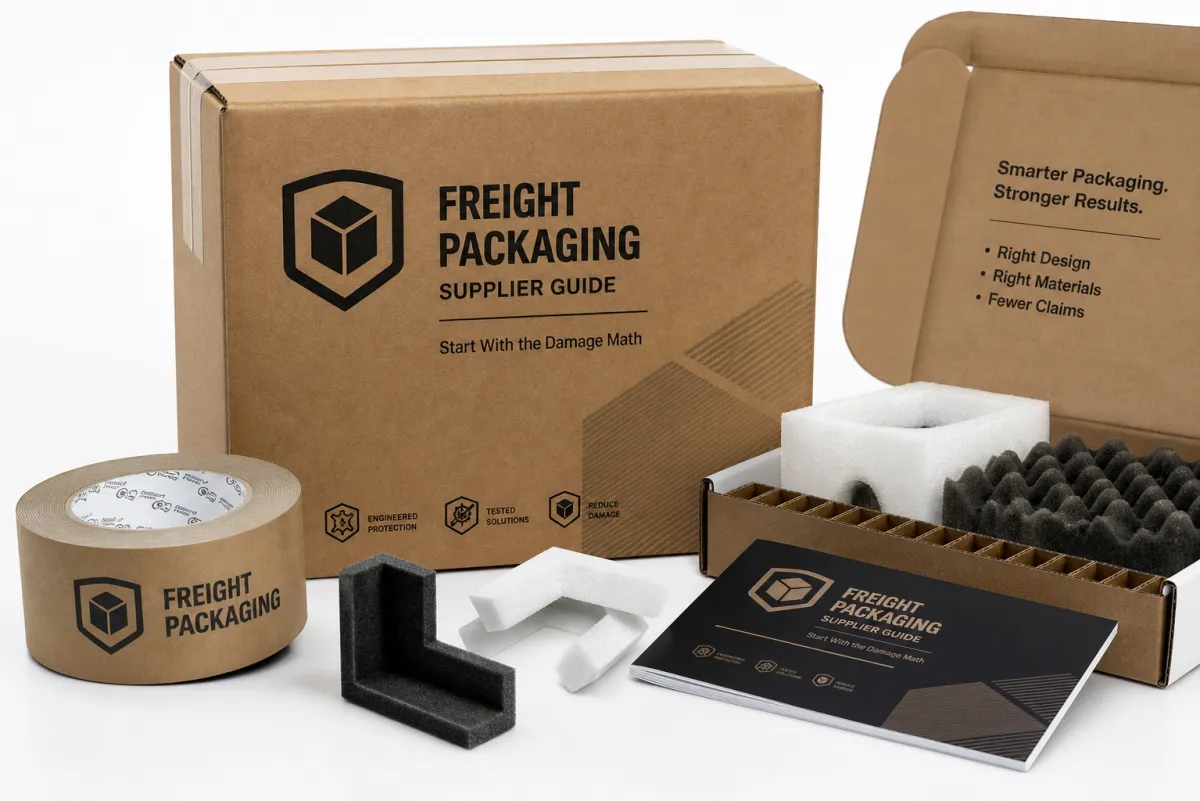
If a shipment fails, the real cost rarely stops at the damaged item. A broken unit can mean repacking, re-labeling, a rescheduled dock appointment, a goodwill credit, and an expedited replacement that burns margin twice. That is why a freight packaging supplier guide should start with the damage math, not with board caliper or foam density. Packaging is not just "stronger boxes"; it is a logistics decision that affects cube, labor, carrier handling, and claims exposure.
Think about the last mile before the truck even moves. A pallet that looks fine in a warehouse can still fail once it hits vibration, tilt, stacking pressure, or a damp trailer floor. In practice, a freight packaging supplier is there to reduce that risk by selecting materials, engineering pack-outs, and building for the actual shipment profile. That might mean pallets, crates, skids, corner boards, internal bracing, or custom inserts. A good freight packaging supplier guide makes each option easier to compare.
Here is the part many teams miss: the cheapest packaging choice is often the most expensive one after damage. If a $14 pack-out leads to even one $250 replacement shipment, $80 in labor, and a claim that takes weeks to settle, the economics flip fast. That is where a freight packaging supplier guide earns its keep. It shows how one failed pallet can cost more than a higher-spec solution across an entire lane.
Packaging truth: a pallet is only as strong as its weakest restraint. If the load shifts, the package already failed.
Who should care most? Procurement, because landed cost is not just unit price. Operations, because labor and dock flow matter. Fulfillment, because pack speed and staging space are real constraints. Brands, because damaged product often damages perception faster than it damages the ledger. A freight packaging supplier guide gives all four groups a common language: protection, handling, and total cost per protected shipment.
How a Freight Packaging Supplier Guide Works in Practice
A practical freight packaging supplier guide usually follows a simple workflow. First comes shipment intake: product dimensions, weight, photos, current packaging, pallet pattern, destination mix, and the kind of damage already showing up. Then comes route review. Is the product moving LTL, truckload, air freight, or a mix? How many handoffs happen? Is the shipment crossing climates, borders, or tight delivery windows? Those details change the packaging answer more than most buyers expect.
After intake, the supplier assesses fragility and load behavior. Dimensional weight matters because oversized packages cost more to move. Product fragility matters because impact resistance is not the same as compression resistance. Stacking pressure matters because a box that survives a drop can still crush under a loaded pallet above it. Moisture exposure matters because some shipments sit in trailers, yards, or ports long enough to pick up humidity. Transit time matters because longer exposure means more chances for vibration and handling errors. A good freight packaging supplier guide translates those risks into a design brief.
That translation is where packaging design becomes useful. Corner protection can keep a panel from collapsing. Internal bracing can hold heavy components in place. Void fill can stop movement, but only if the structure around it is strong enough. Reusable crates make sense when the same asset moves on a loop. Corrugated solutions work well for many loads, but not every load. Custom printed boxes can help with package branding and receiving clarity, yet print should never weaken the structure just to look better. A freight packaging supplier guide should keep those priorities straight.
Testing and prototyping are not optional if the shipment is sensitive. A supplier may build a sample, run it through a pilot, or use lab methods aligned with ASTM D4169 or ISTA testing protocols such as those outlined at ISTA. The point is not to chase a lab score for its own sake. The point is to see whether the pack-out survives the same kind of compression, vibration, and handling your freight sees in the real world. A freight packaging supplier guide that ignores validation is usually a shortcut to surprise.
Packaging also affects warehouse operations. Heavier crating may slow loading but improve protection. Flat-packed components may save storage cube but add assembly time. A narrower footprint may improve carrier acceptance and pallet density. That is why the best freight packaging supplier guide does not treat packaging as an isolated purchase. It treats it as part of the throughput equation.
There is also a trust piece here. If a supplier cannot explain why a design works, that is a warning sign. You do not need poetry. You need a clear explanation of load path, restraint points, and failure modes. If the answer sounds vague, it probably is.
Freight Packaging Supplier Guide: Key Factors and Pricing
Any useful freight packaging supplier guide has to talk about price in a realistic way. The main drivers are product weight, fragility, dimensions, shipping distance, mode of transport, and storage conditions. A 22-pound electronic assembly and a 220-pound metal housing do not belong in the same packaging conversation, even if both ship on pallets. The structure, the cushioning, the restraints, and the external skin all shift with the load profile.
Cost is a bundle of moving parts, not a single quote. Material cost is only one piece. Custom tooling can matter if the solution needs dies, fixtures, or special corrugate sizing. Labor can matter just as much if assembly takes ten minutes instead of two. Minimum order quantities can change the unit economics, especially if you are trying to protect a smaller program. Freight charges can move too, because larger packs often consume more cube and more weight. A freight packaging supplier guide that breaks out each element gives you a better basis for comparison.
Here is a broad planning view for common freight packaging options. These are not universal quotes, and they are definitely not a promise from every supplier. Still, they help buyers frame discussions and avoid sticker shock. The right option depends on the lane, the product, and the damage history. A freight packaging supplier guide should compare total protection value, not just the package line item.
| Packaging option | Typical use | Indicative cost range per shipment | Strengths | Watch-outs |
|---|---|---|---|---|
| Reinforced corrugated pallet pack | Light to medium freight with moderate handling risk | $18-$45 | Low material cost, easy to stage, good print surface for branded packaging | Can fail under high stacking pressure or moisture exposure |
| Double-wall corrugated with internal bracing | Fragile products that still need efficient cube | $28-$80 | Better compression resistance, lighter than wood | Assembly time can rise if the pack-out has many parts |
| Plywood crate with blocking | High-value, heavy, or irregular freight | $120-$350 | Strong protection, better for rough handling, better load security | Higher labor, more storage space, heavier freight charges |
| Foam and corrugated hybrid | Sensitive components needing shock control | $35-$95 | Good for product packaging with precise fit and lower movement | Material mix can complicate recycling goals |
| Reusable returnable crate | Closed-loop or repeat-lane shipments | $180-$600+ | Spreads cost over multiple trips, strong durability | Needs reverse logistics and control of asset returns |
The important comparison is not unit price, but protected-shipment cost. A higher-cost crate may still be cheaper if it cuts claims, labor, and replacement freight. A lower-cost carton may look good on paper and still become a bad buy if it generates even a small number of damages. From a packaging buyer's point of view, the cleaner question is: what does the solution cost per shipment, after protection is counted?
That is also where sustainable material decisions come in. If the application allows it, FSC-certified fiber can support sourcing goals without sacrificing structure. For broader industry context, the FSC site is a useful reference for certification basics. But sustainability does not excuse weak performance. A greener box that arrives crushed is not a responsible choice. A strong freight packaging supplier guide keeps both performance and material stewardship in view.
One more thing: regional pricing can swing more than buyers expect. Wood availability, resin costs, fuel surcharges, and local labor all move the number around. If a quote seems too clean, ask what is included and what is not. Hidden assembly labor has a habit of showing up later, usually at the worst possible time.
Freight Packaging Supplier Guide: Step-by-Step Process and Timeline
The process should be visible before a supplier ever sends a quote. A solid freight packaging supplier guide starts with discovery: what is shipping, where is it going, how often does it ship, and what has gone wrong before? Good suppliers ask for product specs, photos, pallet patterns, shipping lanes, carrier types, and damage history. The better the input, the less guesswork in the design.
After discovery comes the recommendation phase. This is where the supplier may present two or three routes: a lower-cost option, a balanced option, and a higher-protection option. That side-by-side view matters because it lets buyers compare damage protection, labor time, and landed cost at the same time. If the supplier only offers one answer, the freight packaging supplier guide should make you ask why.
Then comes prototype and revision. A sample can reveal practical issues that drawings miss: a flap that slows assembly, a brace that interferes with tape application, or a crate that is stronger than needed but awkward for dock crews. The revised version should be tested or trialed before scale-up. This is where many teams save themselves from expensive surprises. Simple solutions may move quickly, but custom designs usually need time for engineering review, sample approval, and material procurement.
Here is a realistic working sequence for a custom launch:
- Discovery: 2-5 business days if product data is ready.
- Quote and concept review: 3-7 business days.
- Prototype build: often 5-10 business days for straightforward designs.
- Testing and revision: 1-3 weeks, depending on complexity and approval speed.
- Production: commonly 10-20 business days after sign-off, longer for specialty materials.
- Rollout: staged by lane, product family, or customer account.
That timeline is why procurement, operations, and quality often need separate sign-off. Procurement wants price and terms. Operations wants line speed and warehouse fit. Quality wants validation and documentation. The best freight packaging supplier guide respects all three. It also recognizes that launch timing must fit inventory planning. If you switch packaging too late, you can strand old material. If you switch too early, you risk shipping with packaging that has not been fully approved.
A practical launch plan starts with one lane or one product family, not the whole network. That reduces disruption and gives you data to compare before and after. If the new pack-out lowers damage, speeds assembly, and keeps freight costs stable, you have evidence to expand it. If it creates a new bottleneck, the pilot catches that before the whole operation feels it.
Common Mistakes When Choosing a Freight Packaging Supplier
The first mistake is choosing on unit price alone. It is tempting, because packaging looks like a commodity until damage appears. A lower-cost carton can become the most expensive option if it creates rework, claim handling, or chargebacks. A strong freight packaging supplier guide keeps the conversation on total shipping performance, not just purchase price.
The second mistake is giving poor measurements. Rounded dimensions, guessed weights, and missing accessory parts lead to the wrong design. If the product ships with cords, brackets, manuals, or other attachments, those pieces change both weight and shape. Even a small overhang can change how a pallet stacks. A freight packaging supplier guide should insist on clean dimensions, real weights, and images from multiple angles.
The third mistake is skipping transit testing. That is risky because freight failure rarely comes from only one threat. Vibration can loosen parts. Compression can crush outer walls. Humidity can weaken fiber. Multiple handoffs can shift a load that looked stable on day one. A test plan does not have to be exotic, but it should reflect actual shipping stress. ASTM D4169 and ISTA protocols exist for a reason: they make risk visible before product moves.
The fourth mistake is overpackaging. Yes, it happens. Extra foam, extra wood, and oversized cartons can inflate cube, increase labor, and add freight cost without improving real protection. More material is not always more safety. A freight packaging supplier guide should be willing to trim waste where the structure can still perform. That is especially true for Product Packaging That ships in volume. A lighter, better-fit design can protect just as well and move more efficiently.
The fifth mistake is treating every SKU the same. One product may need corner protection and a simple pallet base. Another may need a custom crate with blocking and moisture control. A third may need retail packaging that also functions as shipping protection, which changes the packaging design entirely. The smartest freight packaging supplier guide treats each SKU as its own shipping problem, then looks for standardization only where the fit is real.
A final mistake is ignoring the receiving environment. Some carriers and receivers want pallet labels in a specific location. Some docks have forklift limits. Some customers reject loose film, excessive nails, or damaged outer surfaces. Freight packaging lives in the real world, not just on a drawing. If the design does not suit the warehouse, the carrier, and the receiver, it is not finished.
I have seen teams spend weeks optimizing the pack-out and then blow the rollout because the receiving side could not process the new pallet pattern. That is an annoying, but very fixable, mistake. Check the dock rules early. Saves everyone a headache.
Expert Tips for Getting More from a Freight Packaging Supplier Guide
Start with the highest-risk lanes or products. That is usually where the fastest return shows up because losses are already visible. A freight packaging supplier guide becomes more useful when it targets the places where damage, delay, or rework already hurts. If one product family accounts for most of the claims, begin there. If one lane has repeat handling issues, begin there. The lesson is simple: prioritize where the pain is measurable.
Ask for side-by-side options. A good supplier should be able to compare material cost, labor time, damage protection, and landed cost across at least two or three configurations. The cheapest option on paper may not be the cheapest after assembly. The strongest option may not be necessary. The balanced option is often the most interesting. A freight packaging supplier guide that shows tradeoffs clearly helps buyers defend the decision internally.
Track a few metrics after rollout, and keep them boring. Damage rate. Claim value. Pack time. Freight cost per shipment. Receiving complaints. Those numbers tell you whether the new packaging is working. A freight packaging supplier guide should not stop at the purchase order. It should create a measurement habit that shows whether the packaging design pays back the way the supplier promised.
- Damage rate: count failures per 100 or 1,000 shipments.
- Claim value: measure dollars lost, not just incident count.
- Pack time: track seconds or minutes per unit.
- Cube efficiency: watch how much trailer or pallet space each design uses.
- Material waste: note scrap, overages, and avoidable rework.
Standardize where possible, and customize where it matters. That sounds obvious, but many teams swing too far in one direction. Too much customization creates complexity, inventory sprawl, and training headaches. Too much standardization leaves money on the table when a particular product needs a different pack-out. The right freight packaging supplier guide looks for repeatable building blocks: common pallet sizes, common inserts, common fastening methods, then targeted custom work only where the shipment profile demands it.
Also, treat the supplier like a packaging partner, not a commodity vendor. Better input usually produces better packaging design. If you can share photos of damaged shipments, pallet patterns, or receiving notes, the supplier can work from reality instead of theory. That is often the difference between generic product packaging and a pack-out that actually fits your operation. If you are not sure where to begin, our Custom Packaging Products page is a practical place to review options before requesting quotes.
One thing I ask every time: "What failure mode are we actually preventing?" If the answer is not specific, the design probably is not specific either. Vague goals produce vague packaging. Specific risks produce better decisions.
What to Do Next With Your Freight Packaging Supplier Guide
The next move is not to guess. It is to audit the lanes, products, and failures that matter most. Start by listing your top three shipping problems: breakage, chargebacks, delayed receiving, or labor-heavy pack-outs. Then document current damage costs, including replacement freight and internal handling time. A freight packaging supplier guide becomes far more useful when it is tied to actual numbers instead of general frustration.
Next, gather the inputs a supplier will need: product dimensions, weights, photos, pallet patterns, shipping lanes, storage conditions, and any special handling rules. The cleaner the brief, the faster the recommendation. That is not just an efficiency play. It also lowers the chance that the first prototype misses the real problem. A freight packaging supplier guide should function like a working brief, not a vague shopping list.
Then build a supplier comparison checklist. Include capabilities, lead times, testing support, pricing transparency, and experience with your type of freight. Ask whether the supplier can validate against ISTA methods or other relevant test plans. Ask what documentation they provide. Ask how they handle revisions. Ask whether they can support branded packaging, custom printed boxes, or hybrid solutions if you need them. The answers tell you more than a polished sales sheet ever will.
Run a small pilot before a full rollout. That lets you confirm protection, labor impact, and timeline assumptions on a manageable scale. If the pilot performs, expand lane by lane or SKU by SKU. If it does not, you have time to adjust without disrupting the full operation. That is the best use of a freight packaging supplier guide: not to produce a perfect answer on day one, but to move the team from uncertainty to evidence.
For teams comparing vendors, the strongest move is usually the practical one. Choose one lane, one product family, and one measurable improvement target. If the packaging reduces damage by even a small amount, or trims assembly time without lifting freight cost, you have a business case. If it also improves package branding or receiving clarity, that is a bonus. The freight packaging supplier guide is only valuable when it leads to action, and the best action is usually a focused pilot with a clear success metric.
A freight packaging supplier guide is about control. Control over damage. Control over labor. Control over freight spend. Control over what your customer sees when the pallet finally arrives. The right supplier does not just sell materials; it helps you protect margin, cut noise, and ship with fewer surprises. The takeaway is simple: audit your worst lane, document the real failure costs, and test one better pack-out before you scale anything else.
FAQ
What does a freight packaging supplier guide help me compare?
It helps you compare packaging materials, protection levels, lead times, testing support, and total landed cost. It also shows whether a supplier can design for your actual freight risk instead of selling a one-size-fits-all solution. A good freight packaging supplier guide should make those differences easy to see.
How do I know if I need custom freight packaging?
You usually need custom packaging when the product is fragile, high-value, oddly shaped, or frequently damaged in transit. If standard cartons or pallets are causing claims, custom engineering can lower total cost even if unit price is higher. That is a common outcome in a freight packaging supplier guide review.
What pricing details should I ask a freight packaging supplier about?
Ask about material cost, tooling, minimum order quantities, lead times, labor requirements, and freight charges. Request a per-shipment comparison so you can see whether the packaging reduces damage enough to justify the spend. A freight packaging supplier guide is most useful when it forces the quote into total-cost language.
How long does the freight packaging supplier process usually take?
Simple solutions can move quickly, but custom designs usually need time for discovery, samples, testing, and revision. The timeline depends on product complexity, approval speed, and whether special materials or tooling are required. A realistic freight packaging supplier guide should treat timeline as part of the decision, not an afterthought.
What is the biggest mistake companies make when choosing freight packaging?
The biggest mistake is buying the lowest-cost option without measuring damage risk, labor time, or freight impact. A better approach is to compare total cost per protected shipment, not just packaging Price Per Unit. That principle sits at the center of any serious freight packaging supplier guide.

