Buying a Frosted Zipper Bags logo print quote is really a packaging decision disguised as a pricing request. The bag is doing three jobs at once: protecting the product, presenting it cleanly, and carrying a brand mark that has to survive handling, shipping, and shelf light. If any one of those jobs is underspecified, the quote may look fine and still be wrong for the application.
Frosted Zipper Bags sit in a useful middle ground. They are softer-looking than clear poly, less expensive than a box, and more presentable than a plain utility pouch. That combination explains why they show up so often in apparel, beauty, accessories, and sample packaging. The film hides a little visual clutter without making the product disappear.
The print changes the math. A blank frosted bag is a commodity. Add a logo, a stable print position, and a sensible closure spec, and it becomes a branded package with production constraints. That is where the quote is shaped: size, thickness, print method, and order quantity usually matter more than the headline description.
Why frosted zipper bags get chosen when shelf impact matters
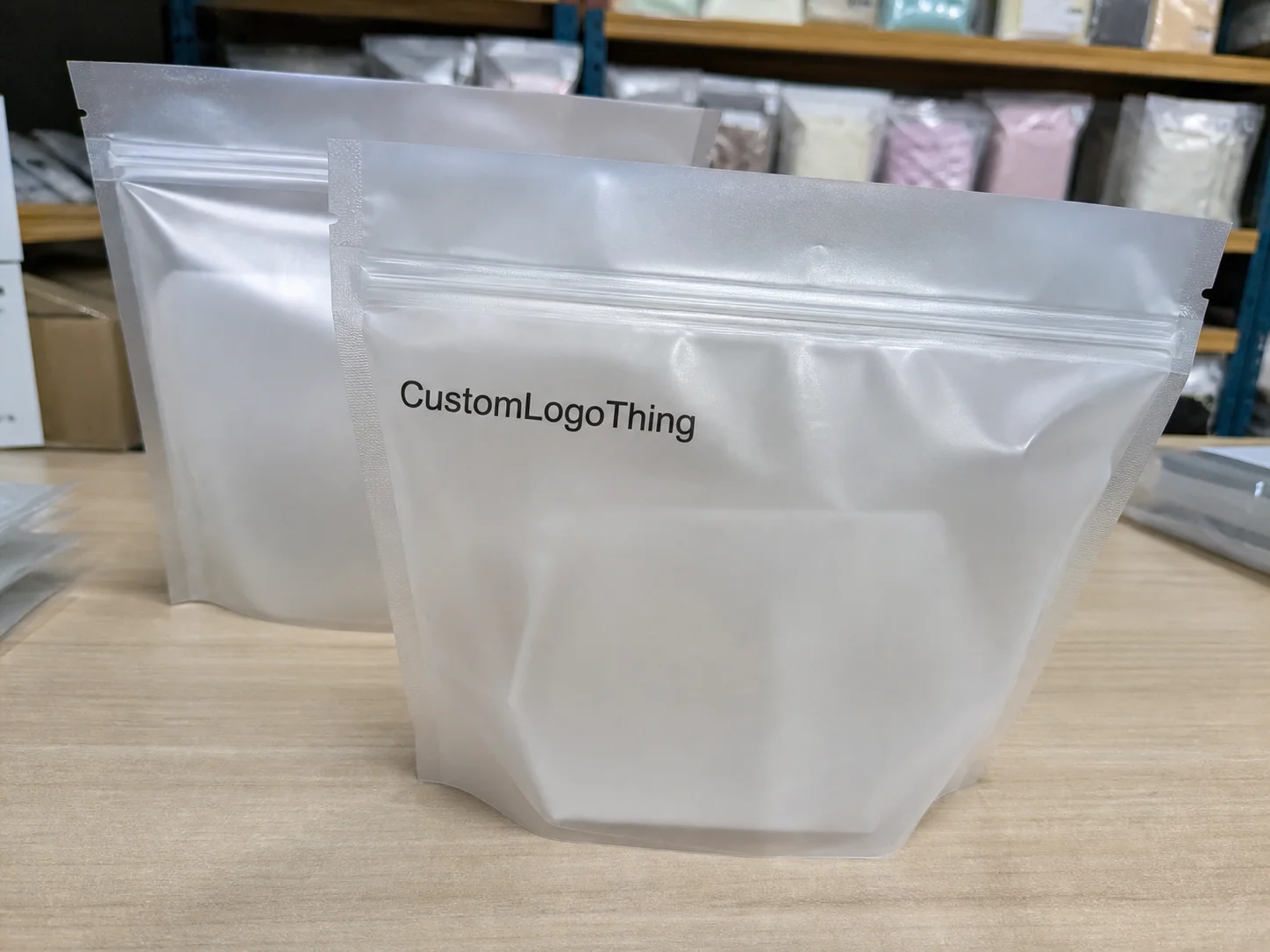
Most buyers do not start by asking for frosted packaging. They start with a problem. The product looks too plain in a clear pouch. The old bag scratches too easily. The packaging needs to feel more deliberate without adding carton cost or freight weight. Frosted zipper bags often solve that gap cleanly.
The frosted finish changes the read of the package. Clear poly exposes everything, including wrinkles, folds, and uneven packing. A frosted film softens those details and makes the package feel more controlled. It also preserves enough visibility for the product to be recognized, which matters for items that need to be seen but not fully exposed.
That is why these bags show up across categories that depend on first impression. A folded garment inside a frosted pouch looks more composed than the same garment in a plain clear bag. A beauty kit looks less temporary. Accessories read as inventory rather than loose stock. The difference is subtle, but in retail packaging subtle is often what separates acceptable from forgettable.
There is also a handling advantage. Frosted film tends to disguise minor scuffs and fingerprints better than crystal-clear material. That does not make it indestructible, and it does not fix sloppy packing, but it does buy some visual forgiveness during transit and store handling.
A frosted zipper bag usually wins on presentation because it looks intentional before the customer even opens it.
The logo is what finishes the job. Without branding, the package is just a pouch. With a clean logo, it becomes part of the product experience. The best results come from simple artwork, clear contrast, and a print placement that respects the zipper track and side seals. If those details are ignored, the bag can look more expensive than it performs, or more functional than it should.
That distinction matters because not every use case needs the same spec. Retail display needs stronger visual polish. E-commerce fulfillment may care more about closure reliability and pack efficiency. Internal organization or secondary packaging can tolerate a plainer print and lighter film. A serious quote should reflect the use case, not just the dimensions.
Frosted zipper bags logo print quote: the specs that move price
If the request is vague, the quote will be vague. “Frosted zipper bag with logo” can describe several different constructions, and each one prices differently. A useful request starts with measurable details: dimensions, film thickness, zipper style, print colors, coverage area, and target quantity. Those inputs do more to shape the final number than most first-time buyers expect.
Bag size is the first lever. A small pouch for accessories uses far less film than a garment bag, and the die layout changes with every size jump. Thickness is the second lever. Thin film is cheaper, but it can wrinkle more, feel less substantial, and offer less protection during packing. Thicker film usually costs more, but it also gives the bag a firmer hand and better resistance to scuffing.
The zipper specification matters too. Standard press-to-close closures are common and economical. Slider zippers add convenience and a more premium feel, but they usually increase material and assembly cost. If the bag will be opened repeatedly, the closure quality is worth paying attention to. If it will be used once for retail delivery, a simpler closure may be the smarter option.
Finish is another variable that gets underestimated. Not all frosted film is identical. Some grades are lightly hazed and still show product detail clearly. Others are more opaque and create a stronger premium effect. Better consistency in the film can raise cost, but it also gives the print a steadier base and reduces the chance of uneven appearance across a run.
Any custom feature adds pressure to the quote. A hang hole, euro slot, gusset, reinforced seal, or custom zipper color can trigger additional tooling or setup. Even small changes near the top seal can affect where the logo can be placed. Buyers often think of these as minor details. In production, they are not minor. They change layout, waste rate, and sometimes the feasible print area.
Print coverage is one of the most direct cost drivers. A single logo on one side is simpler than front-and-back printing. A large solid area costs more than a small mark because it uses more ink, takes more control, and increases the chance of alignment issues on translucent film. Fine lines and delicate type also need more care than bold shapes. The bag will not forgive weak artwork.
The practical conclusion is simple: the more the package behaves like a branded retail item, the more the quote should reflect setup, consistency, and inspection. That is not markup for its own sake. It is the cost of keeping a custom package from turning into a pile of inconsistent bags.
- Size drives film usage and die layout.
- Thickness drives feel, durability, and price.
- Zipper type drives closure quality and convenience.
- Print coverage drives setup time and ink use.
- Special features drive tooling, labor, and waste.
Good quoting starts with those facts, not with a mockup alone. A mockup helps visualize the result. It does not replace a specification sheet.
Logo print options for a cleaner branded finish
Printing on frosted film is straightforward in principle and unforgiving in practice. The film softens contrast, so weak artwork can disappear faster than it would on white paperboard. Fine lines can break up. Pale colors can fade visually. Busy gradients often flatten out. The material is not a problem if the design is chosen with it in mind.
For most logos, spot-color printing is the cleanest choice. One-color screen printing gives strong opacity and a crisp brand mark, especially when the logo is simple and the shapes are bold. It keeps setup manageable and usually produces the most reliable result on translucent film. If the goal is visual clarity rather than graphic complexity, one strong color often wins.
Multi-color printing can work, but it needs more control. CMYK is useful for artwork with tonal variation or photographic elements, though the result depends on the film surface, print registration, and how much background haze the material introduces. On frosted bags, more color does not automatically mean a better logo. Sometimes it just means more ways for the image to look muddy.
Flexographic printing is often used for higher-volume packaging because it handles repeat production efficiently once the setup is locked in. Digital printing can be a good fit for shorter runs, artwork changes, or sample development. The choice is less about fashion and more about run length, turnaround, and how stable the artwork will be over time.
Logo size deserves more attention than it gets. Too small, and the mark loses legibility against the frosted finish. Too large, and it can crowd the zipper or fight with the seals. Good suppliers should provide a safe print area on the dieline, not just a flat proof. That is where a lot of first-round artwork mistakes are caught.
Color matching is another place where expectations need to be realistic. PMS matching can be requested, but exact matching on translucent film is harder than on coated paper or white board. The final appearance depends on film tint, ink density, and the way light passes through the material. A buyer who expects paperboard color behavior from frosted poly is setting up a revision cycle.
For launch-critical packaging, ask for a printed sample or pre-production proof. A monitor proof only confirms layout. It cannot show you how the logo reads through the film, how the white space behaves, or whether the print feels balanced once the pouch is filled. That is where the package either earns its keep or starts over.
For technical references on packaging performance and transit expectations, the Packaging School and related industry resources at packaging.org are useful for terminology, and ISTA is the right place to look when packaging has to survive shipping abuse rather than just sitting on a shelf.
Pricing, MOQ, and quote drivers you should check first
A quote only means something if it shows what is inside it. Unit cost alone is not enough. A clear frosted zipper bags logo print quote should separate the bag price, setup fees, sample charges, freight, and any special packing requirements. Otherwise the low number may just be a rearranged number.
The main drivers are predictable. Quantity lowers unit cost because setup gets spread across more bags. Print color count pushes cost up because every extra color adds complexity. Larger print coverage uses more ink and increases the chance of registration issues. Extra features, from gussets to custom zipper colors, add cost again. It is a linear relationship until the spec gets complicated, then it stops being linear very quickly.
The ranges below are realistic enough to help with planning, but they are not fixed market prices. Material markets move. Freight changes. Print coverage changes. Region, factory capacity, and inspection requirements all matter. Use the table for shape, not for a final budget.
| Run Type | Typical MOQ | Estimated Unit Price | Best Fit | Notes |
|---|---|---|---|---|
| Sample / prototype | 50-300 pcs | $0.80-$2.50 | Artwork review, launch testing | Setup is spread over very few bags, so the per-unit cost stays high. |
| Small production run | 500-2,000 pcs | $0.30-$0.85 | Pop-up retail, early product runs | Useful for checking print quality and closure performance before scaling. |
| Mid-volume order | 3,000-10,000 pcs | $0.12-$0.35 | Retail replenishment, recurring programs | Often the most balanced range for buyers who want price and flexibility. |
| High-volume production | 10,000+ pcs | $0.08-$0.22 | Established SKUs, multi-month supply | Best unit economics, but only if storage and demand planning are stable. |
MOQ affects more than cost. It affects risk. A low MOQ helps with testing, but it usually comes with a higher unit price and less room to refine the spec. A high MOQ improves economics, but it assumes the bag design is already final. Buyers who skip the pilot stage sometimes pay for inventory they did not need because the first version was never fully validated.
Ask for line-item clarity. If plate charges are buried inside the unit price, it becomes hard to compare suppliers. If freight is folded into the packaging cost, you may be looking at a quote that appears lower than it really is. A clean quote is easier to challenge, easier to approve, and easier to audit later.
The cheapest quote is not automatically the best one. If the zipper binds, if the print smears, or if the film shows uneven haze, any savings disappear in rework and customer complaints. A packaging cost that saves a few cents but weakens the product presentation can end up expensive very quickly.
Process and turnaround for a custom quote
The quoting process should be methodical. You submit the key inputs. The supplier confirms the spec, prices the job, and gives a lead time that reflects the actual production path. If that sequence gets noisy, the job is probably underdefined.
Send the essentials first: bag size, quantity, artwork file, number of print colors, and the intended use case. If the bag is for retail display, say so. If it will be used for kits or samples, say that too. The more context the supplier has, the better the recommendation on thickness, closure style, and print method.
Artwork quality matters more than many buyers expect. Vector files in AI, EPS, or print-ready PDF format usually move faster because they are easier to place accurately. Low-resolution screenshots and flattened web graphics slow the process down because they need cleanup before anyone can assess print feasibility. A rough visual is fine for discussion. It is not fine for production.
The proof stage is where bad assumptions get removed. A digital proof checks size, placement, and general balance. A physical sample checks the things screens hide: how the frosted film reads under light, how the closure feels, and whether the print still looks deliberate once the bag has structure. That extra step is not decoration. It catches expensive mistakes before they become inventory.
A normal flow looks like this:
- Artwork review and spec confirmation.
- Digital proof or sample approval.
- Plate or tool setup if needed.
- Production run.
- Quality inspection and packing.
- Freight booking and shipment.
Lead times vary by complexity. A small proof run can move quickly once artwork is approved. Standard production often lands around 12-15 business days after approval, but that assumes the spec is final and the supplier is not waiting on clarification. Larger orders, extra print colors, or special finishing usually add time. Shipping time should always be treated separately from production time.
Buyer-side delays are one of the most common reasons a project slips. A logo file that needs correction adds another round of proofing. A size change after approval means the setup has to be checked again. If the sample is not approved promptly, the production slot can close and the schedule moves with it. None of this is unusual. It just needs to be planned for.
If the order also includes cartons or insert cards, confirm whether those items need FSC sourcing or other documentation. Not every buyer needs that level of paperwork, but retail programs often do. If the packaging has to withstand transit stress, ask for references to ISTA testing or equivalent shipment validation rather than relying on a general promise that the bags are “strong enough.”
What to check before you approve the final spec
Before approval, check the opening size against the actual product. A bag can be dimensionally correct and still feel awkward if the item is bulky, folded, or has sharp edges. This is one of the more common fit problems in packaging work. The product fits. The process does not.
Review the dieline carefully. A logo that looks centered on a flat mockup can land too close to a seal, sit oddly near the zipper, or disappear into a fold once the bag is formed. Frosted film makes placement issues more visible because the material already softens contrast. Small mistakes do not hide well.
Ask how the bags will be packed for shipment. Nested packing saves carton space, but it can increase the chance of scuffing. Bulk cartons are simpler to receive, but they can be slower to count and inspect. If your warehouse wants speed, pack count matters. If your retail team wants cleaner appearance, surface protection matters more. The right answer depends on who opens the carton first.
Two quality checks should always get attention: zipper action and film appearance. The zipper should close without resistance or gaps. The film should look even, not blotchy, foggy, or inconsistent in a way that feels accidental. If the package is meant for display, inspect it under the lighting it will actually face. Store lights change how both haze and print density read.
Match the spec to the job. Retail presentation wants visual polish. E-commerce fulfillment needs tougher handling resistance. Internal storage may favor lower cost and simple closure performance. A single bag format rarely serves all three equally well.
When suppliers show a disciplined quality process, look for actual checkpoints rather than broad claims. Film thickness verification, zipper closure inspection, print alignment checks, and packed-carton counts tell you more than generic language about quality. Packaging is repetitive work. The difference lies in how tightly the repetition is controlled.
How to move from quote request to production without delays
Fast quoting depends on sending a complete request the first time. For a frosted zipper bags logo print quote, the minimum useful package is straightforward: target size, estimated quantity, logo file, print color count, and whether a sample is required before mass production. With that in hand, a supplier can price the job as a real order rather than as a rough estimate.
Vector artwork saves time. Clean source files reduce revision loops and help keep the logo positioned correctly on the bag. JPGs, screenshots, and low-resolution PNG files create avoidable work because they have to be interpreted, redrawn, or confirmed at a later stage. That delay is small on paper and large in the schedule.
Ask for a quote breakdown that distinguishes unit cost, setup, sample charges, and freight. Then compare each item against the same items from any other supplier. A lower unit price can be offset by a heavier setup fee. A slightly higher unit price can include cleaner packing or better control over print consistency. The only useful comparison is a like-for-like one.
The approval sequence should be simple and strict:
- Confirm the spec.
- Review the proof.
- Approve the sample if one is required.
- Release production only after all details match the target.
That is not paperwork for its own sake. It is how you avoid paying twice for the same mistake. Packaging errors multiply across volume, and the cost of correction rises much faster than the cost of prevention.
If the project still has two possible directions, ask for two quotes: one for the minimum viable spec and one for the upgraded finish. The difference between those versions usually reveals the cost of better film, cleaner print, or a more durable zipper. That makes the tradeoff measurable instead of vague. For a package that needs to look composed and perform reliably, that is the only comparison that matters.
What information do I need for a frosted zipper bags logo print quote?
Send the bag size, thickness, quantity, logo file, number of print colors, and whether you need a sample before production. It also helps to describe the product and how the bag will be used, because that affects the recommended closure style and film weight.
How does MOQ affect frosted zipper bag pricing?
Lower MOQ usually raises the unit price because setup costs are spread across fewer pieces. Higher quantities lower the per-unit cost, but only if the design stays fixed and the print setup does not need to be repeated.
Can I print a full-color logo on frosted zipper bags?
Yes, but the result depends on the artwork and the film. Bold, high-contrast designs usually print more cleanly than soft gradients or pale tones. Full-color printing also increases setup complexity and can raise cost.
How long does production usually take after approval?
Standard production often takes about 12-15 business days after final approval, though quantity, print method, and sample requirements can change that. Shipping time is separate and should be added to the production schedule.
What should I compare between supplier quotes?
Compare unit price, setup fees, sample cost, freight, film thickness, zipper style, print method, and the exact packing requirement. A quote is only useful if it describes the same spec at the same quality level.


