Two frosted bags can look nearly identical in a render and still land in different price bands once the factory starts quoting material, printing, and sealing waste. That is the part buyers learn quickly. The quote is not driven by the mockup alone, and cosmetics Frosted Zipper Bags unit cost only makes sense when the spec is read as a production document, not a marketing image.
Frosted packaging earns its place in cosmetics because it does more than look cleaner. It can support a more premium shelf presentation, reduce the need for extra sleeves or outer wraps, and protect smaller items during transport. Used well, it simplifies pack-out. Used loosely, it adds cost without adding value.
The real test is whether the bag solves a job. Sample kits, travel sets, and retail-ready bundles each place different demands on film stiffness, zipper feel, print visibility, and seal reliability. Those differences are small on paper. They are expensive in production.
Why the Same Bag Looks Cheap or Expensive at Order Time
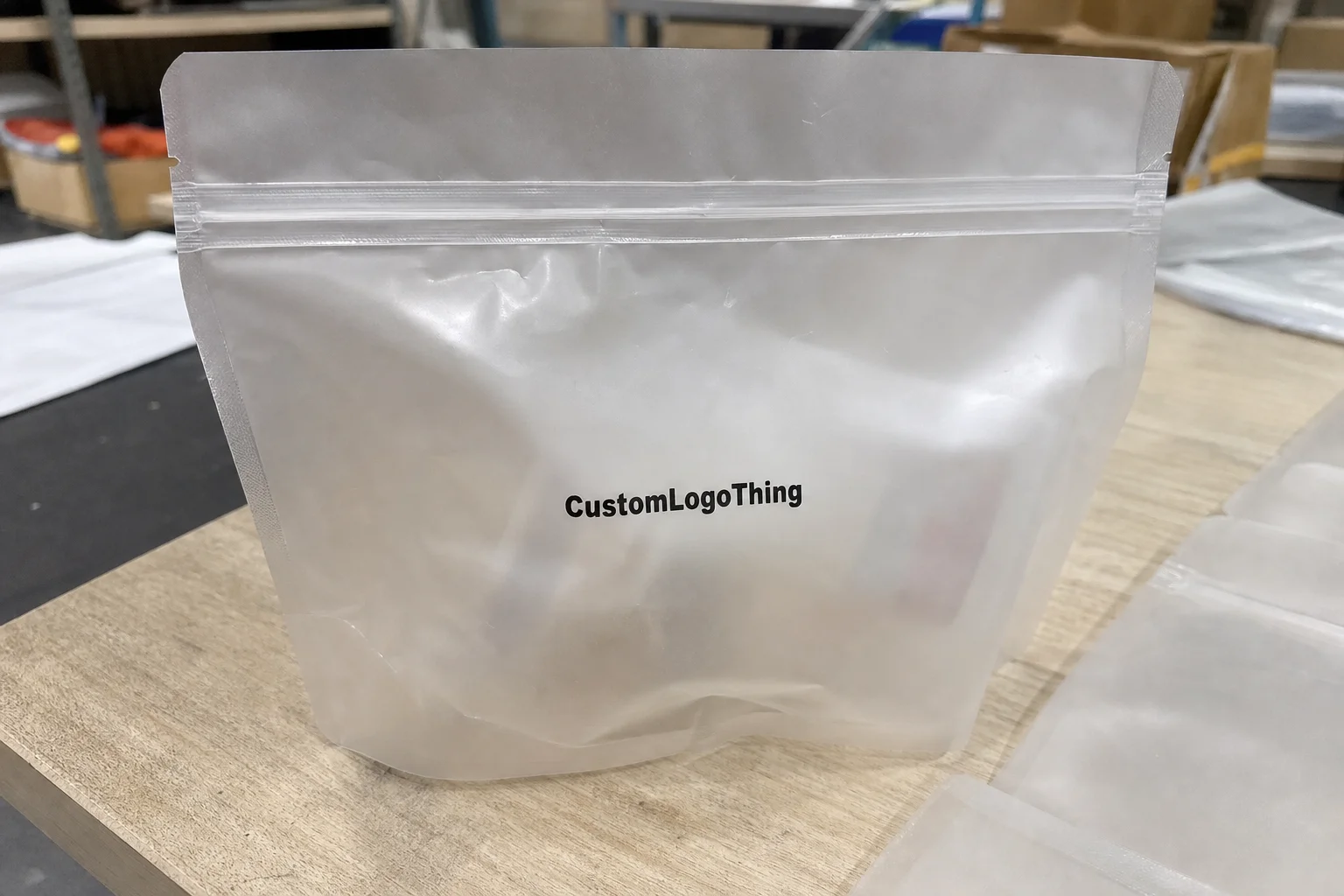
The visible features are only part of the story. A frosted zipper bag with standard PE film, a single zipper track, and a small one-color logo can be priced very differently from a bag that looks similar but uses thicker film, tighter tolerance, and wider print coverage. Once the factory runs material yield, plate setup, and sealing loss through the order, the gap appears fast.
That is why packaging buyers should think in terms of total pack cost, not unit price alone. If one bag replaces a carton sleeve, a label, and an inner pouch, the bag can be the cheaper route even when the piece price is higher. If the bag only adds visual polish while the rest of the pack still needs extra components, the value case gets weaker.
The other hidden variable is handling. Frosted film tends to signal a cleaner, more controlled presentation than plain clear film, especially for skincare and gift sets. But the surface finish must survive the same reality as everything else in shipping: compression, rubbing, bending, and repeated opening. If the bag scuffs easily or seals unevenly, the premium signal disappears quickly.
Buyers often underestimate how much the intended use drives cost. A dust cover, a product carrier, and a retail display item are not interchangeable specs. Each one needs a different tolerance for thickness, closure strength, and print durability. If the use case is vague, the quote will usually be vague too.
Material, Frosted Finish, and Zipper Build Options
Common Film Structures
Most cosmetics Frosted Zipper Bags are made from PE, EVA, or a blended structure that borrows traits from both. PE is the common baseline because it is flexible, familiar to converters, and economical in bulk. EVA usually feels softer in hand and can read as more premium, but that comfort often comes with a higher unit cost. Blended films sit between the two and are used when the buyer wants a specific balance of clarity control, stiffness, and seal behavior.
The frosted effect is not one fixed look. Light frosting still allows the silhouette of the contents to show through. Heavier frosting pushes the surface toward a matte, diffused appearance that hides internal clutter and makes the pack feel more controlled. That choice affects brand expression and print contrast. It also affects how much of the product remains visually readable through the bag.
Film thickness matters as much as the material type. For many cosmetic uses, a range around 80 to 120 microns is common, though small sample bags may run lighter and larger retail formats may run heavier. Thinner film lowers cost but can wrinkle, stretch, or tear more easily at the corners. Thicker film improves hand feel and stiffness, yet past a certain point it just adds resin cost without making the pack meaningfully better.
Zipper and Closure Choices
Single-track zippers are the standard starting point. They are adequate for many sachet kits, travel items, and light retail uses. Double-track closures cost more, but they can improve reclosability and reduce complaints when the bag is opened often. The extra material and sealing time have to be justified by the product category, not by habit.
Special features should be selected with a cold eye. Rounded corners reduce snagging and make the bag look more finished. Hang holes help when the package must sit on a hook. Gussets add volume for bulkier cosmetic sets. Tear notches can improve first-open experience. All of them add complexity. All of them should earn their keep.
What buyers need from a supplier is specificity. A phrase like “premium frosted bag” means very little. Ask for the film type, thickness in microns or mils, zipper profile, seal method, and any add-on features listed separately. When those details are missing, comparing quotes becomes guesswork.
In practice, the best quote is the one that makes the spec measurable. That is the point where cost becomes comparable instead of decorative.
Sizes, Thickness, and Print Limits That Affect Fit
Size is not just width and height. A bag that is technically large enough can still perform badly if the fill is too tight, the zipper sits too close to the product, or the cosmetic shape creates pressure near the seal. Travel-size skincare, makeup tools, sample bottles, and bundled promo kits all need different clearance.
Thickness and fit are tied together. A thin bag may be cheap, but if the corners split or the surface creases so much that the pack looks tired, the savings vanish in rework and rejects. A heavier film can improve handling and shelf presence, but if it is chosen only because it “feels better,” the buyer may be paying for texture rather than performance.
Print space adds another constraint. A small logo on frosted film is easy. Large-area branding across the front and back can create registration problems, higher setup charges, and more waste while the press is tuned. Fine lines and tiny type also become harder to hold cleanly on a diffused surface. The artwork has to respect the material, not fight it.
Before approving the size, confirm these details:
- Finished width, height, and gusset depth
- Expected fill volume and product shape
- Seal margin above the top of the fill line
- Print-safe area and logo placement
- Whether the bag needs hanging or shelf display features
One recurring mistake is approving a flat artwork proof before the actual contents are finalized. The mockup can look balanced and still fail once the product is loaded. The zipper may sit too low, or the closure may have to fight the product volume. That creates a bag that looks right in review and wrong in packing.
Cosmetics Frosted Zipper Bags Unit Cost: MOQ and Pricing Drivers
Cosmetics frosted zipper Bags Unit Cost is driven mostly by quantity, material grade, size, zipper build, and print complexity. Of those, quantity and material usually have the largest effect. Larger orders spread setup costs more efficiently. Higher-grade film, heavier gauge, and more complex closures raise cost directly. Print coverage adds both labor and waste, especially when multiple colors are involved.
MOQ follows the same logic. Stock-style bags with no print can often start lower because the factory can draw from standard tooling or existing material runs. Custom sizes, branded print, and unusual finishes usually push MOQ upward because the line needs dedicated setup time and the supplier needs enough volume to absorb it.
The real split is fixed versus variable cost. A plate fee, cylinder fee, or other tooling charge may sting on a small order, but it becomes less visible once the run grows. That is why a 3,000-piece quote can look expensive next to a 10,000-piece quote even when the larger order has a much lower per-unit price. The tooling is not cheaper. It is simply spread thinner.
Broad market ranges help buyers sanity-check a quote, but they should never be treated as a promise. For common cosmetic applications, a standard frosted PE bag with a single zipper and simple one-color print might land around $0.18 to $0.32 at 3,000 pieces, while a 5,000-piece run might fall into the $0.12 to $0.24 range. At 10,000 pieces, many orders move toward $0.09 to $0.18, and larger custom runs can dip lower if the spec stays controlled. Heavier film, wider print coverage, and extra features can pull those numbers back up quickly.
| Order size | Typical spec | Estimated unit cost | What usually drives it |
|---|---|---|---|
| 3,000 pieces | Standard frosted PE, single zipper, one-color print | $0.18-$0.32 | Setup charges and lower yield efficiency |
| 5,000 pieces | Custom size, frosted finish, one- or two-color print | $0.12-$0.24 | Better spread of tooling fees and print prep |
| 10,000 pieces | Heavier film, branded print, standard zipper | $0.09-$0.18 | Material buying power and better line efficiency |
| 20,000 pieces+ | Custom structure, higher print coverage, added features | $0.07-$0.15 | Lowest cost per piece, but more cash tied up in inventory |
Those ranges only make sense if the supplier is quoting the same product against the same assumptions. If one quote includes thicker film, better print, or more demanding closure specs, the lower number may simply be underbuilt. A cheap quote that misses seal strength or color consistency is not a bargain.
A low unit price stops mattering the moment the bag fails a seal check, shifts in print, or misses the ship window.
That is the part buyers should keep in view. The right number is not the lowest line item. It is the cost of a bag that arrives on spec, packs cleanly, and does not create surprise labor later.
Lead Time, Sampling, and Production Steps
The path from inquiry to shipment usually follows the same sequence: spec review, quotation, artwork confirmation, sampling, production, inspection, and freight booking. The steps are predictable. The delays hide in the details.
Sampling should not be treated as a box to tick. A stock sample is useful if the buyer needs to evaluate feel, transparency, zipper action, and general build quickly. A pre-production sample matters more when the order carries a premium brand, a launch deadline, or a print layout that has to land exactly. The first sample can confirm the format. The second confirms the order.
Typical timing for a custom run might look like this: 1 to 3 business days for proofing, 5 to 10 business days for sampling, and 12 to 20 business days for production after approval. Those numbers move with factory load, artwork complexity, and whether new tooling is needed. Freight is separate. Buyers lose time when they treat production and transit as one clock.
Delays usually come from three places:
- Missing or unclear dimensions, especially around gusset depth and seal margin
- Artwork changes after proof approval
- Sample revisions that reopen color or fit decisions
Shipment planning deserves the same attention as production. For transport testing, the ISTA framework is useful because it gives a practical way to think about vibration, compression, and drop handling, even for soft packaging. If the order includes paper inserts, sleeves, or outer cartons, the FSC chain-of-custody framework may matter for those components as well.
Lead time becomes easier to control once the buyer freezes the variables that actually affect the run. That means knowing what is cosmetic preference and what is a manufacturing input. The factory can work with the second. The first tends to create churn.
Quality Checks That Change the Invoice
Packaging quality is not just about appearance. The checks that happen before approval can change the final invoice because they determine whether the first run succeeds or gets partially reworked. That is especially true for printed frosted bags, where a small registration issue can become a full reprint if the artwork has tight margins.
Ask how the supplier checks dimensions, zipper action, seal strength, and appearance consistency. If they only talk about visual inspection, that is not enough. A bag can look fine in a photo and still fail in repeated use. Seal lines should be even. Zippers should close with consistent resistance. Thickness should stay within the tolerance promised in the quote.
Defect handling matters too. A responsible factory should state an acceptable defect rate and explain what happens if the batch exceeds it. That discussion is not bureaucracy. It is how buyers protect the budget. If the supplier is vague about scrap, replacements, or rework, those costs will usually come back to the buyer in a less visible form.
There is also a difference between sample quality and production quality. Samples are often handled more carefully than bulk goods. The buyer should not assume the sample automatically represents the full run. Production needs its own inspection standard, especially when the bag is holding powders, liquids, or mixed cosmetic sets that will be opened and closed repeatedly.
How to Judge a Supplier Before You Approve a Run
Price matters, but consistency decides whether the order stays profitable. A supplier that quotes aggressively and then misses width tolerance, print alignment, or seal performance can cost more than a higher-priced factory that holds the line. Reprints, delays, and rejects are hidden expenses until they hit the schedule.
Ask for specifications that can be checked. Material type. Thickness. Zipper style. Finish. Acceptable defect rate. Inspection method. Shipping term. If a supplier cannot state those clearly, the quote is incomplete. If they can, you have something real to compare.
Communication speed is part of the cost structure too. Slow replies are not just frustrating; they create risk when artwork changes or freight windows move. A supplier who documents revisions and answers precisely will usually save money, even if the first quote is not the cheapest. The order spends less time in uncertainty, and uncertainty is expensive in packaging.
Compare landed cost, not factory price. Include freight, duties, sample charges, carton or pallet handling, and the possibility of reprint if the first run misses the mark. That is the only honest comparison across suppliers. Anything else flatters the cheapest quote and hides the actual cost of getting sellable bags into your inventory.
What a Good Quote Should Include
- Finished size and thickness
- Frosted level or finish type
- Zipper style and add-on features
- Print colors, coverage, and artwork format
- MOQ, setup charges, and tooling fees
- Sample timing and production lead time
- Shipping terms and destination
If that information arrives in a clean, itemized quote, the supplier is probably treating the job as a production order rather than a speculative price sheet. That distinction matters.
What to Send for a Faster Quote and Sample Run
Fast quotes come from complete briefs. Send the finished dimensions, target thickness, frosted finish preference, zipper style, artwork file, quantity, destination, and the date the bags need to be in hand. Missing one of those usually produces a placeholder price, not a usable one.
It also helps to ask for two versions. One can hit the target budget. The other can be a higher-spec comparison so you can see what better film, stronger closure, or improved print coverage costs in real terms. That comparison often tells the story more clearly than a long email thread.
Usage details matter. Tell the supplier whether the bag will hold powders, liquid products, sample sachets, travel bottles, or mixed sets. That affects thickness choice, zipper choice, and whether extra resistance against leakage or snagging is needed. Cosmetic packaging gets expensive when the spec ignores the contents.
If the bag has compliance, labeling, or retail requirements, list them up front. That includes carton labeling, insert cards, inner pack counts, or any testing expectations. The more complete the brief, the less likely you are to pay for changes after the first proof.
Once the sample arrives, check three things first: closure feel, visual finish, and fit. If those pass, the run can move forward. If they fail, fix the spec before approving production. That is the simplest way to keep cosmetics Frosted Zipper Bags unit cost aligned with the real job instead of letting avoidable revision cycles inflate it.
FAQ
What affects cosmetics frosted zipper bags unit cost the most?
Size, thickness, and zipper style usually move pricing more than small artwork changes. Print coverage and color count can add setup charges, while higher volume lowers cost per piece because fixed tooling fees are spread across more bags.
What MOQ should I expect for frosted zipper bags for cosmetics?
MOQ depends on whether you are buying stock, custom-printed, or fully custom-made bags. Simple stock formats usually have lower minimums than specialty sizes or premium finishes. If volume is a concern, ask for tiered pricing so you can compare entry-level MOQ against lower unit cost at higher quantities.
How long is the usual lead time after artwork approval?
Sampling can add time before production begins, especially if you need a color or fit check. Mass production depends on order size, print complexity, and current factory capacity. Freight is separate from production and should be confirmed before approval so the delivery date is realistic.
Can I request a sample before placing a bulk order?
Yes. A pre-production sample is the right choice when finish, zipper feel, or print placement matters. A stock sample can still be useful if you mainly want to check material appearance and closure quality. Confirm whether sample fees are credited against the final order.
What information do you need to quote zipper bag pricing accurately?
Start with the finished size, desired thickness, and finish type. Add artwork, color count, target quantity, and any special features such as gussets or hang holes. Include delivery location and deadline so the quote reflects production and freight realities.
Why do two suppliers quote different prices for the same bag?
One may be using a different film grade, a different zipper build, or a different allowance for waste and inspection. Some suppliers also include tooling, packaging, or freight in the quote while others separate those costs. The numbers only compare cleanly when the spec and the quote terms match line by line.
For cosmetics packaging, the cheapest bag is rarely the best buy. The better order is the one that matches the product, prints cleanly, closes reliably, and arrives when the launch needs it. That is where the real value sits.


