For a launch kit, subscription insert, or pop-up retail line, Frosted Zipper Bags small Batch Custom Order can do more than hold a product. The surface treatment changes the read immediately. Logos look sharper against the haze, photography gets less glare, and a modest package can feel intentional instead of improvised. That matters because the bag is often the first physical signal of brand control, not just the last step before shipping.
The business case is practical. A small run lets buyers test response, avoid tying up cash in dead inventory, and adjust the package before the line hardens into something expensive to change. In packaging, the cheapest bag is not always the cheapest decision. A run of plain bags that never gets used can cost more than a slightly pricier custom order that actually supports sell-through.
That is why frosted film shows up in categories where presentation and speed matter at the same time. It is common in sample programs, retail inserts, event giveaways, and limited product drops. The goal is rarely to hide everything. More often, it is to frame the product so the contents look deliberate rather than random.
There is also a psychological effect that buyers underestimate. Clear packaging exposes every inconsistency in product layout, label placement, and fill level. Frosted material softens that. It gives a small brand the visual discipline that larger brands often buy with custom cartons and long lead times.
Frosted zipper bags small batch custom order: where the finish pays off
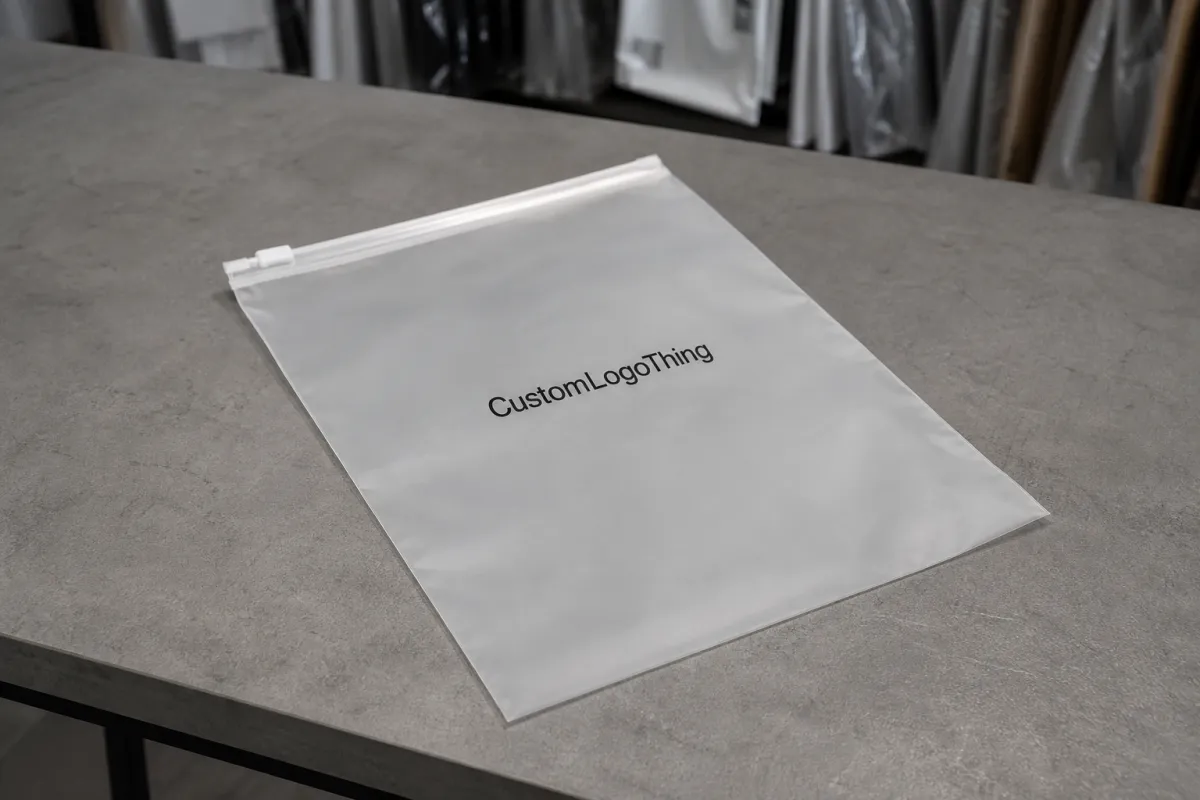
One thing experienced buyers learn quickly: a frosted finish can make a small run look more polished than a larger run of clear bags. The surface reduces visual noise. Reflections are softer. A one-color logo often reads cleaner because the background does not compete with it. If the artwork is restrained, the bag can look premium without needing much ink coverage.
That is why this format is common in launch kits, sample packs, apparel inserts, and event promotions. Those jobs do not need warehouse-scale inventory. They need packaging that feels planned and can be approved without weeks of back-and-forth. Small batch ordering also makes it easier to change direction after the first market test. If the logo, product mix, or messaging shifts, the package can shift with it.
The trade-off is straightforward. Frosted film reduces full transparency. If the product itself is the selling point, clear packaging may work better. If the goal is to create a cleaner presentation, the frosted look usually wins. In practical terms, a slightly higher unit cost can be worth it if it avoids overbuying packaging that misses the mark. A bag priced at $0.22 that supports conversion is better than a $0.16 bag that looks generic and sits in storage.
Best-fit scenarios usually include:
- Subscription inserts that need a repeatable, tidy presentation
- Cosmetics and wellness sample packs where label contrast matters
- Craft, accessory, and apparel items that ship flat
- Pop-up retail and short event runs with fast turnaround pressure
- Pilot launches that may change after customer feedback
For buyers comparing package systems, the important question is not whether the bag looks good in isolation. It is whether the bag supports the rest of the product story. Frosted material is better at framing than showcasing, and that distinction changes the whole design brief.
Materials, zipper styles, and frosted finish options that change performance
Not all frosted bags are built the same. The base film is often a polyethylene blend, though some jobs use laminated construction for extra stiffness or a more refined hand feel. Lighter film usually lowers cost and shipping weight. Thicker film increases puncture resistance, but it can also make the bag feel less flexible and more rigid than the product needs.
The zipper matters just as much. A standard press-to-close zipper is the most familiar option and usually the easiest choice for short runs. Double-track zippers create a firmer closure feel and are often preferred when the bag will be reopened several times. Tear-and-reseal styles can work for sample programs, but they are not always the best fit if the opening experience needs to feel clean and premium.
Finish level is another quiet variable with visible consequences. Light frost gives a subtle haze and leaves more of the contents visible. Medium frost balances concealment and readability. Heavy frost creates a stronger branded look and hides more of the product, which can help if the contents are visually busy or the fill varies from unit to unit.
Material and finish choices usually break down like this:
- Light frost: better visibility, softer branding effect, lower visual contrast
- Medium frost: balanced concealment, solid label readability, common for retail packaging
- Heavy frost: stronger brand presence, less product visibility, more premium feel
- Laminated structure: more body and durability, useful for heavier inserts or display packs
There are cases where frosted bags are the wrong choice. Products that depend on complete visibility, moisture-heavy contents, or a high-gloss luxury look may perform better in clear or specialty film. Regulated categories deserve extra scrutiny. Food contact, cosmetic labeling, and child-resistance expectations can all affect the final structure, so the material should be selected around the actual contents rather than the design mood board.
Buyers often ask for outside references when they are comparing handling and compliance expectations. Organizations such as ISTA are useful for distribution testing context, and FSC matters when paper components or sustainability claims enter the conversation. Those references do not replace product-specific testing, but they help keep the discussion grounded.
From a production standpoint, the finish should never be judged on appearance alone. A sample that looks elegant on a desk can still fail if the zipper is loose, the film scuffs too easily, or the bag turns cloudy under store lighting. Good packaging is a balance of appearance, closure feel, and repeat use.
Size, thickness, print method, and compliance specs to lock down
Most quote problems start with incomplete measurements. Buyers often send a rough size and expect the factory to infer the rest. That rarely goes well. For Frosted Zipper Bags small batch custom order, the core specifications should include width, height, gusset depth if one exists, usable print area, and any feature such as a hang hole or tear notch. If the product is thick or irregular, a filled sample is more useful than a guess.
Thickness is another place where clear language helps. Film gauge affects hand feel, stiffness, and resistance to tears. Too thin, and the bag reads as disposable in the wrong way. Too thick, and it becomes bulky or awkward in shipping cartons. The right choice depends on product weight, fill shape, and how often the bag will be opened and closed.
Print method changes the economics too. A one-color logo is usually the most efficient path for a short run. Spot-color matching helps when brand consistency matters and the logo has to match an established standard. Full-coverage print looks dramatic, but setup and ink coverage usually push the cost up fast. For many buyers, a restrained label zone on the frosted panel is the best compromise because it keeps flexibility while still creating strong package branding.
Confirm these details before requesting a quote:
- Exact finished size and acceptable tolerance
- Estimated product weight per bag
- Closure style and whether the bag needs a strong reseal feel
- Artwork format and number of print colors
- Retail or shipping conditions, including heat, compression, or moisture exposure
Compliance can be category-specific. Food contact, cosmetic labeling, ingredient space, and child-safety requirements may all affect the final spec. That is why a careful supplier asks what is going inside the bag before quoting it. If you are not sure how a product will be packed, send a filled sample or a comparable reference piece. That one step often prevents the mismatch that burns time and money later.
Fit deserves more attention than it usually gets. A bag that is 10 mm too narrow can look acceptable on a screen and fail in the hand. A bag that is too loose may reduce shelf appeal. Small dimensional errors become visible fast in packaging because buyers are judging by feel, not just by a drawing.
| Spec choice | Best for | Typical effect | Buyer trade-off |
|---|---|---|---|
| Light frost, 1-color print | Test launches, inserts | Low visual contrast, clean label read | Lower setup cost, less concealment |
| Medium frost, spot color print | Retail packaging, samples | Balanced brand presence and visibility | Moderate cost, better shelf control |
| Heavy frost, full-coverage print | Premium branded packaging | Strong presentation and concealment | Higher setup and ink cost |
Pricing, MOQ, and unit-cost breakpoints for short runs
Pricing for Frosted Zipper Bags small batch custom order usually comes down to five variables: bag size, film thickness, zipper style, print coverage, and the number of SKUs in the order. Every added variant creates setup work. Every extra color adds complexity. Every special feature shifts the quote upward. That is not a penalty; it is how short-run manufacturing works.
MOQ exists for a reason. Printing plates, setup labor, trimming, and production waste have to be spread across the run. A 250-piece test order and a 2,500-piece reorder almost never share the same economics. On a small job, the setup burden can be a large share of the total price. On a larger job, material and freight begin to matter more. The shift is easy to miss if buyers focus only on the per-unit number.
In practice, a slightly higher unit cost can still be the better decision if it avoids dead stock. A 12-cent bag that never moves is more expensive than a 28-cent bag that gets used immediately and supports the launch. That is the part of packaging math people forget when they are only comparing line items.
Illustrative pricing ranges for short-run Frosted Zipper Bags:
| Run size | Typical unit range | Common setup profile | Best use case |
|---|---|---|---|
| 250-500 pieces | $0.28-$0.55 | Simple print, standard size | Launch tests, market trials |
| 1,000 pieces | $0.18-$0.32 | Moderate print coverage | Seasonal programs, sample packs |
| 2,500+ pieces | $0.12-$0.24 | Better amortized setup | Repeat retail packaging orders |
Those numbers are planning ranges, not guarantees. Heavy frost, a custom zipper, strict color matching, or complex artwork can push cost higher. A simple one-color layout on a standard bag often lands lower. The cleanest quote requests include quantity, dimensions, artwork, finish preference, and delivery location. Leave one of those out and the conversation usually slows down while the missing detail gets rebuilt.
If you are buying across multiple packaging formats, compare the bag against cartons, sleeves, and labels before committing. Sometimes a frosted pouch wins because it is faster to approve than a printed box. Other times a carton is the better choice because the bag would not carry enough of the brand story. The cheapest format is not always the most efficient one.
Production process and timeline: from artwork to shipment
The production path looks simple on paper: request quote, confirm specs, review artwork, approve proof, produce sample if needed, run the batch, inspect, ship. In real work, the order of those steps matters because one missing measurement can delay everything that follows.
One common mistake is treating quote speed as the same thing as production speed. They are different. A supplier can return a quote quickly and still need time to reserve a production slot. If the order is urgent, that has to be stated early. It affects material choice, shipping method, and whether the job can fit into an existing run.
Delays usually happen in the same places: proof approval, color corrections, unclear dimensions, and sample changes after the fact. If the bag must fit a retail insert precisely, a physical sample is often worth the extra day or two. It can prevent a reprint that costs far more than the sample ever did.
A practical planning rule: finalize artwork and measurements first, then place the order. That sounds obvious, but it is where many short runs slip. The more complete the first submission, the faster the proof stage moves and the lower the chance of revision fees.
For most buyers, turnaround depends on three variables: print complexity, whether a sample is needed, and how fast the approval cycle moves. Ask for both the proof timeline and the production slot estimate. That gives a far better picture than a vague promise of “quick turnaround.”
Typical small-run jobs move in roughly one of three ways. Straightforward orders can move quickly if the artwork is simple and the dimensions are already known. Orders that need proof revisions slow down. Orders with custom features, tight compliance needs, or unusual sizes usually take the longest because more variables have to be checked before production can begin.
That is why short-run packaging works best when the supplier understands smaller orders as their own category, not as a diminished version of a warehouse-scale purchase. The process should match the buyer’s reality, not the factory’s ideal batch size.
How a short-run program keeps repeat orders simple
Repeat orders are where a well-run short-run program proves itself. The first job takes the most time because the specs, artwork, and fit all need to be locked down. After that, the best suppliers keep the working details intact: bag dimensions, print files, finish, and notes from the proof stage. The reorder then starts from a known baseline instead of a fresh round of guesswork.
That matters for subscription packs, seasonal launches, and product lines that update every quarter. Buyers do not want to rebuild the packaging logic every time they reorder. They want matching bags across channels, enough flexibility to adjust quantity, and a process that does not force a full reset just because the volume changed.
There is a quieter benefit too. A good short-run program helps catch fit decisions before the first shipment leaves the dock. A bag that is slightly oversized may pass a quote review and still disappoint on the shelf. A bag that is too tight can frustrate fulfillment teams. Good process reduces that trial-and-error instead of adding more of it.
For buyers building a broader packaging system, small-run frosted bags can be one piece of a phased plan that later expands into custom printed boxes, labels, or larger retail packaging. That does not mean everything has to be ordered together. It means the visual language can scale without forcing the business into a huge upfront commitment.
The business argument is simple: a vendor that handles short-run frosted bags well saves time on every reorder, not just the first one. Fewer corrections. Less rebuilding. Better consistency. That is supply-chain efficiency in a form that shows up on the shelf and in the fulfillment room.
"The best short-run packaging is the one you can reorder without rethinking every detail."
What to send for a fast quote and a clean first proof
If you want a clean quote, send the facts upfront. Bag dimensions. Estimated quantity. Product weight. Closure preference. Print or label-zone needs. If the bag must support a specific use case, say that too. A sample pack has different priorities than a shelf display. A shipping pouch has different needs than an in-store giveaway.
Artwork quality matters. Vector files are the safest starting point, especially for logos. If you have brand colors, include them. If you do not, send a reference image or a previous package so the proof can be judged against something real. That matters because package color often shifts under production conditions, and the gap between concept and output is larger than most buyers expect.
Lead time should be stated early, not after the proof and not after the first revision. A firm delivery window affects whether the job can use standard material, a faster freight method, or a sample step before production. If the order is time-sensitive, ask for the production slot estimate before approving artwork.
Best-practice quote checklist:
- Finished size, including gusset if needed
- Quantity by SKU
- Product weight and fill type
- Desired frosted level and zipper style
- Artwork files, color standards, and logo placement notes
- Delivery address and target arrival date
If the product is new, fragile, or display-sensitive, request a sample or pre-production proof. That is the fastest way to catch fit issues, print scale problems, or presentation gaps. Buyers sometimes skip this step to save time, then spend more time fixing the result later. The math usually favors the sample.
One more filter helps keep the decision grounded: compare unit cost, proof speed, and reorder flexibility together. If all three line up, the order is probably the right one. If one of them is weak, the lowest quote can become the most expensive choice once revisions and delays are counted.
What is the usual MOQ for frosted zipper bags small batch custom order?
MOQ depends on size, print method, and whether the bag uses stock construction or custom tooling. Smaller unprinted or lightly customized runs can start lower than fully printed jobs. The fastest way to confirm MOQ is to share exact dimensions and quantity needs with the quote request.
Can frosted zipper bags be printed for a short-run launch order?
Yes, short-run print is common when the artwork is simple and the bag size is standardized. Single-color or limited-color layouts usually keep setup costs more manageable than full-coverage art. Provide vector artwork and brand colors early so the proof stage does not slow the production schedule.
How long does a frosted zipper bag custom order usually take?
Timing depends on proof approval, sample needs, order size, and freight method. A clean spec sheet can shorten the quote and prepress stage significantly. If the order is time-sensitive, ask for the production slot and shipment estimate before approving artwork.
Are frosted zipper bags suitable for food, cosmetics, or sample packs?
They can be, but the bag construction must match the product category and any required compliance rules. Food and cosmetic use may require specific film properties, odor control, or labeling space. Always confirm the intended contents before finalizing the material spec.
What should I prepare before requesting a frosted zipper bags small batch custom order quote?
Prepare dimensions, quantity, product weight, closure preference, and desired finish. Include logo files, print colors, and any must-have compliance or retail display details. If possible, send a physical sample or reference photo so fit and presentation can be judged accurately.

