For many labels, the first packaging decision is not a carton or a hang tag. It is the pouch on the table. A Frosted Zipper Bags for streetwear labels bulk order guide matters because packaging changes the read of the product before the garment is even handled. It affects how quickly a customer understands the brand, how clean the item looks in transit, and how much control the label keeps over presentation. A well-folded tee in the right bag often looks more considered than a premium blank dropped into a generic sleeve.
That effect is practical, not decorative. Buyers and warehouse teams see packaging before they see stitching, print quality, or fabric weight. Frosted film hides scuffs, lint, fingerprints, and shelf wear better than clear poly, which helps the item hold a cleaner look through shipping and retail handling. For streetwear, that visual restraint fits the category better than glossy retail packaging that feels too broad or too polished.
The bag also has to do more than look good. It needs to protect the product, speed up pack-out, and support the brand story without slowing operations. If it fails one of those jobs, the economics start to slip. If it fails two, the packaging program becomes noise.
Why frosted zipper bags outperform plain poly at the table
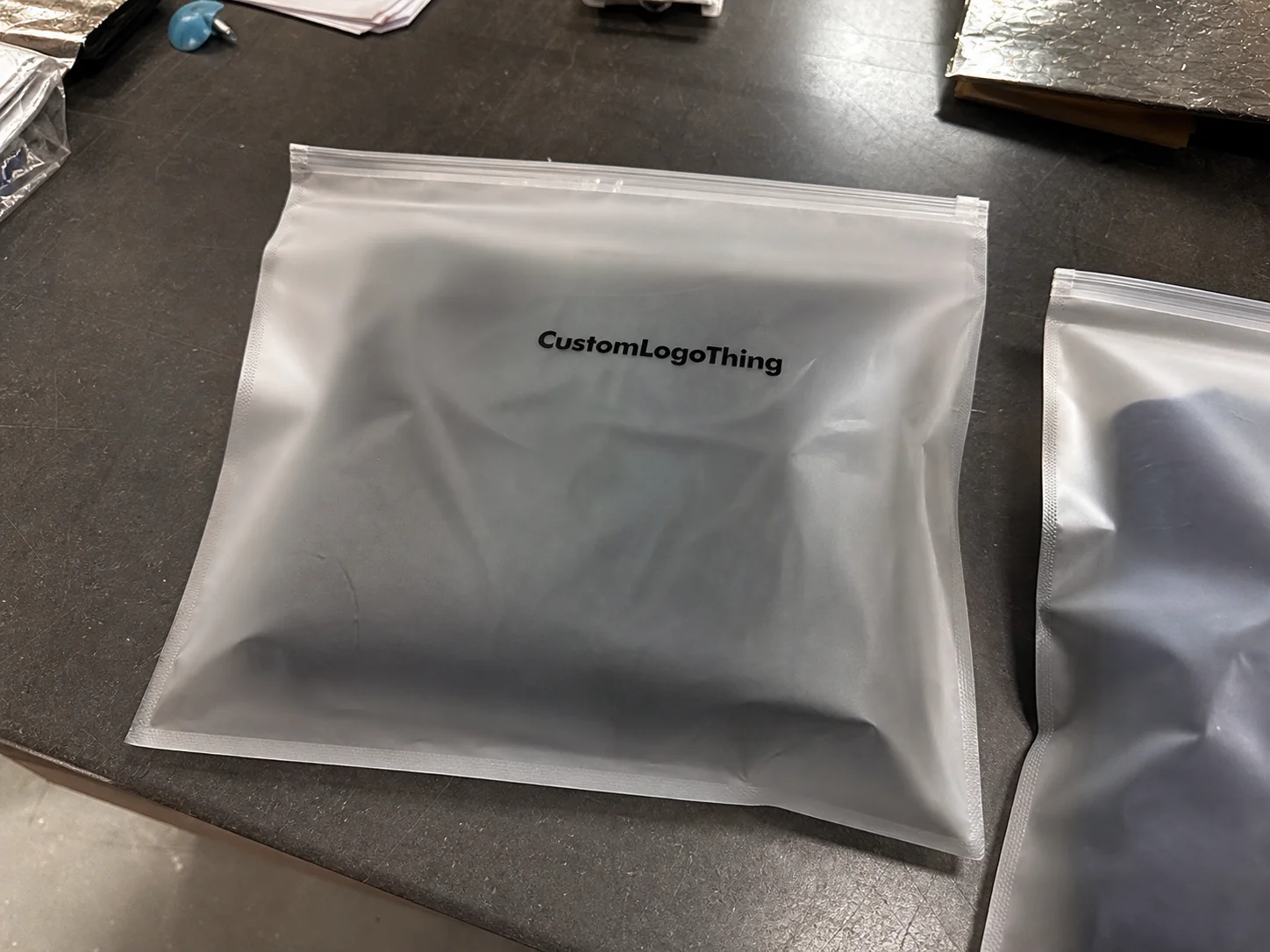
At the packing table, Frosted Zipper Bags have a clear operational advantage. They are easier to standardize than a mixed packaging setup, and a single fold-and-load routine reduces errors. That may sound minor until a crew is handling hundreds or thousands of units across different size runs. One bag format means fewer mispacks, fewer repacks, and less confusion during returns or restocking.
The visual difference also matters more than brands sometimes expect. Clear poly shows everything: wrinkles, dust, product shifting, and the marks left by repeated handling. A frosted finish softens that view. The garment still reads accurately, but it looks more controlled. For streetwear labels, that matters because the packaging should support the line, not compete with it.
Shipping and merchandising benefit too. Frosted film tends to hide handling marks better than crystal-clear polyethylene, so the bag stays presentable after warehouse touches, boutique transfers, and customer inspection. That is useful for labels that move stock from warehouse to pop-up to reseller shelves, or for e-commerce orders that may be opened, checked, and repacked before final delivery.
There is a quieter advantage in returns processing. If a brand uses one reusable pouch format across a line, the warehouse can sort, refold, and rebag with less friction. That does not remove returns, but it cuts disorder. For labels balancing drops, restocks, and seasonal sizes, the labor savings are real.
Packaging also works best when it matches the rest of the system. If the bag, size cue, and garment identity are meant to read as one unit, coordinate the pouch with Custom Labels & Tags so the customer sees a consistent set of signals from the first glance.
Bag formats, finishes, and closure details that fit streetwear
Not every frosted pouch sends the same message. A semi-frosted finish looks softer and less opaque, which suits basics and core collections. A fully frosted bag feels more deliberate and cleaner on the shelf. Matte films sit between the two and can work for heavier outerwear packaging, but the texture changes the way artwork reads. Proofing matters more there than on a standard clear sleeve.
Closure details are not cosmetic. A solid zipper line helps the bag feel reusable and keeps garments protected during storage and shipping. A weak zipper can create the opposite effect: the bag looks premium until the first failure. If the bag will move from carton to peg wall without repacking, the zipper type and pull strength need to be tested before the order is approved.
Hang holes matter too. They are useful for boutique display, pop-up racks, and any retail setup where the packaging has to move from shipping carton to floor presentation without being replaced. Hole placement should sit high enough to support hanging but not so close to the zipper that the top edge curls or tears under weight.
Common size decisions are straightforward on paper and less forgiving in production. A folded tee fits comfortably in a compact sleeve. Hoodies and heavyweight fleece need wider openings and more headroom above the fold. Socks, hats, and accessories can use smaller dimensions, but if the opening is too narrow, pack-out slows and the corners wrinkle. The bag can be correct on spec and still be wrong in the hand.
The choice between stock dimensions and a custom bag depends on how often the format repeats. A stock size with brand print usually keeps tooling simpler and replenishment faster. A custom dimension makes sense when the product line is unusual, the fold standard is strict, or the packaging has to stack a certain way for warehouse automation or boutique display.
If the label is still testing its packaging mix, Wholesale Programs can help compare repeat-run economics against one-off custom specifications.
Thickness, size, and print specs that protect product quality
Thickness is one of the first numbers buyers should lock down. It affects stiffness, seal reliability, and how the bag holds shape after packing. Lighter gauges can work for socks, tees, and accessory kits. Thicker film is usually safer for hoodies, heavyweight fleece, export cartons, and any run that will be handled repeatedly before reaching the customer.
A practical range for apparel packaging is often around 60 to 100 microns, but the right number depends on garment weight and the way the pouch is used. If the bag has to survive multiple touches in a warehouse and still look clean on retail display, the thicker end of that range is easier to defend. If the brand is trying to reduce freight weight across large runs, a thinner film may work, provided folding standards are tight and the bag is not overfilled.
Size is not just width and height on paper. Buyers should ask for usable width, bag depth, zipper allowance, and the amount of headroom above the folded garment. A pouch can be technically large enough and still look cramped if the zipper lands too close to the folded edge. That is the sort of mistake that creates packing delays and a sloppy final presentation.
Print specs deserve the same level of control. One-color logos, size marks, and brand identifiers usually print more cleanly on frosted film than complex full-bleed art. Streetwear brands often want bold graphics, but tight registration on semi-opaque material is harder than it looks. If a supplier says a three-color logo will run fine, ask how they handle alignment, trim variance, and repeatability across the full quantity.
Material consistency matters as much as artwork. Uneven film thickness, weak side seals, and zipper misalignment can make a premium product look discounted. Buyers who care about sustainability markers can also ask about recyclable film options, resin content, and packaging certifications. For general testing and transit stress reference, the ISTA framework is useful. For end-of-life considerations, the EPA recycling guidance helps teams ask better questions before ordering.
| Option | Best for | Typical thickness | Approximate unit cost at 5,000 pcs |
|---|---|---|---|
| Stock-size frosted zipper bag | Tees, socks, simple accessories | 60-70 microns | $0.18-$0.26 |
| Custom printed frosted bag | Core streetwear drops, retail display | 70-90 microns | $0.24-$0.38 |
| Heavier custom pouch with wider zipper | Hoodies, fleece, outerwear | 90-100 microns | $0.32-$0.55 |
The table is a starting point, not a promise. Freight, print coverage, zipper style, and order geometry can move the final number quickly. A slightly thicker pouch may cost more upfront, but it can reduce damage, improve presentation, and lower the chance of repacking waste. That trade-off is often easier to justify than a lower-cost film that wrinkles, splits, or arrives with a cheap-looking feel.
Pricing, MOQ, and quote inputs
Pricing moves in a predictable way once the quote is broken into parts. Film thickness, print coverage, zipper style, bag size, order volume, and shipping method all affect unit cost. The biggest surprise for new buyers is that the lowest headline price is often missing something important: setup, art handling, freight, or a replacement clause.
MOQ depends on whether the bag is stock dimension or fully custom. A stock-size order with simple branding may begin at a lower quantity, while custom sizing and multi-color printing usually push the minimum upward. In many production setups, 1,000 to 3,000 units is the practical starting zone for custom work. Larger repeats can improve unit economics once setup cost is absorbed, but only if the label can actually use the inventory on schedule.
For a streetwear brand, the smarter question is not just “What is the minimum?” It is “Where does the per-unit price drop enough to justify the extra stock?” On some runs, moving from 3,000 to 5,000 units can reduce unit cost by 15% to 25%. That is a meaningful shift, but it only works if launch cadence, size distribution, and restock timing can absorb the volume.
To get an accurate quote, send the supplier the following:
- Exact dimensions, including usable width and height
- Quantity by size if the run includes more than one format
- Artwork file, logo placement, and color count
- Finish preference: frosted, semi-frosted, or matte
- Zipper type, hang-hole needs, and any retail features
- Delivery destination and target in-hand date
A quote only means something if the supplier is quoting the same spec the brand intends to buy. Otherwise the comparison is cosmetic. If one price is materially lower, ask what is absent: plate fees, sampling, freight, defect tolerance, or packaging conversion charges. Buyers who compare only the total number usually pay for the missing details later.
For labels with recurring packaging needs, the best comparison is often between a one-off order and a standing replenishment model. That is where repeat terms, documentation, and a stable spec sheet matter more than a one-time discount.
Production steps, turnaround, and lead time from proof to delivery
The order path should be simple enough that a buyer can audit it without chasing the supplier for basics. A clean sequence usually looks like this: inquiry, spec confirmation, artwork review, digital proof, sample or pre-production check, mass production, inspection, and shipment. If any step is missing, the risk tends to show up later as delay or rework.
Delays usually come from two places. First, the art file is not print-ready, which means the supplier has to clean up resolution, positioning, or color separation. Second, the dimensions change after the first proof, forcing another round of confirmation. In apparel packaging, a few millimeters matter because they affect fold consistency and zipper placement.
Lead time varies with stock availability, customization level, queue depth, and freight mode. A simple stock-format run may move faster than a fully custom print job. For many buyers, the production window after proof approval lands around 12 to 20 business days. Larger volumes or more complex printing can extend that. Air freight may shorten transit, but it does not change the factory schedule. Ocean freight lowers transport cost on larger runs, but it adds weeks, not days.
Use a checkpoint system to keep the drop on track:
- Approve dimensions before artwork placement.
- Confirm print color count before proof signoff.
- Lock the packing plan before mass production starts.
- Review inspection photos or samples before shipment release.
That last step carries more weight than many buyers give it. Once the bags are in motion, corrections are expensive. A label can absorb a short proof delay far more easily than a reprint after the launch window has opened.
How to vet a supplier before you place the first bulk run
Factory capability and sales confidence are not the same thing. A good supplier should be able to explain where the bags are made, who checks quality, and what documentation sits behind the quote. If they cannot show recent production photos, material specs, or basic inspection evidence, the risk profile rises quickly.
Look for process control. That means consistent seals, repeatable print placement, clean zipper function, and clear tolerances on bag dimensions. A pretty sample is useful, but it does not prove repeatability. Streetwear drops need repeatability because one weak lot can distort the packaging look across an entire size curve.
Ask how the supplier handles revisions, defect claims, and replacement policy. If a bag arrives with zipper failures or print defects, the brand needs a clean path to resolution. A supplier that answers those questions directly is usually easier to work with than one that only talks about low pricing and short turnaround.
Communication quality during quoting is a strong indicator. Fast, specific answers usually mean the supplier understands production discipline. Vague replies, even if polite, often lead to back-and-forth once the order is underway. That is where delays hide.
Before approving a first run, check whether the supplier can support the kind of consistency a label needs over time. That includes repeat specs, saved artwork setup, and an accurate record of what was ordered last time. The first order is rarely the hard part. The second and third orders reveal whether the packaging program is actually controlled.
What to send for a fast bulk order and clean approval
If the goal is a fast quote and a clean approval cycle, send one compact order packet. Include the product type, folded dimensions, bag size, thickness target, print files, quantity, delivery address, and launch date. That gives the supplier enough data to quote instead of guessing.
Reference photos help a lot. If the label wants a soft frosted look with centered branding and a particular zipper profile, a photo is usually better than a paragraph of description. It reduces interpretation errors and gives the supplier a realistic target for the proof.
Ask for a written quote that separates unit cost, setup charges, shipping, and optional sample or rush fees. That keeps the budget visible before approval. If the quote lumps everything together, it becomes harder to see where the real cost sits and what changes later if quantities or timing shift.
The cleanest approvals happen when the spec sheet is final before payment. Confirm the dimensions, approve the proof, and place the order only after every print mark and zipper detail matches the drop plan. Anything less invites avoidable rework, and rework is the fastest way to turn a packaging purchase into a margin leak.
What MOQ should I expect for frosted zipper bags for streetwear labels?
MOQ depends on whether the bag is stock size or fully custom. Custom print and custom sizing usually require a higher minimum, often in the 1,000 to 3,000 piece range or more. Ask for several quantity tiers so you can see where the unit price improves enough to justify a larger run.
Can frosted zipper bags for streetwear labels be custom printed?
Yes. Most buyers add a logo, size cue, brand mark, or care note. Keep the artwork simple if you want crisp output on frosted film, and confirm the color count before asking for a final quote. Complex graphics can work, but they need tighter proof control and more careful registration.
Which thickness works best for apparel in a bulk order?
Lighter gauges fit socks and accessories, while heavier apparel like hoodies usually needs thicker film for structure and seal reliability. A useful range is often 60 to 100 microns, but the right choice depends on handling conditions as much as on garment weight.
How long does a bulk order usually take after approval?
Lead time usually starts after artwork and specs are approved, not when the first inquiry is sent. For custom runs, many buyers see 12 to 20 business days for production, with freight added on top. Air and ocean shipping need to be treated as separate timing decisions.
What should I prepare to get a fast quote on frosted zipper bags?
Send dimensions, quantity, finish preference, print file, delivery location, and the date you need the bags in hand. If possible, include a reference sample or photo so the supplier can quote the closest match instead of a broad estimate.


