A buyer can change how a product line is perceived with one packaging decision. That is why a Frosted Zipper Bags unit cost breakdown matters before any bulk order is approved: the finish, film gauge, zipper style, print coverage, and freight assumptions can each move the final price by several cents, and those cents multiply fast across a long run.
For brands sourcing through Custom Logo Things, the commercial question is usually practical rather than theoretical. Can a frosted zipper bag improve presentation without weakening margin? In many cases, yes. A 5,000-piece run of small Frosted Zipper Bags may land in the roughly $0.18-$0.35 range per unit for simpler builds, while larger custom apparel bags can move closer to $0.40-$0.90 once heavier film, larger dimensions, and packaging volume are included. Those are planning ranges, not a universal price sheet, but they show where the cost pressure tends to sit.
Why frosted bags can raise shelf appeal without extra print
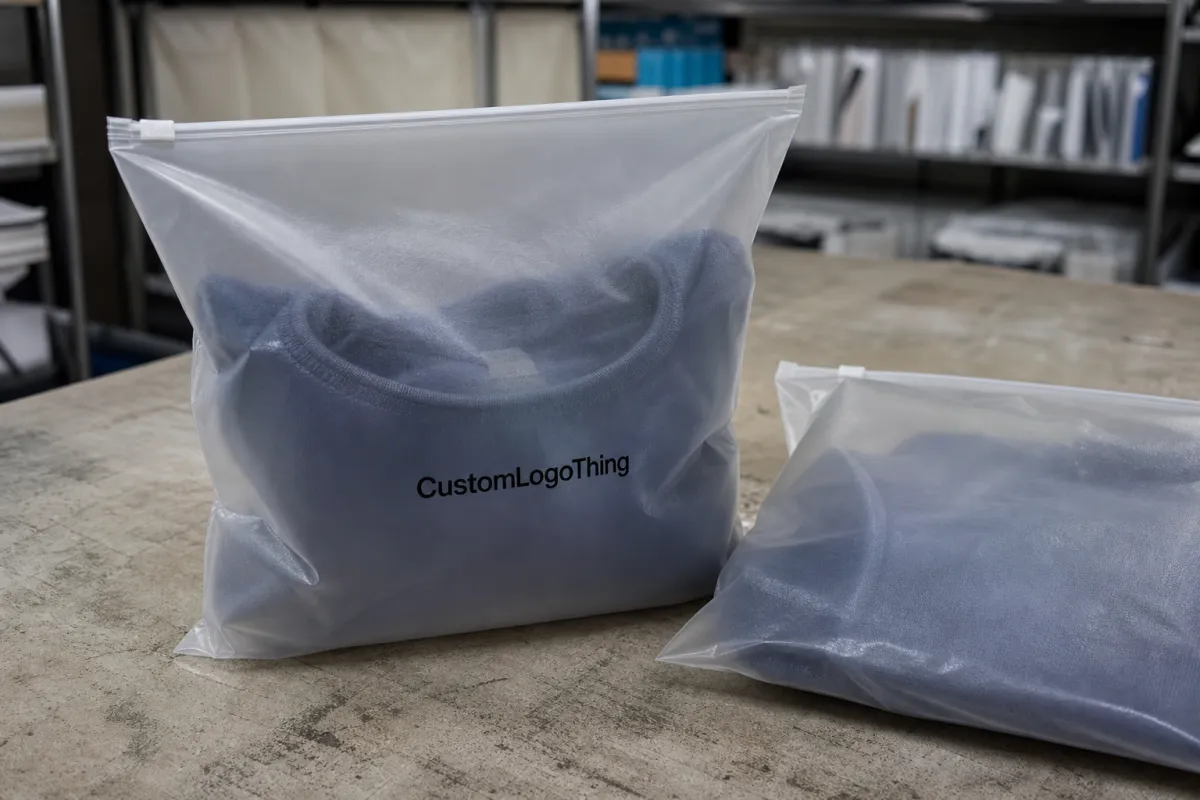
Plain Clear Poly Bags do the job, but they can also make a product look temporary. A frosted zipper bag changes that feel before any logo is printed. The semi-matte surface softens glare, reduces the hard plastic shine that can look cheap under retail lighting, and creates a more controlled presentation even for simple items.
That visual change matters because decoration is not free. Heavy ink coverage adds setup time, proofing, and the possibility of waste during color adjustment. A frosted substrate does part of the visual work on its own, so a buyer can often use a smaller logo, a single-color print, or even just a clean label instead of a full graphic treatment. On a 20,000-piece order, saving $0.03 per unit equals $600 before freight is counted. The math gets serious quickly.
Clear bags remain strong when product visibility is the priority. Opaque bags are better for privacy and stronger brand control. Frosted Zipper Bags sit between those two options. They still show the product, but they hide fingerprints, minor scuffs, folded edges, and mixed contents better than a high-gloss pouch. That middle ground is useful in apparel, accessories, and sample kits where the goal is to look polished without hiding the product completely.
Cost control is not always about choosing the simplest-looking bag. A better substrate can reduce the need for heavy ink, extra inserts, or secondary sleeves.
That is one reason the unit-cost conversation needs more than a single quote number. A slightly more expensive bag may lower the total packaging system cost if it removes a printed insert, reduces label size, or lets several SKUs share one format. Reorders also become easier when the same bag fits multiple items with only minor artwork changes.
How the bag is built: film, seal, zipper, and frosted finish
A frosted zipper bag looks simple from the outside, but the quote depends on several construction choices. The base film is usually PE or PP, sometimes with a blend chosen for clarity level, stiffness, sealability, and hand feel. Common gauges for light retail goods often sit around 2-4 mil, while heavier apparel, cosmetics kits, or accessory packs may need 4-6 mil depending on fill weight and handling.
The seal construction is one of the hidden cost drivers. Side seals, bottom seals, and zipper attachment all need enough heat and pressure to hold cleanly without warping the opening. A bag can look fine when empty and still fail after repeated use if the zipper track is misaligned or the seal area is too narrow. For bulk buyers, seal quality is not cosmetic; it is a return rate issue.
The zipper style changes both price and user experience. A standard press-to-close zipper is usually the least expensive option. A heavier zipper, slider closure, or double-track style can raise the unit cost, but it may be worth it for products that customers open many times. Cosmetics, craft supplies, jewelry findings, and sample packs are common cases where the closure matters more than the lowest possible price.
The frosted look itself can come from material selection, surface treatment, or film texture. It does more than alter appearance. A frosted bag often feels less slippery and more substantial in hand, which can lift perceived value even before print is added. It also hides fingerprints better, which matters when staff pack thousands of units manually and every smudge shows under retail lighting.
Add-ons should be chosen carefully. Hang holes are usually modest in cost but need alignment control. Tear notches are useful for tamper-style openings, though they do not suit every reclosable format. Writable panels help with sample labeling and batch notes, but they reduce usable print space. Rounded corners, vent holes, reinforced headers, and custom die shapes can add waste or labor without improving the actual product experience.
Different products place different pressure on the bag. Apparel buyers usually care about softness, consistent size, and easy packing. Cosmetics buyers often watch finish quality, seal cleanliness, and print sharpness. Accessory programs tend to focus on zipper repeatability and containment of small parts. A serious frosted zipper bags unit cost breakdown should connect each construction choice to the item being packed rather than listing upgrades in isolation.
Specs buyers should lock in before requesting quotes
The fastest way to get a vague quote is to send a vague request. “Need frosted zipper Bags with Logo” leaves too much open to interpretation. Different suppliers will make different assumptions, and those assumptions are rarely identical. One quote may be based on 2.5 mil film and one-color print; another may use 4 mil film, double-sided frosting, and heavier cartons. The numbers cannot be compared cleanly if the spec is not fixed first.
Start with a specific request set:
- Finished dimensions: width, height, lip size if needed, and usable fill area.
- Film thickness: often 2-6 mil for common retail and promotional use.
- Material: PE, PP, recycled-content option, or specialty film if needed.
- Zipper type: standard press-close, heavy-duty track, slider, or double zipper.
- Finish level: light frost, medium frost, heavy frost, single-side, or double-side treatment.
- Print details: logo size, colors, placement, ink coverage, and print side.
- Packaging method: bulk packed, inner packs of 100, retail bundled, or carton labeling.
Thickness alone does not tell the whole story. A 3 mil bag with strong seals and decent stiffness can outperform a thicker bag made from a softer film that stretches badly under load. Fill weight, product edges, zipper stress, and carton compression all matter. If the bag will hold metal parts, folded garments, bottled samples, or sharp-cornered accessories, ask for a sample or a comparable production photo before approving volume.
Artwork changes pricing too. One-color print on one side is usually simpler than two-sided, multi-color artwork with tight registration. Large ink coverage can raise the per-piece cost and also increase waste during setup. For brand colors, ask whether the supplier works from Pantone references or CMYK approximations. If color repeatability matters across reorders, document the target and the acceptable tolerance before production starts.
Buyers should also ask for tolerance ranges. A quoted 6 x 9 inch bag may arrive with a normal production variance of a few millimeters. Film gauge can vary within an accepted range as well. For packaging that must fit a retail insert, box, or shipping kit, those tolerances affect packing speed and line stability. What looks like a small variance on paper can stop a filling line if the opening is too tight or the finished height is off.
For sustainability or compliance claims, treat the language carefully. If recycled content, resin origin, or other material claims are part of the order, ask for supporting documentation and define the claim exactly. Packaging buyers should not assume a supplier’s marketing term matches a retailer’s policy or a regulator’s definition.
Frosted zipper bags unit cost breakdown and MOQ tradeoffs
A practical frosted zipper bags unit cost breakdown starts with seven variables: resin grade, bag size, film thickness, zipper style, frosted treatment, printing, and secondary packaging. Freight can become an eighth if the bag is large enough to ship a lot of empty air. That is especially true for apparel bags, which often look light on a scale but occupy real carton volume.
Unit cost usually falls as volume rises, but the curve is not smooth. Setup charges, tooling fees, plate charges, machine changeover, and minimum run requirements distort small orders. A 1,000-piece custom run can look expensive because fixed costs are spread across too few bags. At 10,000 or 25,000 pieces, those fixed costs shrink per unit, and resin, labor, packing speed, and carton efficiency become easier to see in the quote.
| Cost factor | Typical impact on unit cost | Buyer note |
|---|---|---|
| Bag size | Medium to high | Larger dimensions use more film and increase carton volume. |
| Film thickness | Medium to high | Moving from 3 mil to 5 mil changes material cost and shipping weight. |
| Zipper style | Low to high | Standard press-close is economical; slider or heavy-duty tracks cost more. |
| Frosted finish | Low to medium | Single-side frost is often cheaper than double-side treatment. |
| Printing | Medium to high | Color count, coverage, plates, and registration affect setup and waste. |
| Inner packing | Low to medium | Bundles, labels, and carton marks add labor but help receiving accuracy. |
Stock-style changes save money. If an existing size already works, customization can stay focused on print, finish, or packing rather than rebuilding the bag from scratch. Fully custom builds make sense when size, zipper position, hang-hole placement, or structure affects the retail fit. They cost more because they may require tooling, sampling, and additional production checks.
Here is a realistic comparison for planning purposes:
| Order path | Estimated quantity range | Likely cost pattern | Best fit |
|---|---|---|---|
| Stock size with simple logo | 2,500-10,000 units | Lower setup risk; faster quote; moderate bulk pricing | Samples, accessories, small retail goods |
| Custom size with one-color print | 5,000-25,000 units | Better fit; setup charges spread across volume | Apparel, kits, cosmetics, subscription items |
| Custom structure with premium zipper | 10,000+ units | Higher cost per piece but stronger user experience | Reusable packaging, higher-value product lines |
An accurate quote should include per-unit pricing, MOQ, setup charges, tooling fees if any, sample fees, proofing assumptions, carton quantity, freight method, and estimated lead time. If a quote only gives one attractive number, ask what is excluded. Low headline pricing can hide freight, print plates, inspection charges, or a more expensive pack configuration.
Packaging performance can also be checked against recognized transit and handling methods depending on the product path. For fragile or high-value goods, buyers often look at simulation standards from the International Safe Transit Association. Not every frosted zipper bag needs formal testing, but products that travel through distribution centers, retail backrooms, and customer returns deserve more than a squeeze test on a desk.
Production steps, proofing, and lead time from sample to ship
The production path is straightforward when the inputs are clean. It usually starts with spec review, then quote, artwork check, digital proof, sample or pre-production approval, production, inspection, packing, and shipment. Each step can move quickly. Each step can also stall if the buyer changes dimensions, revises artwork late, or waits too long to confirm a sample.
Artwork files are a common delay point. A low-resolution logo pulled from a website is not production-ready. Vector files, Pantone references, clear placement instructions, and confirmed print size reduce back-and-forth. Dimensions cause another common delay. Inside usable space and outside finished size are not the same once the zipper area, lip, and seals are counted.
For simple stock-style frosted zipper bags with a one-color logo, proofing may take only a few business days after artwork is ready. Production for moderate quantities often runs around 10-20 business days after approval, depending on capacity and materials. Custom sizes, special zippers, heavier gauges, or multi-color printing can add another week or more. Ocean freight, air freight, and domestic delivery schedules then decide the actual in-hands date.
Sample approval deserves real attention. Check size, frost level, zipper feel, seal strength, print placement, color, odor, carton packing, and the way the product slides in and out. If multiple departments need to sign off, give one person final authority. Packaging projects slow down when merchandising, operations, and marketing all approve different details on different days.
Fast production starts with frozen decisions. Confirm the product dimensions, choose the zipper, approve the finish level, and lock artwork before the production slot is reserved. A useful frosted zipper bags unit cost breakdown only matters if the approved spec matches the bag that gets made.
What a reliable supplier should show before you place volume orders
A reliable supplier does more than quote a price. It shows material consistency, seal quality, print accuracy, zipper alignment, finish repeatability, and packing discipline. A buyer ordering 30,000 units should not rely on one attractive mockup.
Ask for production photos if samples are not practical yet. Ask how the bags are inspected. Ask what happens if print placement shifts or carton counts come up short. For repeat orders, request a retained sample or approved standard so the next run can be compared against something physical. Color and frost level can drift between batches if no reference is locked.
There is also a difference between a responsive production partner and a pure middleman model. A middleman can still be useful if communication, consolidation, or design support is strong. The issue is transparency. If no one can explain why the MOQ is 5,000, why the setup charge exists, or why freight moved, procurement has a blind spot.
Quality control is cost control. A bag that saves $0.02 per unit but creates 3% rejects is usually the more expensive option. On a 20,000-piece order, 3% means 600 bad bags before labor, repacking, replacement freight, or delayed launches are counted. Small defects compound when they hit a high-volume packaging line.
Practical QC checks for frosted zipper bags are simple but not optional: examine zipper engagement, confirm the seal line is even, check corner symmetry, test the print for rub resistance, and look for odor or haze variation between boxes. For bags that hold sharp or heavy contents, add a load check and a short handling test. A few minutes of inspection on the front end can prevent a week of cleanup later.
For Custom Logo Things, a useful supplier conversation is specific: “Can this 4 mil medium-frost PE zipper bag hold a 12-ounce textile item, print a 2.5-inch logo in one color, ship in cartons of 500, and reorder with the same finish?” That question usually gets a better answer than “What is your cheapest bag?” because it forces the quote to match the actual use case.
Next steps for an accurate quote and clean reorder plan
The best quote request is short and complete. Send target size, film thickness, zipper preference, frost level, print needs, order quantity, estimated annual volume, shipping location, and target in-hands date. If you have a current bag, share photos with a ruler in frame. If you have a product sample, measure it after folding or grouping it the way it will actually be packed.
Ask for two quote paths. One should target the lowest practical unit cost without weakening the bag. The other should target the best presentation within reason. That comparison makes the tradeoffs visible: 3 mil versus 4 mil, single-side frost versus double-side frost, one-color print versus larger artwork, stock size versus custom dimensions.
Before production starts, confirm sample approval rules, final artwork, lead time, freight method, carton counts, and reorder triggers. Reorder planning matters because packaging often runs out sooner than the product team expects. If monthly usage is 8,000 bags and production plus transit takes 25-35 days, waiting until 5,000 units remain is risky.
Smart buyers treat frosted zipper bags as a small engineered component, not disposable filler. The bag protects the product, frames the brand, supports packing speed, and affects the cost of handling. A few cents saved or lost can scale into real money, but only if the specs are clear and the same definition is used from quote to reorder.
For a clean frosted zipper bags unit cost breakdown, verify size, film gauge, zipper style, frosted finish, print coverage, MOQ, setup charges, tooling fees, freight assumptions, and reorder volume before final pricing is approved.
Frequently Asked Questions
How does frosted zipper bags unit cost change with size?
Larger bags use more film, take up more carton space, and usually carry a higher per-unit price before printing is added. Ask for pricing at two or three nearby sizes, such as 6 x 9 inches, 7 x 10 inches, and 8 x 12 inches, so you can see whether a small format change creates a major cost jump.
Is printing included in the unit price for frosted zipper bags?
Often no. Print setup, plates, color matching, or extra ink coverage may appear as separate line items. Confirm whether the quote includes one-color printing, multi-color printing, or no print at all, and ask whether reorder pricing changes after the first setup is complete.
What MOQ is typical for custom frosted zipper bags?
MOQ varies by size, thickness, zipper style, and print complexity, but custom runs usually start higher than stock bags. If volume is modest, ask whether a stock size, shared tooling, one-color print, or simplified finish can reduce the minimum order quantity.
Which specs have the biggest effect on frosted zipper bag pricing?
Thickness, zipper style, size, print coverage, and order quantity usually move the quote more than cosmetic changes alone. A frosted finish can add perceived value, but the biggest cost jumps often come from structure, not appearance.
What should I send to get an accurate frosted zipper bag quote?
Send dimensions, film thickness, finish preference, zipper type, artwork files, estimated order quantity, target timeline, and shipping location. For the cleanest frosted zipper bags unit cost breakdown, include annual volume estimates and any packaging standards your retail or distribution channel requires.

