A frosted zipper bag can make a simple product feel more finished before the shopper reads the label. For a custom frosted zipper Bags Bulk Order, the difference between polished packaging and an expensive correction usually comes down to four practical details: film thickness, closure strength, print method, and sizing.
Frosted plastic softens the view of the product, reduces the sharp glare of clear poly, and gives retail packaging a cleaner shelf presence without moving into rigid boxes, molded trays, or specialty pouch structures. It suits apparel accessories, stationery, cosmetics, small electronics, sample packs, promotional kits, travel goods, and lightweight merchandise that benefits from a reusable closure.
Custom Frosted Zipper Bags Bulk Order: What Buyers Should Confirm First
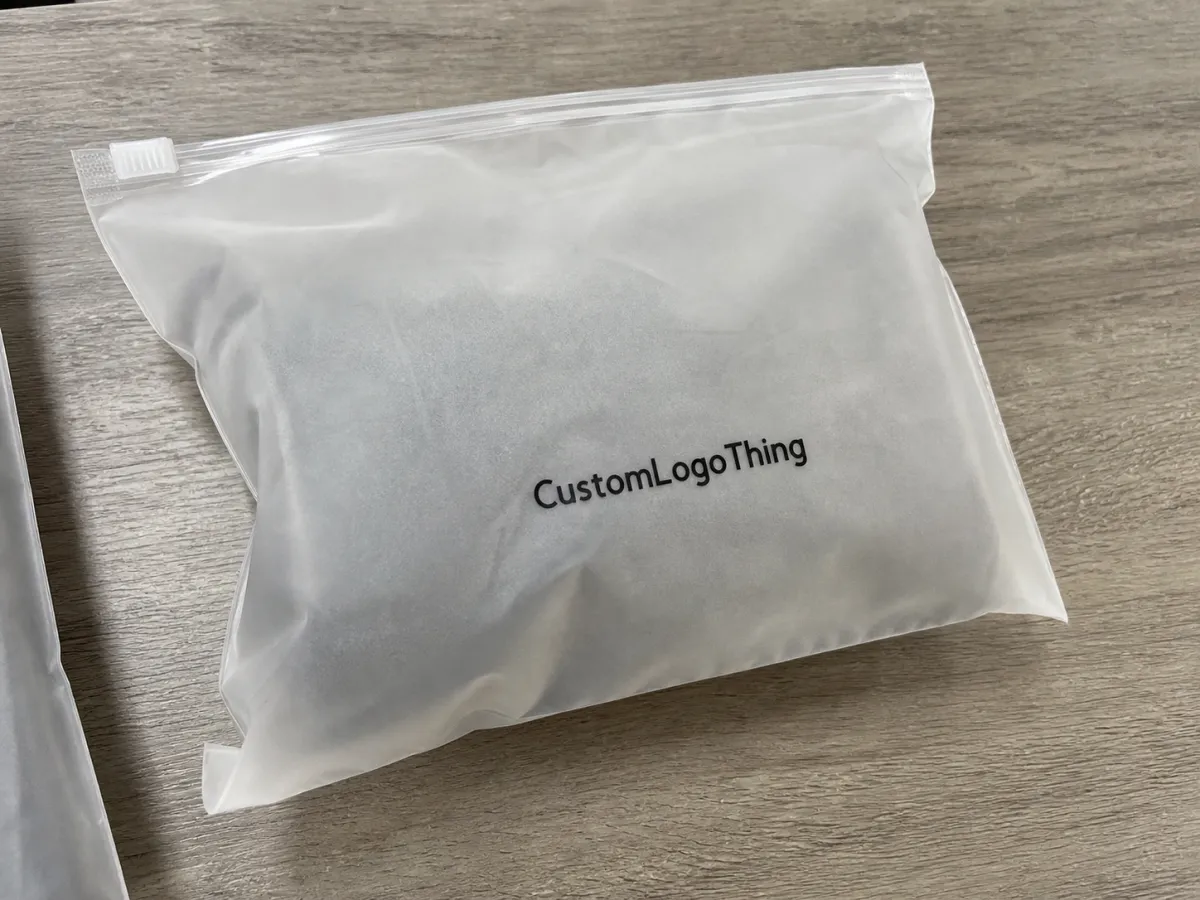
The point of a custom frosted zipper Bags Bulk Order is not simply to place a logo on plastic. The bag has to fit the product, close reliably, support the brand presentation, pack efficiently into cartons, and still make sense after freight, storage, and packing labor are included.
Start with the product as it will actually be packed. Measure it folded, bundled, carded, kitted, nested with an instruction sheet, or wrapped in protective tissue if that is how it will reach the customer. A folded textile accessory may look thin on a desk but become a 20 mm to 35 mm stack once it is packed. A cable kit may include small corners, strain reliefs, paper inserts, and wound components that push against the film in places a flat measurement will not reveal.
For a cleaner quote, gather these details before asking for pricing:
- Finished width and height: measured in inches or millimeters, with usable space below the zipper separated from total bag height.
- Target quantity: include two or three volume points, such as 3,000, 5,000, and 10,000 pieces, so price breaks are visible.
- Film thickness: list the preferred gauge or micron range if known; if not, describe product weight, shape, and handling route.
- Print plan: one side or two sides, one-color logo or multi-color artwork, and approximate print coverage.
- Retail features: hang hole, suffocation warning, barcode space, writable panel, vent holes, gusset, or custom carton packing.
Buyers often spend too much time comparing a low unit price and not enough time confirming the working specification. A bag that saves $0.02 per piece but slows packing by 15 seconds per unit can lose that savings quickly during a real production run. The numbers matter, but so does the way the bag behaves in someone’s hands at the packing table.
Practical rule: a frosted zipper bag should be sized around the packed product, the zipper clearance, and the person loading it. If any one of those three is ignored, the bag usually feels wrong.
Custom Logo Things can review the intended product, logo files, delivery requirements, and packaging goals before the order is locked. That keeps the specification focused on usable product packaging rather than a generic frosted bag that only looks acceptable on a screen.
Material, Finish, and Closure Details That Affect Bag Performance
Frosted plastic is best understood as a finish, not a single material. Most Frosted Zipper Bags are produced from polyethylene-based flexible plastic film or related structures that can be adjusted for softness, stiffness, opacity, seal behavior, and hand feel. The surface diffuses light, so the product remains partially visible without the sharp transparency of glossy clear poly.
That softened view is why many brands choose frosted film for branded packaging. It hides minor scuffs, reduces glare in product photography, and gives the bag a quieter, more premium look. It is not the right choice for every item. If exact color inspection, ingredient visibility, or product detail is critical at retail, a clearer film, printed window, or less opaque structure may be better.
Zipper and Closure Choices
A standard press-to-close zipper works well for light goods, sample packs, flat accessories, and many retail kits. Stronger zipper tracks are better for repeated opening, heavier contents, or items likely to be handled many times in a warehouse, showroom, or store. Slider-style closures add convenience, especially for larger bags, but they also raise unit cost and can reduce carton packing density because the slider changes how the bags nest.
Film gauge affects both performance and perception. Thinner film can reduce material cost and shipping weight for lightweight inserts or promotional items. Thicker film gives the bag more body, better puncture resistance, and a more substantial feel in hand. A small beauty tool kit, hardware set, or travel accessory often needs more structure than a paper insert or soft fabric patch, especially if the product has firm edges.
Typical light to medium retail Frosted Zipper Bags may fall around 2.5 mil to 4 mil, though the correct thickness depends on size, product weight, closure style, and expected handling. Larger bags may feel flimsy at a gauge that works perfectly for a small pouch. The material choice should be evaluated as a complete construction, not as a number by itself.
Print and Feature Options
Printing can range from a one-color logo to multi-color artwork with spot placement or a full-panel layout. Fine lines, tight registration, gradients, and heavy ink coverage need review because flexible film moves during production, and frosted surfaces can make ink appear slightly softer than it does on white paper. Vector art is strongly preferred for crisp logo edges and cleaner plate or screen preparation.
Optional features include hang holes, tear notches, bottom gussets, vent holes, writable panels, barcode windows, suffocation warnings, and carton packing by SKU. If products will be distributed to several warehouses, carton labels and inner pack counts should be decided early. That decision affects receiving, storage, replenishment, and the amount of sorting the buyer has to do after delivery.
Material and closure decisions should match the product’s weight, corners, storage conditions, display method, and expected number of open-close cycles. For technical guidance on shipping and handling environments, the International Safe Transit Association is a useful authority, especially for buyers coordinating retail packaging with broader distribution requirements.
Specifications to Prepare Before Requesting a Frosted Zipper Bag Quote
A clear specification sheet saves time and protects quote accuracy. For a custom frosted zipper Bags Bulk Order, the core specs should include finished width, finished height, lip size above the zipper, bottom gusset if needed, film thickness, quantity, print colors, and whether the artwork prints on one side or both sides.
Measure the product at its widest, tallest, and thickest points. Then add loading allowance. A flat item may only need 6 mm to 12 mm of side allowance, while a thicker kit may need 15 mm to 25 mm or more, depending on product rigidity and how quickly packing staff need to load it. The zipper also needs clearance. If the packed product crowds the closure, the tracks can misalign, pop open, or become frustrating for the customer to reseal.
Usable space below the zipper is different from total bag height. That detail matters if the product sits near the top edge, if a hang hole is placed above the closure, or if a retail header area carries the logo, barcode, or warning text. A bag listed as 6 x 9 inches may not give the full 9 inches below the zipper.
| Specification | What to Confirm | Why It Matters |
|---|---|---|
| Film thickness | Common light to medium ranges may fall around 2.5 mil to 4 mil, depending on product use | Affects puncture resistance, feel, packing weight, and cost |
| Zipper type | Standard press-to-close, stronger track, or slider-style closure | Controls resealability, convenience, carton density, and unit price |
| Print colors | One-color logo, spot colors, or multi-color artwork | Changes setup cost, proofing needs, production tolerance, and color control |
| Retail features | Hang hole, barcode space, warning text, gusset, or vent holes | Supports shelf display, compliance, scanning, fulfillment, and customer use |
Artwork should be supplied as vector files where possible, such as AI, EPS, or editable PDF. Pantone references help when brand color accuracy matters, although exact color appearance depends on ink, film opacity, print method, and viewing light. Keep small type away from seals and zippers. For warnings, ingredients, or care instructions, readable text often needs to be larger than marketing teams expect, especially on a matte plastic surface.
Also confirm how the bags will be packed after production. Will they be hand-loaded one product at a time? Used in a kitting line? Sent to multiple warehouses? Packed by size, color, or SKU? Bulk Frosted Zipper Bags are easier to receive and reorder when cartons are labeled with bag size, print version, count, purchase order, and SKU reference.
Custom Logo Things can review these details through its Custom Packaging Products support path, particularly if the buyer is comparing frosted zipper bags with mailers, pouches, inserts, or Custom Printed Boxes for a broader packaging project.
Pricing, MOQ, and Unit Cost Drivers for Bulk Frosted Zipper Bags
Pricing is shaped by bag size, film thickness, order quantity, number of print colors, artwork coverage, zipper type, added features, packing requirements, and freight method. No serious supplier can price a custom frosted zipper bag accurately from only a logo and a rough size.
MOQ is a production-efficiency threshold, not a random obstacle. Custom film converting, printing setup, zipper application, machine changeover, proofing, and quality control all require material planning and machine time. As quantity increases, setup cost is spread across more bags, so the unit cost usually improves.
| Order Scenario | Typical Cost Behavior | Buyer Consideration |
|---|---|---|
| Small custom run | Higher unit cost because setup is spread over fewer bags | Useful for launch testing, but watch the landed cost |
| Mid-volume bulk order | Better unit cost, often the most balanced choice for first repeatable runs | Good fit when demand is clearer and storage space is available |
| Larger production run | Lowest unit cost if specs are stable and inventory can be used | Best for steady SKUs, but artwork changes can create obsolete stock |
As a broad planning example, a simple one-color frosted zipper bag may land in a very different price band than a large, thicker, two-sided printed bag with a gusset and special carton packing. A small retail pouch might quote around $0.18 to $0.35 per unit at moderate volume, while a larger or heavier construction can move higher depending on size, ink coverage, zipper style, and freight. Those are planning ranges, not fixed promises, because material markets and final specifications matter.
The lowest quoted price is not always the lowest working cost. If the bag is too thin, too tight, difficult to open, or inconsistent at the zipper, the buyer may lose money through packing waste, returns, repacking labor, and weaker shelf presentation. In a fulfillment setting, a bag that opens cleanly and closes properly has value beyond the invoice line.
Ask for price breaks at several quantities. A move from 5,000 to 10,000 bags might meaningfully reduce the unit cost, or it might not justify the extra inventory if the product is seasonal, artwork is still changing, or cash flow is tight. Custom Logo Things can help balance MOQ, storage space, reorder planning, and margin through Wholesale Programs.
Cost-control levers are usually straightforward: use a standard zipper, limit print colors, choose a common film thickness, avoid oversized dimensions, and combine similar SKUs when artwork and size allow. For sustainability and recovery planning, buyers can also review current guidance from the U.S. Environmental Protection Agency, since local recycling acceptance for flexible films varies by material and location.
Process and Timeline from Artwork Proof to Delivered Cartons
The normal workflow is manageable when decisions are organized: specification review, quote confirmation, artwork preparation, digital proof, material and zipper confirmation, production scheduling, printing, converting, quality checks, carton packing, and shipment. Each step has a purpose. Skipping one rarely saves as much time as people hope, and it can make mistakes harder to catch.
Lead time depends on quantity, artwork complexity, production capacity, custom features, proof approval speed, and whether the buyer requests samples. A simple printed run may move much faster than a bag requiring a new size, heavier film, multi-color print, pre-production sample, and special carton sorting. Many buyers plan around several business weeks from approved proof for custom work, then add freight and receiving time. Exact timing depends on the confirmed order.
The proofing stage is the best opportunity to catch logo placement, spelling, barcode position, warning text, color callouts, and bag orientation. Check the zipper side. Check the hang hole. Confirm whether the artwork faces the correct direction once the product is loaded. Small mistakes look harmless on a PDF but become expensive across thousands of bags.
Digital Proof, Physical Sample, and Production Sample
A digital proof shows layout, size relationships, logo placement, print side, and general construction notes. It is fast and useful for most standard orders. A physical sample helps check fit, hand feel, opacity, zipper function, and loading speed. A production sample is closer to the final manufactured result and is helpful for high-visibility launches, strict retail programs, or products where color and fit need extra confidence.
Extra approval steps can add time, but they reduce risk. For a bulk order tied to a major launch, a few added days for sample review may be less costly than discovering after delivery that the barcode scans poorly or the zipper sits too close to the product.
Quality checks for zipper bags should cover seal strength, zipper alignment, print clarity, color consistency, bag dimensions, film appearance, count accuracy, and carton labeling. A good inspection also looks for practical handling issues: whether the zipper opens without tearing the lip, whether the bag mouth is easy to separate, and whether stacks of empty bags cling together too aggressively during packing.
If the bags must pass through a specific distribution route, ask whether carton size and weight limits should be considered. Standards from groups such as ISTA can be relevant when packaging is part of a larger transit test plan, especially for retail programs with defined drop, vibration, or compression expectations.
Build in receiving time. Freight can arrive on a Friday afternoon, cartons may need warehouse intake, and packing teams may need a short trial before full product loading. A realistic schedule protects the launch better than a rushed order with no inspection window.
Common Ordering Mistakes That Raise Cost or Delay Production
Undersizing is the mistake that appears most often in packaging conversations. Buyers measure only the flat face of the product and forget thickness, folds, accessories, instruction cards, protective sleeves, or the space needed to close the zipper cleanly. The result is a bag that technically fits but fights the packer every time.
Another common problem is choosing film that is too thin for the product’s corners, weight, or handling route. Thin film can be fine for light promotional inserts. It can also stretch, puncture, wrinkle badly, or feel out of step with the brand if the product has firm edges or a premium retail price.
Artwork problems create avoidable delays. Low-resolution PNG files, flattened layouts, missing fonts, and unclear color references make it harder to produce clean print. A frosted surface is forgiving in some ways because it reduces glare, but it does not repair poor artwork. If small type matters, send editable files and confirm minimum readable size before approval.
Heavy ink coverage deserves review. Large solid panels can change the feel of the bag, reduce the frosted effect, and show scuffing more clearly during handling. If the brand wants a bold graphic panel, that can work, but ink coverage, opacity, and print consistency should be discussed before production.
Fulfillment needs also get overlooked. Bags that are hard to open slow the line. Cartons without labels create receiving errors. Mixed SKUs without separation waste time in the warehouse. If the order supports multiple products, carton organization should be part of the specification, not a note added after the bags are produced.
Do not approve proofs casually. Zipper-side orientation, hang-hole placement, barcode contrast, and warning text position are small details until they are repeated across a full run. A good corrective approach is simple: test the product in a correctly sized sample, confirm artwork against the real bag orientation, and have both marketing and operations review the final specification.
Buyer caution: a custom bag is easy to reorder only if the first order is documented well. Save the final dimensions, film thickness, print references, carton count, and approved proof.
Next Steps for Ordering Retail-Ready Frosted Zipper Bags
Before requesting a quote, gather product measurements, estimate packed weight, choose the target bag style, decide whether the product needs hang display, confirm print locations, and collect current logo or label files. If you already have sample bags, photos, dielines, or competitor references, share them. Also explain what needs to improve: sturdier zipper, softer finish, better opacity, cleaner print, tighter carton packing, or lower landed cost.
Prepare two or three quantity targets. A first run may help prove demand. A launch quantity may support the first retail push. A larger inventory buy may reduce unit cost if artwork and demand are stable. Seeing all three price points helps the buyer make a business decision instead of guessing from a single MOQ.
Custom Logo Things can review the intended product and recommend practical specifications instead of forcing the buyer to guess at gauge, zipper type, bag allowance, and print placement. If the project is part of a larger product packaging refresh that also includes labels, mailers, inserts, or Custom Printed Boxes, the team can help keep the package branding consistent across formats. For general ordering questions, the FAQ page is also a useful starting point.
Request a quote with dimensions, quantity, artwork, delivery location, and desired in-hands date. A custom frosted zipper Bags Bulk Order is easiest to price accurately when those details are ready, and the right bag should look polished, pack efficiently, protect the product through handling, and arrive with specifications you can reorder consistently.
FAQ
What information do I need for a custom frosted zipper bags bulk order quote?
Provide finished bag width and height, product dimensions, estimated packed weight, target quantity, film thickness preference if known, zipper style, print colors, artwork files, delivery location, and any features such as hang holes, gussets, warning text, or barcode space. If thickness or sizing is unclear, send product photos or a sample reference so the bag can be specified around actual use rather than guesswork.
What is the usual MOQ for custom frosted zip bags?
MOQ depends on bag size, material, print method, zipper construction, and customization level, because each order requires setup, material planning, printing, converting, and inspection. Buyers comparing budget options should request price breaks at multiple quantities so the cost difference between MOQ and a larger run is clear.
Can frosted zipper bags be printed with a full-color logo?
Yes, frosted zipper bags can usually be printed with one-color, multi-color, or more detailed branding, depending on the artwork and production method selected. Vector artwork is best for sharp logos, and colors should be reviewed against the frosted film because matte plastic can make ink appear different than it does on white paper or a screen.
How do I choose the right thickness for bulk frosted resealable bags?
Choose thickness based on product weight, corner sharpness, handling conditions, and the feel you want in the customer’s hand. Light inserts or soft goods may work with thinner film, while cosmetics, accessories, kits, or products with firm edges often need a heavier gauge for better puncture resistance and presentation.
How long does production take for custom frosted zipper bags in bulk?
Lead time depends on order quantity, artwork readiness, proof approval speed, material availability, print complexity, added features, and shipping method. The fastest path is to approve complete specifications early, submit clean artwork, respond quickly to proofs, and allow time for freight and warehouse receiving before the bags are needed for packing.
