Gift Set Drawstring Plastic Bags Supplier: What Buyers Should Actually Check
If you are sourcing from a gift set drawstring Plastic Bags Supplier, the real question is not who can print a logo on a bag. The better question is who can keep the size, closure, clarity, seal strength, and delivery window aligned without forcing you to chase details across five email threads. That distinction matters. A bag that looks fine in a mockup can fail once the contents are assembled, the drawstring is pulled, and the carton count starts to matter.
Drawstring plastic bags keep showing up in gift packaging because they solve three problems at once. They group the items, they create a neat presentation, and they avoid the labor of wrapping every piece separately. For retail sets, hospitality kits, seasonal bundles, and corporate giveaways, that combination is hard to beat. The format is simple, but the decisions behind it are not.
The strongest versions do not rely on decoration to do the work. They rely on fit, film choice, and closure design. A good-looking bag that is too thin, too tight, or printed in the wrong zone creates more trouble than it saves. Buyers usually feel that problem after the first production run. By then, the order is already expensive.
Why drawstring gift bags stay in the buyer's mix
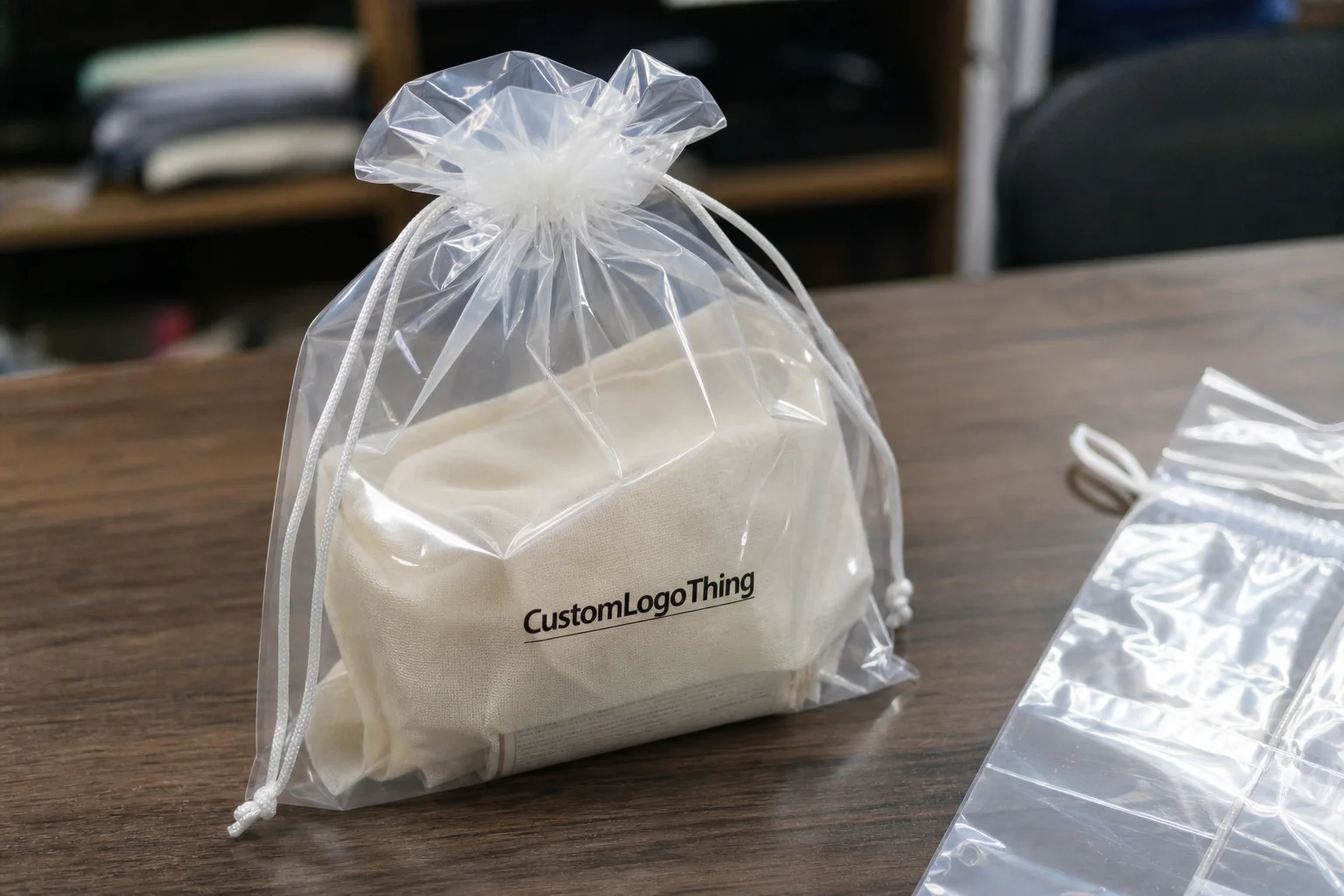
Drawstring bags are not premium by default. The premium effect comes from the details. When the film is clear enough, the print is clean, and the top cinches without wrinkling the artwork, the finished pack feels deliberate rather than improvised. That is a meaningful difference in gift presentation, especially for short-run promotions where the packaging carries a large share of the perceived value.
The format is also practical. A bag can hold mixed shapes more easily than a rigid carton. It can be packed flat before use, stored in less warehouse space, and assembled quickly on a packing line or at a fulfillment table. For operations teams, that matters almost as much as the visual result. The less handwork required, the easier it is to keep a program consistent from one batch to the next.
There is a second reason the format stays popular: the contents can still be part of the visual story. If the gift set includes a candle, cosmetics, snacks, or a folded textile item, a translucent or clear bag lets the buyer see what they are getting without opening the package. Opaque film is better when the contents do not need to be visible, or when the brand wants a cleaner, more controlled surface for graphics.
That choice is not cosmetic. It affects the material, the print strategy, and the cost. The wrong finish can make a product feel cheap even when the contents are not. The right one can make a simple bundle look far more considered than its bill of materials would suggest.
How the format works in production
The mechanism is basic: the bag opening is gathered by a cord, ribbon, or plastic drawstring, which closes the top without adhesive or heat sealing at the opening. That simplicity is useful, but it comes with constraints. The top edge still needs enough structure to guide the closure, and the cord channel has to be built cleanly so the bag closes evenly instead of bunching on one side.
The closure style affects the entire user experience. A thin tie is fine for lightweight sets. A stronger cord and bead system is better when the bag will be opened and closed repeatedly, or when the contents are heavier and create more stress at the top seam. Some buyers want a soft, fabric-like feel. Others want a crisp plastic finish that looks cleaner in transit. Both are valid. They are not interchangeable.
Fit is where many orders go wrong. A bag can be technically large enough and still perform badly if the set is bulky, irregular, or top-heavy. If the contents push hard against the sides, the print can distort, the closure can misalign, and the final pack can look forced. The correct size is based on the assembled gift, not the separate items measured in isolation.
Print placement needs equal discipline. Any artwork that creeps too close to the cinch area risks distortion when the bag is closed. Logos near the top edge can wrinkle. Heavy coverage near a heat-sealed zone can show banding or dull spots. A reliable supplier should flag those issues before production starts, not after the first sample is already approved.
For a buyer, the production logic is straightforward: the bag should behave like packaging, not like decoration attached later. That means the construction, the closure, and the art placement all need to work together. If one piece is off, the whole set looks less stable.
What specs drive quality and price
Most of the price variation comes from a short list of inputs. Thickness, size, print complexity, and closure hardware usually explain more than the supplier’s “factory advantage.” That is not a marketing problem. It is a materials problem. A heavier film uses more resin. More color coverage takes more setup. Better closure parts cost more than basic cord.
Thickness is usually described in microns or mils. A thinner bag can work for light promotional sets, but it may feel insubstantial and tear more easily if the contents have sharp corners. Thicker film improves strength and tends to feel more premium in hand, though the price rises with it. In practice, many buyers find that a small increase in gauge is worth it because it reduces complaints, rework, and damaged packs.
Material choice also affects how the bag behaves. LDPE is softer and more flexible. HDPE is lighter and crisper. PP usually gives a stiffer, cleaner look and often suits branded retail packaging. Laminated structures are used when a more premium finish or better moisture resistance is needed. None of these is universally best. Each one solves a different problem.
Print method matters more than many first-time buyers expect. One-color logos are simple. Full-color art, metallic effects, and white underprint increase setup demands and inspection time. If the bag is translucent, ink coverage may need to be adjusted to preserve legibility. If the film is glossy, reflections can make small defects easier to see. If the film is matte, the same artwork may feel more upscale but can lose some visual brightness.
Closure hardware is the final lever. Basic cord is cheap and functional. Custom beads, printed ends, and specialty stops add cost and can extend lead time. If the bag only needs to hold a gift set together, overspecifying the closure rarely pays back. If the packaging is part of a premium gift program, the closure may be worth the upgrade because it changes the tactile impression immediately.
As a rule, ask for the spec in measurable terms. Material type, thickness, dimensions, closure style, print coverage, and tolerance should all be written down. A quote built on assumptions usually becomes a revised quote later, and that is when timelines slip.
What a gift set drawstring plastic bags supplier should control
A capable gift set drawstring Plastic Bags Supplier should not just quote a size and a price. They should help test whether the set is realistic. That means checking the packed dimensions, identifying where the art can sit without distortion, and warning you if the closure space is too tight for the intended contents. If the supplier never asks about the actual gift set, they are quoting a shape, not a solution.
The best suppliers also understand production constraints. They know that tight tolerances cost more. They know that color matching across different resin lots is not always perfect. They know that a clear film and a frosted film will not show ink the same way. These are ordinary manufacturing realities, not defects. The point is to surface them early, before the order becomes a rush job.
Inspection discipline matters too. A proper check should cover seal consistency, drawstring function, print registration, surface defects, and carton packing count. If the order is for retail or a seasonal launch, visual consistency becomes even more important because the packaging will be seen in bulk, not one unit at a time. A single weak seam may be enough to create returns or repacking work.
There is also a communication test. A supplier that can explain the tradeoff between a lower MOQ and a higher unit cost is usually more useful than one that simply says yes to everything. Low minimums are attractive, but they often spread setup cost across too few pieces. Buyers who understand this usually get better outcomes because they are choosing between options with open eyes rather than trying to force a number down.
One more practical point: ask who owns the artwork check. If the print file has a problem, a supplier with a real prepress process will catch it before it reaches the line. A weak one will wait for a failed proof. That difference can add days, sometimes weeks, to an order that looked simple on paper.
Cost, MOQ, and landed price
Unit price depends on more than the material. Size, print complexity, quantity, and closure hardware all change the quote. Freight and packaging also matter, and they are often left out of the first conversation. A factory price alone is not a useful comparison if one supplier quotes ex-works and another includes export packing or a clearer carton spec.
For planning purposes, a simple custom run may land around $0.18-$0.28 per unit at 5,000 pieces when the bag is straightforward and the print is simple. Heavier film, more complex graphics, or upgraded closure hardware can push the range to $0.30-$0.55 per unit or beyond. Those figures are directional, not universal, but they are close enough to be useful when you are screening supplier responses.
MOQ deserves careful handling. A smaller order is easier to approve and easier to store, but it often carries a higher per-unit cost because setup gets spread across fewer bags. A larger order can lower the unit price, yet it increases inventory exposure. If the design is likely to change next season, a huge run may be false economy. If the program is stable, a larger quantity often makes more sense.
Freight can undo a seemingly good deal. Bag counts, carton dimensions, palletization, and shipping mode all affect the landed cost. Two quotes with the same unit price can produce very different totals once the cartons are packed and the route is assigned. If you compare suppliers, compare the same thickness, the same size, the same print coverage, and the same delivery terms. Otherwise the numbers are not equivalent.
| Option | Typical Cost Profile | Best For | Tradeoff |
|---|---|---|---|
| Stock-style bag with simple logo | Lowest setup, lower unit cost | Promotions, internal kits, high-volume basics | Limited structure and fewer branding choices |
| Small custom run | Mid-range unit cost, setup spread across fewer pieces | Seasonal programs, launch tests, limited editions | MOQ pressure and weaker cost efficiency |
| Fully customized bag | Higher setup, higher unit cost, tighter control | Premium retail, repeat programs, brand-sensitive kits | More approval work and longer lead time |
The cheapest quote is often the one with the most omitted details. That is not a bargain. It is a placeholder.
Process, lead time, and approvals
The normal sequence is predictable: inquiry, spec confirmation, artwork review, sample or proof approval, production, inspection, packing, and shipment. What slows orders down is not usually the manufacturing itself. It is the missing information before production begins. If the supplier has to chase dimensions, confirm artwork twice, and ask about carton packing after quoting, the timeline will stretch.
Lead time depends on how custom the order is. Standard materials and simple printing move faster than specialty films, multi-color designs, or special closure parts. If the bag is for a seasonal launch or a high-value gift program, a physical sample is worth the extra time because the final impression depends on things a flat PDF cannot show, such as film clarity, gloss level, and how the drawstring behaves under tension.
Approvals should be specific. A green light on artwork is not the same as a green light on materials. A sample that looks good on a white table may behave differently once the actual gift set is inside it. That is why packed samples are more useful than empty ones whenever the dimensions are close or the contents are irregular.
Timelines should be broken into milestones. Ask when proof approval is due, when production starts, when inspection happens, and when cartons leave the facility. A supplier who can define those steps is giving you something actionable. Vague “fast turnaround” claims are not a schedule.
The other hard truth is that freight time can equal manufacturing time. Ocean shipping, customs clearance, inland delivery, and warehouse receiving all influence the final date. If the program is tied to a holiday, launch, or event, those days matter more than the factory cycle alone.
Common buying mistakes
The first mistake is buying on unit price alone. A low quote that cannot hold the actual weight or shape of the gift set will cost more later, usually through damaged packs, rework, or dissatisfaction from the receiving team.
The second mistake is approving artwork before confirming the no-print zone near the top edge. When the bag cinches, the top area changes shape. Logos placed too close to that zone can wrinkle or skew. That is easy to prevent and annoying to fix.
The third mistake is treating all plastic films as though they behave the same. They do not. Clarity, stiffness, sealability, and print response differ by resin and thickness. A film that looks great in a sample photo may show scuffs or dullness in bulk.
The fourth mistake is ignoring the closure. The drawstring needs space and structure. If the top edge is too crowded with graphics or too narrow for the intended contents, the bag closes badly and the presentation drops immediately.
The fifth mistake is ordering too many sizes for a program that will be re-used. That creates storage issues and weakens future reorder efficiency. Standardizing a few dimensions usually pays off better than chasing micro-optimizations for each item.
The sixth mistake is skipping a sample on a premium or seasonal order. A sample may feel slow, but it is still cheaper than re-running a batch because the bag looked right on screen and wrong in hand.
The final mistake is forgetting that the supplier quote is not the landed cost. Cartons, freight, duties, and handling can turn a decent offer into a poor one. Buyers who compare only ex-factory pricing usually end up comparing incomplete numbers.
"A vague bag spec produces a vague shipment, and the shipment rarely becomes more charming because of it."
How to spec a cleaner order
Start with the packed gift set, not the loose components. Measure the tallest point, the widest point, and the deepest point after assembly. If anything is irregular, write that down. A round bottle, a folded textile, and a rigid box behave very differently inside the same bag.
Next, decide what the bag has to do. If the contents need to be visible, choose clear or frosted film. If branding matters more than visibility, choose opaque film or a higher-coverage print approach. If the package will be handled repeatedly, upgrade the closure. If it is a one-time presentation item, keep the construction simpler.
Then lock the spec in measurable terms. Material type, thickness, print method, dimensions, closure style, carton count, and tolerance range should all be listed. If any of those items are left open, the quote will be broader than it needs to be and the production team will spend time filling in gaps later.
Ask for the same quote structure from every supplier. If one quote includes thickness and carton count and another only lists price and lead time, those are not equivalent offers. You are not comparing vendors yet. You are comparing how much information each vendor chose to give you.
If the order will repeat, build the reorder path now. Keep one approved artwork version, one color reference, and one agreed material spec. That prevents drift across seasons. It also makes it easier for the same gift set drawstring plastic bags supplier to hold the packaging consistent from one run to the next.
The practical standard is simple: cleaner inputs produce cleaner quotes. Better quotes produce fewer surprises. Fewer surprises are the real savings here.
FAQ
What should I ask a gift set drawstring plastic bags supplier before ordering?
Ask for material type, thickness, dimensions, print method, closure style, MOQ, lead time, carton count, and tolerance range. If the set is premium, seasonal, or tightly sized, request a sample or proof. Also ask for landed cost so freight and packing do not show up later as an unwelcome surprise.
How do I choose the right size for a drawstring gift bag?
Measure the assembled gift set after packing, not the loose items. Leave enough headroom for the drawstring to close without stretching the film. Check width and depth together so the contents do not bulge and distort the print.
Why do quotes from different suppliers vary so much?
They may be quoting different thicknesses, materials, print coverage, closure hardware, or tolerances. MOQ and setup fees can also change the unit cost significantly. Freight, cartons, and delivery terms are often not identical either, which makes a simple price comparison unreliable.
How long does production usually take for custom drawstring plastic bags?
Simple custom runs are faster than specialty materials or complex printing. Artwork approval and sampling often take longer than the factory run itself. Shipping time can equal or exceed production time depending on the route.
What are the most common quality issues with these bags?
Weak seals, poor print alignment, closure distortion, and the wrong size are the usual problems. Thin film can tear or look cheap if the set is heavy or irregular. Clear specifications and sample approval prevent most of the avoidable failures.
A good gift set drawstring plastic bags supplier will keep the process grounded in measurable details, not vague promises. That matters more than a polished quote. In this category, the bag has to fit the set, support the brand, and survive the logistics between factory and final handoff. If those three parts are right, the packaging does its job quietly, which is usually the best outcome.


