A white gift bag can do more selling than many teams expect. The gift set white Boutique Paper Bags material guide matters because the bag is often the first thing a customer touches, and that first touch changes perceived value before the gift set inside is even visible. A crisp white bag signals care. A dented, scuffed, or weak one sends the opposite message just as quickly.
For brands, retailers, and hospitality programs, the challenge is simple to describe and hard to execute: the bag has to look refined, carry reliably, and arrive clean enough to be handed over without apology. White makes every one of those requirements more demanding. It is forgiving in the design meeting and unforgiving in the warehouse.
Why white boutique bags can lift a gift set fast
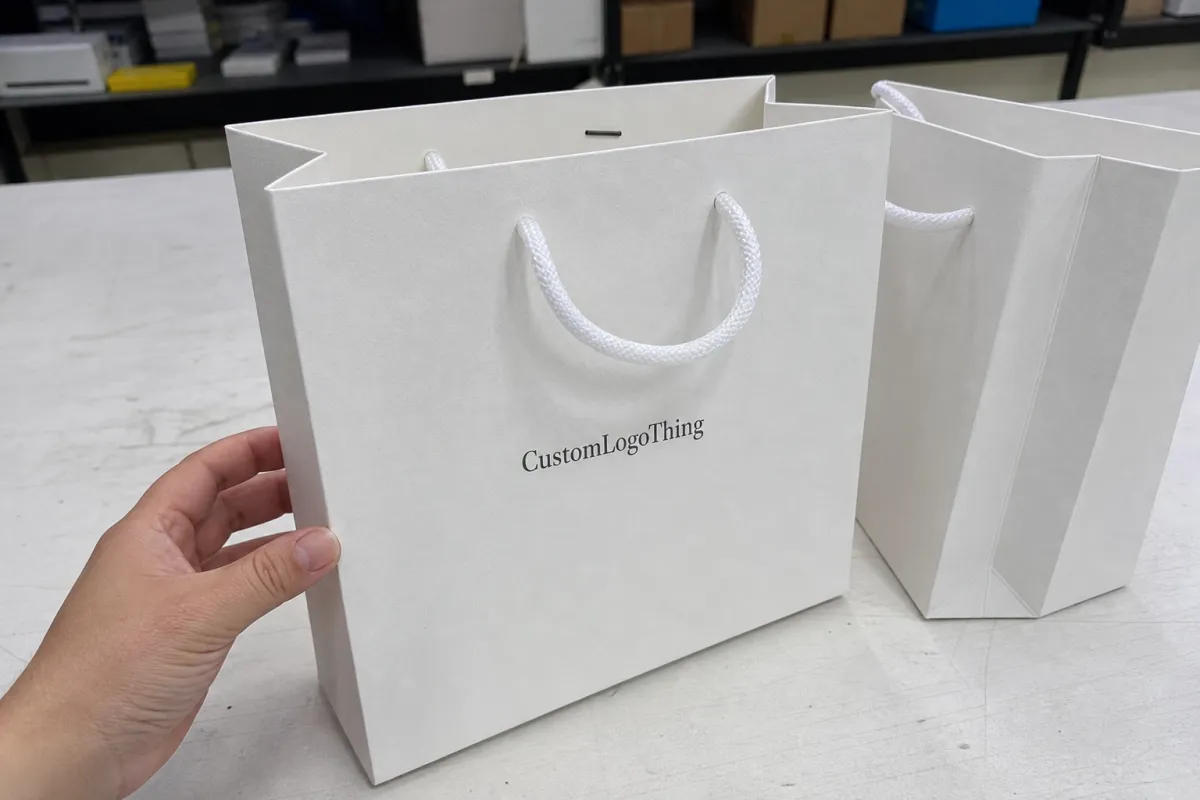
White communicates clean, bright, and premium with very little effort. That is why it shows up so often around retail gift bundles, seasonal sets, welcome kits, fragrance packs, and PR mailers that need a polished first impression without visual clutter. A black bag can feel strong. A kraft bag can feel natural. White reads as a gift object on its own.
That effect comes with a practical cost. White reveals small defects that darker stocks hide: scuffs from carton friction, glue shadow at the gusset, uneven ink coverage, and faint compression marks where the stack was packed too tightly. Even minor issues are visible. A white surface does not need a major defect to look tired; one rough transit lane is enough.
The best white boutique bag is doing three jobs at once. It supports the product weight, keeps its shape after filling, and leaves enough visual space for the set to feel elevated. If the structure is weak, the premium feeling collapses fast. If the decoration is too loud, the bag stops behaving like boutique packaging and starts behaving like an advertisement.
A white boutique bag should feel like part of the gift, not a wrapper around it.
That is the real benchmark. The bag should improve the presentation before the contents are revealed. It should also survive real handling: being stacked, lifted, refilled, and carried through a retail floor or event setup without creasing at the handles or bowing at the base.
Gift set white boutique paper bags material guide: how the build really works
Most buyers focus on the printed face first, but the structure under the surface determines whether the bag performs like a boutique carrier or a thin sleeve. A standard build includes the face stock, side gussets, a bottom panel, reinforcement at the handle area, and the handle attachment itself. Each layer affects shape retention, load capacity, and how neatly the bag folds and stacks in packing.
For lighter presentation bags, coated paper in the 200-250gsm range is usually enough, especially for compact sets with cosmetics, confectionery, accessories, or folded apparel. If the bag needs a firmer hand feel, buyers often move toward thicker art paper or a laminated build with reinforcement. The difference is subtle on a shelf and obvious in the hand. Heavier stock resists collapse better, holds the side walls upright, and hides the contents more cleanly.
White boutique bags can also be made with kraft paper if the brief calls for a more natural look. White printed kraft has a softer, more matte personality than coated stock. It can work well, but the texture changes the brand impression. It looks less polished and more organic, which is either a feature or a problem depending on the project. If the set is meant to feel modern, bright, and giftable, the stock choice has to support that mood rather than fight it.
Sustainability claims deserve a careful read. Some programs specify FSC certified paper, while others ask for recycled content or post-consumer waste fiber. Those are not identical claims, and they do not guarantee the same print quality or stiffness. A recycled sheet can be the right answer, but only if it still carries the load and accepts the finish cleanly. A green claim is not useful if the bag sags under a candle set or creases badly at the top fold.
The outer carton is part of the material system too. Finished boutique bags are usually shipped in corrugated cardboard master cartons so the white faces do not rub against each other in transit. That sounds like a minor detail until you open a carton and find rub marks across half the stack. White stock shows compression fast, especially when the shipment is heavy or the route includes rough sorting.
Handles, adhesives, and reinforcement patches are the quiet performance parts. Ribbon handles feel elegant, but they need good reinforcement if the set has any real mass. Twisted paper handles are familiar and economical. Rope handles feel more premium and usually carry weight better. Flat paper handles sit somewhere in between and can suit a clean, minimal presentation.
Adhesive quality matters as much as handle type. If the anchor point is weak, the handle may twist, separate, or peel under load. That failure is visible to the customer and expensive to correct after the fact. The same applies to seam glue and bottom locking. A bag that looks flawless when empty can still fail when filled if the bonding line was not tested under load.
Printing and finishing should be matched to the substrate, not added as decoration after the structure is chosen. Soft-touch lamination can make the surface feel more expensive, but it may also show rub along the folds if the paper underneath is too light. Foil and embossing look strong on white, though they work best in moderation. On a boutique bag, the quiet areas matter just as much as the decorated ones.
Sizing, handles, and finish choices that matter most
The smartest way to size a boutique bag is to start with the packed gift set, not with a single product dimension. The final bundle may be wider, deeper, or taller once tissue, inserts, protective packaging, or multiple items are arranged together. A bag that fits the tallest item still may not fit the final presentation.
There is also a presentation issue that does not show up in the dieline. If the bag is too shallow, the top edge closes awkwardly and the handles feel crowded. If it is too tall, the contents sink low in the body and the bag starts to look underfilled. White makes that imbalance easier to see. The eye notices empty space faster against a pale surface.
A practical bag specification should consider both the item dimensions and the carry path. Will the customer lift it from a counter, carry it through a hotel lobby, or receive it at an event desk? Those use cases affect handle drop, bag depth, and the amount of reinforcement needed around the top edge. A short carry from a boutique checkout does not demand the same construction as a gift set that moves across a venue and into a car.
Handle choice changes the tone of the bag more than many teams expect:
- Ribbon handles feel polished and gift-like, best for lighter or medium-weight sets where presentation matters most.
- Twisted paper handles are practical, cost-conscious, and common for retail programs that still want a clean branded look.
- Rope handles give a stronger hand feel and work well on heavier gift sets or higher-end hospitality packs.
- Flat paper handles can look refined and understated, especially when the design is minimal.
Finish should support the brand rather than compete with it. Matte finishes soften the look and usually hide handling marks better than gloss. Gloss gives a sharper surface, but it also shows scratches faster. Soft-touch lamination feels expensive in the hand, though it can show rub on sharp edges if the order will be touched often. Foil accents, embossing, and spot textures can all work on white, but too many effects at once start to feel busy.
Opacity matters too. If the paper is too thin, interior board, glue lines, and even dark product packaging can show through the face. That ruins the calm, polished look buyers pay for. Tight seam alignment, clean top folding, and consistent panel tension do more for the final appearance than a crowded print treatment ever will.
One small production detail can change everything: the corner wrap. If the wrapped edge is loose or the fold line is uneven, the bag loses its crisp profile. On white stock, that defect reads immediately. A 2 mm misalignment may sound minor in a spec sheet, but it is visible in hand and on shelf.
Cost and pricing factors that shape your quote
Unit cost is driven by quantity, paper weight, handle style, reinforcement, and print complexity. A simple one-color logo on a standard size may still quote higher than expected if the bag needs a stronger bottom insert, better handle patches, or a higher-opacity stock. White is not automatically inexpensive just because the palette is simple.
At a 5,000-piece run, a rough pricing picture often looks like this:
| Build option | Typical spec | Estimated unit price | Best fit |
|---|---|---|---|
| Standard boutique bag | 210gsm coated paper, twisted paper handle, 1-color print | $0.22-$0.38 | Light retail gift sets and mailers |
| Premium presentation bag | 250gsm coated paper, ribbon handle, matte lamination | $0.35-$0.58 | Launch kits and hospitality packs |
| Natural white kraft option | 230gsm kraft paper, reinforced bottom, flat paper handle | $0.28-$0.46 | Brands using recycled-materials language |
| High-finish luxury build | 350gsm artboard, rope handle, foil plus embossing | $0.65-$1.10 | High-value gift sets and VIP packs |
These ranges move with volume. At 1,000 pieces, the same style can cost 30-60% more per unit because setup, proofing, and converting overhead are spread across fewer bags. At 10,000 pieces, the price usually settles down, especially if the size is standard and the artwork is restrained.
Paper choice influences cost in less obvious ways. Heavier stock adds weight to freight. A soft-touch or foil finish may require extra time on press and more careful handling in converting. If the bag includes custom inserts, window cutouts, or unusual handle mounting, the labor rises fast. None of those details sounds dramatic in isolation. Together, they change the quote materially.
Suppliers usually need a few clear inputs before they can give a useful number: finished size, artwork coverage, target quantity, carton count, and any special pack-out instructions. If sustainability language matters, ask exactly what is certified and what is simply claimed. FSC certified paper supports a chain-of-custody story. Recycled content supports a different story. Post-consumer waste content is not the same as biodegradable packaging, and those terms should not be blurred together in product copy.
Savings tend to come from standard sizes, fewer print colors, and simpler handles. The tradeoff is that going too light on construction can create crushed corners, handle pull-out, or visible warping. That is a poor exchange. Spending a little more on the right build is usually cheaper than replacing bags after a launch or handling customer complaints later.
Process and timeline from brief to delivery
The cleanest projects follow a steady production sequence. First comes the brief and spec review. Then the dieline or sample confirmation, artwork setup, proof approval, printing, converting, inspection, packing, and shipment. The steps are familiar. The delays usually come from slow approvals, unclear dimensions, or finish choices that need one more adjustment before production starts.
Sampling deserves more respect than it usually gets. A physical sample shows whether the white surface reads clean, whether the handle attachment feels balanced, and whether the bag depth fits the real set. A flat proof cannot reveal how a seam meets a fold, how the edges wrap, or how a foil logo behaves once the paper has been creased and glued. On white stock, those small variations matter more because the eye sees them faster.
Typical timing looks like this:
- Blank or unprinted sample: 3-7 business days if the size is standard.
- Printed sample: 5-10 business days for a familiar build, longer for new dies or premium finishes.
- Mass production: often 12-20 business days after final proof approval, depending on quantity and decoration.
- Freight and delivery: add domestic trucking, or 20-35 days for ocean freight if the shipment is moving internationally.
Custom handles, foil, embossing, and new sizing add schedule pressure because they create more approval points and more room for correction. A buyer who needs bags for a launch date should work backward from the event and include carton labeling, warehouse receiving, and export paperwork in the timeline. The bag is only on time when it lands, is counted, and is ready to use.
Testing should be matched to the actual use case. A lightweight fashion set may only need a fill-and-carry check. A heavier fragrance or glass set should be tested with realistic load and movement. For transit validation, especially on parcel-heavy routes, ISTA methods are a useful reference for vibration, drop, and compression thinking. They do not replace every supplier-specific test, but they help buyers ask sharper questions before release.
A simple sample test can save a full production run, especially if the bag will carry glass, fragrance, or anything with a sharp corner.
One more practical point: white bags should be packed in clean cartons with controlled stack height. Loose cartons lead to corner bruising. Overpacked cartons lead to edge crush. Neither looks good once the customer opens the box. Packaging quality does not stop at the bag itself.
Common mistakes that weaken the premium result
The most common sizing mistake is choosing a bag that looks elegant when empty but sags once the set goes in. That usually happens when the gusset is too narrow or the bottom panel is too light for the packed load. A bag that is 15 mm too narrow can bow at the side seam. A bag that is too tall can leave the contents floating low inside the body. Both problems are visible immediately.
White surfaces are unforgiving about handling marks. Glue streaks, corner bruising, and fold-line scuffing show up more readily here than on kraft or dark stock. If the bags will be touched repeatedly in retail, event, or hospitality settings, a finish with better rub resistance is worth considering, even if it adds cost. The savings from a cheaper finish disappear once the inventory starts looking tired.
Overdecorating the bag is another easy mistake. Too much ink coverage, too many foil hits, or a crowded layout can make white packaging feel busy instead of premium. Boutique presentation depends on restraint. A strong logo, clean margins, and enough breathing room usually outperform a surface that tries to do too much.
Skipping the filled sample test is a classic false economy. A bag can look perfect on a screen or even under a press proof and still fail once it carries the real item mix. Weight distribution matters. So does center of gravity. A candle set, for example, may seem manageable on paper, then pull the bag forward and stress one handle anchor more than the other.
There is also a materials mistake that shows up often: buying into the sustainability story without checking the actual construction. Recycled content, FSC paperwork, and biodegradable packaging language all have their place, but they need to match the substrate, coating, and print system. Otherwise the claim becomes hard to defend, and the bag may not behave the way the buying team expected.
Finally, some teams forget that packaging is handled by people, not just machines. If the opening is too tight, staff will force the product in. If the handle feels weak, customers will carry it by the fold. If the white stock marks easily, warehouse crews will notice before the end customer does. That feedback loop is worth listening to.
Expert tips and next steps before you request samples
Before requesting samples, build a one-page spec sheet. Keep it concrete: finished size, item list, target quantity, handle preference, finish preference, and the exact look you want from the white surface. If the gift set includes bottles, jars, boxed items, or inserts, list their dimensions and weights. That reduces back-and-forth and improves the chance that the first sample is close to production reality.
If budget allows, ask for two sample paths. One should reflect the best visual version of the bag, with the handle and finish you actually want. The other should reflect the cost-conscious version. Seeing both in hand makes the tradeoff obvious. That is better than guessing from a quote sheet and hoping the premium version will feel worth the extra spend later.
Use a filled sample, not just a blank shell. Check how the bottom seam behaves, whether the handles sit evenly, whether the logo survives handling, and whether the bag still feels crisp after being lifted several times. If the bag is meant for a launch or a gift-with-purchase program, run it through a short carry test with the actual contents. Five minutes of testing can uncover problems that would otherwise show up in front of customers.
Ask for the carton pack-out details too. How many bags per carton? Are the handles wrapped or nested? Is there edge protection between stacks? Those small details affect the appearance of the goods when they arrive and the speed of receiving at the destination. A good production plan protects the bag all the way to the final handoff.
Here is the final filter I use:
- Does the bag fit the packed set without distortion?
- Does the white surface stay clean-looking after handling?
- Do the handles support the true weight with a comfortable drop?
- Does the finish match the brand mood instead of overpowering it?
- Can the order ship and land before the launch date with room to spare?
The cleanest quote is not the cheapest quote; it is the one that still works after the sample is filled and carried.
If you keep the gift set white Boutique Paper Bags material guide focused on size, structure, finish, and handling, the bag becomes a quiet but effective part of the presentation. That is usually what buyers want most: a white boutique bag that looks simple, feels solid, and arrives exactly as planned.
What material is best for gift set white boutique paper bags?
A coated or premium paper face with reinforcement usually gives the best balance of clean appearance and carry strength. For heavier gift sets, choose a thicker build with a reinforced bottom and proper handle patches so the bag keeps its shape after filling. A matte or soft-touch finish can also hide small handling marks better than a high-gloss surface.
How do I size gift set white boutique paper bags for multiple items?
Measure the fully packed bundle, not each item separately, because the arrangement inside the bag changes the required width and depth. Leave enough room for easy insertion, but avoid so much extra space that the contents shift or look underfilled. Check handle drop and gusset depth together so the bag carries comfortably and stands up neatly.
What affects the price of white boutique paper bags the most?
Quantity, paper weight, handle type, and print complexity are the biggest drivers of unit cost. Foil, embossing, custom reinforcement, and specialty finishes usually add cost quickly. Standard sizing and simpler branding often create the best savings without hurting the premium feel.
How long is the usual turnaround for custom boutique paper bags?
Sampling can take longer than expected if the bag needs a new size, handle, or finish combination. Production time depends on approval speed, print method, and whether the order includes special decoration or reinforcement. Freight and carton packing should be included in the schedule, not treated as an afterthought.
How can I keep white boutique bags looking clean and premium?
Use a finish that resists scuffing and keep carton packing tidy so the bags do not rub against each other in transit. Avoid overfilling the bag, since stretching the seams can make the surface look uneven and the handles feel stressed. Ask for a filled sample test to confirm the bag still looks crisp after handling.

