Large Boutique Paper Bags look simple until the quotation lands and the numbers start shifting for practical reasons. A wider gusset adds paper usage. A heavier stock changes the carton count. A stronger handle can add labor before a logo is even discussed. That is why the large boutique Paper Bags MOQ guide is less about finding a magic number and more about understanding where cost actually moves.
From a retail buyer’s angle, the bag is doing several jobs at once. It carries the product, protects the brand presentation, and has to survive the walk from counter to car. If the spec is underbuilt, the customer feels it immediately. If the spec is oversized, freight and storage become part of the problem. The useful answer sits in the middle: a bag that is large enough to work, but not so large that it wastes material and space.
The most expensive mistake is usually not the print. It is the mismatch between the bag and the merchandise. Once the size, paper, and handle are wrong, every other choice gets more complicated. Good buyers know that before they ask for foil or embossing.
Why Large Sizes Change the Economics Fast
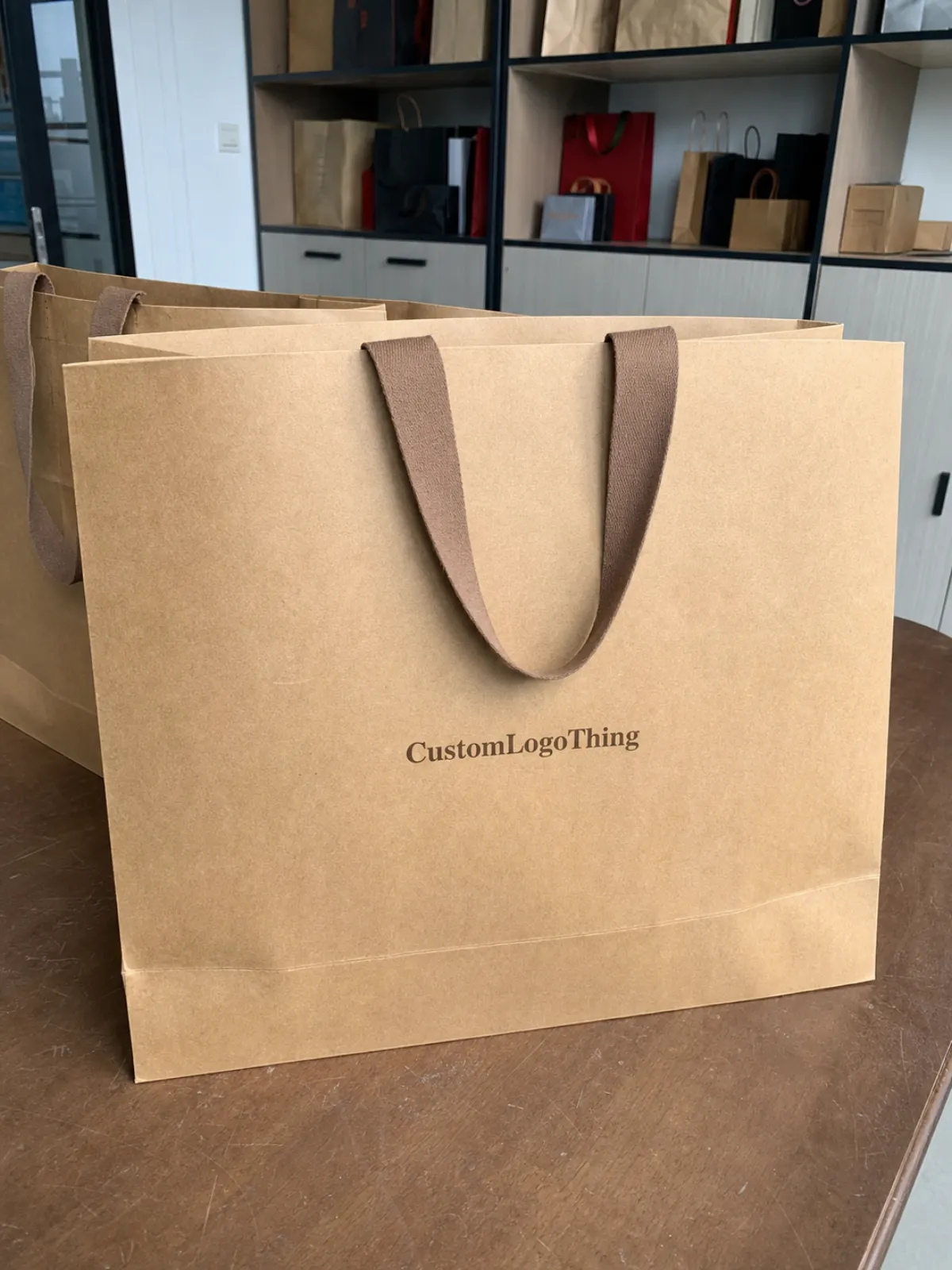
Large boutique bags use more paper than many first-time buyers expect. The flat size grows, the gusset deepens, and the base has to resist more load without bowing. That sounds obvious only after the quote arrives. More paper means more board consumption, more glue area, more waste at trim, and usually less efficient packing in cartons. The price increase is not arbitrary; it is built into the structure.
The jump becomes clearer when the bag has to hold a boxed set rather than a single item. A candle may fit comfortably in a modest bag. A shoe box, a rigid gift box, or a bundled purchase needs width, height, and enough clearance for tissue or filler. If the bag is too tight, corners crush and the customer has to fight the package open. If the bag is too large, it looks careless and the pack-out line slows down because everything takes up more room than it should.
That is why oversized bags often feel inexpensive on a screen and expensive in real production. Freight charges do not care about the mood board. Cartons do not care about the logo. A large format affects pallet density, storage volume, and sometimes the number of cartons required to ship the same quantity. The unit quote may look fine until the landed cost is added.
The cleanest presentation usually comes from restraint. A stiff stock, straight cuts, and a handle that feels secure often outperform a bag packed with finish effects. Buyers sometimes spend more on soft-touch film or foil than they do on the structural parts that actually determine whether the bag holds up in store. A premium bag still has to stand on its own.
Oversizing also creates dead space in the system. Warehouses store less per shelf. Cartons carry fewer pieces. Store staff have to move larger packaging through tighter counters and back rooms. There is a reason seasoned buyers keep asking the same question: what is the right size for the product, not just the brand image?
Product Details: Sizes, Handles, and Finishes That Hold Up
Large boutique bags cover a handful of common retail uses, and the dimensions should follow the merchandise rather than the concept art. For small apparel boxes and lighter gift sets, 12 x 4 x 10 inches often works. Shoes, skincare kits, and medium boxes usually move into 16 x 5 x 12 or 16 x 6 x 12. Bigger mixed purchases and event kits may need 18 x 6 x 14 or 20 x 6 x 16.
- 12 x 4 x 10: accessories, candles, small boxed sets.
- 16 x 5 x 12: apparel, skincare, folded merchandise.
- 18 x 6 x 14: shoe boxes, premium bundles, holiday sets.
- 20 x 6 x 16: event kits, larger gifts, layered packaging.
Handle choice affects both feel and cost. Rope handles have the strongest premium cue and usually carry weight well, but they add assembly time and hardware cost. Ribbon handles feel softer and more giftable, though they are not always the best choice for a heavy load. Flat paper handles are efficient and easy to print around, which keeps costs down. Die-cut handles look tidy and can be economical, but they need reinforcement if the bag is expected to carry real weight rather than a lightweight purchase.
Paper stock matters just as much as the handle. Many large bags use 157gsm to 230gsm art paper, kraft board, or laminated specialty paper. Matte lamination gives a calmer look and hides scuffs better than gloss. Soft-touch feels richer in hand, but it raises the price and can show wear if the bag is handled constantly on the sales floor. Spot UV works best when there is enough negative space for the contrast to read clearly. Embossing can be effective, but only if the bag already has good structure underneath it.
Luxury on a paper bag is usually not a long list of effects. It is clean proportion, crisp folding, and a handle that feels secure from the first pick-up.
Structure details keep the whole build honest. Reinforced tops, proper gusset gluing, and a bottom that does not sag are not decorative extras; they are the difference between a bag that looks finished and one that looks expensive in the wrong way. If the product is heavy, a bottom insert or thicker board often does more for durability than another print effect ever will.
For buyers comparing options, a simpler premium build often wins. One sharp logo on a stiff bag can look more intentional than a soft-touch bag overloaded with finishes. The bag has to hold shape first. If it collapses, the brand presentation collapses with it.
How to Write a Spec Sheet Buyers Can Actually Approve
A spec sheet should remove ambiguity, not create another round of clarification emails. Start with the exact dimensions, then list handle drop, gusset width, intended product weight, and what will actually go inside the bag. If the bag must hold a 5 kg boxed set, say that plainly. If it is carrying a light apparel purchase, say that too. A factory can only reinforce the top fold or adjust the stock when the load target is stated.
Print instructions need the same level of discipline. Include the print method, Pantone targets, bleed, safe zones, and whether artwork crosses folds or handle areas. If brand color is sensitive, provide the code and note the acceptable tolerance. If the logo position matters, show it on the dieline instead of describing it in email thread fragments that are difficult to interpret a week later.
Send print-ready files. Vector PDF or editable AI is best. A screenshot forces reconstruction and increases the chance of subtle errors: mismatched logo spacing, poor edge quality, or the wrong stroke weight in production. Finish callouts should be just as specific. State matte lamination, soft-touch, foil, embossing, or no finish at all. Every missing detail becomes someone else’s assumption, and assumptions cost money.
Proof expectations should be set early. A digital proof is useful for layout, text placement, and color intent, but it does not show handle feel or paper stiffness. A printed proof gives a better read on color and finish interaction. A physical sample costs more, yet it is often worth it for a higher-value retail launch or for bags that need to survive repeated handling over a long selling season.
Carton count, packing method, and destination should be on the first brief. Large bags can distort a freight quote quickly because they pack inefficiently if the carton size is off. If you need landed cost, the supplier needs to know whether the order is moving by air, sea, or domestic freight. Without that, the quote is only half useful.
If your team wants a quick reference point for artwork and proof questions, the ordering notes on our FAQ page cover the standard file requirements without adding unnecessary back-and-forth.
Large Boutique Paper Bags MOQ Guide: What Actually Moves the Quote
The large boutique Paper Bags MOQ guide really comes down to fixed costs and production complexity. Size is one variable. Stock thickness is another. Add handle type, finish level, print count, and packing method, and the MOQ can shift faster than buyers expect. There is no universal floor because setup charges do not rise in a neat straight line.
Setup costs are real and usually front-loaded. Cutting dies, embossing tools, special handle assemblies, and proofing all sit in the background before the first finished bag is packed. That is why pricing improves in steps rather than smoothly. A 1,000-piece order tends to absorb a heavier share of setup than a 3,000-piece order. The quote is not simply getting cheaper; the fixed cost is being spread across more units.
| Build | Typical MOQ | Estimated cost per piece | Setup or tooling charges | Best fit |
|---|---|---|---|---|
| Simple large bag, one-color print, flat paper handle | 500-1,000 | $0.55-$1.10 | $75-$150 | Promotions, seasonal retail, lower-risk launches |
| Rope handle, matte lamination, two-color print | 1,000-2,000 | $0.85-$1.75 | $100-$180 | Apparel, candles, premium gift packaging |
| Soft-touch finish, foil, reinforced base | 2,000-3,000 | $1.35-$2.95 | $150-$300 | Luxury retail, launches, gifting programs |
| Embossing, special paper, custom hardware | 3,000+ | $2.10-$4.50 | $200-$400+ | Flagship packaging, events, brand-led presentations |
The usual quote problems are predictable. Artwork changes after the dieline is approved waste time and create reproof charges. Mixed SKUs that share a logo but not a size or finish can complicate the order structure. Custom inserts add parts and labor. If you want a meaningful comparison, ask for tiered pricing and landed cost, not just a factory number that ignores freight, cartons, and repacking.
Buyers sometimes believe a smaller logo or slightly different artwork layout will reduce the MOQ. In most cases it will not. Changes in construction, handle style, or finish tend to move cost more than tiny artwork edits. The better question is whether the bag can be simplified without weakening the presentation. A clean, repeatable spec usually saves more than a decorative tweak.
A low quote is only low if the second proof, the reprint, and the freight bill do not erase the savings.
Production Steps and Lead Time: From Proof to Delivery
The production sequence should be visible from the beginning: brief, quote, dieline, artwork check, proof approval, production, QC, packing, transit. If any of those stages is vague, the schedule usually pays for it later. The smoothest orders are the ones where the spec is locked before cutting starts.
- Brief: dimensions, quantity, stock, handle, finish, destination.
- Quote: unit cost, bulk pricing tiers, setup charges, freight.
- Dieline: exact bag shape, print areas, and fold locations.
- Artwork check: Pantone, bleed, safe zones, file quality.
- Proof approval: sign off on the version that will be produced.
- Production and QC: print, assemble, inspect structure and finish.
- Packing and transit: carton counts, pallet build, ship method.
Lead time depends on how much complexity is built into the order. Straightforward large bag runs often land in the 12-18 business day range after proof approval. If the order includes foil, embossing, special paper, or nonstandard handle assembly, 18-28 business days is more realistic. Transit is separate. A production schedule that ignores shipping is not a full schedule.
Most delays come from avoidable issues: print files that are not ready, dimensions that change after the dieline is signed off, or a finish choice that requires extra tooling. Rush production sounds helpful, but only if materials and labor are already available. If the launch date is fixed, confirm the proof timing, stock availability, and shipping method before promising a date to retail.
Quality control should not be reduced to a quick visual check. On larger bags, the important checks are color consistency, handle attachment, bottom strength, glue alignment, fold accuracy, and whether the bag stands properly when filled. If the bag collapses in a carton or leans badly on display, the issue shows up immediately in store use. Transit damage matters too, which is why pack-out and drop expectations should be discussed before shipping rather than after a complaint.
For brands that care about paper sourcing and compliance claims, ask for FSC-certified stock if that matters to your program, and verify what that claim covers. If the package needs transit testing, standard guidance from ISTA can help shape pack-out decisions. Those checks are far cheaper before production than after a buyer asks for evidence.
Why Boutique Retail Buyers Stick With a Controlled Bag Program
Retail teams that reorder bags rarely treat them as one-off projects for long. They move toward a controlled program because consistency protects the customer experience. Color, handle quality, and stiffness should feel the same from one reorder to the next. One batch that feels crisp and another that wrinkles in the hand creates the kind of inconsistency buyers notice fast.
- Color control: logo and background stay within the same visual range across reorders.
- Handle consistency: the carry feel remains dependable on heavier purchases.
- Structural repeatability: the bag stands and folds the same way each time.
- Reorder continuity: the same spec avoids surprise cost changes.
Buying from different sources can feel flexible until a reorder becomes urgent. Then the tiny differences between vendors become visible and expensive. A controlled program reduces that noise. One clear specification, one proof standard, and one agreed finish level usually save more time than a collection of disconnected quotes ever will.
The less glamorous benefits are often the most valuable. Sample review, reorder continuity, and stable color control cut down on mistakes. Fewer mistakes mean fewer rush shipments, fewer reprints, and fewer write-offs from the wrong bag spec. That is real savings, not just a lower headline number.
For a buyer managing multiple locations, the bag is part of the operating system. The cleaner the program, the less time staff spend checking quality and the more time they spend serving customers. That is why the best repeat orders can look almost plain on paper. Predictable usually wins.
How to Request a Clean Quote and Move Straight to Order
The fastest quote is the one that arrives with enough information to be useful. Send dimensions, quantity, paper preference, handle style, finish, and artwork in one package. If you have a previous spec sheet or a reference sample, include it. A photo helps, but a proper spec sheet tells the supplier far more about the load target, print area, and build.
- Dimensions: exact width, gusset, and height.
- Quantity: one target plus two or three pricing tiers.
- Build: stock, handle type, reinforcement, finish.
- Artwork: vector files, Pantone calls, placement notes.
- Logistics: destination, freight method, preferred ship date.
Set the budget ceiling before asking for variants. Otherwise the quote turns into a menu of minor upgrades and nobody reaches a decision. If the goal is to balance presentation and cost per piece, ask for a practical version, a better version, and a premium version. That gives the team something real to compare instead of a pile of loose options.
Confirm lead time, freight method, and sample approval before the order is signed. Those details shape the real schedule. If a supplier says the bags can ship in 15 business days but the sample still needs approval, the timeline is not actually 15 business days. It is 15 business days after the last unknown disappears.
That is the most useful way to work through the large boutique Paper Bags MOQ guide: compare specs, not just headline price. If the bag has to protect the product, support the brand, and stay within budget, the quote needs to be built on real details from the start.
What MOQ should I expect for large boutique paper bags with logo printing?
MOQ usually moves with size, print complexity, and finish level rather than with the bag category alone. Simple one-color bags often sit lower than foil, embossing, or special-coating jobs. If you want a lower floor, keep the build simple and ask for tiered quantities instead of one fixed number.
How do finishes affect large boutique paper bags pricing?
Each extra finish adds setup, labor, or material cost, so the unit price rises faster than many buyers expect. Soft-touch, foil, embossing, and custom handles usually cost more than a standard matte print. If the budget is tight, prioritize structure and print quality before adding decorative effects.
Can I lower the MOQ by choosing a simpler bag spec?
Yes, a simpler spec can reduce both the quote floor and the unit cost curve. Dropping special finishes, keeping one print color, and using standard handle types usually helps. A change in construction often saves more than shrinking the artwork by a few millimeters.
What files do you need to quote large boutique paper bags accurately?
Send the bag dimensions, desired quantity, artwork files, print colors, finish notes, handle style, paper preference, and destination information in one package. If you have a reference sample or previous order spec, include that too. It cuts guesswork and shortens the proof cycle.
How long does it take to produce large boutique paper bags after approval?
Lead time depends on the print method, finishes, order size, and how quickly the proof is approved. Straightforward orders move faster than special-finish or peak-season runs. If the launch date is fixed, confirm materials and proof timing before the order is locked.


