Buyer Fit Snapshot
| Best fit | to black friday packaging and ships for packaging buyers comparing material specs, print proof, MOQ, unit cost, freight, and repeat-order risk where brand print, material, artwork control, and repeat-order consistency matter. |
|---|---|
| Quote inputs | Share finished size, material target, print colors, finish, packing count, annual reorder estimate, and delivery region. |
| Proofing check | Approve dieline scale, logo placement, barcode or warning zones, color tolerance, and any recyclable or compostable wording before bulk production. |
| Main risk | Vague material claims, crowded artwork, or missing packing details can create delays even when the unit price looks attractive. |
Fast answer: To Black Friday Packaging and Ships: Material, Print, MOQ, and Cost should be specified like a repeatable production item. The safest quote includes material, print method, finish, artwork proof, carton packing, and reorder notes in one written spec.
What to confirm before approving the packaging proof
Check the product dimensions against the actual filled item, not only the sales mockup. Ask for tolerance on folds, seals, hang holes, label areas, and retail display edges. If the package carries a logo, QR code, warning copy, or legal claim, reserve that space before decorative graphics fill the panel.
How to compare quotes without losing quality
Compare board or film grade, print process, finish, sampling route, tooling charges, carton quantity, and freight assumptions side by side. A lower quote is only useful if the supplier can repeat the same color, closure quality, and packing count on the next order.
Guide to Black Friday Packaging That Sells and Ships
A guide to black friday packaging starts with a blunt reality: shoppers judge the box before they judge the discount. Mailer, sleeve, carton, wrap. Whatever carries the product has to earn its place fast. Peak season leaves no room for packaging that only looks good in a mockup and then folds under real-world handling.
This is not a decorating exercise with a business label slapped on top. Good branded packaging can lift conversion, protect margin, and make the sale feel planned instead of panic-driven. For Custom Logo Things, the real question is usually not, “How loud can we make it?” It is, “How do we make this work in design, production, and fulfillment without creating a mess?” If you are comparing options, our Custom Packaging Products page is a useful place to start.
Black Friday buyers move fast. They compare offers, skim shipping promises, and decide whether a product feels worth the money in a few seconds. That means packaging design shapes more than the look of the box. It changes urgency. It changes perceived value. It changes whether the customer feels confident enough to click buy. A clean mailer with sharp graphics can make a discount feel curated. A flimsy shipper can make a good deal feel cheap. Same price. Different story.
From a packaging buyer’s point of view, product packaging and retail packaging stop being separate categories during promotional season. The same structure has to survive transit, look polished on opening, and keep labor under control. A guide to black friday packaging has to cover all three. A beautiful concept that slows packout or fails a drop test is not a win. It is just expensive art.
Honestly, the best seasonal packaging is usually the least fussy. It is the package branding system that prints cleanly, reads fast, and fits the operation. One format can carry the promotion. Another can protect the product and keep the line moving. That balance is the point. Miss that, and the season gets loud for all the wrong reasons.
Guide to Black Friday Packaging: Why It Changes Buying Behavior
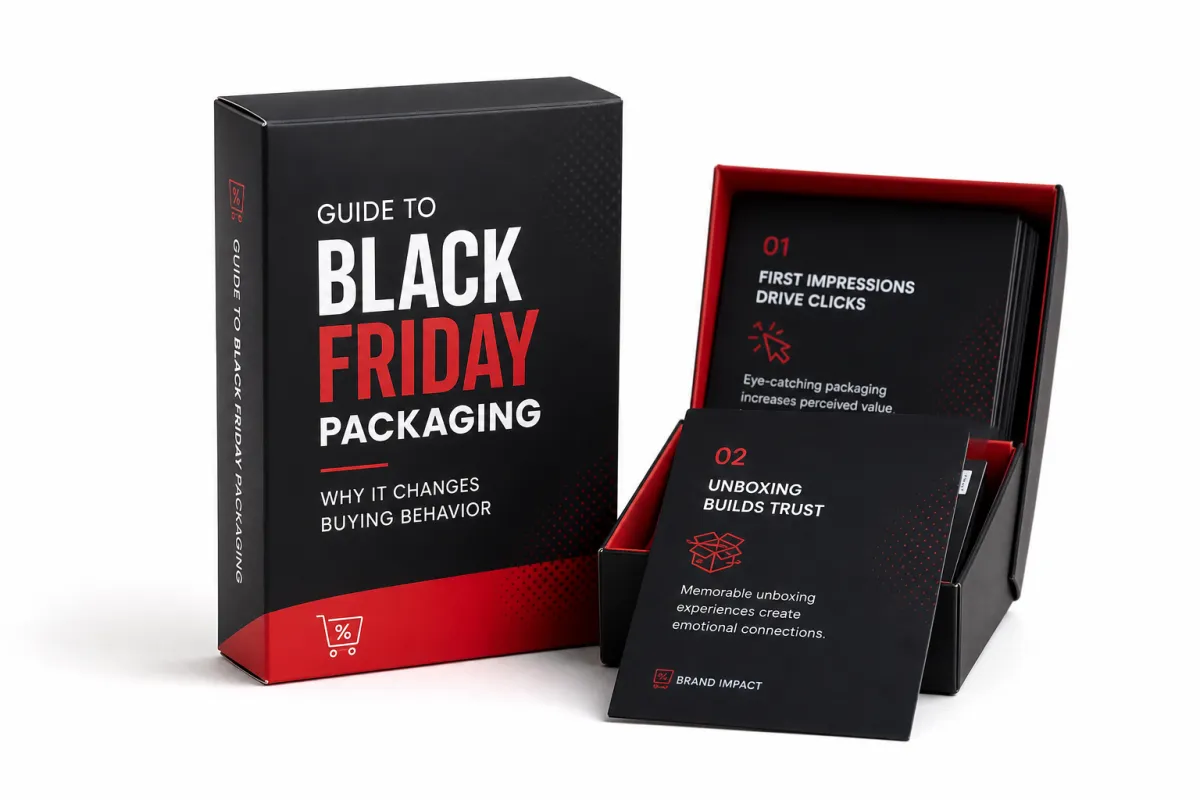
A guide to black friday packaging starts with psychology, because seasonal buying is emotional before it is rational. Shoppers are often choosing between two close offers in seconds. The package becomes the first proof that the brand is organized, trustworthy, and worth the spend. Thin packaging can make the deal feel thin. Solid, deliberate packaging gives the offer weight before anyone touches the product.
Black Friday packaging pulls three levers at once: urgency, giftability, and confidence. Urgency comes from strong contrast, limited-time messaging, and a layout that signals a special run. Giftability comes from neat opening mechanics, tidy graphics, and materials that feel good in hand. Confidence comes from structure, because people notice when a carton closes square or a mailer holds shape instead of collapsing like it gave up halfway through the job. A guide to black friday packaging that skips any of those points misses the sale trigger.
That is also why branded packaging usually outperforms generic cartons during promotional windows. Buyers do not want a stock box with a discount sticker and a shrug. They want proof the sale was thought through. A well-built carton with seasonal art, a sleeve, or a strong insert makes the purchase feel curated, which matters when a customer is looking at ten similar offers and trying not to regret anything before lunch.
Here is the part teams miss: the package is often the first thing a customer actually owns. Ownership changes perception fast. A guide to black friday packaging should treat the opening moment as a conversion event, not a cute extra. If the sequence feels smooth, the customer is more likely to trust the brand next time. If it feels sloppy, the product may still sell, but the memory gets weaker. That is not a huge mystery. People remember friction.
The strongest results usually come from packaging design that stays disciplined. A bold logo panel, one short seasonal message, and a couple of material choices can do plenty. Every surface does not need to shout. Too much print coverage turns a package noisy and pushes cost up for no good reason. A guide to black friday packaging works best when it respects the eye and the production line at the same time.
A box that saves two seconds on every packout can beat a prettier box that slows the line, because peak season rewards speed that still feels deliberate.
That is the real behavior shift. Seasonal packaging does not just frame the product. It frames the decision. A strong guide to black friday packaging helps the brand look ready, helps the product look valuable, and keeps operations from eating the margin the promotion was supposed to create.
How Black Friday Packaging Works Across the Customer Journey
A guide to black friday packaging only works if you follow the entire customer journey, because packaging starts doing its job long before the box reaches a doorstep. The path usually begins with the listing image or retail display, then moves through selection, packout, transit, delivery, and opening. Each stage asks something different from the package. Good planning keeps those demands from stepping on each other.
At the front end, the outer look has to sell. That might mean custom printed boxes, a seasonal sleeve, or a label system that calls out the promotion instantly. On the fulfillment side, the same package has to protect the goods, match the packout pattern, and close quickly. A guide to black friday packaging that only cares about the front end tends to rediscover labor costs the hard way.
The main layers are easy to map. You may have an outer shipper for transit, a retail carton for presentation, an insert to stop movement, a label for SKU and promo data, and a wrap or band for seasonal messaging. Some programs add tear strips, promotional seals, or interior print that makes the opening feel like part of the campaign. Every layer has a job. The smartest product packaging choices keep those jobs separate instead of turning the whole thing into a confused stack of little tasks.
Different formats create different outcomes. E-commerce bundles usually do well in corrugated Mailers With Custom inserts because the structure is sturdy and the opening is tidy. Cosmetics and smaller consumer goods often work better in folding cartons where shelf presence matters. Heavier or mixed-SKU offers usually need stronger corrugated because weight punishes weak panels and loose closures. A guide to black friday packaging should never pretend one box style fits everything. It does not. Packaging is annoying like that.
The handoff between teams matters more than many brands admit. Design, prepress, production, and fulfillment each make choices that affect the next step. Late artwork approval can rush the structure. A sloppy dieline check can slow packing when cartons arrive. Vague warehouse instructions can make the same package get built three different ways across three shifts. A strong guide to black friday packaging keeps all of that visible from the start.
Clear copy and readable offer language matter too. During high-volume weeks, the people packing orders are not pausing to decode a design puzzle. They need barcode placement, SKU markings, and packout instructions that make sense at a glance. Good package branding is not just for buyers. It also helps the warehouse avoid avoidable mistakes when every minute counts.
Seen as a system, a guide to black friday packaging becomes a map of decisions, not a style moodboard. The outer layer sells the promotion, the inner structure protects the product, and the operational details keep the line from stalling. Teams usually feel that only after the season starts, which is a clumsy time to learn it. Better to design for the full path from the start.
Key Factors That Shape Black Friday Packaging Decisions
A guide to black friday packaging usually comes down to five practical factors: brand fit, protection, speed and labor, sustainability, and offer strategy. Those are the levers that decide whether the package supports the campaign or quietly inflates cost. The strongest choices are rarely dramatic. They are the ones that fit the product, the timeline, and the way the warehouse actually works.
Brand fit matters because seasonal work should still feel like the same brand wearing different shoes. The energy can change without tossing out the color system, typography, or structural logic. Many good campaigns keep the core brand steady and use one seasonal accent, one headline treatment, and one strong visual cue. That keeps the message recognizable while still making the packaging feel special. A guide to black friday packaging that decorates every panel usually loses the plot.
Protection is not optional. Black Friday means more handling, more parcel touches, and more pressure on stock that is already moving fast. Fragile products need inserts, dividers, corner supports, or heavier board. Mixed shipments need a real look at how items shift in transit and whether the closure still holds after a long ride through the network. A packaging engineer does not get points for optimism. The box either protects the product or it does not.
Speed and labor often decide the final structure. A pretty package that needs extra folding, taping, or manual insert placement can slow the line by 10 to 20 seconds per unit. Multiply that across thousands of orders and the numbers get ugly fast. I have watched a beautiful seasonal sleeve add more labor than it ever earned back in perceived value. That is the kind of mistake that only sounds harmless in a spreadsheet. If the box slows the line, you are gonna pay for it somewhere else. The best guide to black friday packaging respects the person building the package. If a carton nests cleanly, closes in one motion, and cuts touchpoints, the operation keeps pace when volume spikes.
Sustainability should be practical, not performative. Recyclable corrugated, FSC-certified board, and material reduction all make sense when they do not compromise strength. Waste can also drop if you eliminate unnecessary void fill or use a structure that fits the product more closely. For general material and recycling guidance, the EPA recycling resources are a useful reference point, while FSC-certified materials can support sourcing goals when paperboard is part of the program.
Offer strategy shapes the packaging language itself. A limited-time bundle may need bolder messaging than a standard discount. A gift set may need a more polished opening sequence. A clearance run may need high-contrast graphics that are cheap to produce and easy to understand. The campaign should decide the package, not the other way around. That is the part people say they understand right before they approve a design that does three jobs badly.
One more detail matters: the structure should match the shelf life of the promotion. Some campaigns need packaging that disappears after the sale. Others need a format that can roll into regular selling periods with only a label or sleeve change. If the post-promo use case is strong, tooling and print plates can make sense. If the promotion is short, keep the base format simple and spend only on the surfaces shoppers notice first.
That is why a guide to black friday packaging works as a decision framework. The right answer depends on the product, the customer promise, and the speed of the operation. The wrong answer is the one that looks impressive in a deck and turns into friction on the floor.
Guide to Black Friday Packaging Costs and Pricing
A guide to black friday packaging has to talk about money, because seasonal packaging loves hiding costs in places buyers do not see until orders are already moving. Material grade, print method, coatings, structural complexity, inserts, windows, foils, and setup all affect the final number. A clean design with a sensible structure usually beats a flashy concept that demands extra tooling and extra handling. Fancy is expensive. Shocking, I know.
For rough planning, simple high-volume mailers or corrugated shippers with limited print coverage may land around $0.18-$0.45 per unit at larger quantities, depending on size and substrate. Printed Folding Cartons often sit closer to $0.35-$0.95 per unit at common run sizes, with premium finishes pushing the number higher. Seasonal kits with inserts, specialty coatings, or heavy embellishment can move into the $1.25-$3.50+ per unit range. These are planning numbers, not fixed quotes, and they will swing with region, freight, supplier capacity, and the exact spec. Still, they help anchor a guide to black friday packaging in something closer to reality.
Minimum order quantities matter too. Smaller runs usually carry a higher unit price because setup and press time are spread across fewer pieces. Tooling works the same way, especially when a new dieline or custom insert is involved. In many programs, setup stings first, then freight, then the rush charge when the calendar gets tight. A guide to black friday packaging that ignores setup will understate the budget every time.
Here is a simple way to compare common options.
| Packaging option | Typical unit cost | Best for | Main tradeoff |
|---|---|---|---|
| Plain corrugated mailer with label | $0.18-$0.45 | High-volume, cost-sensitive shipments | Limited branding impact |
| Custom printed folding carton | $0.35-$0.95 | Retail packaging, cosmetics, smaller goods | More print setup and finish decisions |
| Seasonal bundle kit with insert | $1.25-$3.50+ | Gift sets, bundles, premium promotions | Higher material and labor cost |
The table is not a quote sheet. It shows where the money tends to go. A guide to black friday packaging gets easier once the team separates the visual goal from the operational cost. Sometimes the smartest move is not a pricier carton. It is a simpler dieline with a stronger print face and one finish chosen with actual restraint.
There are hidden costs too, and they show up after launch when everyone is already busy pretending the plan was flawless. Reprints happen when artwork approval comes too late or color shifts are missed early. Freight premiums show up when production slips and the shipment has to move faster than planned. Labor slowdowns happen when the package takes too long to assemble. Inventory waste appears when a design is too seasonal to carry into later selling periods. These are the costs that make a cheap-looking box expensive.
Here is a practical rule that helps. If the package saves time on the floor, protects the product better, or improves conversion enough to lift average order value, the extra spend may be worth it. If it only adds decoration, the return is weaker. A guide to black friday packaging should treat the pack as part of the revenue model, not a decoration budget with a nicer font.
That is also why teams should compare options at the product-SKU level instead of across the whole category. A premium gift set may justify custom printed boxes and a special insert. A fast-moving accessory may do better in a clean mailer with strong branding and minimal labor. Different jobs, different spend. That is the honest way to use a guide to black friday packaging during budgeting.
Step-by-Step Black Friday Packaging Process and Timeline
A guide to black friday packaging works best when the process is broken into clear steps. Peak-season work tends to fail when too many decisions stay open too late. A disciplined timeline keeps artwork, structural choices, testing, and warehouse intake moving in the right order.
- Define the packaging goal. Decide whether the package is meant to win attention, protect bundles, improve giftability, or speed fulfillment. Pick the primary goal first, then let the structure follow it. A guide to black friday packaging becomes much simpler once the team agrees on the one thing the package has to do best.
- Choose the material and structure. Match the board grade, mailer style, or folding carton to product weight, shipping method, and the premium feel you want the customer to notice. A lighter item may only need a clean mailer, while a heavier bundle may need stronger corrugated and an insert.
- Build the artwork and copy. Check dielines, safe areas, color values, barcode placement, legal copy, and any seasonal message. If the package will live in retail packaging as well as direct-to-consumer shipping, make sure the graphics work in both places. A guide to black friday packaging should never let a rushed art review create a structural headache.
- Request proofs and samples. Physical samples reveal more than a screen ever will. Test closure, print placement, finish feel, and packout speed. Even a small trial run of 10 to 20 units can expose a weak corner, an awkward fold, or a label that blocks important copy.
- Set the production and intake schedule. For straightforward custom printed boxes, a common window is often 12-15 business days from proof approval, though specialty finishes or complex structures may need several weeks more. Build backward from the ship date, not the promotion date, so the warehouse receives materials before volume spikes.
For transit validation, many teams reference methods from ISTA test standards, especially when shipments face long parcel routes, multiple handoffs, or mixed handling conditions. A guide to black friday packaging does not require every program to turn into a lab experiment, but a basic drop, compression, and vibration test can save real money later.
The same timeline should also cover the warehouse reality. Where will the cartons be stored? Who stages them? Are the inserts pre-folded or packed flat? Do workers need one instruction sheet or three? If a package adds a step, that step needs a date on the schedule. A guide to black friday packaging that respects warehouse flow usually delivers fewer surprises and fewer damaged units.
A launch checklist helps more than people like to admit. Include artwork sign-off, sample approval, quantity counts, inbound inspection, packout instructions, and a contact name for any issue that appears after receipt. Basic discipline keeps peak season from turning into a scramble. A guide to black friday packaging is only useful if the details make it to the floor intact.
Common Mistakes in Black Friday Packaging
A guide to black friday packaging should be honest about the ways teams trip themselves up. Most problems are not dramatic. They are small, practical misses that pile up when volume rises. The first mistake is choosing a design that looks strong on a mockup but fails during real assembly. A beautiful fold sequence means little if it takes too long to pack or opens too easily in transit.
The second mistake is underestimating lead time. A sale campaign can feel early in the office and late in production at the same time. Artwork revisions, sample checks, color correction, and press scheduling all eat calendar days. Teams that wait too long end up paying rush freight or accepting a compromise on finish. A guide to black friday packaging should treat time like a material, because once it is gone, it gets expensive.
The third mistake is ignoring labor cost. Packaging that needs extra taping, extra hand folding, or a separate insert placement can quietly slow a line by hundreds of units per shift. That cost does not show up in the art file, but it absolutely shows up in overtime, missed cutoffs, and frustrated staff. A good guide to black friday packaging asks how many touches each order requires, not just how the package looks on the shelf.
The fourth mistake is making the package so seasonal that it stops feeling like the brand. A short-lived graphic can work well, but if the layout has no connection to the core identity, the customer may feel the offer is disconnected from the company itself. The better move usually keeps the brand system steady and uses seasonal elements as accents. That is where package branding earns its keep.
The fifth mistake is skipping structural testing. Corners crush. Seals fail. Fill patterns shift when actual shipments hit the network. A guide to black friday packaging should always include at least a basic physical test before volume production begins. For many products, that means checking compression, drop performance, and how the package behaves after repeated handling. ASTM-based thinking helps here, especially for goods that can be damaged by impact or stacking pressure.
There is another problem teams do not always spot early: poor SKU planning. Too many size variations create complexity in production, storage, and picking. If two or three packages can do the work of six, the operation becomes easier to manage. That is why a guide to black friday packaging often favors smart consolidation over endless variation.
Plainly put, the common mistakes are rarely about taste. They are about fit, timing, labor, and proof. Fix those, and the packaging usually improves faster than people expect.
Guide to Black Friday Packaging: Expert Tips and Next Steps
A guide to black friday packaging should end with moves the team can make right away. The most useful next step is usually not a total redesign. It is a focused improvement that lowers risk, speeds packout, or strengthens the customer’s first impression without blowing up the budget.
Start with one design system across multiple SKUs. That keeps the promotion cohesive and cuts the number of artwork versions, boards, and closures you need to manage. If the products vary in size, use a family of packages that share the same visual language even when the structures differ. A guide to black friday packaging gets easier to execute once the team stops reinventing the look for every item.
Choose one or two premium touches instead of five decorative flourishes fighting each other for attention. A soft-touch finish on the hero panel, a strong inside print, or a well-designed opening flap can do more than scattered embellishments. Customers notice consistency, fit, and crisp print more than a long list of effects. That is especially true in custom printed boxes and seasonal mailers where the opening moment carries most of the emotional weight.
Build a pre-launch checklist and treat it like a control document. Include proof approval, sample inspection, inventory counts, fulfillment instructions, and a contact path for exceptions. The smoother the handoff, the fewer late surprises. A guide to black friday packaging that includes this kind of list usually saves money before the first carton is even packed.
After launch, watch the numbers that matter. Damage rate tells you whether the structure is holding up. Packout speed tells you whether the line is efficient. Customer feedback tells you whether the opening experience feels intentional. Reorder timing tells you whether the campaign created a follow-on demand signal. Those metrics are more useful than vague praise because they point to the next improvement.
Here is the final practical test I would use: if a package looks good, ships safely, and keeps labor under control, it is doing its job. If it only looks good, it is not done. That sounds blunt because it is blunt. The difference between a promotional piece and a working system is usually just that simple. A guide to black friday packaging should help you build the latter.
If you are comparing formats now, review your current packout, check the amount of handling each order requires, and identify the fastest change you can make before the next sale window opens. For many teams, that means simplifying one structure, tightening one print spec, or moving one promotional message into a better place. A guide to black friday packaging is most valuable when it turns into a short list of moves, not a long list of nice ideas.
For Custom Logo Things, the best outcome is usually a package that feels branded, ships cleanly, and stays practical at scale. The takeaway is simple: pick the structure that protects the product, print only what helps the sale, and test it in the warehouse before volume hits. That is the standard worth aiming for, and it is the standard that keeps a guide to black friday packaging useful long after the promotion ends.
How far in advance should I plan black friday packaging?
Start as soon as the promotion strategy is set, because artwork, structural choices, proofing, and production all take time. If you need custom printing or specialty finishes, allow extra room for samples and revisions. The safest schedule is built backward from the ship date, not the launch date, so inventory arrives before the warehouse gets busy.
What types of black friday packaging work best for bundled offers?
Rigid or corrugated mailers usually work well for bundles because they add strength and give the set a cleaner presentation. Inserts, dividers, and custom-fit cartons help keep items from shifting in transit. Assembly should stay simple so the packer can move quickly without creating a labor bottleneck.
How can I keep black friday packaging costs under control?
Simplify the structure before you cut print quality, because complex shapes usually cost more to make and more to pack. Use special finishes only where customers notice them most, such as a logo panel or opening flap. Consolidating sizes and SKU variations can also improve unit pricing by letting you order larger runs.
Can black friday packaging still feel premium if I need fast turnaround?
Yes. Premium feel often comes from print quality, structure, fit, and consistency rather than a long list of embellishments. A clean package with good typography and a well-built form can look more polished than a busy design that arrives late or damages in transit. A guide to black friday packaging should treat clarity as a premium trait too.
What should I test before launching black friday packaging?
Test how the package opens, closes, stacks, and survives transit under real shipping conditions. Check that branding, barcode placement, and the promotional message stay readable after packout. A small fulfillment trial can reveal labor issues early, which is far cheaper than discovering them during peak volume.


