Buyer Fit Snapshot
| Best fit | To Corrugated Sheet Board projects where brand print, material claims, artwork control, MOQ, and repeat-order consistency need to be specified before quoting. |
|---|---|
| Quote inputs | Share finished size, material target, print colors, finish, packing count, annual reorder estimate, ship-to region, and any compliance wording. |
| Proofing check | Approve dieline scale, logo placement, barcode or warning zones, color tolerance, closure strength, and carton packing before bulk production. |
| Main risk | Vague material claims, crowded artwork, missing packing details, or unclear freight terms can make a low unit price expensive after revisions. |
Fast answer: To Corrugated Sheet Board: Material, Print, Proofing, and Reorder Risk should be specified like a repeatable production item. The safest quote records material, print method, finish, artwork proof, packing count, and reorder notes in one written spec.
Production checks before approval
Compare the actual filled-product size with the drawing, then confirm tolerance on folds, seals, hang holes, label areas, and retail display edges. Reserve space for logos, QR codes, warning copy, and material claims before decorative graphics fill the panel.
Quote comparison points
Review material grade, print process, finish, sampling route, tooling charges, carton quantity, and freight assumptions side by side. A quote is only useful when the supplier can repeat the same color, closure quality, and packing count on the next order.
I still remember the guide to corrugated sheet board in the worst possible way: a clean-looking pallet load that passed a dock inspection in Columbus, Ohio, then buckled after one humid overnight trailer run through the Tennessee Valley and turned an entire shipment into a rework headache. The cartons looked stiff enough on paper, yet the route sat in a warm trailer for 11 hours, the liners pulled in moisture, and the stack lost enough compression to fail in the field. I was standing there with a coffee from a 24-hour shop on Front Street in one hand and a damaged shipment report in the other, trying not to mutter things that would have made the dock supervisor blush.
That is why I like to talk about corrugated sheet board in plain English instead of hiding behind packaging jargon. It is a layered paper structure with fluted medium sandwiched between linerboards, and that geometry does more work than most buyers expect. In a real shipping lane, flute shape, liner weight, adhesive quality, and moisture balance matter just as much as the headline thickness, whether the board is being made in Milwaukee, Wisconsin, or in a converting plant outside Monterrey, Nuevo Leon. Honestly, that is where a lot of packaging specs go sideways: the spreadsheet gets a clean number, while the trailer gets a whole different story.
People still say "cardboard" as a catch-all, though in the plant the conversation is usually about corrugated sheet board that has to survive freight conditions, not just sit neatly on a shelf in a store in Dallas or a fulfillment center in Savannah. If you are buying for ecommerce, retail replenishment, or palletized distribution, the difference between a loose description and a real specification can mean fewer corner crushes, fewer returns, and fewer 6:30 a.m. calls from the warehouse. And yes, those calls always seem to happen before coffee and before the 7:00 a.m. shift handoff.
I wrote this guide to corrugated sheet board the way I would explain it to a procurement manager standing beside a stack tester in a plant near Charlotte, North Carolina: what the board is, how it behaves in transit, what drives cost, how long production usually takes, and where buyers quietly overspend because they asked for "stronger" without defining the lane. If you are comparing Custom Shipping Boxes or planning a new launch in Phoenix, Arizona, the details here should help you choose with a lot more confidence.
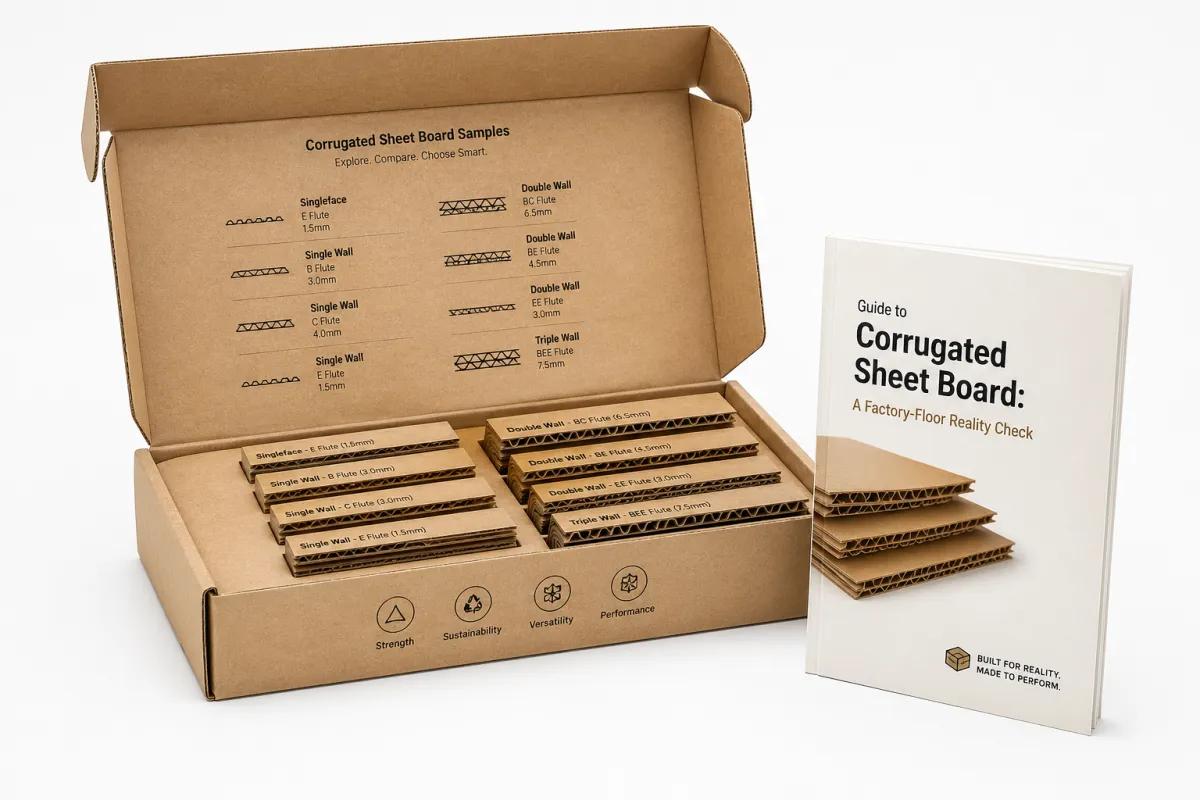
Guide to Corrugated Sheet Board: A Factory-Floor Reality Check
The guide to corrugated sheet board starts with one truth I learned on a night shift in a Midwest converting plant outside Cincinnati, Ohio: a pallet can look perfect under warehouse lights and still fail after a 20-degree temperature swing and a little moisture. We had a run of cartons stacked 7-high on a returnable pallet, and the board itself was fine, but the trailer had sat closed long enough for the air to go heavy. The glue line softened just enough that the top tiers began to creep. Nobody likes hearing that a "good" spec got beat by weather, but that is how reality works on a dock from Memphis to Mobile.
That is why I push buyers to think of corrugated sheet board as a system, not just a sheet. The fluted medium gives the structure its vertical crush resistance, while the linerboards spread impact and stacking pressure over a wider area. When the flute arch stays healthy, the board behaves like a small array of columns; when the arch gets damp or over-compressed, the same sheet gives up a meaningful slice of its protective value. I have seen people blame the outer wrap, the pallet, the driver, and even the moon phase before they finally looked at the paper structure itself, which, to be fair, was the actual culprit on that 14-mile transfer from the warehouse in Fresno.
The guide to corrugated sheet board also has to clear up the cardboard confusion. "Cardboard" is what people say at the coffee machine. Corrugated sheet board is what you specify when you need a real material with measurable performance, whether that means a 32 ECT single-wall shipping carton, a double-wall master pack, or a die-cut insert that keeps a glass bottle from shifting 3 millimeters in transit. Those 3 millimeters matter more than a lot of people want to admit, especially when the product is moving through a regional hub in Atlanta, Georgia.
On a buyer's desk, the temptation is to reduce everything to "thicker is better." I have seen that mistake in a client meeting with a subscription brand in Austin, Texas, that was paying for double-wall when a well-designed single-wall with proper inserts would have done the job at a lower cube and a lower freight bill. The guide to corrugated sheet board is really about matching construction to the lane, not buying the heaviest paper stack you can justify to finance. If the box is overbuilt, it can be a quiet budget leak for months before anyone notices, and the leak often starts at $0.09 to $0.14 per unit before anyone reads the freight line.
There is also a practical reason this matters. Corrugated sheet board influences pallet density, warehouse handling, damage rates, and even labor flow on the pack line in facilities from Reno, Nevada, to Allentown, Pennsylvania. A box that stacks cleanly at 0.375 inch caliper may move beautifully through automated packing, while an overbuilt alternative can slow down packout, create pallet overhang, and raise shipping costs by 8% or more. I have sat through enough ops meetings to know that "a little extra board" never stays little once freight and labor get involved.
"The board was not the problem," a distributor ops manager in Indianapolis told me after a damage review. "The spec was written for the product on the drawing, not the product after 1,200 miles in a trailer." That sentence has stayed with me because it captures the real job of corrugated sheet board: survive the lane, not the lab brochure.
If you are just getting started, keep this simple framework in mind: product weight, carton dimensions, stacking height, route distance, and exposure to humidity. The guide to corrugated sheet board becomes much easier once you stop asking, "How strong is the sheet?" and start asking, "What conditions will this sheet have to survive for the next 72 hours?" That shift alone saves a lot of bad guesses, especially on shipments moving between Houston and Orlando in August.
How Corrugated Sheet Board Performs in Transit
The guide to corrugated sheet board makes more sense once you picture the board under load. A flute is a repeating arch, and arches are excellent at distributing force when they are dry, properly bonded, and not over-stressed. That is why flute profile matters: A-flute gives more cushioning, B-flute packs tighter and prints well, C-flute is the workhorse many factories rely on, and E-flute is thin enough to help with retail presentation while still adding structure. I have a soft spot for C-flute because it tends to do exactly what it says on the tin without making anyone's life complicated.
In transit, corrugated sheet board rarely sees just one kind of abuse. A pallet can face stacking pressure in a warehouse, vibration in a trailer, puncture from a fork tine, and humidity in the same 48-hour window. That mix is where the guide to corrugated sheet board turns practical. A board that looks strong in a static compression test may still disappoint if the route includes rough handling and a damp transfer yard in Savannah, Georgia, or a refrigerated cross-dock in San Diego, California. Real freight is messy, and the board has to survive the mess.
Single-wall constructions are common because they balance cost, weight, and protection well for many cartons. Double-wall adds another flute layer and is often chosen for heavier loads, longer routes, or higher stacking heights. Triple-wall is more specialized, usually reserved for industrial shipments, heavy parts, or large-format packs where cube and compression are both non-negotiable. The guide to corrugated sheet board should help you choose the lightest structure that still survives the lane, because every extra ounce affects freight and pallet count. Nobody gets a trophy for shipping empty air in a monster box moving from El Paso to Newark.
I once worked with a machinery parts supplier in the suburbs of Detroit that kept blaming the box when corner damage kept appearing on a 4-leg pallet pattern. The real issue was fork handling plus a long dwell time in a hot warehouse in July, with the load sitting near 92 degrees Fahrenheit for most of the afternoon. Once we changed the stack pattern, raised the edge crush target, and moved to a better fit with a tighter insert, the damage dropped by more than half. That is the kind of lesson the guide to corrugated sheet board is meant to deliver: performance is an interaction, not a single number. If you only tune one variable, the rest will absolutely remind you they exist.
There is also a real business outcome here. Better corrugated sheet board can reduce returns, keep pallets straighter, and cut the number of partial-loss claims that eat up labor on both ends of the supply chain. If your distribution center in Joliet, Illinois, handles 300 cartons an hour, even a small reduction in crushed corners can save real money because someone does not have to stop and repack a compromised unit. I have watched teams lose entire chunks of a morning to repairs that should never have happened in the first place, and that lost labor is rarely budgeted at the start.
For lane qualification, I like to look at the test method as much as the result. A compression number means more when you know whether it came from ASTM D642, an internal stack test, or a lab condition that mirrors your route. If you want a technical baseline for transit testing, the resources at ISTA are worth studying because they tie packaging performance to shipping realities rather than abstract lab numbers. That is a refreshing change from the usual test report that looks impressive until you compare it with a real trailer and a real warehouse schedule in Nashville or Oakland.
Key Factors That Decide Performance and Strength
The guide to corrugated sheet board gets technical fast once you start comparing specs. The first number many people hear is ECT, or Edge Crush Test, which tells you how much stacking force the board can support at the edge. Burst strength still matters in some applications, and caliper matters when you need predictable fit, but ECT is often the number that best connects board structure to pallet performance in a shipping environment. It is not the only number I care about, but it is one of the first ones I ask for, especially on jobs headed to hot inland markets like Las Vegas or inland freight hubs like Kansas City.
Flute type is only one piece of the picture. Basis weight, liner grade, medium grade, adhesive quality, and moisture resistance all shape how the board behaves after it leaves the corrugator. A 275 gsm liner paired with a lower-grade medium will not perform like a well-built construction with stronger fiber and better flute formation, even if the sheets look similar to the eye. The guide to corrugated sheet board is about reading beyond the surface. Corrugated can be very polite-looking right up until it starts failing, and that failure often starts with a paper recipe that was too light by 20 gsm or too dry by 2 percentage points.
Product weight matters more than many buyers expect. A 2-pound mailer kit and a 38-pound industrial part do not belong in the same structure, even if the outer box size looks similar. The same goes for carton dimensions and stack height: a wide, shallow carton on a 42 x 48 pallet behaves differently from a tall narrow carton stacked 8-high on a 40 x 40 load. The guide to corrugated sheet board becomes a lot easier when you write the shipping geometry down before you ask for quotes. I know, I know, that sounds obvious, but you would be amazed how often it gets skipped at plants in Tampa and Tulsa.
Climate exposure is another factor people underestimate. A lane that runs through a dry warehouse in Phoenix is not the same as one that sits in an unconditioned trailer near the Gulf Coast. I have seen linerboard soften enough in humid storage to change how a carton folds, closes, and resists stacking. That is why the guide to corrugated sheet board should always include a question about storage time, warehouse humidity, and whether pallets will wait 24 hours or 7 days before they move. Moisture is sneaky; it does not announce itself, it just slowly ruins your afternoon in Baton Rouge or Brunswick.
Coatings and recycled fiber content sit in the same conversation because they affect both performance and sustainability. Water-resistant coatings can help in wet environments, though they are not a cure-all, and higher recycled content can support sourcing goals if the fiber mix still meets the lane. If your company needs chain-of-custody documentation, ask for FSC paperwork and verify it against the supplier's claims rather than assuming the logo is enough. I have seen too many teams trust a badge and skip the paperwork, which is a nice way to end up in audit limbo after a shipment from Shenzhen or Ho Chi Minh City.
I also ask suppliers to show me how they compare apples to apples. The guide to corrugated sheet board should push you toward a comparison set that includes flute combination, liner grades, ECT or burst data, caliper, print requirements, and minimum order quantity. Without those details, one quote may look 14% cheaper simply because it is built from lighter paper and will fail earlier in the route. Cheap quotes can be very persuasive until you count the boxes that arrive looking like they had a rough week on a road from Raleigh to Richmond.
For a clean supplier comparison, use questions like these:
- What exact flute combination is quoted: B, C, E, or double-wall?
- What are the liner and medium grades, not just the generic "kraft" label?
- What ECT, burst, and caliper targets are being used?
- What happens to the spec if the order drops from 20,000 sheets to 5,000?
- Does the quote include print, die-cutting, coating, and freight to your dock?
That checklist sounds simple, yet it keeps the guide to corrugated sheet board grounded in facts instead of sales language. In a supplier negotiation, facts are cheaper than surprises. And unlike surprise freight charges that show up on a bill from a carrier in Fontana, facts do not show up three days after approval to ruin your mood.
Guide to Corrugated Sheet Board Costs and Pricing
The guide to corrugated sheet board costs and pricing has one rule that saves buyers a lot of trouble: do not shop price before you understand spec. Paper grade, flute combination, sheet size, print coverage, coatings, order volume, and freight all move the number. A quote for 5,000 sheets will almost always carry more setup pressure than 20,000 sheets because the machine still needs the same make-ready time, trim loss, and line adjustment. The press still wants to be fed, whether you ordered 5,000 or 50,000.
Small runs cost more per sheet because the plant cannot spread the fixed work across many units. On a 5,000-sheet order, you may see a per-sheet cost that is 20% to 35% higher than the same design at 20,000 sheets. That does not mean the supplier is overcharging; it means the guide to corrugated sheet board economics is working the way any converting line works, with setup time, paper waste, and labor efficiency all baked into the result. The machine does not care about your budget, sadly, whether it is in a plant in Charlotte or a converted warehouse in Querétaro.
Pricing also changes with print and finishing. A plain unprinted sheet may be straightforward, while a custom-printed carton with two colors, a die-cut handle, and a water-based coating introduces more steps and more scrap risk. I have sat in pricing reviews where the print estimate alone added $0.06 to $0.11 per unit, and that was before anyone talked about special ink coverage or tight registration on a large panel. Registration errors are the kind of thing that look tiny until you are paying for a whole re-run on 8,000 cartons.
Hidden cost traps are where the guide to corrugated sheet board pays for itself. One buyer may over-specify double-wall for a 12-pound product that only needs smart insert design and a single-wall outer. Another may choose the cheapest sheet available, then spend more on labor because the boxes stack crooked, collapse during pallet wrap, or create rework at the DC. The cheapest line item is not the cheapest program if it drives 3% to 5% damage in the field. I have never once seen a claim form that said, "Thanks for saving us $0.02 on the board."
Here is a practical comparison I use with buyers who want a fast read on value, not just price:
| Construction | Typical Use | Approx. Unit Price at 5,000 Sheets | Approx. Unit Price at 20,000 Sheets | Main Value Driver |
|---|---|---|---|---|
| Single-wall B/C-flute | Retail cartons, lighter ecommerce shipments, inserts | $0.24 to $0.42 | $0.15 to $0.28 | Lightweight protection with good pallet density |
| Single-wall C-flute with higher ECT | General shipping boxes, midweight goods | $0.31 to $0.55 | $0.19 to $0.36 | Better stacking performance without jumping to double-wall |
| Double-wall | Heavier product, longer routes, high stack loads | $0.58 to $0.96 | $0.40 to $0.72 | Compression strength and puncture resistance |
| Triple-wall | Industrial, export, large-format, heavy parts | $0.98 to $1.75 | $0.72 to $1.28 | Maximum rigidity for demanding freight conditions |
Those numbers are planning ranges, not quotes, and they change with sheet size, freight lane, market paper cost, and whether the mill is loaded in Wisconsin, Ontario, or coastal Guangdong. Still, the guide to corrugated sheet board pricing is easier to manage when you compare total program value, not just unit cost. A $0.08 higher sheet can save $0.22 in labor and claims if it prevents one crate from crushing under a 900-pound pallet stack. I have seen that happen, and the finance team suddenly became much more interested in packaging science.
Freight matters too. Large sheets, oversized die-cuts, and low-volume print runs can add a meaningful delivery charge, especially if the plant is shipping long distance. I have seen buyers save $0.03 per unit on paper and then spend $0.07 more per unit in inbound freight because the supplier sat 800 miles away and the truck had to move partial loads from North Carolina to Illinois. The guide to corrugated sheet board should always include freight math, not just material math. Otherwise the "savings" turn into a very expensive illusion.
If you want to see the value side clearly, ask yourself three questions before you approve a price: Will this sheet reduce damage? Will it speed packout or slow it down? Will it allow more units per pallet or fewer? The answer to those three questions usually matters more than shaving a cent off the paper cost. I would rather defend a slightly higher board spec than explain why the warehouse is repacking damaged cartons on a Thursday night in December.
The Process and Timeline From Spec to Shipment
The guide to corrugated sheet board is not complete unless you understand how the material gets made. A corrugator takes linerboard and medium, conditions the paper with heat and steam, forms the flute on a single facer, applies starch adhesive, and bonds the layers through the double backer. Then the sheet moves into converting, where it gets slotted, die-cut, folded, printed, or bundled depending on the order. It is a pretty elegant process, honestly, even when it smells a little like warm paper and starch for half the shift in a plant near Columbus, Ohio.
That process sounds straightforward until you watch the line. Moisture balance is everything. Too dry, and the flute can crack or lose forming quality; too wet, and the sheet can warp or slow down in conversion. I have stood beside a plant engineer watching the glue line and the paper moisture reading because a tiny drift there can add warp on a 42-inch sheet that later becomes a warehouse handling issue. The guide to corrugated sheet board has real factory consequences, and the corrugator never forgets it. Neither does the shipping dock, unfortunately, especially on summer days in Houston or Mobile.
Timelines depend on the type of order. Simple stock or plain-sheet runs can move in 5 to 8 business days if the paper is available and the schedule is open. Custom printed work often needs 12 to 15 business days from proof approval, and if you need a special coating, a die-cut insert, or new structural testing, 3 to 4 weeks is more realistic. That is why the guide to corrugated sheet board should always be paired with the launch calendar, not written after the deadline has already passed. I have watched a rushed launch turn into a scrambled launch, and nobody looked happy in the postmortem.
Peak-season bottlenecks are another reality. A plant that can turn a simple order quickly in a quiet week may stretch to longer lead times when every line is running full and the mill allocation tightens. I have seen a modest 8,000-sheet job sit for 4 extra days because the paper roll arrived late, and I have seen another job move ahead because the customer approved a digital proof the same morning. Good paperwork shortens real lead time. Bad paperwork just makes everybody sigh louder, especially in September when holiday programs start colliding.
Here is the sequence I recommend planning backward from:
- Define product weight, dimensions, and stack pattern.
- Choose the flute and ECT target that match the route.
- Request samples and verify print or fit on real product.
- Approve artwork, dielines, and material spec.
- Reserve production time and confirm outbound freight.
The guide to corrugated sheet board also has a hidden timing issue: sample approval. A box that looks fine on a PDF may need 2 physical rounds of adjustment once you see how the product sits in the cavity or how the flap scores behave at the fold. If your launch date is fixed, pad the calendar so you are not forced into rush freight or a last-minute downgrade in board quality. There is nothing glamorous about saying, "We took the cheaper board because we ran out of time," especially when the first shipment is already booked for a Friday afternoon pickup in Reno.
One of my cleaner supplier negotiations came down to this exact point. The buyer wanted 10,000 printed cartons in 9 business days, and the plant said yes only if the proof was approved by 2 p.m. and the medium grade stayed unchanged. That was a fair trade, because the guide to corrugated sheet board is as much about respecting production realities as it is about the final price on the quote. A calm schedule usually beats a heroic one, and a clear proof file beats a last-minute design scramble every time.
Common Mistakes When Specifying Corrugated Sheet Board
The guide to corrugated sheet board saves the most money by preventing the easy mistakes. The biggest one I see is habit-specifying: a buyer uses the same board callout they used on the last project, even though the product weight, pallet pattern, or route changed. A box that worked for a 14-pound kit on a regional lane may fail for a 19-pound version that now goes 1,100 miles and sits 2 extra days in a distribution center. That kind of mismatch is painfully common in programs moving out of Chicago, Illinois, or Baltimore, Maryland.
Another common mistake is ignoring humidity and storage time. Corrugated sheet board stored directly on a concrete floor or left in a damp corner can take on moisture and lose strength before it is ever built into a carton. I have watched a warehouse team stack pallets too high, warp the bottom tiers, and then blame the converter when the damage was actually storage pressure plus poor airflow. The guide to corrugated sheet board has to include how the material is handled after delivery, because the box starts living the moment it lands on the dock, whether that dock is in Portland, Oregon, or Savannah, Georgia.
Overbuilding is just as costly as underbuilding. One customer came to me after specifying double-wall for a simple consumer accessory that weighed 1.8 pounds with packaging. The ship rate went up, pallet density went down, and the boxes took longer to fold. We reworked the packout, used a single-wall with better fit, and the program got lighter without raising damage. That is the kind of correction the guide to corrugated sheet board should encourage. More board is not always more protection; sometimes it is just more cardboard and more frustration, especially when the line is folding 600 cartons an hour.
"We spent six months arguing over board grade and never asked whether the product was moving on a humid route," a procurement lead told me after a pilot failure. That kind of oversight is common, and it is exactly why the guide to corrugated sheet board should live beside logistics, not in a separate folder on a shared drive in Minneapolis.
Mismatched communication creates another expensive trap. Procurement may be chasing price, packaging may be chasing compression, and logistics may be worried about cube. If those groups do not share the same load data, you can end up with a spec that looks neat in a spreadsheet but fails under a 40 x 48 pallet load. The guide to corrugated sheet board works best when all three teams agree on the same real shipping condition. Otherwise everyone gets to argue about a box that never had a chance.
There is also a testing mistake I see too often: using a generic number from the catalog instead of a test that matches the lane. A carton that passes a short static load test may still fail vibration or drop handling. If the route includes cross-dock handling, fork contact, or a 6-foot drop risk, ask for evidence that the construction survives more than one kind of stress. The guide to corrugated sheet board is not about chasing the highest number; it is about Choosing the Right number. High numbers look nice, but real freight does not care about nice.
Here are the red flags I look for in a spec review:
- The buyer cannot explain why the board is 44 ECT instead of 32 ECT.
- No one can say how long the cartons sit in storage before shipping.
- The quote omits freight, print, or die-cut setup.
- The pallet pattern is not defined, even though stack height drives compression.
- The sample was approved on paper only, without a real product fit test.
If you avoid those five mistakes, the guide to corrugated sheet board gets a lot easier to apply, and your damage rate usually tells the story within the first few shipments. That first damage report is very persuasive, but I prefer not to wait for it if our team can help it, especially on launches with a 15,000-unit opening order.
Expert Tips and Next Steps for Corrugated Sheet Board
The guide to corrugated sheet board becomes genuinely useful when you turn it into a working checklist. Start with product weight, carton dimensions, stack pattern, shipping distance, and warehouse conditions. Add whether the cartons will sit in a dock area for 24 hours, whether the lane includes humidity, and whether the product needs retail-ready print or plain utility packaging. Those details let a supplier build a spec that fits the real world instead of a generic sample. I have never seen a strong spec come from vague answers, whether the plant is in St. Louis or Shenzhen.
I also recommend a small pilot run before you commit to full production. A 200-unit or 500-unit test can reveal things a drawing will miss, like flap memory, insert looseness, or compression loss after 48 hours of storage. The guide to corrugated sheet board is strongest when it includes testing under actual freight conditions, not just a desk review. If your board can pass an internal pallet test, a short route trial, and a warehouse handling review, you are in much better shape. That small investment up front can save you from a much bigger headache later, and it usually costs less than one emergency air shipment.
When you request quotes, ask for the material data sheet, lead time, minimum order quantity, and sample timing up front. If the supplier mentions FSC-certified fiber, verify the chain-of-custody paperwork and check the standards directly at FSC. That is especially important for brands that need a documented sourcing story and do not want to discover paperwork gaps during audit season. Nobody enjoys discovering a missing document after the shipment is already moving from a plant in Raleigh or Veracruz.
Pair the board spec with the outer package structure so the product and the package work together. If you are still refining the carton style, the Custom Shipping Boxes page is a practical place to start because the box dimensions, board type, and print approach should all reinforce the same shipping goal. The guide to corrugated sheet board is never just about a sheet; it is about the full pack system, from the flute to the flap to the final pallet wrap, and the last mile from the warehouse in Las Vegas to the customer doorstep.
My honest advice is simple: do not ask for the strongest board you can afford, ask for the lightest board that survives your actual shipping lane with margin. That approach usually saves money, keeps the warehouse moving, and gives you fewer surprises when the first big outbound run hits the road. I wish more packaging decisions were that tidy, but at least this one can be, especially when the target is a 1,000-mile line from North Carolina to Texas.
Use the guide to corrugated sheet board as a checklist before your next quote, your next prototype, and your next freight review. If you measure the lane correctly, Choose the Right flute, and validate the stack before mass production, the board will do its job quietly, which is exactly what good packaging is supposed to do. Quiet packaging is underrated, especially by the people who never have to unstack a crushed pallet at 7 a.m. in a cold warehouse in Erie, Pennsylvania.
What is the best type of corrugated sheet board for shipping fragile products?
Start with product weight, drop risk, and stacking load instead of picking the thickest sheet on the quote sheet. For a fragile item that weighs 3 pounds and rides in a 24-inch carton, a stronger flute combination or a double-wall construction may perform better than a simple single-wall board. If the route includes humidity, long dwell time, or cross-dock handling, the guide to corrugated sheet board says to ask for moisture-resistant options and a real sample test before you commit. I would rather spend an extra day testing than spend a week apologizing for broken product, especially if the shipment is moving through Atlanta or Miami in summer.
How do I know which corrugated sheet board thickness I need?
Match thickness to compression needs, carton size, and pallet stacking height rather than relying on appearance alone. A 16-inch box stacked 8 high needs a different structure than a small shipper riding 2 high on a mixed pallet. The guide to corrugated sheet board points you toward edge crush data, caliper, and actual stack performance, because those numbers tell you far more than a side-view photo ever will. A box can look impressive and still fold like a tired lawn chair after 72 hours in a hot trailer.
Is corrugated sheet board cost mostly based on material weight?
Material weight is a major driver, but it is not the whole story. Sheet size, print coverage, coatings, order volume, and freight can shift the final price noticeably, and short runs of 5,000 sheets often cost more per unit than runs of 20,000. The guide to corrugated sheet board also warns that the cheapest board is not always the lowest-cost program if it creates returns, labor rework, or damage claims. A low price can be an expensive way to start a problem, especially when the freight lane runs 700 miles.
How long does corrugated sheet board usually take to produce?
Simple stock orders can move in 5 to 8 business days, while custom printed sheets often need 12 to 15 business days from proof approval because the line still has to schedule paper, make-ready, and converting. The guide to corrugated sheet board recommends building extra time for samples, especially if you need a special coating or a die-cut insert, because a rush order can force avoidable freight costs later. The machine does not speed up just because the launch meeting ran long, and most plants in the Midwest will not promise what the paper mill cannot support.
How should I store corrugated sheet board before use?
Store sheets flat, dry, and off the floor so the liners do not pick up moisture from concrete or damp air. A controlled warehouse corner is better than a loading dock, and you should use older stock first if pallets will sit for more than a few days. The guide to corrugated sheet board is clear on this point: good storage protects the flute structure, and poor storage can undo a good spec before the first carton is even built. A great box left in a bad spot becomes a mediocre box very quickly, especially in a humid building in New Orleans or Tampa.