Buyer Fit Snapshot
| Best fit | To Minimalist Box Branding for Modern Brands projects where brand print, material claims, artwork control, MOQ, and repeat-order consistency need to be specified before quoting. |
|---|---|
| Quote inputs | Share finished size, material target, print colors, finish, packing count, annual reorder estimate, ship-to region, and any compliance wording. |
| Proofing check | Approve dieline scale, logo placement, barcode or warning zones, color tolerance, closure strength, and carton packing before bulk production. |
| Main risk | Vague material claims, crowded artwork, missing packing details, or unclear freight terms can make a low unit price expensive after revisions. |
Fast answer: To Minimalist Box Branding for Modern Brands: Board, Finish, Dieline, and Unit Cost should be specified like a repeatable production item. The safest quote records material, print method, finish, artwork proof, packing count, and reorder notes in one written spec.
Production checks before approval
Compare the actual filled-product size with the drawing, then confirm tolerance on folds, seals, hang holes, label areas, and retail display edges. Reserve space for logos, QR codes, warning copy, and material claims before decorative graphics fill the panel.
Quote comparison points
Review material grade, print process, finish, sampling route, tooling charges, carton quantity, and freight assumptions side by side. A quote is only useful when the supplier can repeat the same color, closure quality, and packing count on the next order.
Guide to Minimalist Box Branding for Modern Brands sounds tidy on a page, but the real test happens before sunrise on a packing floor in Dongguan, with a pallet jack rattling past a stack of 350gsm C1S cartons and a buyer holding two samples under cold 4,000K warehouse lights. I have stood there more than once, coffee going cold, while a plain kraft box with a two-color imprint beat a louder competitor with foil, gloss UV, and six extra claims on the face panel because it read faster from three feet away and photographed cleaner on a phone. That kind of moment keeps a guide to minimalist box branding tied to the behavior of cartons, inks, coatings, and human attention instead of floating off into design theory.
Minimalist box branding is not the same thing as leaving a package unfinished. The strongest versions use restraint as a deliberate system, with fewer graphic moves, tighter typography, a clear hierarchy, and a material choice that supports the brand rather than competing with it. I have watched teams spend two weeks polishing an elaborate illustration that vanished under a 3,000-lux retail fixture, while a simpler layout with one Pantone accent and a blind-embossed logo looked more confident in the same aisle. That is why a practical guide to minimalist box branding starts with production reality, not just aesthetics, because the box has to hold up in a Shenzhen photo studio, a Chicago fulfillment center, and a store shelf in the same week.
The promise here is straightforward: by the time you finish, you will know what to keep, what to remove, what affects cost, what saves it, and where minimalism can make a package feel more expensive without making the factory schedule unmanageable. I say that with respect for the process, because packaging production has a habit of turning one extra spot varnish into a six-day delay and one copy change into a full plate remake. The advice below stays tied to real board grades, real unit prices, and real factory timelines, since a polished concept means very little if the dieline, the glue flap, or the master carton count breaks the launch plan.
Guide to Minimalist Box Branding: What It Really Means
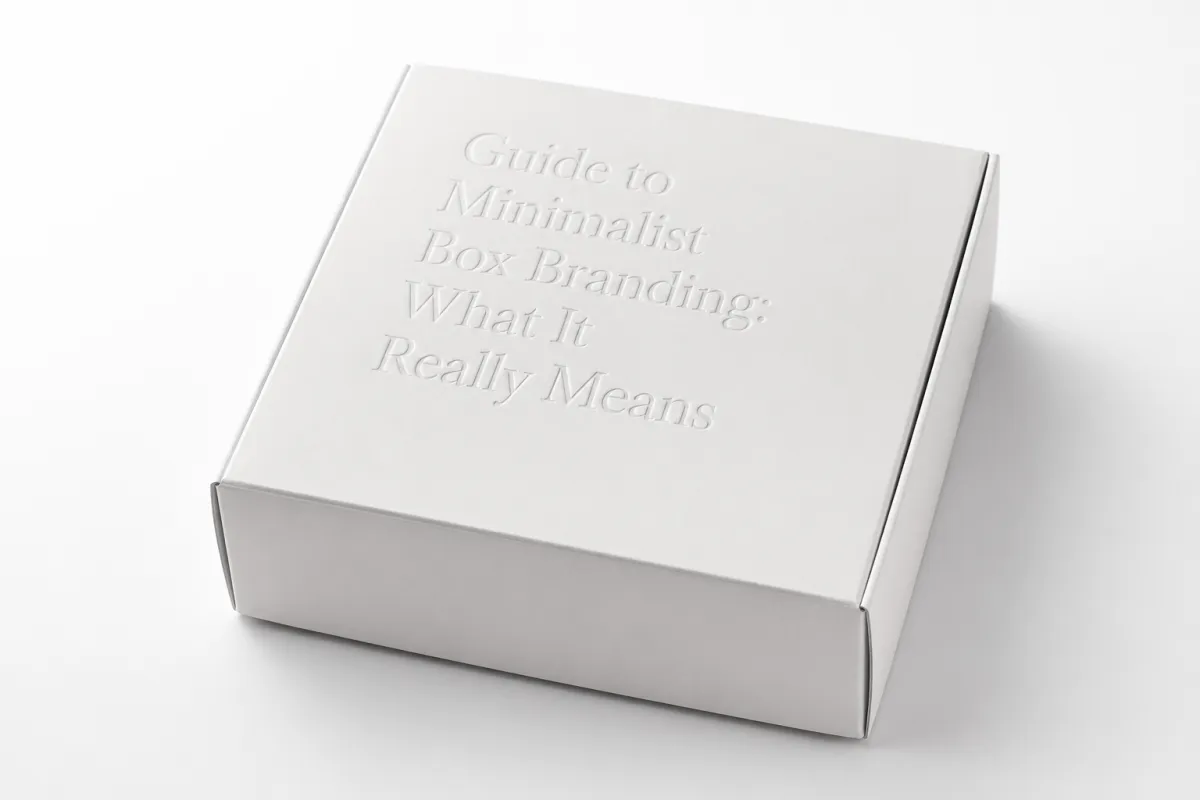
The first thing I tell clients is that a guide to minimalist box branding is not a recipe for emptiness. It is a system of restraint where every line, color, and finish has to earn its place, the same way a press operator on a Heidelberg Speedmaster or a Komori GL checks every registration mark before the run starts. I still remember a skincare job in New Jersey where the front panel had seven callouts in the first proof; we cut it to the logo, the product name, and one benefit line, and the carton immediately looked more premium because the hierarchy became readable from arm's length. No dramatic pitch, no theory-heavy debate, just a cleaner file and a better box.
Minimalist box branding works because it reduces friction. A shopper scanning a shelf in under a second does not process a full design story; they catch the brand name, the product name, and one cue that tells them whether the carton belongs in their hand. That is why a good guide to minimalist box branding treats whitespace, typography, and contrast like production tools rather than decorative extras. A 24 pt sans serif in deep black on an uncoated kraft board, with 8 to 12 mm of clear space around the logo, can feel stronger than a ten-color layout if the spacing is controlled and the ink density is consistent. Simple is not lazy here; simple is often the only thing that survives distance, glare, and a busy checkout aisle.
What most people get wrong is thinking that minimalism means less design. That is the lazy version, and I say that with some irritation because it shows up constantly in concept reviews from brands that want luxury results without editing anything out. A proper guide to minimalist box branding is about precision, not absence. I have seen one-color cartons with blind embossing, a 1.5 mm rule line, and one accent color outperform heavily illustrated boxes because the message structure was clean and the tactile signal felt intentional. Customers may not know the technical terms, but they can feel the difference between a box that was edited in a factory sample room in Suzhou and a box that was merely left unfinished.
This approach fits especially well for subscription boxes, boutique apparel mailers, cosmetics, supplements, premium food packaging, and electronics accessories where trust, consistency, and quick recognition matter more than dense copy. A plain carton can signal sustainability, calm, and quality at the same time if the paper is honest and the finish is controlled. For teams building a broader packaging system, I often point them to our Case Studies page, because the strongest examples of minimalist box branding usually show how one repeated visual move across five SKUs creates more brand memory than five different boxes that only share a logo. That kind of consistency is especially useful for launches in California, Texas, and the UK, where buyers compare multiple variants on the same shelf.
"The box looked too quiet on the proof sheet, but once it hit the shelf under warm LEDs in a New Jersey retail bay, it was the one buyers remembered." I heard that from a packaging manager outside Newark, and it stuck with me because it captures a real truth: a strong guide to minimalist box branding respects the retail environment, not just the art file.
If you want a quick test, ask whether the box still makes sense after the logo is removed from one side panel or the copy is cut by 30%. If the answer is yes, the structure is doing real work. If the answer is no, the design is carrying too much noise. That is why every guide to minimalist box branding should begin with hierarchy, material, and fit before anyone starts arguing about color palettes or spot varnish. I have sat through those arguments in factories in Dongguan and Los Angeles, and they can burn an afternoon while the actual carton sits there waiting for a decision.
How Does Minimalist Box Branding Work on the Shelf?
A strong guide to minimalist box branding has to explain shelf behavior, because a box lives or dies in the first glance. Visual hierarchy should be readable in under a second: brand name first, product name second, and one supporting cue third, whether that cue is a scent, function, size, or ingredient claim. I once watched a buyer at a trade show in Milan pick up two cartons from the same category; the one with the clearest hierarchy got the conversation, even though the other had a more expensive foil stamp and a heavier 2 mm rigid board. That is customer perception in action, and it is a little unfair, but retail rarely rewards the most expensive print treatment.
White space is not wasted space. It is a signal. On a 210 x 120 x 35 mm mailer, for example, leaving 16 to 20 mm of clear margin around the logo can make the whole package feel calmer and more premium, especially when paired with a matte aqueous coating or an uncoated stock from a mill in Zhejiang. In a good guide to minimalist box branding, that breathing room gives the typography room to land. It also makes photography easier, because the box does not turn into a busy pattern under glare from a softbox or a warehouse phone camera. I have seen too many otherwise beautiful cartons get flattened by bad lighting and a cheap auto-enhance filter.
Tactile cues matter just as much as print. I have seen minimalist box branding made richer by a soft-touch lamination on SBS artboard, a blind emboss on a rigid setup box, or one spot varnish on the brand mark while the rest of the panel stays flat. That single contrast point can do more for visual branding than a full-page illustration. On a factory visit in Guangdong, a converter showed me three samples side by side: gloss, matte, and matte with a 0.8 mm raised logo. The raised logo sample won every time because the hand felt the difference before the eye had time to overthink it. I still think about that sample table whenever someone asks whether a finish is worth the added cost of about $0.04 to $0.12 per unit on a 5,000-piece run.
Minimalism also tells a story through structure. A drawer box that opens with a paper pull, a tuck-end carton with a clean lock, or a mailer with one continuous printed interior can all reinforce the same idea: the brand has edited itself down to what matters. That is why the best guide to minimalist box branding always includes unboxing sequence, not just artwork. The opening moment, the sound of the board, and the way the insert holds the product all shape brand identity in ways the front panel alone never will. Sometimes the lid opening with a soft catch does more for perception than ten lines of copy, which is useful because nobody wants to read a paragraph about a serum bottle before they see the product.
For brands that need durability and fulfillment reliability, I always pair the visual plan with transport testing. If the carton is going through parcel networks, I ask for ISTA-style test thinking and often reference ISTA guidance for drop, vibration, and compression expectations. A clean box that fails at the corner seam in the first 18 inches of transit is not a design win. It is an expensive rerun, and a very annoying one. The same logic applies to sustainability claims; if the box is presented as responsibly sourced, the paper trail and the certified chain matter, and FSC language has to be accurate, not decorative. A minimalist carton that claims recycled content should be able to show a mill certificate from a supplier in Vietnam or Canada, not just a nice line in a deck.
On shelf, in hand, and in photos, minimalist box branding succeeds when the box makes one confident statement instead of seven unsure ones. That is why a guide to minimalist box branding should measure clarity the same way a plant measures board caliper: by what is actually there, not by what the concept deck promised. The deck can be charming, polished, and full of renderings; the box, however, has to survive the truck ride from the factory in Ningbo to the warehouse in New Jersey without bending, scuffing, or confusing the shopper.
Key Factors That Shape Minimalist Box Branding
Every guide to minimalist box branding has to begin with audience fit, because a luxury buyer reads restraint differently than a sustainability-minded shopper, and both read it differently than a price-conscious retailer. A premium fragrance buyer may interpret a blind embossed mark on rigid board as elegance, while a value-focused buyer may read the same box as too sparse unless the product story is obvious. I have had clients in the same category argue over the same carton for 45 minutes, and the resolution usually came from naming the exact customer segment, the channel, and the price point, such as $28 e-commerce beauty versus $72 boutique retail. Nobody likes that kind of meeting, but it is usually where the useful decisions get made.
Product category changes the rules fast. Cosmetics can use a lot of negative space if the typography is careful, while food packaging often needs compliance copy, ingredients, allergens, and barcode space that reduce the front-panel real estate. Supplements may need disclaimer-heavy back panels, and electronics often require serial information, model numbers, and regulatory marks. A guide to minimalist box branding is only useful if it respects those constraints instead of pretending every category gets the same blank canvas. The cleanest cartons I have seen for supplements usually keep the front to three lines or fewer, then push the dense information to one side panel or the back, often on a 0.5 mm smaller type size than the hero panel.
Box construction is another hard limiter. A tuck-end carton gives you different branding zones than a rigid setup box, and a sleeve changes everything because the seam can slice through a logo if the dieline is not planned early. Corrugated mailers bring flute direction, board stiffness, and stacking strength into the discussion, while display boxes need face visibility from multiple angles. I still remember a supplier negotiation in Suzhou where a client wanted a full-panel wrap on a crash-lock mailer; once we mapped the fold lines, the logo had to shift 12 mm upward so it would not disappear into the crease. That is the kind of detail a serious guide to minimalist box branding should respect, even if it feels annoyingly fussy in the moment.
Material and finish choices often decide whether minimalism feels premium or just underdesigned. SBS artboard, kraft, corrugated, and rigid board each carry a different visual temperature. A 350gsm C1S carton with a matte aqueous finish feels clean and retail-friendly, while a 1.5 mm rigid board wrapped in printed paper can feel more gift-like and controlled. Foil accents, embossing, and soft-touch lamination all add cost, but one finish used well can lift customer perception more than another round of concept art. If you are comparing surface options for secondary packaging and labels, our Custom Labels & Tags page shows how much visual authority a smaller printable area can carry when it is designed with discipline. For many brands, the best starting point is a plain 350gsm C1S artboard with matte varnish at roughly $0.15 per unit for 5,000 pieces out of Guangdong.
Operational needs are where pretty concepts either survive or collapse. Barcode placement, stackability, glue flaps, artwork bleed, and case-packing orientation all affect the final box, even if the design file looks perfect on a monitor. A guide to minimalist Box Branding That ignores those details usually ends up with a clean-looking proof and a messy warehouse reality. In one plant outside Suzhou, a carton looked excellent until the team discovered the barcode sat too close to the base flap, which caused scanner issues on the fulfillment line; moving the code 9 mm solved the problem, but only because the team caught it before mass production. I wish every production issue could be solved that cleanly, but the factory floor tends to prefer surprise.
The best minimalist systems also protect brand consistency across reorder cycles. Ink batches shift. Board lots vary. Coatings cure differently in humid conditions. If your brand relies on a precise off-white or a charcoal gray, you need tolerance ranges and approved references, not vague hopes. That is why a guide to minimalist box branding should always tie visual branding to production controls, because a minimalist package has less visual clutter to hide behind when something drifts. A busy design can disguise a lot; a quiet one tells the truth faster, especially when the run is split between a Shenzhen press line and a finishing plant in Dongguan.
Step-by-Step Guide to Minimalist Box Branding
The smartest guide to minimalist box branding starts with an audit, not a sketch. Pull together your current boxes, customer feedback, sales photos, and the actual brand assets being used across teams. I usually ask for the logo files, the last two print proofs, and a photo of the box in a real warehouse because those three things tell me more than a 20-slide mood board. The audit shows what should stay, what should go, and what has to become more visible, especially if your current packaging is hiding the product name under decorative noise. I have opened enough packaging decks to know that pretty slides can be wildly optimistic.
Next, build a packaging rule set with hard limits. I like to define a color palette of one primary, one neutral, and one accent at most, then lock typography to one family for headers and one for support copy. Decide logo clear space in millimeters, set the front-panel hierarchy, and establish what can live on the side panels. A good guide to minimalist box branding is really a rule book for brand identity, because once those decisions are written down, every new SKU becomes easier to approve and harder to accidentally bloat. It also saves you from the classic "just one more callout" request that somehow arrives after five rounds of review.
Choose the structure and substrate before final artwork. That sequence saves time and money, and it prevents the common mistake of designing a sparse layout that only works on a flat mockup. A 200 x 150 x 50 mm mailer in corrugated board does not behave like a 90 x 90 x 140 mm rigid set-up box. The first has seam lines, shipping stress, and print limitations tied to flute direction. The second has a wrap, corners, and a premium feel that invites a different visual rhythm. A serious guide to minimalist box branding never treats the dieline as an afterthought. I have seen a beautiful logo placement fall apart because nobody checked where the fold line landed, and that is the sort of mistake that makes a sample review go very quiet very quickly.
Prototype with the real light, not the studio light
I have seen more than one finished carton fail under actual store lighting in Chicago and Seoul. That is why I always recommend two prototypes: one photographed under a 5,000K light box and one placed on a mock shelf under warm retail LEDs around 2,700K. A guide to minimalist box branding should be tested in hand, on shelf, and in a shipping scenario, because the same white can look crisp in the studio and gray under a warehouse bulb. Bring in three to five people from different teams if you can; the production manager notices edge crush, the designer notices spacing, and the sales lead notices whether the box feels confident enough to sell. Sometimes the sales person is the first to say, "This one looks like it means business," which is not scientific, but it still tells you something useful.
Proof the mechanics before the first production order
Once the concept is approved, move to dieline proofing, ink mapping, coating confirmation, and barcode checks. I like to review the file at 100% scale, then inspect overprint risks at the seam, glue flaps, and fold lines. If a foil stamp sits too close to a score line, it can crack after the first fold. If a soft-touch coat lands on a barcode, a scanner may struggle. A practical guide to minimalist box branding is built on these unglamorous checks, because minimal artwork leaves very little room for production mistakes to hide. That can be frustrating, but it also keeps everyone honest, especially if the line is running 8,000 units per shift in a plant outside Shenzhen.
Then lock the sample approval path. A small test run of 300 to 500 units can reveal whether the board scuffs too easily, whether the print density matches the approved swatch, and whether the unboxing experience feels right. For high-volume programs, I usually want a first production order of at least 2,000 to 5,000 pieces if the line, supply chain, and MOQ support it, because the first full run tells you more than a single hand sample ever will. The best guide to minimalist box branding is always part design process and part factory discipline, and the factory half is the part people often underestimate until they get burned by it. A 5,000-piece test run at $0.15 to $0.32 per unit can be far cheaper than reprinting a failed 20,000-unit launch.
Finally, document the production logic so the next reorder does not drift. Note the substrate, coating, Pantone references, die number, carton count per master case, and acceptable color variance. That keeps the packaging team, the buyer, and the factory looking at the same standard. If you want to see how disciplined packaging decisions show up in finished work, our Case Studies page is a useful reference point because it shows how small design choices can stay consistent across multiple SKUs and multiple production cycles. A clear spec sheet can save a brand in Portland, Toronto, or Dubai from a costly mismatch on the second or third reorder.
Cost, Pricing, and Timeline for Minimalist Box Branding
A good guide to minimalist box branding has to talk about money plainly, because simple does not automatically mean cheap. The biggest cost drivers are box style, board grade, print method, number of colors, finishing, and order quantity. Artwork complexity matters less than most buyers think. I have seen a one-color rigid box cost more than a six-color folding carton simply because the rigid board, paper wrap, and magnetic closure added labor and material steps that the printed carton did not need. That part always surprises someone in the room, usually right after they say, "But it only has one color."
For a practical reference, a 5,000-piece order of a 350gsm folding carton with one or two print colors and a matte aqueous finish may land around $0.18 to $0.42 per unit, depending on size and origin. If the carton is produced in Dongguan or Zhongshan with standard tooling, you can sometimes get closer to $0.15 per unit for 5,000 pieces on a simple two-color layout. Step up to an SBS carton with a spot UV or blind emboss, and you may see $0.24 to $0.55 per unit. A rigid setup box with soft-touch lamination and foil stamping can move into the $1.10 to $2.80 range per unit, especially if the box has a custom insert or complex closure. These are the kinds of numbers a realistic guide to minimalist box branding should put on the table early, before anyone falls in love with a sample that quietly blows the budget.
| Packaging Option | Typical MOQ | Unit Price Range | Finish / Features | Best Fit |
|---|---|---|---|---|
| Kraft folding carton | 5,000 units | $0.15 - $0.42 | 1-2 colors, matte aqueous, uncoated feel | Natural, eco-forward visual branding |
| SBS carton | 3,000 units | $0.24 - $0.55 | Spot UV, emboss, refined print clarity | Beauty, wellness, premium retail |
| Rigid setup box | 1,000 units | $1.10 - $2.80 | Soft-touch lamination, foil, insert | Gift sets, luxury, high-value products |
Timeline matters just as much as price. A straightforward project can move from discovery to approved sample in 2 to 4 weeks if dimensions, copy, and finishes are locked early. Production then often takes 12 to 15 business days from proof approval for simple folding cartons, while rigid boxes and specialty finishes can stretch to 18 to 25 business days or more. I have had client teams save a full week just by approving the logo placement before asking for a second sample, which is why a serious guide to minimalist box branding should treat sign-off discipline as a cost-control tool. The less back-and-forth you have, the less likely the schedule drifts and the fewer 10 p.m. emails you get from the factory in Guangzhou.
Delays usually come from late copy changes, slow sample reviews, or a finish request that appears after the die has already been cut. A buyer once asked me for a foil shift from gold to silver after sample approval, and that single change added a plate remake, a new test pass, and almost six extra days. If your timeline is tight, simplify the number of components, choose standard board sizes, and freeze the structure before the art starts moving. The less indecision you have, the easier the project runs, and the fewer panic emails show up at 9:47 p.m. from procurement, design, and operations all at once.
One more practical note: freight and packaging damage can erase savings fast. A lower-cost carton that crushes in transit is not actually cheaper, especially if 3% to 5% of the run has to be reworked or repacked. I always tell teams to budget for the full package, not just the printed shell. A guide to minimalist box branding is strongest when it counts the carton, the insert, the outer case, the shrink or tape, and the labor needed to get the product out the door cleanly. Otherwise you end up with a nice-looking spreadsheet and an irritated operations team in the warehouse.
Common Mistakes in Minimalist Box Branding
The most common mistake I see in a guide to minimalist box branding is overdoing restraint until the box looks vacant, unfinished, or generic. Minimal does not mean forgettable. If the logo is tiny, the type is thin, and the background is flat white with no tactile detail, the package can disappear next to a competitor that used one strong mark and one smart finish. I have watched buyers describe that kind of box as quiet but not confident, which is a useful warning sign. Quiet can be elegant. Quiet can also be a problem, especially in a retail bay where the shopper sees 30 cartons in 15 seconds.
Weak contrast is another problem. A pale gray logo on warm kraft or a hairline font on a matte carton may look elegant on screen and fail under fluorescent warehouse lighting. The same problem appears in product photography, where low-contrast packaging turns muddy as soon as a camera compresses the image for e-commerce. A proper guide to minimalist box branding should insist on legibility tests at 1x, 50%, and thumbnail size, because online marketplaces do not forgive delicate type that vanishes on a mobile screen. If the shopper has to squint at a 3-inch phone display, you have already lost the moment.
Ignoring structure is a costly mistake, and I have seen it happen with sleeves, mailers, and rigid boxes alike. A flat design may look perfect in a PDF, but once it wraps around a seam, the logo can split across a fold or land inside a glued flap. That is why dieline review matters so much. If the visual center is not aligned with the physical center, the package can feel off balance even when every color is correct. A good guide to minimalist box branding respects the box as an object, not just a surface, because the object is what ends up in the customer’s hands from Shanghai to Seattle.
Treating minimalism like a temporary style is another trap. When teams approve one sparse carton, then switch to a totally different layout for the next SKU, brand recognition suffers because the visual language never settles. I have seen this happen in beauty and wellness launches where the hero product looked premium, but the line extensions looked like they came from three different companies. The fix is to define a repeatable system: one logo position, one type scale, one color family, and a few allowed finish cues. That is brand consistency, and it matters far more than novelty. Novelty is fun in the meeting. Consistency is what gets remembered in a store in Austin or a subscription box in Toronto.
Skipping testing is the last big miss. A box that has not been checked for corner crush, rub resistance, barcode readability, and color shift is a risk waiting to happen. If you are claiming recycled content, uncoated stock, or responsible sourcing, make sure the materials actually support that story. I usually ask for sample rub tests, drop tests, and a quick scanner check before approval, and if the product is going into distribution, I want transit assumptions tied to the right standards and methods. A guide to minimalist box branding is not complete if it ignores the physical abuse that cartons take between the press and the customer, especially on a 600-mile truck route in summer heat.
Honestly, the fastest way to lose the premium feel is to let production shortcuts creep in after the design is approved. A slightly misregistered logo, a dull coating, or a rough cut on the flap can make a simple box feel cheap in a way that a more decorative box might hide. The lighter the design, the more the factory finish matters. That is why minimalism demands more discipline, not less. It is a little rude that way, but packaging is not here to flatter us, and a sloppy 0.3 mm miscut will expose that immediately.
Expert Tips and Next Steps for Minimalist Box Branding
If I had to reduce the best guide to minimalist box branding to one sentence, it would be this: choose one unmistakable brand signal and repeat it with control. That signal might be a warm kraft surface, a charcoal type treatment, a deep green Pantone, a blind emboss, or a single reflective foil on the logo. The key is consistency. I have seen a plain carton become memorable simply because the brand owned one color and used it everywhere, from the master case label to the display box. That kind of discipline looks almost boring in a deck and very smart in a warehouse in Rotterdam or Chicago.
Design for the shelf and the shipping line at the same time. Put the box in a stack of six, photograph it from 8 feet away, and place it in an unboxing video frame before you call it done. A guide to minimalist box branding should never be judged only by the front-facing mockup. I like to see how it looks when a fulfillment worker grabs it with one hand, because that is the moment the package either feels crisp or starts to look flimsy. The best boxes hold up in all three places: shelf, screen, and shipping lane. If they only work in one, the design is probably doing too little or too much.
Build a simple packaging spec sheet and keep it current. List the board grade, exact dimensions, finish, barcode location, Pantone references, coating type, and acceptable color variance. Add the target MOQ, the carton count per master case, and the approved supplier name if you have one. That one document does more for brand consistency than a dozen scattered emails. It also makes reorder conversations much easier, especially if a new team member inherits the project six months later and needs to understand the logic without guessing. I have inherited enough messy spec sheets from factories in Dongguan and Ningbo to know how valuable a clean one can be.
Before launch, I recommend one last review of the entire packaging system: reference samples, dieline approval, prototype sign-off, pricing confirmation, and production slot booking. If a supplier needs a small deposit to reserve line time, pay it once the sample is locked so you do not lose your place in the schedule. A clean rollout is usually the result of small decisions handled in order, not one dramatic design breakthrough. That is the real lesson of a guide to minimalist box branding, and it is a comforting one if you are trying to keep a launch from turning into a scramble. A two-week delay at the factory can be more expensive than a $300 sampling round, so the order of operations matters.
For teams that want to see how this kind of planning shows up in live programs, the best next step is often to review real packaging examples and compare the material choices behind them. A well-built guide to minimalist box branding is never only about looks; it is about managing perception, cost, and production reality together. If the box feels calm, photographs well, survives transit, and repeats cleanly across the line, you have probably found the right balance. That is the moment where the whole thing stops feeling theoretical and starts looking like a brand.
And if you are still deciding between a matte kraft carton, an SBS retail box, or a rigid presentation box, I would start with the category, the shipment path, and the buyer's expectation before touching the artboard. That is the route I have taken in factory meetings from Dongguan to New Jersey, and it has saved more than one launch from expensive overdesign. In the end, the best guide to minimalist box branding is the one that keeps the box simple enough to remember and strong enough to survive production. Pick one signal, lock the substrate, test under real light, and freeze the spec before the first run; that is the cleanest path to a box that looks deliberate instead of merely restrained.
Frequently Asked Questions
How do I start a guide to minimalist box branding for a new product?
Start with the brand rules: logo use, color limits, typography, and the one message the box needs to communicate in 3 seconds or less. Then Choose the Box structure and material before final artwork, because a clean concept can fall apart if the dieline, seam, or flap placement is ignored. A useful guide to minimalist box branding always prototypes early and checks the box in hand, on shelf, and in a shipping scenario before production is approved. I know that sounds basic, but basic is usually where the expensive mistakes hide, especially on a first run of 3,000 to 5,000 units.
Is minimalist box branding cheaper than full-color packaging?
It can be cheaper if you reduce print colors and simplify the artwork, but board grade, structure, and finishing often matter more than ink count. A rigid box with embossing or soft-touch coating may cost more than a busy printed carton, even if the design is visually spare. The safest way to judge cost is to compare the total package, not just the front-panel design, because minimum order quantities and setup fees can change the final number fast. I have seen perfectly simple boxes surprise everyone on the quote sheet by jumping from $0.18 to $0.46 per unit once a finish upgrade was added.
What materials work best for minimalist box branding?
Kraft, SBS, corrugated, and rigid board all work well if the surface matches the brand mood you want to create. Uncoated or lightly coated stocks usually feel honest and modern, while rigid board can deliver a more premium, gift-like impression with less visual clutter. The best choice depends on shipping strength, finish options, and whether the package needs to feel natural, luxury, or highly technical. Personally, I like kraft when the brand has something real to say about materials, and I like SBS when crisp typography needs room to breathe on a 350gsm C1S sheet from a mill in Zhejiang or Guangdong.
How long does minimalist box branding usually take?
A straightforward project can move through concept, proofing, and sample approval in a few weeks if the files and specs are ready early. Custom structures, specialty finishes, and multiple approval rounds can extend the schedule, especially if the team keeps changing copy after the first proof. The fastest launches usually happen when dimensions, structure, and finish choices are locked before samples are requested. That is the boring answer, but boring answers usually save launches, and a typical production window is 12 to 15 business days from proof approval for a simple folding carton.
How many colors should minimalist box branding use?
Most effective minimalist systems use one to three core colors, with the logo and typography doing most of the visual work. A single accent color or a spot finish can create strong recognition without making the box feel busy. The right number depends on print method, contrast needs, and how much information has to fit on the carton without crowding the front panel. If a color is not helping the hierarchy, I usually question whether it needs to be there at all, especially on a carton that will be viewed at arm's length under 3,500K lighting.
What is the biggest mistake brands make with minimalist packaging?
The biggest mistake is confusing minimal with empty. A box that has too little contrast, too little structure, or too little hierarchy can look unfinished instead of premium. The strongest guide to minimalist box branding keeps enough visual discipline to feel calm while still giving the customer a clear reason to trust the product. That balance is harder than it looks, which is exactly why so many brands get it just a little wrong the first time, usually on a first proof that looked good on a monitor and weak on a shelf.
If you want Packaging That Feels quiet, premium, and easy to recognize, the best guide to minimalist box branding is the one that balances restraint, clarity, and production reality from the first proof to the final carton. I have seen that balance save budgets, improve customer perception, and strengthen brand recognition in categories where the box has to do a lot of work with very few moves. Keep the system tight, keep the specs honest, and the minimalist result will look deliberate every time. And if it takes one extra round of proofing to get there, that is still better than opening a shipment and asking who approved a box that missed the fold by 4 mm.


