Buyer Fit Snapshot
| Best fit | To Mycelium Protective Packaging for Modern Brands projects where brand print, material claims, artwork control, MOQ, and repeat-order consistency need to be specified before quoting. |
|---|---|
| Quote inputs | Share finished size, material target, print colors, finish, packing count, annual reorder estimate, ship-to region, and any compliance wording. |
| Proofing check | Approve dieline scale, logo placement, barcode or warning zones, color tolerance, closure strength, and carton packing before bulk production. |
| Main risk | Vague material claims, crowded artwork, missing packing details, or unclear freight terms can make a low unit price expensive after revisions. |
Fast answer: To Mycelium Protective Packaging for Modern Brands: Material, Print, Proofing, and Reorder Risk should be specified like a repeatable production item. The safest quote records material, print method, finish, artwork proof, packing count, and reorder notes in one written spec.
Production checks before approval
Compare the actual filled-product size with the drawing, then confirm tolerance on folds, seals, hang holes, label areas, and retail display edges. Reserve space for logos, QR codes, warning copy, and material claims before decorative graphics fill the panel.
Quote comparison points
Review material grade, print process, finish, sampling route, tooling charges, carton quantity, and freight assumptions side by side. A quote is only useful when the supplier can repeat the same color, closure quality, and packing count on the next order.
Guide to Mycelium Protective Packaging for Modern Brands
Mycelium protective packaging starts with a weirdly elegant swap: agricultural residue plus fungal growth becomes a molded protective part instead of another petroleum foam insert. That sounds almost too clever, which is why people either overhype it or dismiss it too fast. Both reactions miss the point. Packaging has one job first: keep the product intact. The sustainability story is useful, but it only matters if the part survives the trip.
Mycelium is the root-like network of fungi. In packaging, that network grows through a prepared substrate such as hemp hurd, oat husk, corn stover, or sawdust. The substrate gives the fungus structure and food. After growth, the part is heat-treated or dried so it stops biologically active growth and holds its shape. What comes out the other side is not a living material. It is a finished molded component designed to cushion, restrain, and protect.
That makes it a strong option for fragile, premium, and lower-volume shipments. Glass jars, ceramics, skincare sets, electronics accessories, and giftable retail kits are common fits. I have sat through sample reviews where everyone loved the texture, the color, the whole earthy vibe, and then the first transit test kicked the conversation back to reality. If a package looks great but cannot handle side load or humidity, it is just expensive decoration. A real guide to mycelium protective packaging stays focused on the shipment, not the mood board.
For packaging buyers, the right question is not whether the material is interesting. It is whether the part protects the item through the actual supply chain. A sample that sits nicely on a table can still fail in a humid warehouse, a hot dock, or a sloppy fulfillment line. So yes, sustainability belongs in the conversation. So do density, tolerance, lead time, conditioning, and test methods. That part gets skipped all the time, and then everybody acts surprised when the numbers show up.
Here is the honest version: mycelium packaging usually makes the most sense when the product is valuable enough to justify more thoughtful packaging, the order volume is not massive, and the unboxing experience matters. For commodity shipping at huge scale, other materials still win on cost and speed. For premium packaging, though, mycelium can land in a sweet spot where protection and presentation actually help each other instead of fighting.
How Mycelium Protective Packaging Works
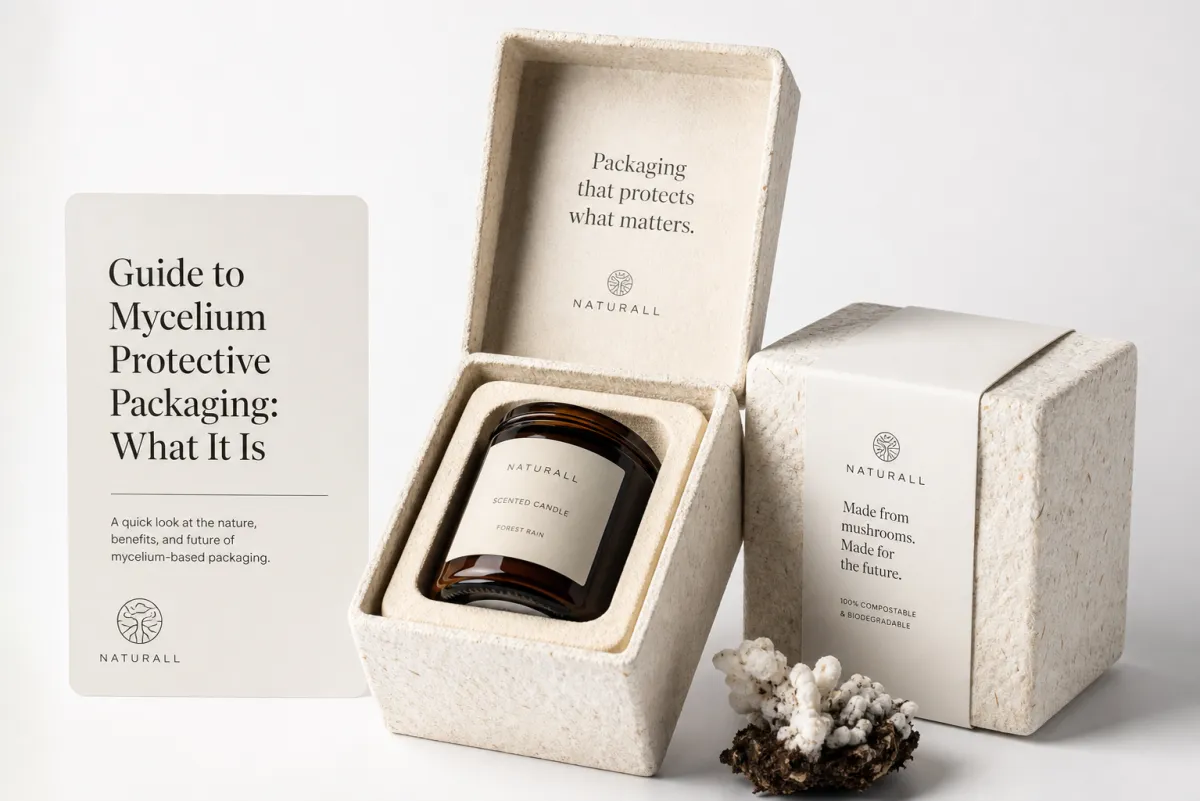
The mechanics are easier to understand than the branding. The process begins with cleaned, dry plant-based feedstock. That substrate is inoculated with fungal spawn, packed into a mold, and left to grow until the fungal network binds the particles into a rigid composite. The mold defines the geometry. The biology binds it together. After that, the part is dried or heat-treated to stop growth and stabilize the shape. The result is a formed protective component, not a petri dish science project.
The mold matters as much as the material. Ribs, corner radii, wall thickness, cavity depth, and edge geometry all affect shock absorption and compression resistance. A thicker wall does not automatically mean better protection. Sometimes a well-placed rib does more work than extra mass ever will. That is why a guide to mycelium protective packaging belongs in packaging engineering, not in a generic trend roundup with pretty photos and no numbers.
Compared with expanded polystyrene, the material logic is different. EPS is a foam with gas cells. Mycelium is a bio-composite that can be tuned through substrate choice, growth time, moisture removal, and geometry. That does not make it stronger in every direction. It means performance depends more on design choices. Change the footprint, the cavity depth, or the corner shape, and drop behavior can shift faster than a lot of teams expect.
There is a useful comparison with molded pulp too. Molded pulp usually wins on mature tooling and a more familiar supply chain. Mycelium can offer a more sculptural form, a lighter tactile feel, and a stronger brand signal for premium launches. Still, it has to earn its place in the bill of materials. If the product is surface-sensitive, the contact points need to be smooth enough to avoid abrasion. If the item is top-heavy, the pack has to resist tip-over and side loading. The packaging decision should come from product risk first, story second. Pretty simple, really.
For teams that rely on standards, testing is where the conversation gets serious. Packaging engineers often use ISTA methods for transit simulation and drop behavior. You can review those methods through ISTA test standards and transit guidance. The test does not care whether the insert sounds sustainable in a pitch deck. It only cares whether the product survives the distribution environment.
A material story is nice. Survival is nicer.
That sounds blunt because it is. The best guide to mycelium protective packaging treats the part as a tool, not a slogan. If the geometry is tuned correctly, the material can dampen impact, restrain movement, and support retail packaging goals without resorting to petrochemical foam. If it is not tuned correctly, you have a very expensive lesson in wishful thinking. Nobody needs that kind of learning curve.
Key Factors That Decide Performance and Fit
The practical questions show up fast. How heavy is the product? Where is it fragile? What surface can tolerate contact, and what surface absolutely cannot? How far will it travel, and how many handling points will it hit along the way? Those answers decide whether the part should be an insert, a corner block, a tray, or a full protective shell.
Weight is only the start. A 300-gram cosmetic bottle can be harder to protect than a 2-kilogram ceramic piece if the bottle has a thin neck and a slippery finish. Compression load matters too, especially if cartons are stack-stored in a warehouse or palletized for distribution. Humidity is the quiet variable that trips people up. Mycelium can perform well in normal shipping conditions, but a damp environment changes the equation. A useful guide to mycelium protective packaging always includes storage and climate assumptions, not just dimensions.
Order volume affects the business case. Low volumes can tolerate more manual handling and a little more unit cost. Higher volumes demand tighter repeatability and a better understanding of mold amortization. Branding matters as well. If the insert is part of the reveal, the shape and surface finish matter more than they would in a plain shipper. The box stops being just a container. It becomes proof that the brand paid attention.
Here is a useful rule. Use inserts when the product already has a primary carton or an outer system that does some of the heavy lifting. Use corner blocks when shock isolation matters around a rigid object. Use trays when you want repeatable placement in a retail-ready kit. Use a full shell when the item has multiple vulnerable surfaces and the assembly needs to stay centered. One format will not suit every SKU. If anyone on the team is pretending otherwise, they are probably selling something.
For sourcing teams, the decision usually falls into three buckets:
- Product risk: drop sensitivity, abrasion risk, and compression exposure.
- Program fit: annual volume, tooling flexibility, and revision tolerance.
- Brand fit: unboxing experience, retail presentation, and sustainability messaging.
If you need a broader packaging program, compare mycelium against the other options in your kit. Many brands still pair it with Custom Packaging Products for printed cartons, sleeves, or inserts around the same launch. That hybrid approach often gives a better result than forcing one material to do everything. A guide to mycelium protective packaging works best when it sits inside a full system view, not as a standalone fetish object.
For suppliers that can explain moisture limits, repeatability, and part tolerances in plain language, ask for the same discipline on testing. Compression values, drop criteria, and conditioning assumptions should be clear. If the supplier cannot tell you how the part behaves after environmental exposure, that is not a minor omission. It is a warning sign. A practical guide to mycelium protective packaging helps separate enthusiasm from capability, and you want that separation before you sign anything.
| Option | Typical Strengths | Typical Tradeoffs | Indicative Cost Position |
|---|---|---|---|
| Mycelium protective packaging | Strong brand story, good cushioning geometry, premium feel | Longer lead time, moisture sensitivity, tooling discipline required | Often higher at low volume |
| Expanded polystyrene | Low cost, mature supply base, lightweight | Poor brand alignment for many premium products, recycling concerns | Lowest on many commodity runs |
| Molded pulp | Familiar, recyclable, decent protective performance | Less sculptural, can feel ordinary in premium launches | Moderate and often scalable |
| Corrugated inserts | Fast to prototype, easy to print, good for some shippers | Lower cushioning for fragile items, less premium presentation | Usually economical |
That table is not trying to crown a winner. It shows the trade space. The guide to mycelium protective packaging is about fit, not ideology. A smart buyer compares the whole system: insert, outer carton, freight density, customer perception, and damage rate. That is the difference between packaging design and procurement guesswork.
Step-by-Step Guide to Mycelium Protective Packaging
The easiest way to make this useful is to think in steps, not inspiration. Start with the product risk profile. What breaks first? What finish scratches? What can tolerate contact? Write those answers down before you talk to suppliers. If you do not define the risk, you will approve a sample because it looks nice, and that is a fast route to disappointment.
Next, collect exact dimensions and weights. Not approximate numbers. Actual measurements with tolerances. A protective part that is 2 mm too tight on one face can work in the lab and fail on the pack line. Include the shipping environment too: carton size, ship method, palletization, storage time, and whether the product moves through hot docks or humid stockrooms. A solid guide to mycelium protective packaging should read like a shipping brief, not a mood board.
What to Ask Before Sampling
Ask for sample photos, CAD or dieline concepts, material assumptions, and any known limits on wall thickness or part depth. If the supplier can share prior test results, even better. Request data for your actual weight range and product geometry. If you need Packaging for Fragile glass or ceramics, ask for the specific drop heights and orientations used in testing. You want a real answer, not a polished shrug.
Then request physical samples. Fit checks are not optional. Place the product in the cavity, close the carton, shake the pack lightly, and inspect for movement. Run your own damage criteria after that. A packaging lab may focus on survival, while a brand team may focus on cosmetic condition, and operations may care most about pack-out speed. All three matter. Ignore one, and the whole thing starts wobbling.
Here is a simple decision path:
- Define the product hazards and shipping environment.
- Request one or two mold concepts with known dimensions.
- Check fit, contact points, and packing speed on a sample unit.
- Run drop, compression, and conditioning tests.
- Revise geometry if movement, cracking, or abrasion appears.
- Approve a pilot run before final production.
That sequence looks basic, but plenty of teams still skip the revision step. They fall in love with the first sample and move straight to production. A smart guide to mycelium protective packaging slows that impulse down. A small geometry change early is cheap. A breakage problem after launch is not.
For formal validation, align your tests with recognized methods such as the transit simulation frameworks used by packaging labs and shippers. If you need a broader sourcing benchmark, the FSC resource on responsible sourcing can help you think through chain-of-custody questions when your packaging system includes fiber-based components. The point is not to add paperwork for fun. It is to make sure the claims behind the package are defensible.
Once the pilot looks good, move to final approval. Keep the documentation tight: approved sample, dimensions, handling notes, storage guidance, and a revision log. That is not bureaucracy. That is how you keep the same issue from resurfacing six months later when a new buyer joins the team and assumes the first quote tells the whole story. Good packaging work survives staff turnover. Bad packaging work gets rediscovered the hard way.
Mycelium Protective Packaging Cost and Timeline
Pricing decides whether the program survives procurement, so the guide to mycelium protective packaging has to be honest about money. Tooling, mold complexity, part volume, substrate sourcing, drying energy, handling labor, and freight density all affect the unit number. If the geometry is intricate, the mold may cost more. If substrate supply is tight, lead times can stretch. If the part is bulky, freight cost can rise faster than people expect. Packaging loves to hide costs in plain sight.
At low volume, mycelium often looks more expensive than commodity foam. That is normal. The first quote usually carries design work, trial runs, and a smaller production batch. At modest scale, the gap can narrow if the packaging system reduces damage, improves unboxing, or supports a premium retail launch. A useful guide to mycelium protective packaging should push total landed cost thinking, not unit-price tunnel vision. Unit price alone is how teams end up buying the wrong thing with confidence.
Here is a practical way to think about the timeline. Design approval comes first, and it is usually where the most back-and-forth happens. After that comes mold creation or tooling modification. Then the supplier grows sample parts, dries them, trims them if needed, and ships them for fit testing. Revisions can add a week or more depending on what fails. Pilot production follows, then final ramp-up. The whole process is manageable, but only if you stop pretending the first estimate is sacred.
Typical timing often looks like this, though every supplier is different:
- Brief and concept review: a few business days to one week.
- Sample creation and delivery: often one to several weeks, depending on mold readiness.
- Testing and revision: variable, and usually the longest hidden step.
- Pilot production: enough time to confirm repeatability and packing speed.
- Full run: depends on order size, drying capacity, and labor availability.
For many brands, the timeline is acceptable because the launch itself is not a last-minute commodity shipment. The packaging is part of the story. That is especially true in premium product packaging, where the insert is visible to the end customer and speaks as loudly as the outer box. A guide to mycelium protective packaging is therefore not only about cost savings. It is about whether the packaging helps the product justify its price.
Below is the comparison procurement teams usually want to see first, even though the final answer depends on testing:
| Cost Driver | Why It Matters | What to Watch |
|---|---|---|
| Tooling complexity | More detailed parts need more precise molds | Sharp corners, deep cavities, and multiple zones can raise cost |
| Part volume | Higher volume can spread fixed costs | Check minimum order assumptions and repeat-run pricing |
| Drying and energy | Finished parts must be stabilized before use | Longer drying cycles can slow the schedule |
| Freight density | Bulky parts cost more to move | Ask for packed cube, not just per-unit pricing |
| Handling labor | Manual touchpoints add labor cost | Confirm whether the line can pack at the needed speed |
The other caveat is this: a lower damage rate can offset a higher insert price. Fewer returns, fewer replacements, fewer repacks, and fewer damaged customer impressions can matter more than a few cents on the unit. That is not always the case. It is just common enough that a narrow price comparison can mislead buyers. Cheap packaging that creates expensive problems is still expensive. Shocking, I know.
Common Mistakes When Specifying Mycelium Packaging
This guide to mycelium protective packaging exists partly because the same mistakes keep showing up. The biggest one is treating the material like a commodity foam clone. Buyers copy old insert dimensions, swap the substrate, and expect the same performance. That usually fails because mycelium is not just a different raw material. It is a different structure with different behavior. The geometry has to be designed for the material, not the other way around.
Another mistake is ignoring moisture. Mycelium can handle normal shipping, but it is not a wet-storage answer. If cartons sit in humid warehouses, move through damp docks, or ride in climate-challenged lanes, you need hard questions about storage guidance, liners, outer corrugate strength, and expected shelf time before use. A good guide to mycelium protective packaging should never pretend moisture is a minor detail.
Oversized tolerances are another trap. If the cavity is too loose, the product shifts and the part loses its protective job. If it is too tight, packing speed slows and the item can scuff or jam. There is usually a middle band that works, but you only find it by testing real units, not ideal drawings. That kind of guesswork is how teams end up saying, “It looked fine in the sample,” right before a wave of returns shows up.
Compression testing gets skipped or underdone more often than it should. That is risky for stacked shipments, warehouse storage, and long supply chains. A part that survives a single drop can still fail under pallet pressure or top-load stress. If the supplier cannot explain how the part behaves under compression and conditioning, keep asking. Good packaging suppliers should be able to discuss not only drop results but also how the part changes after humidity exposure or static load.
The last mistake is buying on sustainability claims alone. A lower-plastic story is attractive, and yes, it can help retail packaging and package branding. But if the supplier cannot support repeat orders, if the lead time is volatile, or if the breakage rate rises, the story loses its value fast. A guide to mycelium protective packaging has to include operational reality. Brands get burned when they approve a material identity before they have approved the supply chain behind it.
Here is the quickest way to avoid the usual pitfalls:
- Test your actual product, not a sample surrogate.
- Condition parts for the environment they will face.
- Confirm repeatability before you scale.
- Compare damage rates, not only unit price.
- Document storage and handling guidance for operations.
That discipline is what makes the guide to mycelium protective packaging useful inside a procurement process. It turns a promising material into a dependable system.
Expert Tips and Next Steps
If a brand is serious about mycelium, the smartest move is to start with one high-risk SKU. Not the easiest one. The tricky one. The item that already causes returns, customer complaints, or awkward repacks. That gives you a clean read on whether the material earns its place. Compare damage rates, pack speed, and customer feedback against the current solution. If the new part only looks better on paper, you will find out quickly.
Ask suppliers for sample data that includes dimensions, weight ranges, environmental assumptions, and test results. Ask for humidity guidance too. Ask what happens if the substrate supply changes or if the product cavity needs to be revised. Those are not awkward questions. They are the right ones. The guide to mycelium protective packaging becomes much more reliable when the supplier can explain the constraints plainly instead of hiding behind eco language.
Compare the insert against the whole pack system, not just the insert itself. Sometimes the outer carton can be resized, which reduces freight cube. Sometimes a simple sleeve or shipper change lowers material use enough to offset the insert cost. That is where packaging design and commercial reality meet. A better guide to mycelium protective packaging should help you design a better package, not just a greener-looking one.
Before you approve artwork or tooling spend, get answers to these four questions:
- What is the exact protection target, and how was it tested?
- What is the expected lead time for samples, revisions, and repeat orders?
- What humidity or storage limits apply to the part?
- What is the minimum viable order and the repeat-run pricing structure?
If you want a balanced program, pair the insert strategy with the right outer box, print finish, and fulfillment workflow. That is where Custom Packaging Products can help the rest of the system work together. Custom printed boxes, sleeves, and accessory packaging can support the mycelium insert instead of fighting it. In a lot of launches, that combination gives a better result than treating the insert as a standalone purchase.
My final advice is simple. Pick the SKU that hurts today, request two supplier concepts, run a real drop test, and get the storage guidance in writing. Then compare those results against your current packaging using the same criteria every time. That is the real guide to mycelium protective packaging: protect the product, support the brand, and fit the economics of the program. If you can do those three things, you have a packaging standard worth keeping.
Use that same process on the next SKU, too. That is how the method turns into a repeatable system instead of a one-off experiment.
FAQ
What products work best with mycelium protective packaging?
It is best suited to fragile items such as glass, ceramics, cosmetics, electronics accessories, and premium gift sets. The guide to mycelium protective packaging is strongest where protection, presentation, and lower plastic use matter more than the absolute cheapest unit cost. Very heavy, wet, or high-volume industrial shipments usually need a different engineered solution.
How long does mycelium protective packaging take to make?
Prototype and mold approval usually take the longest because the shape has to fit the product and pass protection tests. Growth and drying add production time, so lead times are often longer than commodity foam at the start. Once the design is locked, repeat runs become more predictable, but seasonal demand can still extend schedules. That is a normal part of the guide to mycelium protective packaging.
Is mycelium protective packaging water resistant?
It can handle normal shipping conditions, but it is not meant to sit in wet storage or be soaked in transit. If moisture is a risk, pair it with a liner, outer carton protection, or warehouse controls. Ask the supplier for humidity and storage guidance before scaling a new program, because the guide to mycelium protective packaging depends on those limits being understood early.
How much does mycelium protective packaging cost compared with foam?
The per-unit price is often higher than basic foam at low volumes because tooling and growth steps add cost. Total landed cost can narrow when you factor in branding, sustainability targets, and fewer shipping damages. Always compare on the full package system, not just the insert price, which is a core lesson in the guide to mycelium protective packaging.
How do I test a supplier for mycelium protective packaging?
Request samples, compression data, and drop-test results for your actual product weight and dimensions. Ask about mold ownership, repeatability, lead times, and how they handle revisions after the first sample. Check whether they can explain moisture limits, storage conditions, and scaling constraints in plain language. That is the most practical way to use the guide to mycelium protective packaging during sourcing.


