Buyer Fit Snapshot
| Best fit | To Pallet Shipping Boxes projects where brand print, material claims, artwork control, MOQ, and repeat-order consistency need to be specified before quoting. |
|---|---|
| Quote inputs | Share finished size, material target, print colors, finish, packing count, annual reorder estimate, ship-to region, and any compliance wording. |
| Proofing check | Approve dieline scale, logo placement, barcode or warning zones, color tolerance, closure strength, and carton packing before bulk production. |
| Main risk | Vague material claims, crowded artwork, missing packing details, or unclear freight terms can make a low unit price expensive after revisions. |
Fast answer: To Pallet Shipping Boxes: Artwork Proof, Packing Count, and Landed Cost should be specified like a repeatable production item. The safest quote records material, print method, finish, artwork proof, packing count, and reorder notes in one written spec.
Production checks before approval
Compare the actual filled-product size with the drawing, then confirm tolerance on folds, seals, hang holes, label areas, and retail display edges. Reserve space for logos, QR codes, warning copy, and material claims before decorative graphics fill the panel.
Quote comparison points
Review material grade, print process, finish, sampling route, tooling charges, carton quantity, and freight assumptions side by side. A quote is only useful when the supplier can repeat the same color, closure quality, and packing count on the next order.
Guide to Pallet Shipping Boxes: Durability, Costs, Timeline
The first time a pallet load fails, the root cause usually looks annoyingly small in hindsight. A weak corner, a base that flexes too much, a panel that was never meant to carry that kind of weight. Then the entire shipment turns into a recovery job at the consignee, even if the product inside is perfectly fine. Packaging has a way of making expensive problems out of ordinary mistakes.
That is why this guide to pallet shipping boxes focuses on structure, not packaging aesthetics. A pallet shipping box is not just a bigger carton with more cardboard and a fancier drawing. It is load-bearing transit Packaging That Works with the pallet, resists compression, and keeps the shipment stable from first pick to final discharge. If the build cannot do that, the rest is window dressing.
In actual operations, the best pallet shipping boxes do several jobs at once. They move corner loads into the pallet deck, hold stacking pressure without collapsing, resist sideways movement from braking and vibration, and give handlers a predictable way to move the load without tearing panels or splitting seams. That applies to rigid pallet shipping boxes, open-top enclosures, and lighter systems built around film, straps, and unitized product. A useful guide to pallet shipping boxes has to connect structure to product mass, route reality, and receiving behavior, because the wrong build often costs more in rework than it saves upfront.
For ecommerce fulfillment, order processing, and mixed-SKU industrial replenishment, the box is both packaging and load control. People say that like it is obvious, then keep acting surprised when claims rise, handling slows down, or warehouse labor spikes. A solid guide to pallet shipping boxes should help you pick the right build, write it clearly, and keep approvals moving instead of trapped in endless back-and-forth. Nobody needs another packaging decision that dies in email.
If you are serious about reducing returns and dock delays, your guide to pallet shipping boxes should also speak operations fluently: units per layer, unit load behavior, handling path, and load securing method. That vocabulary gets you closer to predictable execution than a prettier spec sheet ever will. And yes, the pretty spec sheet still shows up in the meeting.
Guide to pallet shipping boxes: the hidden performance lever in every shipment
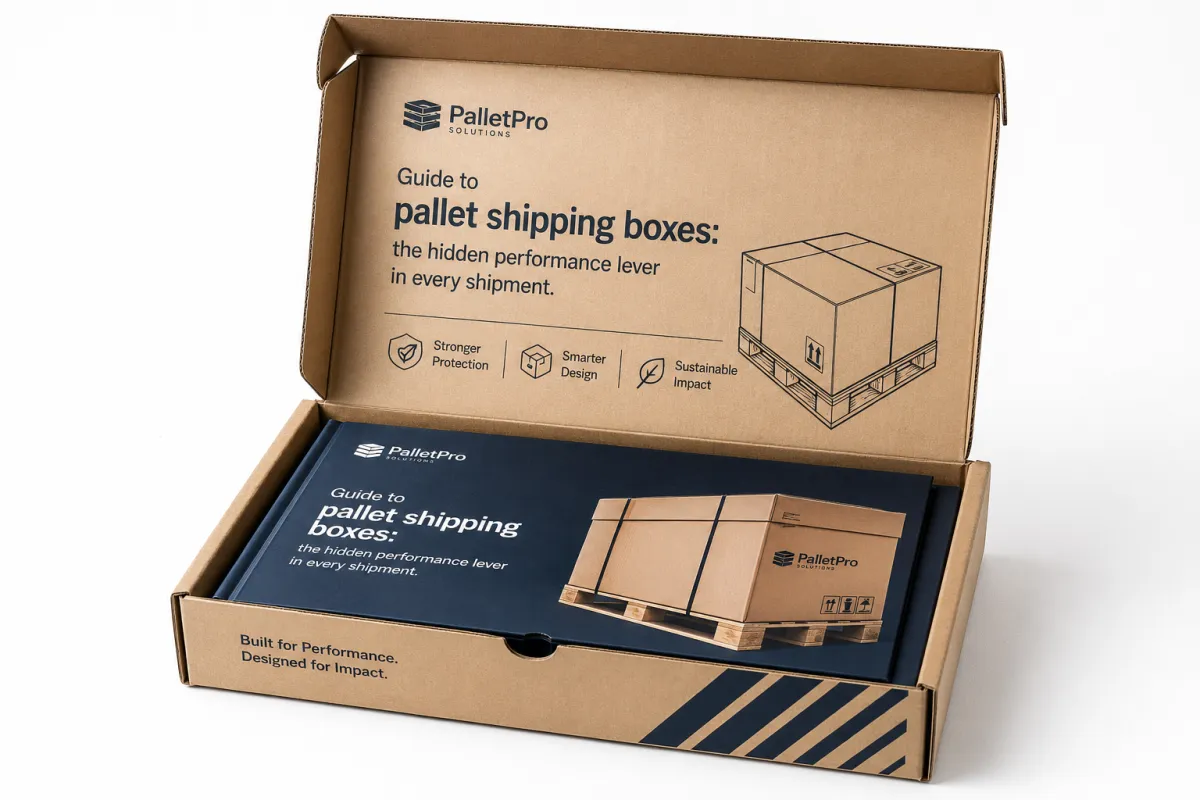
People often judge the contents first and the pallet box second. That is backwards. The pallet shipping box is where a shipment either holds together or falls apart, because it manages force across the footprint. One missing corner support or weak side panel can change the behavior of a full load. In that sense, this guide to pallet shipping boxes starts with a blunt rule: these are engineered systems, not large versions of smaller cartons.
Load transfer explains why they perform. A properly designed pallet shipping box routes force through corners, edges, and base layers instead of concentrating it on weak points. Forklift actions are rarely uniform, and they are definitely not gentle. Dock bumps, side impacts, and stacked storage all add local stress. A design with clean corner load transfer and enough top-load resistance absorbs those shocks better than one built for appearance.
Shipping styles differ sharply. A rigid pallet shipping box uses formed panels, reinforced corners, and often a base that matches the pallet closely. Slip-sheet-only systems can be efficient for stable, homogeneous goods, yet they offer less protection when crush-sensitive or shape-sensitive products are involved. Open-top enclosures work for irregular packing or accessible products, but they rely more heavily on strapping, stretch film, and corner protection. A mature guide to pallet shipping boxes helps buyers match each system to one operating condition, not to a catalog picture.
For brands moving through retail distribution or ecommerce channels, box design also affects dock behavior after pickup. A tight, square load scans cleaner, handles faster, and is less likely to be rejected. A loose or underbuilt load creates extra labor, and extra labor eventually becomes freight cost. No one wants a lane held up because a pallet needs rebuilding when the product itself was fine.
When palletization is clean and consistent, a guide to pallet shipping boxes tends to produce one big payoff: every touchpoint knows what to expect. Forklift operators get predictable lift points, QA sees the right tolerances at bay, and carriers handle the load without improvisation. That kind of boring consistency is exactly what you want.
Practical rule: if the pallet load cannot survive a short dock hold, a forklift stop, and a normal trailer ride without manual correction, the pallet shipping box specification is not finished.
That is why this guide to pallet shipping boxes is, in effect, a guide to controlling movement. The product still matters, of course. The packaging decides whether that product shows up as planned. Buyers comparing Custom Shipping Boxes or broader Custom Packaging Products should ask one question first: what stays stable under freight stress, not just what fits in the dimensions?
How pallet shipping boxes work: load path, stacking behavior, and load restraint
A guide to pallet shipping boxes has to explain load path, because performance lives there, not in glossy renderings. When a pallet is lifted, lowered, or stacked, the weight should travel through the strongest structure path. In corrugated builds, that is usually the corners, vertical walls, and pallet contact points. Edge crush weakness turns walls into soft drums. Weak corner posts push the load outward. The structure then behaves like a stressed shell instead of a stable unit.
Corrugation orientation can matter more than people expect. Score direction affects panel fold behavior, spring-back, and compression resistance before buckling. Vertical compression columns, whether formed from board geometry or inserted hardware, prevent the load from crushing itself during stacking. Vibration-heavy routes amplify tiny shifts until they become visible damage. A trailer does not deliver one impact; it delivers hundreds of small motions in sequence.
Humidity is a frequent blind spot in a guide to pallet shipping boxes. Corrugated performance changes with moisture and temperature. Wood skids and inserts also shift with humidity, expanding or shrinking based on dock conditions. Condensation near loading doors can weaken paper-based systems faster than teams expect. That reality does not eliminate wood; it demands design guards like treatment, protective coating, or controlled staging windows. Some lanes still need tougher board grades, no matter how much someone wants the cheaper option to work.
Load restraint connects all the pieces. Strap points, lashing loops, stretch tension, and corner protection only work if tuned together. Under-restraint lets the load walk. Excess tension crushes outer panels and distorts corners. The strongest systems share load between structure and restraint so the packaging carries part of the stress rather than being punished by film alone. In order fulfillment operations, that distinction is the difference between one minute on the dock and ten. Or forty, if the load really decides to be dramatic.
Diagnostics should be routine, not decorative. A tilt test shows when shift starts early. Top-drop response reveals how much closure and upper structure can take during transfers. Post-shipment unpacking should be reviewed for crushed corners, scuffed edges, torn seams, and uneven footprints. Those clues point to structural weak points. A disciplined guide to pallet shipping boxes uses them before full volume starts, not after a customer has already called.
For teams that need a standards frame, references from the ISTA testing community and sourcing guidance from the FSC help move the decision past unit price and into verified performance and material accountability.
In practical terms, your guide to pallet shipping boxes should include a short stress checklist: edge crush resistance, torsion behavior, corner durability, and the expected vibration profile for the lane. That checklist helps avoid choosing a solution for shipping distance and forgetting the number of forklift touches.
Key factors that decide whether a pallet shipping box succeeds in real-world logistics
Guide to pallet shipping boxes outcomes usually fail in predictable patterns. A safe gross weight can still hide a high center of gravity. A strong nominal rating can still fail when dense items create concentrated point loads. A square pallet can still be mis-sized for a route with turns, frequent transfers, and long dock dwell. Each condition changes the risk profile, and each one deserves its own test setup.
Start by mapping the product behavior. Gross weight, net weight, load distribution, and internal orientation all matter. A full and even case behaves differently from one with dense parts packed into one corner. Asymmetric loads may pass an initial check and fail during a turn or tilt. Load distribution is the difference between a controlled package and one waiting to shift.
Next, define the environment. Humidity cycles, temperature swings, condensation, and wet staging all affect paper-based packaging. Moisture resistance is often not only a material coating decision; it can be a wait-time decision too. A box that works in a dry building for two hours may soften overnight in a humid dock area. That mismatch rarely means poor board choice by itself. It usually means the specification ignored the route timing.
Testing language needs translation. ECT, BCT, burst strength, and water resistance are not scorecards for marketing. They are clues to how the structure handles compression and handling stress. Buyers should verify that board grade and structure match actual service conditions, not just a headline number. A guide to pallet shipping boxes should let engineering calculate while keeping purchasing focused on outcomes like fewer claims and fewer receiving interventions.
Carrier handling rules can derail an otherwise clean plan. Oversize dimensions create dimensional penalties. Some footprints trigger special handling requirements that are expensive and delay-prone. Stacking limits, lift constraints, and acceptance rules are not optional paperwork; they define whether the load moves cleanly through the network. Even small overhang can make a pallet harder to lift safely in certain lanes.
Sustainability can help costs only when it aligns with performance. Recyclable board, right-sized geometry, and reusable layers reduce waste potential, but repeated cycles can still fail if the structure is weak. A thin system that appears greener and then generates claims is no win. A practical guide to pallet shipping boxes treats sustainability as part of procurement outcomes, not a stand-alone label.
Three additional factors should sit in your final criteria list: unit load stability, stack-and-hold behavior, and compatibility with load securing protocols. If those three do not align, the solution may pass a single test and fail in real transport anyway. That is where the cheap-looking option gets expensive, fast.
Step-by-step guide to choosing pallet shipping boxes for your next shipping run
Most packaging errors happen when teams skip sequence and treat selection as one decision instead of a chain. The first step in a guide to pallet shipping boxes is data precision. Capture gross weight, net weight by unit, dimensions, stack pattern, vibration sensitivity, and tolerance limits that the product can truly survive. Incomplete data always becomes incomplete specs.
After the data, map the handling profile before finalizing geometry. One simple truck route is not the same as port transfer or multi-hub movement. International moves demand higher tolerance for humidity, extended dwell, and more handoffs. A short domestic lane can tolerate a simpler build; rougher networks usually cannot. If the line touches four facilities before delivery, the packaging should not pretend it only sees one.
Dimensioning and internal clearance come next. Compare the build against the exact pallet footprint. Fork angles, overhang allowances, and top-open access must be locked before die approval. Excessive clearance makes movement more likely and pushes loads into unsupported faces. Tight spaces force crews into brute-force packing and introduce damage risk. Both conditions create avoidable failures.
Choose construction in clear tiers. Standard wall constructions serve light and stable loads when handling is controlled. Reinforced walls usually win when center of gravity rises or handling frequency increases. Integrated pallet bases reduce alignment and transfer issues, especially for heavier goods. Corner-to-corner reinforcement and inserts become valuable when point loads are aggressive or products have fragile edges. These decisions often save more money than a later retrofit, which is just a polite term for doing it twice.
Validation should follow every design choice. A static load test is baseline. If the route is rough or the contents are sensitive, add vibration checks early. A short pilot with tracked returns and damage photos often reveals behavior that lab conditions miss. One honest pilot is worth three rounds of internal debate.
Once data and test results settle, lock everything into drawings and purchase language. Include dimension tolerances, moisture requirements, print placement constraints, and acceptance criteria. Clarity at PO time cuts disputes later. Teams with small and large SKU families can benefit from coordinated Custom Poly Mailers for smaller items, so fulfillment standards stay consistent and dock sequencing stays predictable.
A guide to pallet shipping boxes should also define palletization sequence: what gets placed first, what gets blocked, and how restraint is applied before the load leaves the line. This is where operations teams often skip documentation and pay for it at receiving. A pallet plan that lives only in someone’s head is not a plan.
Use this comparison when choosing build class:
| Build Option | Typical Use | Relative Cost | Main Strength | Main Risk |
|---|---|---|---|---|
| Standard wall pallet shipping box | Stable loads, lower handling severity | Lowest | Simple, fast to produce | Less margin for heavy point loads |
| Reinforced wall box | Moderate weight, mixed route handling | Medium | Better compression and corner performance | Slightly higher material and converting cost |
| Integrated base with inserts | Heavy or fragile loads, longer transit | Higher | Strong load path and better restraint | More design time and more setup controls |
This table keeps selection honest. A guide to pallet shipping boxes should match structure to operating conditions. Budget-only decisions are easy to reverse after launch. Structure-based choices usually hold steady under real freight stress. That is the difference between a quote and a solution.
Common mistakes with pallet shipping boxes and how to prevent expensive rework
Many teams trust a strong static rating and assume they are safe. That assumption can fail hard. A pallet shipping box may pass static checks and still lose in dynamic handling. A small forklift drop, a brake pulse, or a corner strike often causes the real damage that shows up later. A guide to pallet shipping boxes should surface this gap early, because static comfort often hides dynamic risk.
Load asymmetry is another frequent defect source. Heavy content placed toward one corner can survive the first check and fail on a turn, tilt, or uneven stack. A crushed corner begins a chain reaction through the wall and then across receiving. Uneven load maps need compensation in structure or restraints; ignoring the map means forcing the box to carry a pattern it was never designed for.
Dock inspection alone is not enough. A box can look clean and still hide weak seams, inconsistent dimensions, or misallocated weight. This guide to pallet shipping boxes should enforce weight checks, seam checks, and dimension verification before release. Receiving teams should not become the first quality control checkpoint for manufacturing defects.
Void fill can help, but only when it supports stability. Teams often pile in extra material to "make room" safer and accidentally increase internal movement. Excess voids create bounce and rebound under vibration, which eventually damages corners and seals. Filler, inserts, and dunnage must control motion first and fill empty space second.
Purchase orders fail in recurring patterns. Missing orientation notes create upside-down handling. Unclear moisture requirements weaken packaging in humid lanes. Weak return terms for out-of-tolerance parts prolong resolution. A guide to pallet shipping boxes should require these terms before release and remove uncertainty from post-shipment disputes.
Fixes work best when ownership is clear. A design owner sets structure and drawings. A freight owner defines handling severity and lane expectations. A receiving owner tracks what arrives with photos, measurements, and defect coding. Those three viewpoints close the loop quickly and prevent repeat failures. When a program repeats a defect, most of the time the remedy is one focused correction point, not a blanket thickness increase.
Load-securing mistakes deserve their own sentence: people skip checking tie-down points because they are “good enough for most loads.” Good enough is how you end up paying for emergency fixes at 2 a.m. No one on the dock is impressed by optimism.
Best practice: if a defect appears twice, treat it as a system issue. If it appears three times, treat it as a spec issue.
Pallet shipping box process and timeline: from inquiry to dock-ready shipment
Timeline failures usually begin with fuzzy input. A strong guide to pallet shipping boxes should map every stage from inquiry to dispatch so teams know where delays start. A typical flow moves from intake and brief, to feasibility, prototype sampling, test, approval, production, pre-load inspection, and dispatch. Missing a step pushes correction to a later, more expensive stage.
Simple spec changes can still move quickly, especially with existing platforms. Structural changes usually require a longer path because board choice, die cuts, closures, and insert placement may need retesting. A practical guide to pallet shipping boxes should help teams plan that lead time with eyes open. Fast launch targets only work when the spec is realistic.
Supplier reliability is part of lead time, not a side note. Board availability, converting capacity, and seasonal demand create schedule pressure all the time. A late approval can push production into peak windows where the line has little flexibility. Any design relying on a specific board grade or reinforcement component should include material lead-time risk.
Cross-functional handoffs create most of the avoidable delay. Logistics sets handling constraints. QA locks acceptance criteria. Purchasing manages supply continuity and cost targets. Fulfillment and production need final packaging rules for palletization and staging. A shared revision file and one current design package beat separate email threads every time.
Quality gates make first-production runs honest. Incoming board checks catch lot-level variance. Die-cut checks verify score and score depth. Final pallet simulation confirms behavior against the intended handling model. The best teams keep approvals strict while keeping communication simple and scheduled. The objective is not haste for its own sake; it is release predictability.
Cadence of communication should match complexity. A standard build can move on weekly checkpoints. Fragile or high-value loads often need tighter reviews. Escalation paths need pre-approval before execution, especially near fixed dispatch windows. A delayed sign-off in the wrong stage can create bigger costs than any design change.
In the final review, the guide to pallet shipping boxes should confirm load-bearing behavior through three practical checkpoints: incoming inspection, pre-shipment check, and in-transit evidence review. Skip any one, and you start the next step with a blind spot.
Guide to pallet shipping boxes pricing: cost drivers and value levers
Clear pricing starts by separating cost elements. A practical guide to pallet shipping boxes treats substrate board, converting, printing, die setup, insert hardware, protective treatment, and freight surcharges as distinct drivers. Unit price alone is misleading if the shipment returns damaged. The true bill then shifts to claims, replacements, labor, and delayed receipt penalties.
Board weight and strength usually appear first on every quote. Heavier structures cost more because they consume more material and often take longer to produce. Complex designs also increase converting cost, especially with custom closures, multi-part bases, or reinforcements. Cheapest unit quotes can become expensive programs once failure rates rise. A guide to pallet shipping boxes should compare unit cost against damage probability, not against a single line on a spreadsheet.
A useful budgeting method looks like this:
- First-piece cost: samples, setup, and design review time.
- Recurring unit cost: board, converting, printing, and assembly.
- Total landed cost: freight, handling, damage reserve, and replacement exposure.
The last category exposes where value really sits. A higher-priced build can reduce landed cost when it cuts returns and rework. I have seen slight upgrades in structure erase a full repacking cycle downstream. That outcome sounds small until you watch a dock line grind to a halt because one pallet decided to fall apart.
Volume changes the arithmetic. At low volume, setup and sample overhead dominate. At high volume, recurring cost savings per unit become meaningful. A tiny per-piece reduction can add up fast. Rush orders also add lead-time premiums because normal sample and approval steps compress. Speed demands resources, and resources have price.
Spec stability controls cost too. Frequent changes to panel height, wall grade, or closure method trigger reruns, holds, and revalidations. Each revision can quietly add more than expected. Stable standards plus short change history usually beat creative tinkering after launch.
Include a line item for load securing and handling support. Too many quotes treat strap points, reinforcement clips, and protective wraps as optional. In a guide to pallet shipping boxes, those are part of core cost because they determine whether the shipment behaves like a reliable unit load or a moving puzzle.
| Pricing Lens | What It Includes | Why It Matters |
|---|---|---|
| Unit price | Board, converting, print, setup amortization | Useful for quote comparison, but incomplete on its own |
| Landed cost | Unit price, freight, handling, timing impact | Shows the real budget impact at receiving |
| Failure cost | Damage claims, replacements, labor, delays | Often the biggest hidden expense in transit packaging |
Performance terms in the quote matter as much as price. Tolerance thresholds, rejected-piece policy, replacement timing, and corrective action terms shape actual spend. A higher quote can still win when a supplier consistently holds variance tight and corrects nonconformance quickly. For teams building layered programs, Custom Packaging Products paired with pallet systems reduce conflict between outer and secondary packaging layers.
When the guide to pallet shipping boxes is used correctly, the best purchases are not the cheapest quotes. They are the ones with predictable handling performance, stable supplier delivery, and low failure cost.
Expert tips and conclusion: next steps after this guide to pallet shipping boxes
A useful guide to pallet shipping boxes should finish with execution, not theory. The first 30 days are the right window for real progress. Audit ten recent palletized shipments and rank the top damage modes by frequency. Pick three changes that target the top two causes. Most operations improve by fixing three points, not rebuilding everything.
A concise spec sheet can save hours every week. Capture weight map, load class, dimension tolerance, environment notes, closure method, and restraint requirements on one page. Include moisture sensitivity and stacking expectation as required fields. This one document keeps purchasing, QA, and logistics aligned and cuts reruns caused by assumptions.
Dock teams need clear handling rules before rollout. Train operators on stack orientation, tie points, and lift method for each box class. First three outbound waves deserve close quality inspection, not a sample check-and-wait approach. Early attention catches defects before the correction cost compounds. A weekly issue log and monthly review are often enough to keep the program stable after launch.
The packaging logic is iterative by design. Product mix, carrier behavior, humidity, storage dwell, and fulfillment pace all change the box’s duty cycle. A guide to pallet shipping boxes only works when you use it as a system: test, measure, adjust, repeat. That loop lowers claims, shortens receiving, and hardens margin over time. Simple, not easy.
For the next project, begin with load data and expand outward. A cleaner outer pack and stronger base structure can come from the same design pass if the specification is disciplined. The guide to pallet shipping boxes is ultimately a guide to protecting both margin and operational reliability, and that is where packaging programs justify their existence. If the pack cannot survive the route, it was never the right pack.
The takeaway is straightforward: lock the load data, match the structure to the route, and test the pallet as a unit load instead of trusting a board spec alone. Do that, and the pallet shipping box stops being a guessing exercise and starts behaving like part of the freight system.
How can a guide to pallet shipping boxes improve palletization and loading reliability?
Short answer: it gives your team one source of truth. A guide to pallet Shipping Boxes That is used correctly improves both initial design and execution consistency. It standardizes what qualifies as a safe build, what level of stiffness is required for each lane, and what level of load securing should be applied before freight handoff. That is usually enough to reduce variation without adding complexity.
Longer answer: it aligns the team around outcomes. Engineering gets a framework for sizing walls and reinforcement. Operations gets a clear expectation for handling behavior. QA gets check methods that catch risk before shipment. Carriers and warehouse teams get loads that are predictable at the point of lift. Predictability beats heroics every single day.
So if you run a guide to pallet shipping boxes program, do three things from week one: publish one baseline build template, document a route-risk map, and force one monthly review on the highest-volume lane. That is how good ideas move from PDF to warehouse floor.
Frequently Asked Questions
What is the guide to pallet shipping boxes value if I already buy standard cartons?
It separates cosmetic packaging from load-bearing packaging. A structured guide to pallet shipping boxes shows whether each layer only holds product or also carries forklift and transit loads. Clear load-path rules and tolerances reduce damage rates, dock delays, and receiving disputes by replacing assumptions with specification.
How can I estimate pallet shipping box costs before approving a supplier quote?
Build the estimate from landed cost, not just unit price. Add board grade, converting labor, sample and test charges, freight, and expected damage reserve. Compare at least three volume levels and two lead-time assumptions. Low-volume urgent runs often look cheap until testing, rework, and late changes are included.
What should the pallet shipping boxes process timeline look like for a new SKU launch?
Use a staged timeline with design review, pilot test, sample approval, and revision buffer. Skipping those steps raises first-run defects. Simple builds can move quickly. Reinforced designs and larger pallets need more validation time, especially when route risk is higher.
Which pallet shipping boxes mistakes cause the highest freight claims in practice?
Poor load balance, missing orientation marks, and absent restraint points top the list. Those conditions create movement before visible product damage appears, and then claims escalate. Early real-world testing and strict handling sign-off usually reduce this failure pattern faster than additional decorative packaging tweaks.
How do I write a purchase order that protects a guide-to-pallet-shipping-box quality standard?
List target test values, allowed tolerances, moisture resistance level, marking requirements, and acceptance criteria for incoming and post-load checks. Add service terms for nonconformance: sample hold, replacement SLA, and ownership of correction costs so issues are fixed once, not repeated endlessly.
Can a guide to pallet shipping boxes help me improve load securing across different carriers?
Yes. Carrier-specific handling is where weak specifications fail. Use your guide to pallet shipping boxes to define tie-down rules, tie point locations, and stack height limits by lane. Then make that package requirement part of PO language and receiving inspection.


