Buyer Fit Snapshot
| Best fit | To Waterproof Shipping Mailers projects where brand print, material claims, artwork control, MOQ, and repeat-order consistency need to be specified before quoting. |
|---|---|
| Quote inputs | Share finished size, material target, print colors, finish, packing count, annual reorder estimate, ship-to region, and any compliance wording. |
| Proofing check | Approve dieline scale, logo placement, barcode or warning zones, color tolerance, closure strength, and carton packing before bulk production. |
| Main risk | Vague material claims, crowded artwork, missing packing details, or unclear freight terms can make a low unit price expensive after revisions. |
Fast answer: To Waterproof Shipping Mailers: Material, Print, Proofing, and Reorder Risk should be specified like a repeatable production item. The safest quote records material, print method, finish, artwork proof, packing count, and reorder notes in one written spec.
Production checks before approval
Compare the actual filled-product size with the drawing, then confirm tolerance on folds, seals, hang holes, label areas, and retail display edges. Reserve space for logos, QR codes, warning copy, and material claims before decorative graphics fill the panel.
Quote comparison points
Review material grade, print process, finish, sampling route, tooling charges, carton quantity, and freight assumptions side by side. A quote is only useful when the supplier can repeat the same color, closure quality, and packing count on the next order.
Guide to Waterproof Shipping Mailers: Choose the Right Build is for anyone who has watched a shipment leave the facility looking clean and come back days later swollen, stained, or just plain ruined by moisture.
I have seen that failure pattern on loading docks, in back-of-house packing rooms, and in cross-dock transfers that looked harmless on paper. One wet handoff can throw off a whole fulfillment day. If your team ships apparel, documents, supplements, or accessories through humid lanes, this guide to waterproof shipping mailers deserves a place in your buying process before the next purchase order goes out.
And no, this is not just a plastic-bag conversation. A good guide to waterproof shipping mailers treats packaging as a system: film structure, seam design, closure strength, fit, and route risk all work together. Miss one piece and a low purchase price can turn into a long, annoying trail of replacements. That is the part buyers usually end up explaining to finance after the fact.
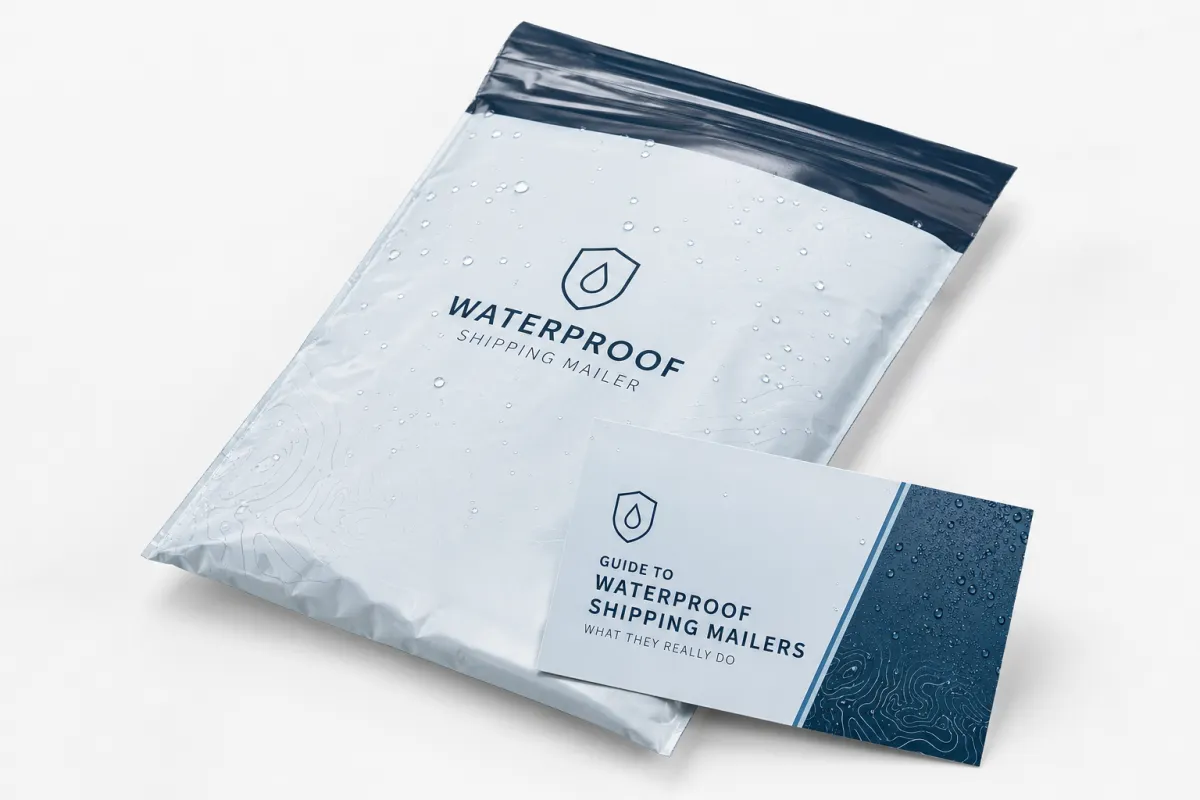
Guide to Waterproof Shipping Mailers: What They Really Do
A reality check before the spec sheet
Most moisture damage does not come from a package being dunked in a river. It comes from wet loading docks, spray from trailers, drizzle during last-mile drop-off, condensation on long lanes, and human error like a half-sealed flap moving through sortation. A guide to waterproof shipping mailers matters because these smaller failures happen every week and quietly chip away at margin.
If you are used to ordinary poly mailers, the terminology can be kinda misleading. People hear “waterproof” and assume it means the same thing as “water-resistant.” It does not. Water-resistant material pushes back against light splashes for a short time; waterproof construction is designed to reduce moisture ingress more aggressively under the handling conditions you actually see. For low-risk document runs, water-resistant may be enough. For premium apparel, cosmetics, or electronics with exposed finishes, that shortcut can get expensive fast.
What it does—and what it does not do
A guide to waterproof shipping mailers does not promise survival after a day underwater. It does not replace a proper container for severe exposure. What it does protect against are the transit threats that show up in normal logistics: spray, brief wet contact, handling moisture, humidity swings, and condensation.
If your route sees repeated weather exposure, port-to-port transfer, or storage outside the warehouse, that protection can be the difference between a clean delivery record and a claim spike. For apparel, moisture can create odor transfer, staining, and label smearing. For documents and manuals, dampness means warped paper and unreadable print. For supplements and spices, a wet package can become a compliance headache. For small goods, corrosion and fogging are the quiet problems nobody notices until returns start stacking up.
Why expectations matter more than marketing language
Most suppliers talk in broad claims. Buyers need sharper questions. Where is the parcel traveling? How long is it sitting? What kind of handling does it get? How much moisture risk can the business actually tolerate? If the answer to that last question is “none,” buy above baseline performance. If the answer is “some, but not catastrophic,” a mid-spec option may be the sweet spot.
That split matters because the hidden costs are rarely in the package alone. In one 5,000-unit run, even a 1% moisture failure rate at a $35 replacement cost creates $1,750 in direct product loss before support time, credits, and reputation damage are counted. I have seen teams focus so hard on the sheet price that they miss the larger arithmetic. A smart guide to waterproof shipping mailers keeps the route, the product, and the claim profile in the same frame.
How do you choose the right waterproof shipping mailer?
The short answer is to match the mailer to route stress, moisture exposure, and product sensitivity. A useful guide to waterproof shipping mailers starts with a barrier film that blocks spray and condensation, a closure that stays shut under pressure, and a size that fits the SKU without stretching the seams. If the route includes wet docks, coastal humidity, or long cross-dock cycles, move up a material grade. If it is short, dry, and controlled, a lighter build may be enough.
That rule sounds simple because it is. The hard part is resisting the urge to buy for appearance alone. A mailer can look premium in a sample photo and still fail if the seam geometry is weak, the adhesive is brittle, or the film has poor puncture resistance. The right choice is the one that survives your actual lane, not the one that wins a tabletop demo.
One practical shortcut: compare the worst route first, not the average route. If your team is gonna ship through a rainy season, a coastal hub, or a long international line, test for that stress up front. Average conditions can hide a bad spec. Worst-case conditions usually do not.
How Waterproof Shipping Mailers Work in Transit
Barrier layers, seams, and the invisible weak line
At the center of any guide to waterproof shipping mailers is the barrier architecture. Typical constructions pair a film with low water-vapor transmission and stable sealing behavior. Cheaper single-layer materials can work for light protection, but they often lose performance at corners and folds. That is where many failures show up first.
The seam is the first detail to inspect. Weak alignment, poor overlap, or bad temperature control during sealing lets moisture enter from the sides even when the body of the mailer looks fine. Better mailers use controlled seam design with defined heat dwell times and pressure so the film bonds without microchannels. A weak seam beats a good film every time, and not in a useful way.
Closure systems under pressure
Three closure families dominate ecommerce shipping: heat seals, pressure-sensitive adhesives, and fold-over closures. Heat seals can perform very well when equipment and operator settings stay consistent. For high-speed production, they are often the cheapest per unit and the cleanest in appearance. Their downside is unforgiving: too much heat can delaminate the film, too little leaves tiny openings, and a wrinkle can become a leak path once the parcel gets compressed.
Pressure-sensitive adhesive closures feel easy for manual packing stations because you do not need heat equipment, but they can peel under vibration and temperature swings. Winter transport, warehouse heat, and dockside temperature changes can soften weak adhesive formulas or make them brittle. Fold-over closures are simple for fulfillment teams, but they usually depend on a double-snap edge; if the fold geometry is soft and not reinforced, it can creep open during long-haul motion.
If you have never pressure-tested a sample after 24 hours of vibration simulation, you are planning by belief, not by data.
Weak points your team should test first
Moisture almost never enters through the center panel. It enters through corners, seams, flap edges, and puncture points. Corners take repeated bending stress; seams carry edge stress; flap edges are vulnerable to adhesive creep; punctures from staples, zip ties, and hand tools get ignored far too often. In practical terms, a guide to waterproof shipping mailers without corner reinforcement is mostly a glossy promise unless the load is soft and low-friction.
In humid routes, water vapor can migrate if a package sits for 10 or more hours in uncontrolled storage. In cold routes, condensation can form and then move once the material warms up. In long lanes, especially with cross-dock handling, parcels get compressed over and over. A 2-inch stack compression over an afternoon can force microscopic openings at fold lines. Stronger film and a more reliable closure usually beat decorative finishing, and that is not me being picky; that is what the failure reports say.
Shipping environment drives failure rates
In dry, short urban routes with stable warehouse handoff, a standard reinforced poly mailer can pass. Add 2,000 miles and coastal humidity, and that same style becomes a gamble. Cross-dock handling adds directional changes and pallet side impacts. Add ecommerce pressure, where people pack fast and move fast, and seams and seals become less forgiving.
That is why this guide to waterproof shipping mailers works best when paired with route profiling. If your parcels travel through humid ports, choose stronger puncture and seam strategies. If your flow includes locker drop-offs and bike couriers, moisture exposure may be lower, but repeated flexing is common. Different environments destroy different parts of the mailer. Knowing which part is under stress is the whole trick.
You can find test framework references at ISTA for shipping simulation methods and Packaging Professionals resources for broader Packaging Best Practices.
Key Factors That Decide Performance and Durability
Material choice: polyethylene, co-extruded, laminated
Material selection is where many teams overpay for the wrong feature. A guide to waterproof shipping mailers is often less about the name of the bag and more about the right stack for the content. Standard polyethylene is familiar, inexpensive, and easy to print. It is usually adequate for light loads and moderate risk if thickness is controlled.
Co-extruded film gives you distinct layers: a tougher outer surface, a functional barrier middle, and a printable face. That improves puncture resistance and seal consistency at a similar weight. Laminated constructions, whether film plus paper plus film or a multi-skin structure, deliver the strongest package-protection feel and a nicer unboxing impression, though they can add stiffness and sometimes reduce recyclability depending on the adhesive layer stack.
What should you choose? For apparel and soft goods, co-extruded at 3.5 to 4.5 mil is often a practical baseline. For heavier or sharper SKUs, move toward 5 to 6.5 mil. For very light inserts or documentation sets, 2.5 to 3.0 mil can work, but only if closure and fold design are tuned. Anything thinner than that starts to get delicate pretty quickly.
Durability signals buyers check before buying
Thickness alone is not proof of success, but it is the first number most teams check. You also need tear resistance, puncture resistance, and stretch recovery. Tear resistance tells you whether a package survives one snag; puncture resistance handles the second snag; stretch recovery shows how it behaves after compression and heat cycles. If your fulfillment team tosses bundles during staging, stretch recovery matters more than a glossy finish.
Opacity also matters, both for appearance and for theft risk. If your brand relies on clear branding, use selective windows sparingly; too much transparent area can reduce the premium feel and may interfere with print consistency if the ink chemistry is not matched to the film. This guide to waterproof shipping mailers is blunt on that point: do not choose a spec that looks attractive in mockups and falls apart under real handling.
Print, branding, and actual waterproof behavior
Print coverage affects both cost and function. Full-color artwork often requires a heavier ink load and sometimes changes heat behavior at the seal zone. Matte laminates can hold stress and make peel seals less consistent than a clean glossy skin. If the printed face is part of your brand story, you can still do it, but ask for samples with the final artwork, final coverage, and final seal settings.
For low-volume pilots, spot varnish and two-color options often perform better because they keep film behavior steadier. For larger runs, one-color full coverage may be cheaper and easier to verify on production lines, which lowers rejections. The goal is not aesthetic perfection. The goal is predictable shipping reliability for every order, which is a much less glamorous thing to buy and a much better thing to own.
From a packaging-industry standpoint, if the buyer-facing SKU looks premium but claims rise, one of the basics failed. Decoration does not save a weak transit pack-out.
Size, closure, and load fit
Wrong size is the silent killer. A mailer that is too large creates excess air, folds the flap incorrectly, and encourages weak sealing because packing staff struggle to align edges. A mailer that is too small stretches seams and tears under load. Both failures increase dimensional weight penalties and waste budget. On freight-heavy lanes, a mailer with overhang can become a quiet cost multiplier.
A guide to waterproof shipping mailers should include fit testing with your exact SKU dimensions. If you ship variable-weight product, define two envelope sizes and keep only one extra-size ratio in production to reduce fulfillment confusion. Closure quality still matters; if the seam and closure are reliable but the fit is wrong, the effort still fails.
Ask whether the supplier can share a closure reliability data point and whether they allow small adjustments to gusset width and seal height without full retooling. In real ecommerce shipping, that flexibility saves headaches when return volume shifts or a new SKU enters the line.
Waterproof Shipping Mailers Cost and Pricing
How to read realistic unit prices
Pricing is where buyers get burned hardest. I see teams pay less per unit on paper, then pay more in freight and reshipments. A guide to waterproof shipping mailers is useless if it ignores that arithmetic. Typical unit ranges, single-color and without special upgrades, often sit around $0.65-$1.15 for 500 pieces, $0.42-$0.85 for 2,000 pieces, and $0.30-$0.60 for 10,000 pieces. Those are ranges, not promises. Add complexity and the numbers move quickly.
Complexity adders include higher film thickness, co-extrusion, custom adhesives, tamper indicators, reinforced seams, and premium print coverage. Every added feature increases scrap risk in production and often raises per-unit costs at low volume. Setup fees usually add another $150-$300 for custom files and die adjustments, and samples can add $40-$150 depending on the type. For pilots, include those costs in the budget from the start instead of labeling them “extra if needed.”
Tradeoff: cheap vs fewer claims
This is the simple but brutal reality: a cheaper mailer that fails is not cheap. Suppose you buy 5,000 units at $0.45 each; the total is $2,250. If 2% fail because of moisture and the replacement cost is $9 plus fulfillment and shipping, the loss lands around $300 per 100 failures, or roughly $3,000 to $5,000 on a run that was supposed to be economical. A stronger option at $0.62 each on 5,000 units adds $850 upfront; that can still save money overall.
So in a guide to waterproof shipping mailers decision, compare unit price + risk-adjusted cost. Keep a simple score: expected damage claims, return logistics, and refund pressure. If your category is highly return-sensitive, do not chase the lowest print sheet alone. That habit looks disciplined in procurement and messy in operations.
| Option | Typical Spec Profile | 5,000 Unit Price (USD) | 10,000 Unit Price (USD) | Best Use Case |
|---|---|---|---|---|
| Standard Water-Resistant Poly Mailer | Single-layer PE, basic heat seal, light coating | $0.45–$0.70 | $0.30–$0.55 | Low-risk domestic, lightweight documents |
| Water-Protective Co-Extruded Mailer | 3.5–5.0 mil, reinforced seam, upgraded adhesive | $0.58–$0.95 | $0.42–$0.75 | Apparel, accessories, most ecommerce shipping |
| Heavy-Duty Laminate Mailer | Multi-layer film-laminate, puncture reinforcement, premium closure | $0.80–$1.35 | $0.60–$1.00 | Supplements, sharp or high-friction SKUs, long-haul routes |
Budgeting framework that actually works
The most reliable framework has five buckets:
- Per-unit cost: based on volume breakpoints.
- Freight: shipping method and dimensional weight effects.
- Setup and sampling: files, proofs, and approvals.
- Warehouse handling cost: rejects, rework, and delay labor.
- Replacement risk: expected damages by route and season.
Build a scorecard for each option. A guide to waterproof shipping mailers only matters if it helps your team defend a purchase in a pricing meeting without hand-waving.
If sustainability is part of your spec, ask for film-structure details early. Some structures are easier to recycle than others. If your policy tracks chain-of-custody, ask about FSC-related documentation for paper-backed builds when available, and do not assume mixed-material mailers are accepted everywhere. Local recycling rules can be a pain, so verify them before you commit to volume.
Step-by-Step Process and Timeline for Choosing the Right Mailer
Step 1: Define what you are shipping and the risk profile
Start with the product map, not the marketing mood board. Pull the top 10 SKUs by volume, weight, shape, and route. If one SKU has a fragile label and another has foam inserts, they do not belong in the same spec bucket. A guide to waterproof shipping mailers begins with classifying items into low, medium, and high moisture-risk groups.
Step 2: Define route and weather stress
Use actual history: zip code mix, climate zones, and transfer nodes. Domestic and international lanes differ. A coastal route with long cross-dock cycles is not the same as same-day metro drops. For high-risk lanes, select thicker film and better seams.
Step 3: Create a short shortlist and test samples
Limit your shortlist to two or three constructions so teams can compare clearly. Ask for samples at final artwork conditions. If your brand depends on color accuracy, request at least one sample with full print and one with no print. Do not let the supplier sell you a prototype that looks good but does not match the final process if your route is weather-variable. A guide to waterproof shipping mailers without samples is a guess dressed up as procurement.
Step 4: Run a small test grid
Put the test through real motion and moisture cycles: drop, shake, compression, and a wet-handling drill. If the product sees cross-dock handling, include repeated bending and stack pressure. A checklist keeps bias out of the decision:
- Seal opening force (can you peel with moderate force? if yes, too weak)
- Edge separation after compression (no fraying or opening)
- Puncture response near corners and gussets
- Print adhesion and ink integrity after heat and moisture
- Fit check for airflow, movement, and dimensional stability
Step 5: Approval, production, and shipping
Typical timeline, if nothing blocks it: sample review 3–5 business days, artwork approval 1–2 days, production 7–12 business days, freight 2–8 business days. That is for straightforward domestic work. International orders often add 4 to 12 more days.
Delays usually come from color-matching revisions, wrong dimension labels, and waiting for final legal compliance proof on symbols or barcodes. In one procurement cycle I reviewed, the same two delays repeated: late final art and nobody testing closure consistency before bulk sign-off. That pattern is common enough to be boring, which is exactly why it keeps costing money.
Step 6: Do a pilot before full commitment
For high-risk shipments, run a 100 to 300 unit pilot before launching 1,000+. Even if your warehouse handles 10,000 units a week, the pilot still earns its keep. You are buying confidence. If pilot wet-handling claims are low, scale gradually. If failures show up, adjust immediately rather than discovering them at quarter end.
Use this structure to keep your decisions grounded. You are not guessing; you are iterating. Your internal team should track: proof acceptance → sample approval → pilot performance → scale decision. Simple, repeatable, hard to fake.
If you want to compare options in a broader supplier view, start from Custom Packaging Products, then narrow by film profile in Custom Poly Mailers. If something still looks off, validate whether a Custom Shipping Boxes upgrade is cheaper overall than forcing everything into one mailer format.
Common Mistakes That Undermine Waterproof Protection
Mistake 1: Overstuffing
Overstuffing kills performance faster than a bad batch. It stretches seals, creates stress at corners, and increases internal movement. Even premium films fail early when operators force too much inside. If you see edges bulging and flap strain, the package is already in failure mode. The mailer does not need a hole to fail; it only needs pressure points to creep open.
Mistake 2: Wrong size and wrong ratio
Wrong sizing is not a minor aesthetic issue. Too much free space creates sloppy folds and weak closure pressure, which leaks under vibration. Too little space creates sharp folds that tear with repeated handling. Both conditions can increase dimensional weight and drive up freight because poor packing density means larger billed dimensions for the same SKU.
Mistake 3: Assuming all plastic mailers are equivalent
Same look, different build. This is probably the most common error in order fulfillment teams. People see gloss and white color and assume water performance is identical across suppliers. It is not. Film type, seal chemistry, and seam architecture matter. In a guide to waterproof shipping mailers, you should ask for a simple matrix: base film, thickness, closure, seam style, test result, and expected transit environment.
Mistake 4: Weak closure pressure and sloppy operations
A high-spec mailer can be ruined by a low-pressure sealing station. If operator pressure is uneven, one batch will hold and the next will fail. Add quick operator checks every 100 units at minimum. It is not glamorous, but it prevents the kind of hidden claim spike that later gets dismissed as “bad luck.”
Mistake 5: Skipping transit testing
You cannot approve against static visuals alone. Moisture is a kinetic problem. If your team never does motion and load simulation, you are certifying to a brochure, not to reality. Test after packing, after pallet staging, and after handling transfer, then retest after a short humidity dwell. If the mailer survives all three, you are close to realistic confidence.
Why teams repeat this cycle
Because teams are under pressure to move fast. Because the failure symptom shows up one quarter later, after the supplier has already moved on. You do not need a giant team or expensive software. You need process discipline. In practical terms, the guide to waterproof shipping mailers is to standardize three gates: incoming fit, closure quality, and moisture exposure test.
Expert Tips and Next Steps for Smarter Ordering
Use tests that mimic your route
Stop relying on paper specs alone. Ask for test plans that match how parcels are actually used. If parcels bounce in a sorter, bounce. If they sit in humid parking lots, include humidity dwell. If they are packed with foam, include it in the test stack. A guide to waterproof shipping mailers with that level of rigor saves expensive firefighting later.
Supplier checklist from a buyer’s perspective
- Can they provide clear specs for film type, thickness, and seal method?
- Do they share sample lead time under one week for small runs?
- Is MOQ realistic for your launch volume and test cycle?
- Do they allow adjustments to length and closure width without full re-pricing penalties?
- Can they confirm freight impact for each spec and lane?
Build by route, not by unit cost
You may discover that a more expensive option saves money once you account for failures and reships. That point feels obvious until it appears in a weekly report: 800 wet claims each quarter can erase margin on the cheapest mailer option. Match mailer profile to route stress and product class, then compare actual claims after 30 days.
Three simple starter actions for next week
Do this now:
- Audit your current shipments by moisture-risk category and lane.
- Request two or three samples from shortlisted suppliers.
- Run a wet-handling test with your heaviest SKU and your most common route profile.
From a packaging buyer's point of view, the only unhelpful move is waiting until the first failure report hits your inbox. Run this process, then place a pilot order only when test results show clear closure and seam performance.
If this guide to waterproof shipping mailers gives your team one practical habit, let it be this: write the route down before you write the purchase order. Packaging gets judged in transit, not in the sample room.
Conclusion: A Practical Guide to Waterproof Shipping Mailers
Let us be blunt: a guide to waterproof shipping mailers is not a shopping list. It is an operating decision. You are balancing film structure, sealing method, closure quality, route stress, and cost. That balance is what keeps packages dry and customers calm.
Start with risk, then budget backwards. Build your choice around what you ship, where it travels, and how it will be handled. If your team handles high volume across varied climates, a mid-to-high spec with stable seams is usually the least painful option. If your volume is low and risk is low, avoid overengineering. If risk is high, overengineering is cheaper than repeat claims.
Use the numbers. Use the test data. Use the checklist. Keep one mindset: a guide to waterproof shipping mailers works only when your team confirms performance before scaling. The right answer is rarely the cheapest bid; it is usually the lowest total cost of ownership with no surprises in transit. That is how shipping materials earn their place in real ecommerce operations.
The clearest takeaway is simple: map your top routes, compare two or three samples under real handling stress, and do a small pilot before you buy at scale. If the seam fails, if the closure creeps, or if moisture shows up in the test grid, adjust the spec before production starts.
FAQ
Are waterproof shipping mailers better than standard poly mailers?
They are better when moisture risk matters, especially for apparel, paper goods, supplements, and products that cannot arrive damp. Standard poly mailers are fine for low-risk domestic shipping with minimal weather exposure, but they are not equal to a truly waterproof build in a guide to waterproof shipping mailers context. Choose based on route, handling conditions, and the cost of a wet-package failure.
How thick should a waterproof shipping mailer be?
There is no magic number, but thicker film usually improves puncture resistance and gives seals more stability. For light apparel and small folded goods, a mid-range thickness often works. For heavier or sharper items, step up the film spec. The right thickness depends on weight, product shape, and route abuse, not just price per square foot.
How do I know if a waterproof shipping mailer is actually sealed?
Check the closure type, seam construction, and whether the seal holds under compression and movement. A proper sample test should include shaking, compression, and a controlled moisture exposure check before you approve a bulk order. If water can creep through flap edges or seam lines, the mailer is not truly protecting the product in this guide to waterproof shipping mailers implementation.
What do waterproof shipping mailers cost in bulk?
Bulk pricing usually drops with volume, but final price depends on thickness, print coverage, and closure upgrades. Typical economics move from roughly $0.65-$1.15 at 500 pieces to much lower in higher brackets, but the cheapest option can still be the most expensive after replacements. In a guide to waterproof shipping mailers strategy, prioritize expected total landed cost, not just unit price.
Can waterproof shipping mailers be recycled or reused?
Some can be reused if they remain intact and the seal system stays effective, but this depends on material and adhesive type. Recyclability also depends on the local collection system and whether a specific film structure is accepted. For sustainability tracking, request exact film composition and confirm disposal guidance with your supplier before buying in volume.

