Buyer Fit Snapshot
| Best fit | sustainable packaging practices for brands for packaging buyers comparing material specs, print proof, MOQ, unit cost, freight, and repeat-order risk where brand print, material, artwork control, and repeat-order consistency matter. |
|---|---|
| Quote inputs | Share finished size, material target, print colors, finish, packing count, annual reorder estimate, and delivery region. |
| Proofing check | Approve dieline scale, logo placement, barcode or warning zones, color tolerance, and any recyclable or compostable wording before bulk production. |
| Main risk | Vague material claims, crowded artwork, or missing packing details can create delays even when the unit price looks attractive. |
Fast answer: Sustainable Packaging Practices for Brands: Claims, Protection, MOQ, and Cost should be specified like a repeatable production item. The safest quote includes material, print method, finish, artwork proof, carton packing, and reorder notes in one written spec.
What to confirm before approving the packaging proof
Check the product dimensions against the actual filled item, not only the sales mockup. Ask for tolerance on folds, seals, hang holes, label areas, and retail display edges. If the package carries a logo, QR code, warning copy, or legal claim, reserve that space before decorative graphics fill the panel.
How to compare quotes without losing quality
Compare board or film grade, print process, finish, sampling route, tooling charges, carton quantity, and freight assumptions side by side. A lower quote is only useful if the supplier can repeat the same color, closure quality, and packing count on the next order.
Sustainable Packaging Best Practices Guide for Brands
I still remember a carton redesign that shaved $0.03 per unit off the bill and removed an entire layer of void fill across a 12,000-unit run in Dongguan, Guangdong. On paper, that sounds tiny. In the warehouse, it meant fewer damaged goods, less trash, and a noticeably calmer call with the finance team in Chicago. That is why this sustainable Packaging Best Practices guide starts with the dull stuff, because the dull stuff is usually where waste, freight costs, and fixable mistakes hide. I have watched brands spend $4,800 on a recycled-content label while missing a bigger savings opportunity sitting inside the carton structure itself. A proper life cycle assessment usually points to the same thing: the hidden waste is often structural, not decorative.
If you are buying branded packaging or redesigning product packaging for retail or e-commerce, the goal is not to make the box look eco-friendly for a campaign photo and call it done. Honestly, that kind of theater is one of the fastest ways to waste money. The real goal is to use less material, protect the product, print clearly, ship at the right weight, and make end-of-life disposal realistic in places like Toronto, Berlin, and Sydney. That matters in supplier calls, factory visits, and the occasional tense meeting where everyone nods at a bad idea because nobody wants to be the first person to say, "This is not working." A box that cannot be recovered in practice is not sustainable. It is a very expensive costume. A strong sustainable packaging best practices guide also keeps one eye on recycled content, FSC certification, and dimensional weight, because those three variables can change the business case faster than a new mockup can.
For custom logo packaging projects, I would keep the approach practical. If you need starting points for Custom Packaging Products, use those specs to compare board grades, print methods, and insert options before you ask for quotes from suppliers in Shenzhen, Ho Chi Minh City, or Mexico City. This sustainable packaging best practices guide is built around production realities, not presentation-deck language. It is also built around source reduction, mono-material packaging where it makes sense, and disposal paths that ordinary customers can actually follow.
Sustainable Packaging Best Practices Guide: What Actually Makes Packaging Sustainable?
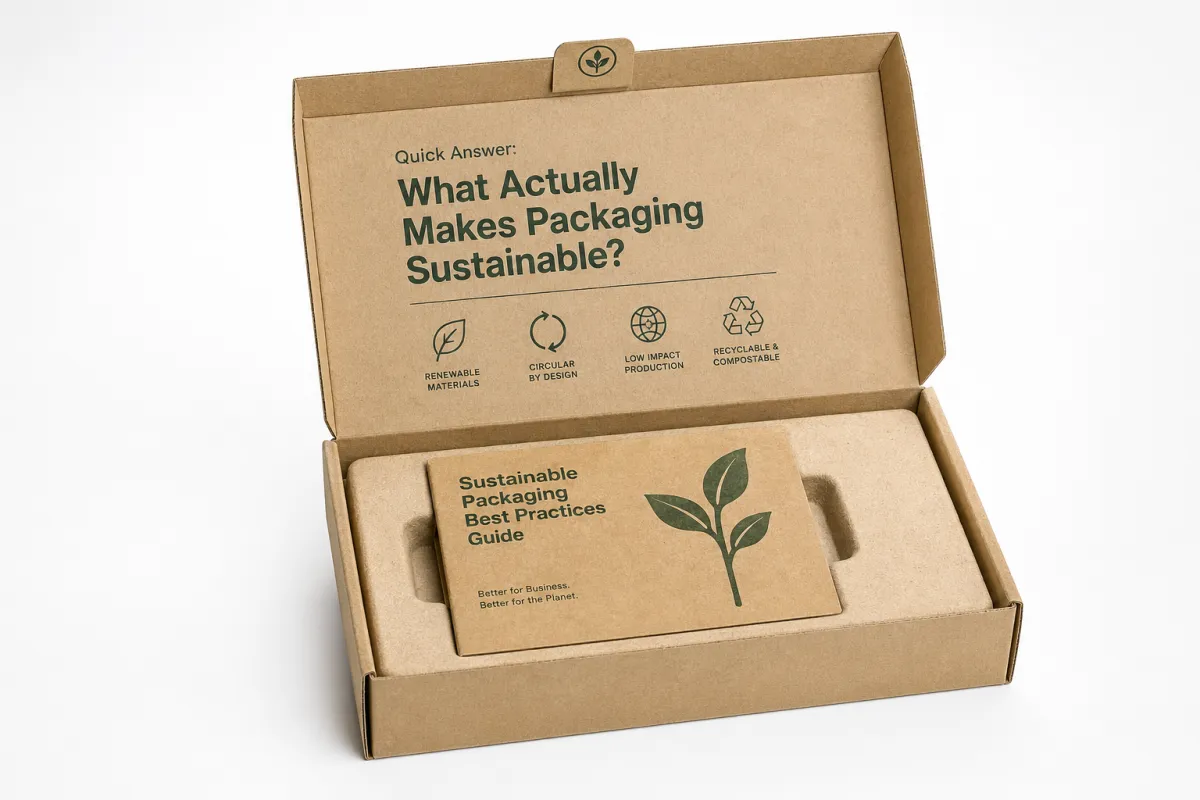
The short version is simple: packaging becomes sustainable when the full system uses less and wastes less. Material choice matters. Structure matters. Fill efficiency, shipping weight, print finish, and disposal path matter too. A carton made from 100% recycled content can still be a poor choice if it ships inside a box that is too large, hides a plastic window, and needs three extra inserts just to stop the product from rattling around like loose change in a dryer. A useful sustainable packaging best practices guide treats sustainability as a system, not a label.
The best sustainable packaging best practices guide starts with one question: how much packaging do you truly need to protect the product? I have stood on a corrugator floor in southern China, near Shenzhen, while an operator pointed at a brand's sample and said, with the kind of blunt honesty only a factory floor seems to produce, "You can save $0.03 a box if you stop overbuilding it." He was right. The brand was paying for visual complexity, not performance. That kind of spending looks clever in a sample room and wasteful in a pallet report, especially when a 10,000-unit order lands with $300 of avoidable carton bloat attached. In practice, source reduction is often the first real sustainability win.
Most eco-packaging fails for the same reasons. Mixed materials get glued together and cannot be separated. Heavy ink coverage buries the fiber story. Inserts get added because someone wants a premium unboxing moment, even though the product does not need one. A sustainable packaging best practices guide should challenge those habits, not celebrate them. Recyclability, source reduction, and verified supplier claims beat vague green language every time, especially when the spec sheet says 350gsm C1S artboard but the sample arrives laminated like a brochure from 2008. The same logic applies to mono-material packaging: fewer layers usually mean fewer disposal problems.
When I review packaging design, I look at four things first: source reduction, recycled content, verified recyclability, and real-world disposal. The Sustainable Packaging Coalition at packaging.org has useful reference material on fiber-based systems, and the EPA's recycling guidance helps when a team needs plain English instead of marketing jargon. That is the lens I use in this sustainable packaging best practices guide, whether the pack is a $0.18 folding carton or a $1.42 molded-fiber gift set. If you want one extra filter, add life cycle assessment to the list; it keeps the conversation focused on impact instead of optics.
"If the customer has to peel, separate, soak, or guess, the pack is already failing." A converter in Qingdao said that after a bad run of mixed-material retail packaging, and the line stuck because it was accurate down to the millimeter.
One more fact from the factory floor: sustainability does not excuse bad pack-out. If a design saves 8 grams of board but doubles transit damage, the carbon math gets ugly fast. A serious sustainable packaging best practices guide should talk about breakage, return rates, and dimensional weight, because the customer does not care that the carton was noble if the serum arrives shattered after a 620-mile ground route. They care that their order arrived intact, which is a much less glamorous metric and a much better one.
Top Sustainable Packaging Options Compared
The practical shortlist starts with corrugated board, kraft paper, recycled paperboard, molded fiber, mono-material plastics, and compostable options. Each one has a job. The mistake is treating them like interchangeable parts. They are not. I have seen brands choose the wrong material because a salesperson repeated the word "eco" until it sounded like evidence, which is not how materials engineering works, no matter how polished the slide deck looks or how many times the sample arrives wrapped in tissue. A credible sustainable packaging best practices guide treats the material choice like a logistics decision, not a mood board.
This part of the sustainable packaging best practices guide matters because the best material depends on what the package has to do. Shipping strength, premium print quality, food-contact safety, moisture handling, and shelf appeal all pull in different directions. The table below is how I compare options when a buyer hands me a SKU, a target price, and a launch date that is already uncomfortably close, like a six-week timetable for a job that really needs eight.
| Material | Best Use | Typical Unit Cost | Main Strength | Main Risk |
|---|---|---|---|---|
| Corrugated board | E-commerce shippers, mailers, protective outer boxes | $0.22-$0.65 at 5,000 units | Strong, easy to source, widely recyclable | Can look plain unless print and structure are handled well |
| Recycled paperboard | Retail cartons, folding boxes, lightweight product packaging | $0.18-$0.52 at 10,000 units | Good print surface, premium feel, efficient pack-out | Weaker than corrugated if the product is heavy or fragile |
| Kraft paper | Mailers, sleeves, wrap, simple branded packaging | $0.07-$0.20 per component | Natural look, easy to recycle, low visual noise | Can feel cheap if the structure is thin or the ink is muddy |
| Molded fiber | Inserts, trays, protective dunnage, electronics | $0.14-$0.38 per insert | Great protection with low plastic use | Lead times can stretch when tooling is custom |
| Mono-material plastic | Flexible pouches, retail overwrap, moisture-sensitive goods | $0.09-$0.22 per pouch | Lightweight and efficient for shipping | Only works as sustainable packaging when recovery systems exist |
| Compostable options | Specialty food service, local closed-loop programs | $0.14-$0.35 per unit | Can fit a narrow disposal path | Often overpriced and underperforming if local composting does not exist |
Corrugated board is the safest default for many brands. A B-flute shipper or an E-flute mailer can carry real load, print well enough for Custom Printed Boxes, and still stay simple enough for curbside recycling in many markets. If I had to give one starting point to a growing e-commerce brand shipping 3,000 to 20,000 units a month from a facility in Dallas or Nashville, this sustainable packaging best practices guide would begin there. Corrugated also tends to fit the easiest path for recycled content claims and supplier documentation.
Kraft paper has more emotional pull than people admit out loud. It looks honest. It does not need heavy ink coverage to look good. I have seen startups spend less by switching from full-bleed printed sleeves to a kraft wrap with one-color art, then improve package branding because the design felt deliberate instead of overworked. Kraft is not magic, though. Heavy products, oily products, and moisture-sensitive products will expose weak specs quickly. Wrinkling, scuffing, seam failure, all of it shows up fast, especially on a 70gsm wrap used for a 1.4-pound kit. And when kraft fails, it fails in a way that makes everyone stare at the sample table and pretend they are not annoyed.
Molded fiber is where some brands get excited and some get burned. It is excellent for trays, cushioning, and nesting parts, and it can cut plastic use sharply. Tooling still matters. I have quoted molded inserts at 30,000 units where the unit price looked attractive, then watched tooling add another $1,800 and six weeks to the project in a plant near Dongguan. In a sustainable packaging best practices guide, that tradeoff should be visible, not hidden in a footnote or quietly buried in procurement's "miscellaneous" bucket. The upside is real, but only when the timeline and total cost are both on the table.
Compostable materials are where the sales pitch often outruns the infrastructure. I have heard people call PLA "the answer" while standing in a city with no industrial composting facility within 300 miles. That is not an answer. That is a brochure. Compostables only make sense when the disposal system exists, the customer understands it, and the product genuinely needs that route. Otherwise, recycled fiber wins on practicality, and frankly, on common sense, particularly in regions like the Midwest U.S. or inland Australia where collection is inconsistent.
Supplier conversations usually arrive at the same reality: corrugated and recycled paperboard are stocked in volume, molded fiber takes longer, and specialty compostable films get expensive quickly when you need tight tolerances or custom print. A Mondi rep once told me a custom fiber insert needed a 9-week window because the mold queue was already full. A local converter in Ho Chi Minh City quoted 12 business days on recycled board and then shrugged: "We can do speed or we can do custom. Pick one." That is the tradeoff this sustainable packaging best practices guide keeps running into, and it is not a small one.
Detailed Reviews of the Best Eco-Friendly Materials
I do not trust material claims until I have handled the sample, checked the board weight, and watched how it behaves after a rough transit test on a 48-hour route. The Best Sustainable Packaging best practices guide is the one that tells you what the material feels like in hand, how it prints, and where it starts to fail. Fancy names are cheap. Performance is not. I also want to know whether the supplier can support recycled content paperwork without turning the process into a scavenger hunt.
Kraft and recycled paperboard
Kraft and recycled SBS board do most of the heavy lifting. Kraft gives you a natural look with less visual noise, while recycled SBS gives you a cleaner print surface for retail packaging and more detailed artwork. A 350gsm recycled board can look premium with a matte aqueous coating, though it will not forgive sloppy structural design. I have seen brands choose a thicker board to hide bad fit, which is backwards. Fix the size first. Then decide on finish. I know that sounds obvious, but you would be amazed how often it gets skipped because everybody is in a rush to see a mockup from a print house in Los Angeles or a supplier in Jiaxing.
Print behavior matters. Heavy ink coverage on recycled paperboard can dull colors, and soft-touch lamination can hurt recyclability in some recovery streams. If your design uses foil, spot UV, or metallic effects, ask whether those finishes are truly necessary or merely decorative. This sustainable packaging best practices guide favors aqueous coating, soy inks, and restraint because they are easier to live with in production and easier to process at end of life, especially when the carton is only 90 x 60 x 25 mm and every layer of finish changes the feel.
Corrugated board
Corrugated is the material I reach for when protection matters more than shelf theater. A properly specified ECT-rated corrugated box can handle shipping abuse with far less drama than a flimsy paperboard structure. For transit-heavy product packaging, that matters more than a loud design. I have tested 32 ECT and 44 ECT board on the same route; the lighter option saved material, while the heavier spec reduced corner crush and cut returns. That belongs in any serious sustainable packaging best practices guide, especially when the order value is $38 and the return freight can eat a third of the margin.
Corrugated also gives you room to simplify. Right-sizing a carton from 12 x 10 x 4 inches to 10 x 8 x 3 inches can drop board usage by roughly a third and reduce dimensional weight charges, which is the kind of boring arithmetic that saves actual money. One skincare client removed a plastic air pillow and a glued insert, then saved $0.03 on board and another $0.21 on shipping per parcel. That is not branding. That is competence. It is the sort of result that makes a designer grumble for ten seconds and then quietly admit the numbers are better, especially after seeing the invoice from a carrier like UPS or DHL.
"We thought the insert was helping the unboxing. It was really just helping our waste bin." A retail client said that after we switched to a single-piece corrugated cradle made in Ontario.
Molded pulp and fiber
Molded pulp is a strong option for inserts, trays, and protected product sets. It handles pressure well, nests efficiently, and often reduces the amount of plastic foam a package needs. The texture feels honest, which a lot of brands like for package branding. The catch is that custom tooling can add weeks, and surface detail is limited compared with board print. If you need crisp corner graphics or a 0.5 mm registration margin, molded pulp is not the place to chase it.
Do not pretend molded fiber works for every product. It can pick up moisture, and some formulations dust more than buyers expect. I have had samples arrive with a nice story and a gritty surface nobody wanted to touch twice. If the item ships in humid conditions or sits in a warehouse near a loading dock in Savannah, Singapore, or Manila, test it for warping, not just appearance. This sustainable packaging best practices guide exists for those unglamorous moments, because that is where the bad surprises live.
Mono-material and plant-based alternatives
Mono-material plastics can be the right answer for pouches and moisture-sensitive SKUs when the recovery path is clear. The key word is "mono." Mixed films are the enemy of simple recycling. If the structure uses one resin, the package has a better chance of entering an established recycling stream. If it is a layered stack of incompatible films, the eco claim weakens quickly. Plant-based films and PLA-based packs need even more scrutiny because local infrastructure varies wildly, and a pack that works in Amsterdam may fail in Atlanta.
I have sat in supplier meetings where a rep tried to sell compostable pouches for a snack brand shipping into regions with no compost pickup. The conversation ended fast. The brand did not need a warmer story. It needed a package customers could dispose of without guesswork. This sustainable packaging best practices guide is blunt on purpose: if the end-of-life path is fictional, the environmental claim is weak, and the shipping carton still has to do the real work in 14 to 18 business days.
Finishes and print choices
Finishes can help or hurt sustainability. Aqueous coating is usually the cleanest default. Soy and vegetable-based inks can reduce some solvent concerns. Add foil, plastic lamination, or heavy spot varnish, and the package may become harder to recover. I watched a premium cosmetics carton lose its recycling-friendly story the moment a designer insisted on full soft-touch wrap plus metallic foil. It looked expensive. It also became a headache for the recycling stream. Everyone loved the render. Nobody loved the actual waste stream, especially when the printed sample cost $1.10 at 2,000 units.
If you want a lower-impact finish, start with light coverage, a single accent color, and a well-chosen board grade. Good structure does more for premium feel than a pile of embellishments. That is one of the main lessons in any honest sustainable packaging best practices guide: restraint often looks more expensive than decoration because the structure finally has room to breathe, and the carton can be built on 350gsm C1S artboard or 24pt recycled SBS without masking mistakes.
Sustainable Packaging Best Practices Guide: Cost Comparison
Unit price is where bad decisions start. Total landed cost is where better ones begin. A box that costs $0.19 instead of $0.16 may look expensive until shipping, breakage, storage, and labor are counted. I have seen brands fixate on a penny difference while paying $14,000 a quarter in avoidable damage. That is not frugal. That is expensive denial dressed up as thrift. A solid sustainable packaging best practices guide has to bring dimensional weight, pack-out time, and waste disposal into the same conversation.
A useful sustainable packaging best practices guide compares raw material, tooling, print complexity, freight, and waste together. The cheapest option on paper is often the one with the worst fit or the highest return rate. In one client project, a slightly thicker recycled board added $0.04 per unit but cut damage from 3.8% to 1.1%. On 25,000 units, the math was obvious. The "cheap" box was costing the brand more than the upgraded one, especially after returns in Texas and Florida started to stack up.
| Setup | Best For | Typical Unit Cost | Production Notes | Cost Trap to Watch |
|---|---|---|---|---|
| Budget recycled corrugated shipper | Shipping boxes, mailers, subscription programs | $0.22-$0.48 | Fast to source, good for standard prints | Oversized dimensions can erase the savings in freight |
| Mid-tier recycled paperboard carton | Retail packaging, beauty, accessories | $0.34-$0.78 | Strong print quality and shelf appeal | Lamination or foil can bump both cost and recyclability risk |
| Premium molded fiber system | Protected kits, electronics, high-touch unboxing | $0.65-$1.85 | Great protection, custom tooling required | Tooling and lead time can surprise first-time buyers |
| Compostable specialty pack | Specific food or service models | $0.55-$1.20 | Useful only when disposal path is real | The infrastructure may not exist where you sell |
The hardest cost lesson I learned came from a supplier negotiation in Shenzhen. A buyer wanted a "green" upgrade, but the vendor quoted a recycled board that was $0.05 higher and a molded insert that added 11 days. The buyer wanted both. I told them to choose one lever, not five. We ended up switching to a right-sized corrugated shipper with a single paper insert and saved roughly $0.27 per parcel in dimensional weight alone. That is the kind of decision a real sustainable packaging best practices guide should encourage, especially when the cartons ship 4,500 miles and every cubic inch starts to matter.
Budget, mid-tier, and premium are useful labels, but the real question is whether the pack pays for itself in lower waste and fewer complaints. A recycled kraft mailer can be excellent at $0.18 if the product is light and stable. A premium folding carton at $0.72 can also be smart if it protects a $120 item and improves shelf conversion. The mistake is buying premium aesthetics for a low-margin SKU and then acting surprised when the margin disappears. I see that mistake all the time, and it always feels a little like watching someone pay extra for a larger plate just to spill the same food.
If you want a clean benchmark, the lowest total cost usually belongs to the package with the least material waste and the easiest pack-out. That is why I keep pushing brands back to simple structures and Custom Packaging Products that fit the product rather than the imagination. This sustainable packaging best practices guide is not anti-design. It is anti-waste, and the difference shows up in a 20,000-unit run faster than anyone wants to admit.
Process and Timeline: From Dieline to Delivery
Good packaging does not appear by magic. It moves through a sequence: brief, material selection, structural design, dieline approval, sampling, testing, prepress, production, and freight. Skip one step and the bill shows up later. I have watched a client skip sample approval to save three days, then lose two weeks because the insert sat 4 mm too high and crushed the cap on the first production run. Nothing humbles a project team faster than a pallet of slightly wrong boxes from a plant in Tianjin or Da Nang.
Here is the honest timeline I give buyers in a sustainable packaging best practices guide: brief and dimensions take 1-3 days if the data is ready, structural design takes 2-5 days, samples take 5-12 business days depending on material, and print proof approval usually adds another 1-3 days if the artwork is clean. Production can take 10-20 business days for standard recycled board and longer for specialty fiber or custom coatings. Freight is its own problem, and ocean transit from Vietnam to the U.S. West Coast can take 18-24 days before customs adds another 2-4 days.
Sustainability choices affect lead time more than people expect. FSC paper may be easy to source, but a niche recycled grade or a custom molded pulp insert can add queue time. Certification paperwork slows things down too if the supplier is sloppy. Ask for documentation early, not after the design is locked. If a vendor cannot send FSC or recycled-content proof in plain English, your schedule is already at risk. For transit testing, I still point teams to the ISTA standards at ista.org because shipping claims without actual test data age badly, especially after a 1.8-meter drop test proves everyone was optimistic. This is also where a practical life cycle assessment can keep the team grounded instead of guessing.
The fastest way to keep the schedule under control is to do the boring work early. Finalize dimensions before art, approve a clean dieline, and test the package with the real product weight instead of a foam dummy that weighs almost nothing. If the pack will face humid warehousing or rough parcel handling, run a drop test and a humidity check. Most "eco" rework comes from rushed approvals, not from the material itself. That is why this sustainable packaging best practices guide keeps returning to the same point: slow down once, or speed through the wrong thing twice.
"Nothing says eco-friendly like overnight shipping and panic packing." I said that to a client who wanted to rush a specialty box with compostable film and a custom insert due in 9 business days, and the silence on the call was entirely deserved.
How to Choose the Right Sustainable Packaging
Start with the product, not the trend. Fragility, shipping distance, shelf impact, and disposal reality should drive the decision. A heavy candle in a subscription box needs a different solution than a lightweight apparel mailer or a premium skincare set on a retail shelf. That is where a sustainable packaging best practices guide earns its place: it keeps you from buying the wrong story for the wrong SKU, whether the ship point is Indianapolis, Rotterdam, or Bangkok.
If the product travels far and gets handled often, prioritize recycled corrugated or reinforced paperboard. If the item sits in retail packaging and needs strong visual impact, recycled SBS with an aqueous finish may be the better fit. If the product needs cushioning, molded fiber deserves a close look. Compostable materials only deserve attention when the local disposal system is real and customers can follow it without a diagram. That is logistics, not idealism, and the answer is usually clear once you map the route from warehouse to household bin.
Compliance matters too. Ask for FSC or SFI proof if wood fiber is involved, check recycled-content percentages, and request food-contact documentation if the package touches food or cosmetics that migrate. For standards, I would rather see a supplier explain ASTM, FSC, and chain-of-custody clearly than throw around vague "green" language. A trustworthy vendor can tell you what the certification covers, what it does not, and how the claim should appear on the box. That clarity belongs in every sustainable packaging best practices guide, along with a date stamp and the signature of the plant manager in case questions come back later.
Some red flags should stop the project immediately. Mixed materials that cannot be separated. Vague claims like "earth-friendly" with no paperwork. Decorative plastic windows on cartons that are otherwise fiber-based. Suppliers who cannot explain what happens after the customer tosses the package. I have walked away from deals where the sample looked beautiful but the disposal story made no sense. The brand would have paid for pretty trash. That is a bad trade, and I have never once regretted saying no to it.
Test three real-world scenarios before sign-off: a drop test, a humid transit test, and a shelf or display test. The drop test shows whether the structure survives abuse. The humid test shows whether the box warps or delaminates. The shelf test tells you whether the brand presentation still works after handling. A sustainable packaging best practices guide that ignores these tests is just a wish list with better typography, and typography does not stop a corner crush.
Our Recommendation: What We Would Buy First
If you asked me what I would buy first for most brands, I would start with recycled corrugated or recycled paperboard, sized correctly, printed lightly, and built with as few parts as possible. For e-commerce, that usually means a right-sized corrugated mailer with one paper insert or none at all. For subscription boxes, I like a recycled folding carton or a well-structured shipper that does not need a second box to feel premium. For protective inserts, molded fiber is often the cleanest upgrade if the budget and lead time allow it, especially for shipments leaving a fulfillment center in Newark or Leeds. That is the core of a practical sustainable packaging best practices guide: start with what works, then refine.
The safest default is boring in the best sense: recycled fiber, minimal coatings, and dimensions that match the product. That combination gives you good printability, wide supplier availability, and a disposal path most customers already understand. I have saved brands money by removing the nonsense first. Decorative foam. Oversized cavities. Hidden plastic sleeves. Those extras usually do less than the sales team thinks and cost more than finance wants to admit, particularly on orders of 8,000 units where every 0.2 seconds of pack-out time starts to matter.
There are cases where premium sustainable upgrades are worth the spend. A luxury fragrance set with a glass bottle and high gift value may justify molded fiber, specialty texture, and a tighter shelf presentation. A food brand with moisture issues may need a mono-material film that protects product quality. Add a compostable insert just to sound virtuous, and I would call that expensive virtue signaling. This sustainable packaging best practices guide sides with useful choices, not performative ones, because useful choices survive the freight bill.
My blunt ranking for value and performance is this: recycled corrugated for shipping, recycled paperboard for retail, molded fiber for inserts, and compostable materials only when the disposal path is proven. If your supplier cannot explain the tradeoffs, go to Custom Packaging Products and compare a simpler spec before you commit. That is the practical takeaway from this sustainable packaging best practices guide, and it holds whether the order is 500 units or 50,000.
Actionable Next Steps for Your Packaging Switch
Start with an audit of your current box sizes and every mixed-material component. Count the plastic windows, foam inserts, laminated sleeves, and oversize air gaps. Then ask one blunt question: what can disappear without hurting the product? In one client review, we removed a printed belly band, trimmed the insert, and saved 18 seconds per pack-out. Labor matters just as much as material, even if people ignore it because labor is harder to photograph, and a 500-parcel day in a New Jersey warehouse makes that painfully obvious.
Request samples from two or three suppliers, not ten. Give them the same one-page spec sheet with dimensions, product weight, print needs, target recycled content, and any claims you want printed. That shuts down the quote game where everyone bids against a different fantasy. A strong sustainable packaging best practices guide always includes a clean spec sheet because vague requests create vague results, and vague results cost real money when the cartons land three weeks late.
Test one product line first. Do not try to convert the entire catalog while the team is still arguing over board grade. Choose a SKU with real volume, real shipping risk, and clear margin data. Run the sample through drop, transit, and shelf checks. If it passes, move forward. If it fails, fix the structure before you reorder 40,000 units and start hoping for the best. Hope is not a production strategy, no matter how many people treat it like one.
Here is the 30-day version I would use: week one, audit and measure; week two, sample and compare; week three, test with actual product; week four, quote and rollout decision. That is enough time to make a smart move without dragging the project into six meetings and a pile of discarded mockups. I have used this with brands that ship 500 units a month and brands that ship 50,000 from facilities in Phoenix and Warsaw. The sequence still holds.
If you want the shortest version of this sustainable packaging best practices guide, it is simple: cut waste first, verify claims second, and buy the structure that protects the product with the fewest parts. Do that, and the packaging gets better, the shipping gets cleaner, and the customer stops paying for fluff. That last part alone is worth the effort.
FAQ
What is the most practical sustainable packaging best practices guide for small brands?
Start with right-sized recyclable corrugated board or paperboard, because it is easy to source, easy to print, and easy for customers to understand. Avoid multi-layer constructions unless the product truly needs them, and request samples before ordering in bulk so you can verify fit, strength, and print quality on a real SKU. A 1,000-unit test run is usually enough to catch structural problems before you spend $7,500 on the full order. For a small brand, that is usually the most useful version of a sustainable packaging best practices guide: simple, measurable, and fast enough to act on.
Is compostable packaging always better than recycled packaging?
No. Compostable packaging only helps when the disposal system exists and your customers actually know how to use it. Recycled paper-based packaging is often the more reliable choice for mainstream brands because the recovery path is familiar and the sourcing is steadier. Choose compostable materials only when the product, local infrastructure, and budget all support it, otherwise you are paying extra for a story that may never reach the right bin, especially in cities without industrial compost pickup within a 25-mile radius.
How do I compare sustainable packaging costs without getting fooled by unit price?
Look at total landed cost, not just the box price. Include freight, dimensional weight, breakage risk, storage space, labor, and any rework from poor fit or print issues. A slightly pricier material can be cheaper overall if it cuts damage and speeds pack-out, and that is the kind of math I rely on when I build a sustainable packaging best practices guide for a buyer who wants real numbers instead of nice slogans. In practice, that often means comparing a $0.19 carton against a $0.16 carton plus $0.08 in freight and damage.
What certifications should I ask for when sourcing sustainable custom packaging?
Ask for FSC or SFI proof for paper sourcing, recycled-content documentation, and any food-contact or compostability certifications if they matter to your product. Do not accept vague "green" claims without paperwork. A good supplier should explain the certification in plain English, show the document, and tell you exactly which part of the package the claim applies to, whether the board came from British Columbia, Oregon, or Bavaria.
How long does it take to develop sustainable custom packaging?
Simple recycled paperboard or corrugated projects can move fairly fast if your artwork and dimensions are ready. Custom structures, specialty coatings, or certification-heavy materials add sampling and approval time, and molded fiber tooling can stretch the schedule even more. Expect the timeline to expand when the design needs multiple test rounds or the material is limited, because packaging does not care about your launch date. A standard project often takes 12-15 business days from proof approval to production, and freight adds another 3-7 days domestically.


