Buyer Fit Snapshot
| Best fit | Holiday Season Packaging Cost Savings for Brands projects where brand print, material claims, artwork control, MOQ, and repeat-order consistency need to be specified before quoting. |
|---|---|
| Quote inputs | Share finished size, material target, print colors, finish, packing count, annual reorder estimate, ship-to region, and any compliance wording. |
| Proofing check | Approve dieline scale, logo placement, barcode or warning zones, color tolerance, closure strength, and carton packing before bulk production. |
| Main risk | Vague material claims, crowded artwork, missing packing details, or unclear freight terms can make a low unit price expensive after revisions. |
Fast answer: Holiday Season Packaging Cost Savings for Brands: Material, Print, Proofing, and Reorder Risk should be specified like a repeatable production item. The safest quote records material, print method, finish, artwork proof, packing count, and reorder notes in one written spec.
Production checks before approval
Compare the actual filled-product size with the drawing, then confirm tolerance on folds, seals, hang holes, label areas, and retail display edges. Reserve space for logos, QR codes, warning copy, and material claims before decorative graphics fill the panel.
Quote comparison points
Review material grade, print process, finish, sampling route, tooling charges, carton quantity, and freight assumptions side by side. A quote is only useful when the supplier can repeat the same color, closure quality, and packing count on the next order.
Holiday Season Packaging Cost Savings for Smart Brands
Holiday season packaging cost savings usually disappear for a familiar reason: the pack is larger, heavier, or more complicated than the product actually requires. A carton that seems only slightly oversized can push parcel rates higher, reduce pallet density, and fill warehouses with air no one planned to pay for. I have sat in sourcing reviews where a three-cent difference in board cost got all the attention, while a much bigger freight penalty hid in plain sight. That is why holiday season packaging cost savings need to be measured from the first dieline, not after the first freight bill. The best outcomes rarely come from chasing the lowest unit price. They come from design decisions that remove waste before production starts.
Packaging buyers face a seasonal math problem disguised as branding. A prettier structure, a stronger corrugated spec, or a fancier insert can protect margin or drain it. Brands that keep holiday season packaging cost savings intact tend to compare the whole packaging system, not just the printed box. Unit cost matters. Freight matters. Storage, labor, and damage risk matter too. A narrow focus on one number hides the real economics, and that is where teams get kinda burned.
The cheaper option is not always cheaper. A lower-priced mailer that fails in transit can trigger reprints, replacements, refunds, and customer service labor that overwhelm the original savings. Holiday season packaging cost savings work best when the team treats packaging as a supply chain decision, not a decorative purchase. Ecommerce, retail, and hybrid programs all need different economics, and the pack should match the channel instead of forcing the channel to absorb the mistake.
The hidden variable is dimensional weight. In parcel networks, a light product in an oversized carton can cost more to ship than a heavier item in a tighter pack. That makes holiday season packaging cost savings less about the visible material bill and more about how the box behaves in freight, on pallets, and at the packing table. The same logic applies to corrugated packaging, where a few millimeters of extra void can turn into measurable cost across thousands of orders.
Holiday Season Packaging Cost Savings: Where the Budget Leaks First
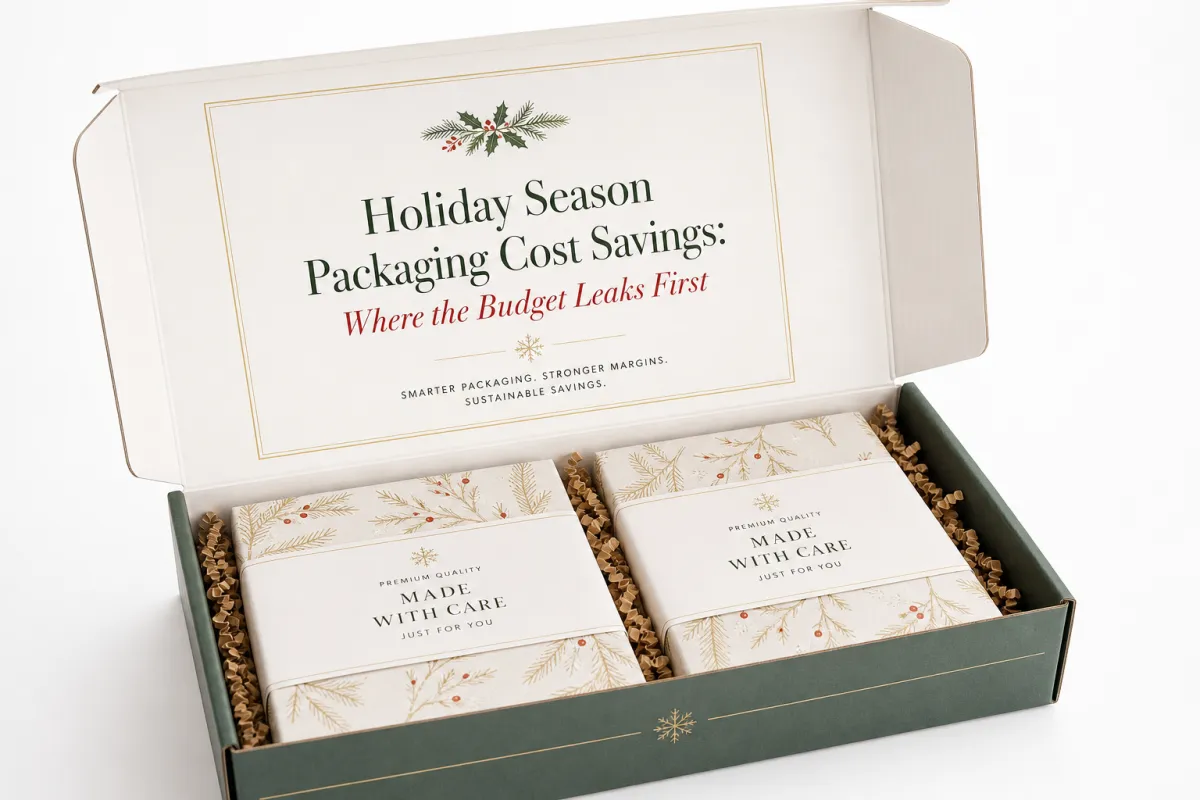
The first leak is usually size. A box that looks only a little too big can change billable weight on parcel shipments and cut down the number of units that fit on a pallet. That is where holiday season packaging cost savings often begin: dimensional discipline. A 12 x 10 x 8 inch carton can cost materially more to ship than a 10 x 8 x 6 inch version, even if the board cost barely moves. Carriers bill space. Warehouses store space. Customers pay for space unless the structure is right-sized.
Over-specification is the second leak. Teams often order a structure that feels safe rather than one that is actually needed. Double-wall corrugate, extra inserts, or heavy coatings can drive cost up without improving the customer experience. Holiday season packaging cost savings improve when the pack is designed for the real risk profile: one transit path, one product weight, one fulfillment process. Fragile candles and premium ornaments need protection. Durable items do not need to pretend they are fragile just because the holiday calendar is crowded.
Fragmentation creates the third leak. Too many seasonal SKUs lead to smaller runs, more changeovers, and more leftover stock once peak demand passes. That is where holiday season packaging cost savings quietly vanish. A brand might save a few cents on artwork or a custom insert, then lose far more through obsolete inventory because the run was too specific. Procurement teams feel that pain quickly. Simpler usually wins.
"A box that saves three cents on paper can cost thirty cents in freight, labor, or damage. The quote is not the whole story."
The cheapest packaging is not always the best short-term move. Holiday season packaging cost savings depend on the path from packing table to final delivery. If a stronger dieline reduces void fill, or if a tighter format increases pallet count by 15% to 20%, the higher unit price may still produce a better result. Brands that handle branded packaging well tend to understand that tradeoff early, before the season starts to compress decisions.
For brands working through Custom Packaging Products, the useful question is not "What is the lowest price?" It is "Which format lowers total landed cost without harming the product or the brand?" That framing keeps holiday season packaging cost savings tied to reality. It also keeps finance, operations, and marketing in the same conversation instead of turning the quote into a debate over the wrong metric.
In practical terms, holiday season packaging cost savings usually improve fastest in three places:
- Carton dimensions that reduce air and improve freight density.
- Insert count trimmed to the actual protection need.
- Board choice that balances strength, print quality, and cost per shipper.
When those three line up, the rest of the economics usually improve with them. When they do not, holiday season packaging cost savings become a hope instead of a plan.
Product Details That Drive Holiday Season Packaging Cost Savings
Different packaging formats solve different problems, and the wrong format gets expensive before it reaches production. Mailer boxes work well for ecommerce gift sets, folding cartons support shelf presentation, rigid boxes create a premium feel, shipping cartons handle heavier transit loads, inserts protect fragile goods, sleeves add branding without building a new structure, and retail-ready displays help store execution. The better the fit between format and product, the stronger the holiday season packaging cost savings.
Simplification is often the biggest untapped opportunity. One well-designed structure can replace three seasonal variants if sizing is disciplined and the graphic system is flexible. That cuts changeovers, lowers the number of parts in the warehouse, and makes reordering easier when demand moves faster than the forecast. Holiday season packaging cost savings usually come from reducing complexity, not adding a new layer because the campaign needs a different look.
Channel fit matters in a very practical way. Ecommerce packaging needs transit durability, dimensional efficiency, and fast assembly. Retail packaging has a different job: the box must stand on a shelf, support package branding, and create a clear purchase signal. If the same product sells in both channels, the structure should either serve both uses or adapt with minimal added cost. Too many Custom Printed Boxes are designed for presentation first and logistics second. That mistake shows up in freight and labor, not in the render.
Hidden costs live in the parts nobody notices in the mockup. Specialty inserts, mixed material families, oversized cartons, and overbuilt closures create labor or storage burdens that do not appear in the first design review. Holiday season packaging cost savings improve when the pack count is reduced and the assembly steps are obvious to the person filling orders at speed. A seasonal program that saves one cent on print but adds twelve seconds to pack-out is not saving money. It is moving cost into the warehouse.
For a buyer evaluating product packaging options, a straightforward lens helps:
- Mailers are strong for lighter ecommerce goods and controlled brand presentation.
- Folding cartons suit retail packaging and lower board consumption.
- Rigid boxes support luxury positioning but usually carry higher material and labor costs.
- Shipping cartons are often the best route for bulk protection and pallet efficiency.
That logic supports holiday season packaging cost savings because it ties structure to function. A gift set that needs shelf impact and parcel durability may need a hybrid approach, but it should still start from the product's actual dimensions and fragility. The closer the structure sits to the product, the less waste the brand pays for.
Premium formats still have a place. Not every seasonal pack should be stripped to the minimum. Even in premium categories, holiday season packaging cost savings remain available if the structure is right-sized and the insert count is rational. A rigid box can be efficient if it replaces secondary components. A folding carton can feel premium if the print system is sharp and the board choice is correct. The aim is not to make everything plain. The aim is to avoid paying for complexity the customer will never notice.
Specifications to Lock in Holiday Season Packaging Cost Savings
Specs are where holiday season packaging cost savings either become real or disappear. Board grade, flute profile, paper weight, dimensions, insert count, coating choice, and print coverage all shape the final quote. Change one variable and the material usage, freight weight, or manufacturing efficiency can shift with it. Packaging design should be evaluated with both the printer and the fulfillment team in mind, since both groups live with the result.
Right-sizing usually delivers the fastest savings. Smaller internal dimensions mean less corrugate, better pallet efficiency, and lower dimensional shipping charges. In many parcel programs, even half an inch in one direction can improve billable weight enough to matter over thousands of orders. Holiday season packaging cost savings are often won in those half-inch decisions, not in dramatic redesigns that take months to approve.
Finish choices deserve equal attention. Full-coverage soft-touch, heavy ink builds, foil, embossing, and complex die cuts all add appeal, but they also add cost and schedule risk. Selective premium finishes can keep the look elevated while preserving holiday season packaging cost savings. A single foil logo on a matte base may deliver enough impact without forcing an expensive all-over treatment. The same logic holds for spot UV, windows, and special coatings.
The manufacturing side matters as much as the visual side. Simpler dielines usually run faster and with fewer errors. Repeatable blank sizes reduce setup time and make future replenishment easier. Tight tolerances matter because a structure off by even a few millimeters can slow filling lines or create fit issues with inserts. Smart brands pursuing holiday season packaging cost savings should ask whether the pack looks good and whether it can be produced and assembled consistently across multiple runs.
The most efficient specs often follow a simple pattern:
- Choose the smallest practical carton footprint.
- Use the lightest board that still protects the product.
- Keep inserts to the minimum number needed for stability.
- Limit specialty finishes to the surfaces customers actually see.
- Preserve enough margin in the dieline for reliable folding and sealing.
That list is not glamorous, but it protects holiday season packaging cost savings in a way that mood boards cannot. If the pack ships under transit stress, the conversation changes immediately. A well-spec'd carton should not need heroic handling. It should survive normal movement through the distribution chain and still arrive looking intentional.
For transit-heavy programs, third-party testing helps. The ISTA test protocols are useful for parcel and distribution validation, while ASTM methods and retailer requirements can help define the right performance target. If sustainability claims are part of the brief, FSC standards can matter for paper sourcing and chain-of-custody documentation. Those references do not replace commercial judgment, but they anchor holiday season packaging cost savings in a verifiable process.
One more point: not every sustainable choice costs more. Recycled paperboard, smarter corrugate selection, and lower-ink coverage can reduce waste and improve the bottom line at the same time. That overlap is where holiday season packaging cost savings become especially attractive. The brand gets cleaner sourcing, lighter freight, and less excess material. The economics and the story both improve.
From a packaging buyer's point of view, the best specs are the ones that do three jobs at once: protect the product, support the brand, and lower the total cost to serve. That is a high bar, but it is achievable. Holiday season packaging cost savings usually come from disciplined spec choices, not from last-minute discounts.
How Do Holiday Season Packaging Cost Savings Affect Pricing and MOQ?
Price is not a single number in packaging. It is a mix of quantity, format, board grade, finishing, setup, and freight. Buyers who focus only on unit price can miss the more important figure: total landed cost. Holiday season packaging cost savings should be judged across the full order, including storage, handling, and any risk of damage or reprint. A box that is $0.05 cheaper but adds 8% more freight can lose the comparison quickly.
MOQ is part of the same equation. Simple stock-based mailers and standard folding cartons often support lower minimums, while Custom Rigid Boxes, unusual shapes, and premium finishes usually need a larger run to stay economical. A higher MOQ can lower unit cost, but only if the brand has the forecast confidence and warehouse space to absorb the inventory. Holiday season packaging cost savings do not improve if the savings appear on the quote and vanish in storage.
Volume breaks are where the math gets interesting. In many custom programs, moving from 2,500 to 5,000 units can lower the per-unit cost enough to justify a slightly larger inventory position. The same is true when one structural family is used across several holiday SKUs. Consolidating artwork or dieboards can improve holiday season packaging cost savings because setup cost is spread over more units. The risk is overbuying a style that will be obsolete after the season. That trade-off deserves a real review before the order is placed.
Here is a practical comparison buyers can use as a starting point. These numbers are representative, not a quote, and they will move based on print coverage, material, and shipping lane.
| Packaging option | Typical spec | Indicative MOQ | Approx. unit cost at 5,000 pcs | Best use |
|---|---|---|---|---|
| Mailer box | 200-250 lb E-flute, 1-2 color print | 1,000-3,000 | $0.45-$0.95 | Ecommerce gifts, subscription sets, DTC launches |
| Folding carton | 16-24 pt SBS or C1S, matte aqueous finish | 2,500-5,000 | $0.18-$0.42 | Retail packaging, lightweight products, shelf display |
| Rigid box | 1.5-2.5 mm chipboard, wrapped with printed paper | 1,000-3,000 | $1.20-$3.50 | Premium gifts, luxury bundles, high perceived value |
| Shipping carton | 32 ECT or 200 lb test corrugate, minimal print | 500-2,500 | $0.28-$0.68 | Bulk ship, warehouse transfers, protective outer pack |
That table shows why holiday season packaging cost savings are not the same as "lowest box cost." A folding carton may have the lowest unit cost, but a mailer might reduce damage claims and improve direct-to-consumer shipping economics. A rigid box may be more expensive, but if it replaces secondary packaging and supports higher pricing through perceived value, the business case changes. Cost per unit is useful. Cost per successful order is more useful.
Buyers should ask for pricing at multiple quantities. That exposes the cost curve and makes the MOQ decision clear. Requesting quotes at 2,500, 5,000, and 10,000 units often reveals where holiday season packaging cost savings begin to flatten out. If the price drops sharply at 5,000, that may be the most efficient point. If the drop is small, smaller inventory exposure may be the smarter move.
Comparison only works when like is compared with like. A quote for a plain carton does not match a carton with full coverage print, foil, and a custom insert. If a supplier can show different material grades and finish levels on the same structure, the team can see which specification actually drives holiday season packaging cost savings. That is far more useful than arguing over a single "best" quote in isolation.
For brands sourcing custom printed boxes, the pricing conversation should include freight terms, pallet counts, and expected warehouse labor. Those factors often matter more than the difference between two unit costs. Holiday season packaging cost savings are strongest when finance, procurement, and operations agree on the same definition of success.
Process and Timeline: From Quote to Peak-Season Delivery
Speed matters, but speed without structure usually costs more. The cleanest seasonal programs follow a clear sequence: discovery, dieline review, quoting, proof approval, sampling, production, quality check, and freight booking. Holiday season packaging cost savings improve when every step is mapped before the rush begins, because late changes create expensive stops and starts. A rushed approval can erase weeks of planning in one afternoon.
Delays usually come from the same three places: artwork revisions, material substitutions, and late sign-off. Artwork changes are especially risky because they often trigger a new proof cycle. Material substitutions can shift cost and lead time if the approved board is unavailable. Late approvals compress production and force more expensive freight options. The pattern is common, and it is avoidable when the brand treats holiday season packaging cost savings as a timeline issue as much as a cost issue.
Typical timing depends on the structure. A simple mailer or folding carton with straightforward print can often move faster than a rigid box with foil, magnets, or specialized wraps. As a rough planning guide, simple packaging might take 10-15 business days from final proof approval to production completion, while more complex builds can need 20-30 business days or more, before transit is even added. If freight is domestic ground, add a few days. If the supply chain crosses oceans, the calendar stretches further. That is why holiday season packaging cost savings are often lost to rush freight more than to print cost.
Here is the part many teams miss: a larger early order can actually reduce total risk. If the forecast is stable, locking in a base quantity ahead of peak demand often avoids emergency reorders at premium freight rates. The reorder should then be triggered at a clear point, not after inventory has already run too low. This is not overbuying. It is protecting holiday season packaging cost savings through the season instead of only at the quote stage.
A practical project flow looks like this:
- Week 1: confirm dimensions, product weight, target quantities, and artwork files.
- Week 2: review dielines, compare material and finish options, and request quote tiers.
- Week 3: approve proof, request sample if needed, and lock print details.
- Weeks 4-6: production, inspection, and freight booking.
- Before launch: receive, inspect, and stage inventory for fulfillment.
That cadence protects holiday season packaging cost savings because it reduces rework and keeps the team from paying for avoidable urgency. If your product packaging must pass retailer routing guides or parcel tests, build that into the schedule up front. A packaging program that ignores validation is not efficient. It is exposed.
Good suppliers make the timeline visible early. They point out which options require more setup, which ones can reuse a dieline, and where a finish choice might add days. That clarity matters because it lets a buyer preserve holiday season packaging cost savings without guessing. It also helps cross-functional teams align before a launch date becomes fixed and expensive.
The best seasonal plan is usually not the one with the shortest lead time. It is the one with the fewest surprises. Less volatility means fewer expedites, fewer substitutions, and fewer mistakes. Holiday season packaging cost savings and schedule control are not separate goals. They reinforce each other.
Why Choose Us for Holiday Packaging Projects
For holiday work, execution matters more than slogans. Brands need a supplier that can read a spec sheet, question unnecessary complexity, and keep the job moving without turning every adjustment into a delay. That is where real holiday season packaging cost savings are built. A good partner does not just print a box. It helps shape the order so the finished pack is easier to produce, easier to store, and easier to ship.
Consistency is the first advantage. Better color control, tighter tolerances, and stable production planning reduce rework. When the same carton needs to arrive in multiple waves or support several holiday SKUs, consistency becomes financial protection. A supplier that keeps the structure and print stable from run to run helps brands avoid last-minute substitutions that destroy holiday season packaging cost savings.
Guidance matters too. Many teams know the look they want but not the most efficient way to get there. A skilled packaging partner can recommend a simpler dieline, a lower-cost board, or a finish that preserves the brand without increasing labor and freight. That kind of advice is especially valuable in branded packaging, where the temptation is to add effects until the quote becomes uncomfortable. The better path is often one strong decision instead of five expensive ones.
There is a practical business case for working with a partner who understands seasonal pressure. The job is not just to quote custom printed boxes. It is to keep the full order aligned with the brand's margin target. A box that looks good but creates damage, storage, or fulfillment problems is not a win. Holiday season packaging cost savings only count if the packaging supports the actual operation, not just the render.
That approach can also improve package branding. Cleaner structure often makes graphics more effective because the design is not fighting the box. A strong logo, a disciplined color system, and the right material finish can do more for perception than a heavy, complicated build. For many brands, especially in ecommerce and retail packaging, a simpler structure with sharper execution reads as more intentional than a crowded premium pack.
Here is the comparison most buyers eventually make: a generic low-cost vendor can look attractive on paper, but if they create more errors, slower response times, and freight surprises, the real cost climbs. A supplier that prevents those issues delivers stronger holiday season packaging cost savings even when the unit price is not the lowest line on the page. That is not marketing. That is total cost control.
If you are evaluating options now, start by comparing your current pack against the options in our custom packaging products range. Then look at what changes if the structure is simplified, the board is adjusted, or the finish is reduced. That exercise often reveals that holiday season packaging cost savings are sitting in plain sight, just hidden behind legacy assumptions.
Next Steps to Capture Holiday Season Packaging Cost Savings
The fastest way to improve holiday season packaging cost savings is to gather the right inputs before asking for a quote. Start with product dimensions, product weight, target quantities, artwork files, ship dates, and your current packaging cost. Add transit method, storage constraints, and any retailer or marketplace requirements. Without those basics, every estimate is guesswork.
Then compare options side by side. Ask for different material grades, different finish levels, and at least two quantity tiers. That makes the trade-offs visible. It also helps finance see where holiday season packaging cost savings are real and where they are simply shifted from one line item to another. A package that saves on print but adds freight is not a savings package. It is a redistribution of cost.
Before approving final specs, align procurement, operations, and marketing. Procurement wants price stability. Operations wants speed and consistency. Marketing wants a stronger shelf or unboxing moment. The best seasonal packaging design balances all three. If those teams agree in advance, holiday season packaging cost savings are much easier to protect through production and fulfillment.
There is one more discipline worth keeping: set a reordering point before launch. That gives the team time to replenish without paying for premium freight or overnight air. A holiday packaging program often succeeds or fails on that one step. The first order may be well priced, but the second order can erase the margin if it is rushed. For that reason, holiday season packaging cost savings should be managed across the entire season, not only during the first quote.
Use the approved pack to establish a repeatable baseline. Measure freight, damage, assembly time, and sell-through against the original assumptions. Those numbers become the blueprint for the next seasonal cycle. Brands that document the result usually improve holiday season packaging cost savings year after year because they stop relearning the same lesson.
For teams ready to act, the next move is straightforward: request a quote, compare the structural options, and choose the version that protects margin without weakening the customer experience. That is the practical path to holiday season packaging cost savings. It is specific, measurable, and far more reliable than chasing the lowest unit cost in isolation.
If you want the shortest route to a stronger seasonal program, begin with Custom Packaging Products, then ask which spec changes improve unit cost, freight, and lead time together. That is where holiday season packaging cost savings become visible in the numbers. It is also where smart brands separate themselves from the rush.
Holiday season packaging cost savings are not a slogan. They are a sequence of small, disciplined choices that lower freight, reduce waste, simplify ordering, and protect the product. Make those choices early, and the season gets easier to manage. Leave them until the rush, and the margin leak starts to spread.
How do I measure holiday season packaging cost savings on a custom box order?
Compare total landed cost, not just the unit price. Include freight, storage, damage rates, labor, and any reprint risk. Final carton dimensions matter because they affect dimensional charges and pallet density, and pack-out time matters because labor savings often equal or exceed material savings. That is the clearest way to measure holiday season packaging cost savings on a real order.
What packaging changes usually create the biggest holiday season packaging savings?
Right-sizing the box usually delivers the biggest gain because it cuts empty space, lowers freight exposure, and can reduce corrugate usage at the same time. Simplifying inserts, coatings, and specialty finishes also helps. Standardizing dielines across related SKUs is another strong move because it reduces setup complexity and supports larger, more efficient runs.
What MOQ should I expect for seasonal custom packaging?
MOQ depends on the style, material, and finishing level. Simple mailers and folding cartons often allow lower quantities than rigid boxes or highly decorated packaging. Higher volumes usually reduce unit cost, but the right MOQ still depends on storage space, forecast accuracy, and how many holiday season packaging cost savings you can actually keep once inventory is received.
How far ahead should I order packaging for the holiday season?
Start early enough to allow for quote review, artwork approval, sampling, production, and freight. Simple packs can move faster, but custom structures and premium finishes need extra buffer. If you are ordering holiday season packaging cost savings into the plan, the approval schedule is part of the savings strategy because it reduces rush fees and avoids last-minute substitutions.
Can sustainable materials still deliver holiday season packaging cost savings?
Yes. Recycled board, FSC-certified sourcing, and lighter corrugate can reduce waste without increasing total cost if the pack is specified correctly. Sustainability and holiday season packaging cost savings overlap when the structure is right-sized, the board is efficient, and the shipment method is matched to the product. The best option protects the item and avoids unnecessary material.

