Home fragrance Frosted Zipper Bags unit cost review is really a packaging decision review. The pouch has to protect the product, support the shelf look, and stay affordable at reorder volume. If one of those breaks, the cost shows up somewhere else in freight, labor, or rejected inventory.
This format works for wax melts, sachets, fragrance refills, and small gift sets because it presents better than a plain clear bag and ships leaner than a rigid carton. For private-label buyers, the key question is whether the unit cost still works once decoration, quantity, and shipping are included.
A well-specified frosted pouch can reduce secondary packaging, improve carton density, and create a more deliberate retail presentation without adding much structural weight.
Home Fragrance Frosted Zipper Bags Unit Cost Review
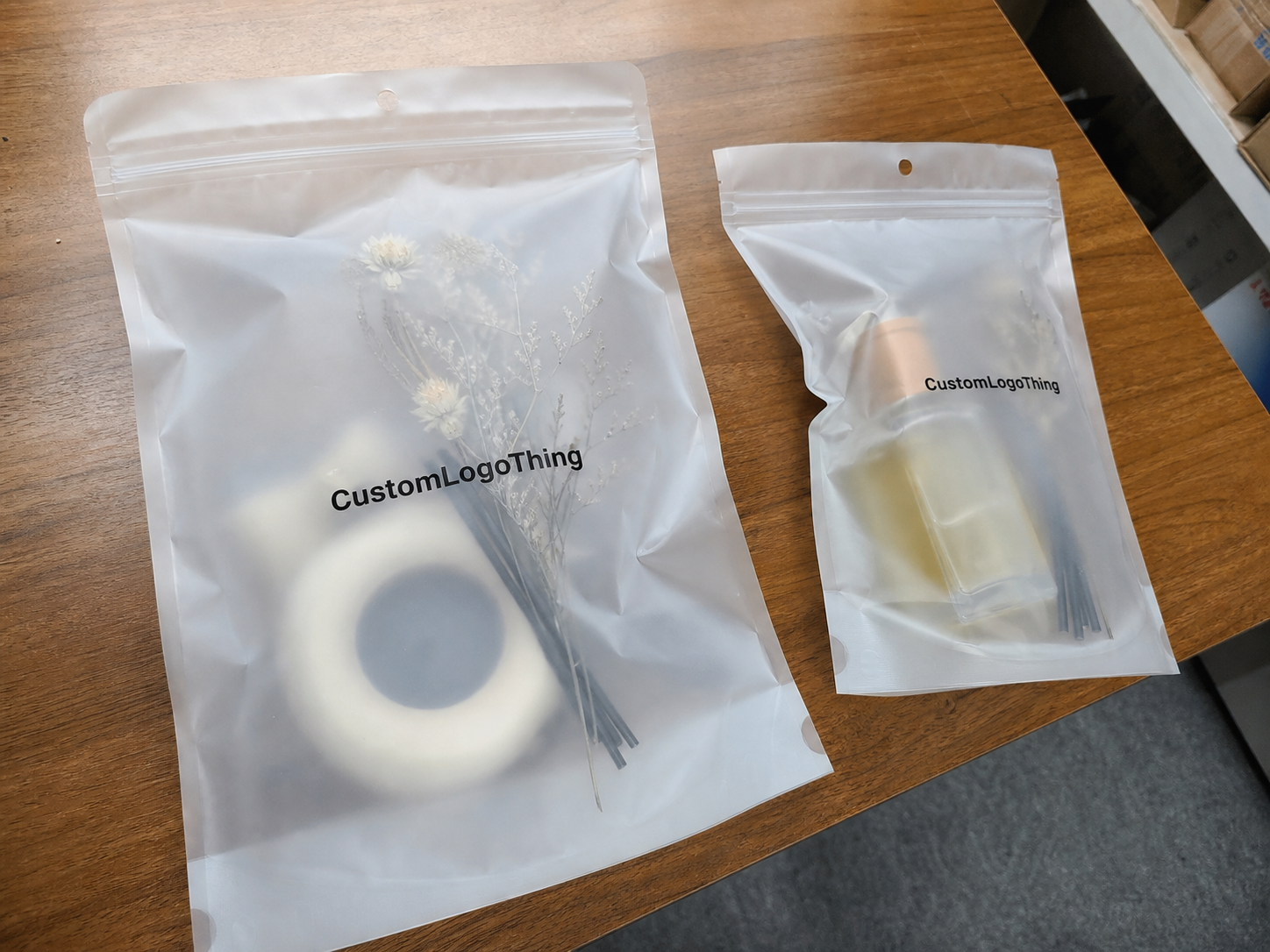
Frosted film softens glare while keeping some visibility, which is useful in home fragrance. A fully clear bag can look exposed, while an opaque pouch may hide fill color or product texture. Frosted material sits between those extremes and usually reads as more premium without forcing a box build.
The zipper matters just as much. These packs are opened, resealed, stacked, and handled repeatedly, so closure quality affects both usability and presentation. A weak zipper can make a product look worn before it is sold, and a poor seal can create avoidable returns or repacking work.
There is also a practical cost benefit. A pouch can replace a small carton for samples, refills, and bundles, cutting material, weight, and assembly steps. The savings are usually modest per unit, but they matter across a full run.
The best versions are restrained: clean zipper line, appropriate film gauge, and artwork that stays legible on frosted stock. Overdesign often creates problems instead of value. Buyers sometimes choose the cheapest bag and end up with wrinkles, weak sealing, or washed-out print that only becomes obvious after inventory is in motion.
Common uses include:
- Wax melts and wax tarts that need resealability and visibility.
- Sachets and scent refills that benefit from a soft matte finish.
- Sample packs and discovery sets that ship flat and open cleanly.
- Gift bundles where the pouch is part of the presentation.
One caution: a frosted zipper bag is not automatically enough for oily or highly volatile formulas. It may work for many fragrance products, but the exact fill should be tested before scale-up if odor retention or puncture resistance is critical.
Product Details Buyers Should Lock Before Quoting
The fastest path to a usable quote is to define the bag before asking for one. Size, contents, finish, and print method all affect how a supplier prices the pouch. A bag for dry sachets does not need the same structure as one for heavy wax pieces or mixed kit components.
Lock the dimensions first. Width, height, and gusset depth should be final before pricing. If the bag needs a hang hole, tear notch, special zipper profile, or other structural feature, include it up front. Even small changes can alter tooling, film use, and line speed.
Then define the fill. A pouch holding a dry fragrance insert is very different from one holding dense wax with sharp edges. Oily contents can also affect seal reliability and ink performance, so the supplier should know whether migration, odor transfer, or low-migration ink is a concern.
Visual intent matters too. Some brands want a soft frosted veil that hides most of the contents. Others want a semi-transparent finish so customers can see color, count, or texture. That choice changes the film and print approach, and sometimes the price.
Before requesting a quote, send these points together:
- Exact pouch dimensions and gusset requirement, if any.
- Contents, fill weight, and whether the product is oily, dusty, brittle, or fragile.
- Finish preference: frosted, matte-frosted, or semi-transparent.
- Print method: label, one-color print, or full-surface graphics.
- Retail handling needs: hanging, resealing, stacking, or bundle compatibility.
If one of those items is missing, the first quote is often only a placeholder. That creates revision loops and delays. It also hides cost until the project is already moving, which is the worst time to discover a packaging mismatch.
It helps to include the end packout as well. Is the bag sold empty, prefilled, or inserted into a larger kit? Will it be hand-packed or machine-packed? That affects how much variation the line can tolerate and should be visible in the quote.
Core Specifications That Affect Protection and Shelf Appeal
The details that protect the product usually shape the price too. Film gauge, zipper strength, seam quality, opacity, and dimensional tolerance all influence performance. A thin pouch may be acceptable for a light sachet, while wax melts or refill packs often need more stiffness and puncture resistance.
As a rough guide, lighter sachet packs often use 50 to 60 micron film. Wax melts, refill packs, and mixed gift kits commonly feel better at 70 to 90 micron. Heavier or sharper contents may justify a thicker build. Thicker is not always better, though; too much stiffness can make packing harder or create a boxy look that works against the brand.
Frosted surfaces also behave differently under light. Warm retail lighting can mute whites and soften contrast, while daylight can make the same pouch look cleaner. If color accuracy matters, request a sample or press proof on the same film family rather than relying on a screen mockup.
There are a few quality checks worth running before approval:
- Cycle the zipper several times and confirm it still closes cleanly.
- Check seal strength along the top, side, and bottom edges.
- Inspect print registration under bright light on the frosted surface.
- Rub-test the artwork to see whether scuffing dulls the logo.
- Stack cartons and confirm the finish is not being flattened or creased.
For transit-sensitive programs, align the pack with ISTA methods so drop and vibration expectations are clear before shipment. If the pouch sits inside an outer carton or sleeve, FSC-certified board can support the overall package story; see FSC for certification context.
Frosted film often hides minor scuffs better than high-gloss film, but it can show pressure marks if packed too tightly. That makes compression testing worthwhile, especially when cartons are dense or the product is being shipped long distance.
Unit Cost, Pricing, and MOQ Drivers
Unit cost is usually driven by four things: material usage, print complexity, order quantity, and the number of production steps before packing. A simple brand mark and a fully wrapped graphic do not sit in the same cost structure.
MOQ matters because setup costs have to be spread across every unit. File preparation, color calibration, plate or cylinder work, sample approval, and first-run waste all sit outside the individual bag. That is why a 1,000-piece order can look expensive next to a 5,000-piece order even if the pouch itself is unchanged.
| Order Profile | Typical Unit Cost | MOQ | Best Use | Main Cost Driver |
|---|---|---|---|---|
| Stock frosted bag + label | $0.10-$0.22 | 500-1,000 | Samples, pilots, quick launch tests | No print plates; label application labor |
| One-color custom print | $0.18-$0.34 | 1,000-3,000 | Core SKU with a simple brand mark | Basic setup and a single print pass |
| Full-surface custom print | $0.24-$0.48 | 3,000-5,000 | Retail presentation and gift packs | More coverage, tighter registration, more press time |
| Premium finish with special accents | $0.30-$0.60 | 5,000+ | Seasonal or high-visibility gift line | Tooling, extra passes, finish complexity |
Those numbers are directional, but the pattern is useful. Every extra print layer, metallic accent, special zipper color, or die-cut feature adds friction to the run. A buyer may save a few cents on the factory quote and lose that savings through extra freight, proof corrections, or repacking labor. Landed cost tells the better story.
Hidden cost points show up often. Artwork revisions can trigger new proofs. Special packing can slow the line. Rush production can push the schedule into air freight. For that reason, a useful quote should separate bag price, setup, packaging, and freight. If those are merged into one number, comparing options gets harder.
Stock pouches with labels can be a smart test run even if they are not the final retail format. They let the team validate fit, shelf behavior, and consumer response without paying for print tooling on the first order. That is often the safest way to learn before locking a custom build.
Production Steps and Lead Time From Proof to Shipment
Good sourcing is also about knowing where time disappears. A clean workflow usually runs through inquiry, spec confirmation, quote, artwork setup, proof approval, sample review, production, inspection, and shipment. If any step is vague, the schedule becomes guesswork.
On a straightforward project, a complete quote can often return in 1 to 2 business days. Proofing usually takes another 2 to 4 business days if the files are clean and the dimensions are final. Sample production may take 5 to 10 business days depending on finish and print method. After approval, a standard custom run often lands around 12 to 18 business days before packing and dispatch.
Delays usually happen in handoff, not on the machine. Late artwork, missing dimensions, color changes after proofing, and scope creep are common causes. Factories can print what is approved; they cannot guess what was meant. Clean vector artwork, clear Pantone references, and a final dieline reduce risk more than most teams expect.
A disciplined timeline should include quality checkpoints:
- First article review to confirm dimensions and zipper feel.
- In-line inspection to catch print drift or seal issues early.
- Final carton inspection for count accuracy and packing consistency.
- Photo confirmation before dispatch so the buyer sees the finished lot.
Freight timing matters as much as production timing. Air freight can protect a launch, but it reduces margin. Sea freight protects budget, but it needs more planning. If the pouch is part of a larger retail kit, the bag schedule should be coordinated with cartons, inserts, and display trays so one delayed component does not hold the release.
If the fragrance product has labeling or compliance requirements, the timeline should also include copy review. A bag can be manufactured on schedule and still miss launch if ingredient text, barcode placement, or warning language is not approved in parallel.
How We Keep Reorders Consistent and Low-Risk
The first order is only the beginning. Reorders are where small packaging drift becomes expensive. A slight shift in width, zipper feel, or frost level may not show much in a photo, but it can slow pack-out or alter how the product presents on shelf.
That is why repeatability matters. A supplier should keep documented specs, approved color references, and retained samples on file. The reorder should match the approved standard, not a fresh interpretation of it. If the first run used a certain film lot or zipper style, that should be recorded.
Subtle changes can be costly. A different opacity level, a firmer zipper, or a logo that shifts a few millimeters can pass casual inspection and still create rework later. Those issues usually show up as extra labor, reject counts, or customer complaints about inconsistent presentation.
Low-risk sourcing also means defining tolerances and defect thresholds early. If the supplier cannot state the acceptable range for width, height, seal quality, or print registration, the quote is incomplete. That does not always mean the vendor is weak, but it does mean the specification conversation is not finished.
To keep reorders tight, request these three items every time:
- A locked spec sheet with dimensions, material, zipper style, and finish.
- A retained sample from the approved run.
- Written defect limits for print, seal, and carton counts.
For brands that reorder often, this discipline is worth more than a small price cut. A slightly lower quote is easy to spend later on rejects or repacking. A stable repeat order protects margin and schedule.
Next Steps for an Accurate Home Fragrance Quote
If the goal is a quote that can actually be used, send everything that affects production in the first message. Exact dimensions, product type, quantity tiers, artwork files, finish preference, shipping destination, and deadline all belong in the brief. A reference sample or clear photo helps because it gives the supplier a realistic target for structure and tone.
Ask for at least three quantity tiers, often 1,000, 3,000, and 5,000 pieces, so the pricing break becomes visible. The lowest tier is not always the best choice. Sometimes the next tier gives a better unit cost, better print stability, and lower freight waste per finished pack. The useful comparison is the best landed cost at the volume you can reorder.
Also ask how the quote handles setup charges, tooling, proofing, and freight. A clear quote should separate those costs so the numbers can be compared honestly. If everything is compressed into one line, the buyer still does not have the real economics.
For fragrance packaging teams, the right decision is the one that protects margin without weakening shelf presentation. That is why a disciplined home fragrance frosted zipper bags Unit Cost Review matters before approval, not after the launch is already in transit.
What affects home fragrance frosted zipper bag unit cost the most?
Bag size and film gauge usually lead because they determine raw material usage. Print coverage, color count, and special finishes add setup work, while lower MOQs spread fixed costs across fewer pieces. Freight mode can also change the landed price more than expected.
What MOQ should I expect for custom frosted zipper bags for fragrance products?
MOQ depends on whether the run is stock-based, printed, or built with special tooling. Standardizing the size and limiting print complexity can bring the minimum down. For early-stage launches, a stock bag with a label is often the least risky way to test demand.
Can frosted zipper bags handle scented oils or strong fragrance retention needs?
They can work for many home fragrance items, but the film and seal structure must match the product. For oil-heavy or highly aromatic contents, test sample bags for odor control, seal integrity, and puncture resistance before ordering at scale.
How long does production usually take after artwork approval?
Simple orders can move through production in about 12 to 15 business days after proof approval, while custom runs with special finishes or extra revisions can take longer. Freight timing should be tracked separately so the shipment lands before launch.
What should I send to get the fastest accurate quote?
Send exact dimensions, product type, quantity tiers, artwork files, finish preference, shipping destination, and deadline. If possible, include a reference sample or photo so the supplier can confirm the right structure before pricing. Clear input usually shortens the proof cycle too.