Buyer Fit Snapshot
| Best fit | Hot Foil Printed Cartons projects where brand print, material claims, artwork control, MOQ, and repeat-order consistency need to be specified before quoting. |
|---|---|
| Quote inputs | Share finished size, material target, print colors, finish, packing count, annual reorder estimate, ship-to region, and any compliance wording. |
| Proofing check | Approve dieline scale, logo placement, barcode or warning zones, color tolerance, closure strength, and carton packing before bulk production. |
| Main risk | Vague material claims, crowded artwork, missing packing details, or unclear freight terms can make a low unit price expensive after revisions. |
Fast answer: Hot Foil Printed Cartons: Branding, Finish, and Fit should be specified like a repeatable production item. The safest quote records material, print method, finish, artwork proof, packing count, and reorder notes in one written spec.
Production checks before approval
Compare the actual filled-product size with the drawing, then confirm tolerance on folds, seals, hang holes, label areas, and retail display edges. Reserve space for logos, QR codes, warning copy, and material claims before decorative graphics fill the panel.
Quote comparison points
Review material grade, print process, finish, sampling route, tooling charges, carton quantity, and freight assumptions side by side. A quote is only useful when the supplier can repeat the same color, closure quality, and packing count on the next order.
On a busy shelf, hot foil printed cartons can grab attention before a shopper reads a single claim or compares ingredients, because the reflected light does part of the selling for you. That quick flash gives the package a sense of care and finish that plain ink alone usually cannot match, and it does so without changing the carton structure at all.
The appeal of hot foil printed cartons is direct. They turn paperboard into a visible branding moment, one that has real surface presence rather than just printed color. That effect only lands well when artwork, board selection, foil coverage, and finishing are planned together, since foil behaves differently from standard ink and tends to expose weak decisions pretty fast.
In production, hot foil printed cartons have to do more than look good in a mockup. They need to survive die cutting, scoring, folding, gluing, shipping, and retail handling while keeping the foil crisp and the carton surfaces clean. If the substrate is wrong, the artwork is too fine, or the foil crosses a fold in the wrong place, the final pack can feel busy instead of polished, which is exactly the opposite of what most brands want.
I have stood at enough press checks to know this much: the best hot foil printed cartons are the ones that look sharp on press, run efficiently on the line, and stay inside budget without forcing a bunch of late-stage compromises. That balance is what makes the finish feel intentional rather than just expensive.
Hot Foil Printed Cartons: Why the Finish Feels So Premium
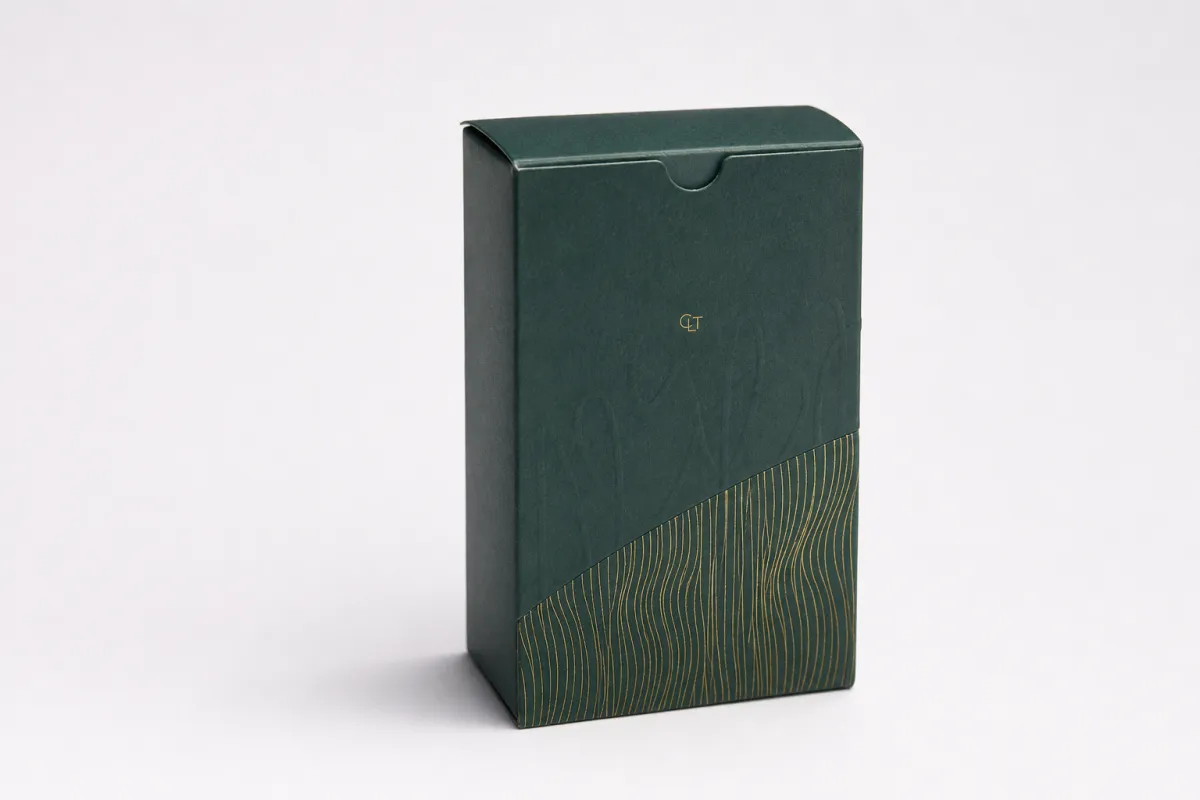
Picture ten cartons lined up on a shelf. Most are printed well enough, yet one of the hot foil printed cartons throws a thin line of gold or silver back at the light, and the eye goes there first. That reaction is not magic; it is controlled reflectivity. Foil changes how the surface catches light, so even a small logo can read as more deliberate than a full-panel ink design that tries a little too hard.
Contrast does a lot of the work. Matte board gives the eye a quiet field, then foil interrupts that quiet with shine, depth, and a slight tactile shift. On hot foil printed cartons, that contrast often outperforms an overbuilt graphic layout. A single metallic mark on a calm, well-built panel can feel stronger than a crowded carton filled edge to edge with decoration.
There is also a familiar consumer habit at play. People connect reflective finishes with gifting, special editions, cosmetics, wine, confectionery, and higher-end retail packaging. That does not mean foil belongs only to luxury goods, though it does mean hot foil printed cartons borrow some of that visual language almost immediately. Used with care, they make a brand feel more established. Used without restraint, they can feel theatrical, and that kind of overstatement is hard to hide.
Foil is not an afterthought. On hot foil printed cartons, the finish has to work with the board caliper, the ink coverage, the die line, the glue seam, and the folding behavior. Ignore those parts and the foil may still transfer, yet it will not necessarily survive assembly in a way that feels clean or repeatable. A carton that looks great flat on a proof can become awkward once it is folded, glued, and stacked.
From a packaging buyer's point of view, the first question is purpose. The strongest hot foil printed cartons begin with a clear decision about what the foil is supposed to do. Is it there to signal luxury, highlight the brand name, separate a seasonal line from the core range, or create a stronger unboxing moment? Once that answer is clear, the finish becomes much easier to specify, and the whole job gets less wobbly.
For a useful technical baseline on carton structure, print finishing, and packaging materials, the Packaging Association offers solid context that lines up with the issues printers and buyers deal with every day.
How Hot Foil Printed Cartons Are Made
At the simplest level, hot foil printed cartons are created by transferring a metallic or pigmented layer from a carrier film onto the carton surface with heat and pressure. A heated die presses the foil film against the board, the image area releases and bonds, and the carrier continues on its way. That is the short version. In production, the details decide whether the result feels refined or rough.
The process usually begins with artwork and a proper die line. The design team needs to know where panels fold, where glue flaps sit, where scores run, and where the foil can live without being crushed. On hot foil printed cartons, registration matters a great deal because the foil image must land exactly where the artwork expects it to land. A logo that drifts even a millimeter or two can look off to a buyer who cannot explain why it feels wrong, only that it does.
Tooling comes next. A foil die or stamping die is created for the exact artwork, then the board is selected with the finish in mind. Smooth paperboard usually gives the cleanest transfer, while heavily textured or soft boards can reduce edge sharpness. That does not make textured stocks unusable; it just means hot foil printed cartons need a more careful match between art and substrate when the surface is not flat and predictable. A good converter will usually test that match before committing the full run.
After tooling, the press work starts. Heat, dwell time, and pressure all influence the transfer. Too little heat and the foil may not release cleanly. Too much pressure and the board can crush or the detail can spread. That matters especially on hot foil printed cartons that rely on fine type, hairline rules, or narrow borders, since those details disappear faster than many buyers expect if the setup is not tuned properly.
Where the process gets tricky
Large foil solids are harder than they first appear. A big shiny block can look elegant, yet on hot foil printed cartons it can also reveal tiny imperfections more clearly, especially if the board has slight variation. Reversed type is another trouble spot because the negative spaces have to stay clean and readable. Once the foil area gets close to scores, panels, or seams, the risk of cracking or distortion rises, and the carton stops feeling premium pretty quickly.
Experienced converters tend to talk about build sequence, not just print design. On hot foil printed cartons, the order of operations affects the final surface. Some jobs need foil before a coating pass. Some need print first, then foil, then a protective varnish. Others need embossing paired with foil so the raised shape does part of the visual work. Good planning reduces waste and makes the run more repeatable, which is one of those unglamorous details that quietly saves money.
For projects that combine foil with structural performance testing, it helps to keep ISTA in view, especially if the carton will move through distribution channels where compression, vibration, or drop handling can reveal weak points in the build.
Hot Foil Printed Cartons: Cost, Pricing, and MOQ Factors
Pricing for hot foil printed cartons depends on more than size. The main factors are carton dimensions, board grade, foil coverage, number of colors, number of print passes, and whether the design needs one setup or several. A small logo in one foil color on a standard folding carton is a very different job from a full-panel premium pack with foil, embossing, and specialty coating. The name may be the same, but the production path is not.
Short runs usually carry a higher unit price because the fixed costs spread across fewer cartons. Tooling, press make-ready, test pulls, foil die creation, and spoilage during setup all matter. For hot foil printed cartons, that means a run of 1,000 pieces can feel expensive per unit even if the total invoice stays manageable, while 10,000 pieces may look far more efficient on a per-carton basis. The economics are simple, even if the setup is not.
MOQ behavior shapes the quote too. Some suppliers can support smaller minimums, especially when the carton structure is standard, but the per-unit cost climbs quickly as the quantity drops. That pattern is common with hot foil printed cartons because the machinery does not care whether the run is 500 or 5,000; the die still needs to be made, the press still needs to be set, and the finisher still has to run approvals and checks. Nobody gets to skip those steps just because the order is smaller.
Artwork complexity can move the price as well. Tiny text needs more care. Multiple foil colors mean more passes or more tooling. Foil on both sides adds labor and registration risk. Foil that overlaps embossing or sits very close to folds can also add technical effort. On hot foil printed cartons, that extra effort usually makes sense only if the visual result truly supports the brand position.
For buyers trying to get an accurate quote, the cleanest path is to provide finished carton dimensions, board specification, foil coverage area, quantity, target finish, and assembly requirements up front. If the project includes inserts, internal print, window patches, or special packing, those details belong in the brief too. Quotes for hot foil printed cartons get much better when the supplier can see the full job rather than guessing at the missing pieces.
Here is a practical comparison of common options and how they tend to price in the market. Numbers vary by region, board choice, and volume, but the pattern holds up well.
| Option | Typical MOQ | Approx. Unit Cost | Best For | Main Notes |
|---|---|---|---|---|
| Standard printed carton, no foil | 1,000+ | $0.20-$0.45 | Everyday retail packaging | Lowest setup complexity, best for volume efficiency |
| Spot foil carton, one foil color | 500-1,000+ | $0.35-$0.80 | Brand logos, premium accents | Common entry point for hot foil printed cartons |
| Foil plus embossing | 1,000+ | $0.55-$1.20 | Luxury, gifting, limited editions | Needs tighter tooling coordination and sample approval |
| Multi-panel foil coverage | 2,000+ | $0.75-$1.50 | High-impact shelf presentation | More time on press, more chance of registration issues |
Those ranges stay broad on purpose. A small cosmetic carton with a single foil logo and a smooth SBS board can price very differently from a rigid folding carton, even when both are called hot foil printed cartons. The real job is to align the finish with the business goal rather than chasing the lowest number and hoping the result still reads premium. Cheap packaging that misses the mark is still expensive in the long run.
Production Steps and Timeline for Hot Foil Printed Cartons
A realistic schedule for hot foil printed cartons starts with concept approval and ends with packed cartons ready for fill. Simple jobs can move through in roughly 10-15 business days after proof approval if the structure is standard and the foil area is straightforward. More involved projects, especially those with custom tooling, special coatings, or structural development, can land closer to 3-5 weeks or longer. If the launch date is fixed, that extra time cushion matters a lot.
The first step is design finalization. Artwork has to be locked, and the die line has to be approved before tooling begins. On hot foil printed cartons, this matters because even a tiny copy change can shift foil placement, and a small shift can mean a new die or another round of proofing. Most delays start here, not on press, which is why the front end of the schedule deserves more attention than it usually gets.
Tooling and proofing come next. The foil die is made, a press proof is run, and the team checks registration, sheen, edge quality, and panel alignment. If the carton also uses embossing, the tooling stack needs extra care so the raised area and foil line sit together correctly. That is where hot foil printed cartons tend to reward patience. A fast approval feels efficient; a careful approval is cheaper than a remake, and that is the plain truth of it.
Production follows. The press run is monitored, cartons are cut, folded, glued, and inspected. If the design places foil near a seam or score, the quality team pays close attention to cracking, pinholes, and edge lift. For hot foil printed cartons, that inspection is not a formality. It is how the batch stays consistent instead of revealing later that half the run looks slightly different from the approved sample.
The last step is packing and shipment. Depending on the carton style, pieces may ship flat, bundled, or pre-glued. If the product launch has a fixed fill date, build margin into the schedule. A one-week cushion can save a lot of stress if an artwork revision or material substitution appears. That is especially true for hot foil printed cartons ordered for seasonal promotions, retail resets, or event-specific packaging where the deadline is fixed and nobody has room to improvise.
A simple rule helps more than most buyers expect: order a sample or prototype early if the finish depends on a precise metallic look. That is the fastest way to catch an issue with foil area, edge proximity, or panel balance before the full run starts.
Design Choices That Make Hot Foil Printed Cartons Work
The strongest hot foil printed cartons usually have restraint built into the design. Foil acts like a spotlight, so the carton should know exactly what it wants to illuminate. A logo, a product name, a seal, a border, or a short brand line can carry the finish beautifully. If the entire carton tries to shine, none of it feels special anymore.
Negative space matters more than many design teams expect. When the foil area has room around it, the eye reads it as a deliberate mark. When the foil is crowded into every corner, it starts to feel like decoration for decoration's sake. On hot foil printed cartons, a little breathing room usually does more for the premium feel than another graphic element ever will.
Typography deserves careful attention too. Thin serif fonts, tiny uppercase text, and hairline rules can reproduce well only when the substrate and press conditions are friendly. If not, they can fill in, break, or blur. A better strategy for hot foil printed cartons is to use foil on type with enough stroke width to hold under pressure, then let the rest of the layout stay quieter.
Color and contrast shape the mood of the carton. A dark matte board with gold foil feels different from a soft-touch white carton with silver foil, and both feel different again from a natural kraft base with a muted copper finish. No single formula fits every brand. The right finish for hot foil printed cartons depends on whether the brand wants heritage, elegance, holiday warmth, modern minimalism, or a more technical premium look. That choice should be made on purpose, not by accident.
Foil should feel intentional, not busy. If the carton looks like it was decorated after the fact, the finish loses authority fast.
Structure affects design decisions as well. Fold lines, glue flaps, tuck-in panels, and die cut windows can interrupt the visual field. If the foil crosses those areas, it may crack or disappear when the carton is assembled. In other words, hot foil printed cartons need design choices that respect the physical behavior of paperboard, not just the flat artwork file. A design that ignores the fold map is gonna cause trouble later.
The best packaging teams understand that part instinctively. They do more than make the box attractive. They make sure the attractive parts survive manufacturing. That is a different skill, and it shows immediately in hot foil printed cartons that feel calm, balanced, and expensive without seeming overworked. There is a kind of confidence in that restraint that buyers can feel right away.
Common Mistakes When Specifying Hot Foil Printed Cartons
Overdesign is the most common mistake. Buyers sometimes ask for too much foil because they want the carton to feel premium, yet too much shine can flatten the hierarchy and make the branding feel noisy. On hot foil printed cartons, the foil should support the message, not compete with it. A little discipline usually beats a lot of sparkle.
Artwork that is too fine is another frequent problem. Hairline borders, tiny reversal type, and very narrow letterforms can be beautiful on screen and disappointing on press. On hot foil printed cartons, fine detail is limited by the board, the die, and the way the foil releases under heat. If the design is fragile, the finish will remind you quickly, which is not always a fun conversation to have after approval.
Substrate behavior is easy to underestimate. Some boards compress more under pressure, some absorb differently, and some show fiber texture that affects foil adhesion. That means the same artwork can look excellent on one stock and merely acceptable on another. For hot foil printed cartons, the board is not just a carrier; it is part of the finish. In practice, that means a paper choice should be judged with the foil sample, not in isolation.
There is also a planning mistake that shows up constantly: treating foil as decoration to add near the end. By then, the structure may already be fixed, the copy may already be flowing, and the budget may already be tight. That can force awkward compromises. With hot foil printed cartons, the cleanest results happen when foil is part of the brief from the start, before the design team has painted itself into a corner.
Proofing errors are another costly trap. Approving artwork without checking panel orientation, fold placement, or the actual sheen under real lighting can create surprises later. A foil that looks elegant in a studio proof may read louder, cooler, or flatter in retail light. That is why hot foil printed cartons benefit from physical samples whenever the finish is central to the brand story.
The standards side matters too. Buyers who work with performance packaging should know that testing references such as ASTM guidance for material behavior and FSC certification for responsible sourcing can affect the board options available, while hot foil printed cartons intended for distribution should also be checked against drop and transport expectations. None of those standards fix a bad design, yet they do reduce avoidable surprises.
Expert Tips and Next Steps for Hot Foil Printed Cartons
Start with the carton's job. Is the packaging trying to win shelf attention, elevate an everyday item, support gifting, or create a limited-edition feel? That answer should shape the foil coverage before anyone starts polishing artwork. For hot foil printed cartons, a small, precise logo may be the better choice for a serious brand than a wide metallic field that looks flashy but less controlled.
Ask for the die line early. That sounds basic, and it saves time. Once the fold map is visible, the designer can place foil away from risky scores, seams, and stress points. For hot foil printed cartons, that one step often prevents the kind of technical revision that eats both time and budget. It also gives the team room to test whether the layout still feels balanced after the folds are accounted for.
Compare foil samples under the lighting conditions where the carton will live. Retail aisles, showroom shelves, and photography setups all make foil behave differently. A warm gold can feel soft in one light and loud in another. The same applies to silver, copper, holographic effects, and pigmented foils. On hot foil printed cartons, light is part of the design whether the brief says so or not, so the sample has to be judged where the product will actually be seen.
Budget for a prototype if the project depends on a precise surface effect. That advice matters especially when foil is combined with embossing, soft-touch coating, textured board, or a narrow type treatment. A prototype costs money, yes, but it also tells you whether the final carton will look like the brand drawing or like a compromise. That matters a great deal for hot foil printed cartons where the finish is a major part of the value proposition.
Keep the next steps simple. Gather the carton dimensions, quantify the run, choose the board, define the foil area, confirm assembly needs, and ask for a detailed quote that separates tooling, setup, finishing, and shipping if possible. If the supplier can see the full picture, hot foil printed cartons tend to move through approval faster and with fewer surprises.
In practical terms, the best results come from a small chain of disciplined choices: clear artwork, sensible foil coverage, the right substrate, and a schedule that leaves room for proofing. That is how hot foil printed cartons end up looking intentional on the shelf instead of merely shiny. If you remember one thing, make it this: lock the dieline early, keep the foil area focused, and approve a physical sample under real lighting before the full run starts.
Are hot foil printed cartons more expensive than standard printed cartons?
Usually yes, because hot foil printed cartons add tooling, setup time, and press handling beyond a standard ink-only carton. The price gap depends on foil area, quantity, board grade, and whether the job needs one foil pass or several. In many cases, the per-unit impact stays manageable on larger runs, while small orders carry a noticeably higher setup burden.
What substrates work best for hot foil printed cartons?
Smooth paperboard generally gives the cleanest transfer for hot foil printed cartons, especially when the artwork includes small type or thin rules. Heavily textured stocks, very soft boards, or boards with inconsistent compression can reduce sharpness. That does not make them unusable, though it does mean the art, die, and finishing plan should be checked carefully before production. A quick sample on the actual board can save a lot of guesswork.
Can hot foil printed cartons include both foil and embossing?
Yes. Foil and embossing are often paired because the raised shape adds depth while the metallic finish adds light reflection, which is a strong combination for hot foil printed cartons. The key is alignment. If the tooling stack is not planned properly, the foil may miss the raised area or the board may show stress at the edges, so proofing matters a great deal here.
How long does it take to produce hot foil printed cartons?
Simple hot foil printed cartons can often move from proof approval to shipment in roughly 10-15 business days if the structure is standard and the tooling is already defined. Custom structural work, special coatings, or multiple finish passes can stretch that timeline to several weeks. The fastest way to keep the schedule healthy is to approve artwork, dielines, and samples quickly, because delays usually begin long before the press run.
What artwork details matter most for hot foil printed cartons?
Font size, line weight, foil coverage, fold placement, and panel orientation all matter more than most teams expect on hot foil printed cartons. Tiny text and very thin linework can lose clarity, especially on textured board or across a score. If there is one practical rule to remember, it is this: build the foil around the carton structure, not the other way around, and the final result is far more likely to feel sharp, premium, and production-ready.
Related packaging resources
Use these related guides to compare specs, costs, quality checks, and buyer decisions before making the final call.