Hotel Promotional Beanies Bulk Order: Buyer's Guide
A hotel promotional Beanies Bulk Order can be a small line item with outsized impact on cost control. Knit beanies ship flat, store easily, and are simple to brand, which makes them practical for hospitality programs that need a warm item without the bulk of robes, mugs, or boxed gifts.
The main buyer questions are straightforward: does the beanie hold its shape, does the logo read cleanly, and can the same spec be repeated next season without rework? That is especially important for hotels, resorts, and property groups that manage guest gifts, staff apparel, or retail merchandise from the same budget.
Why bulk beanies can beat larger gift items on total cost
Beanies are compact enough to lower freight, storage, and handling costs. A carton of knit hats takes far less space than the same quantity of hard goods, and there is little breakage risk during receiving or inter-property transfers. That reduces replacement claims and keeps the order easier to manage.
They also fit several hotel use cases without changing the spec: winter welcome kits, VIP arrivals, staff outdoor wear, or retail shelves. One product can serve multiple departments, which makes replenishment and seasonal planning simpler. If the program is split across properties, the smaller carton footprint helps with distribution as well.
Buyers often keep beanies under the same purchasing structure as their Wholesale Programs because it keeps sample notes and reorders in one place. That matters when the same piece may be reordered months later and no one wants to reconstruct the spec from memory.
For most hospitality programs, the best value comes from a simple knit, one decoration location, and basic packing. A beanie does not need to be expensive to look deliberate if the material and branding choices are controlled.
- Winter welcome kits that need a compact, useful guest item.
- Staff apparel for valet, patio, transport, or outdoor service.
- VIP gifts that need a polished presentation without heavy packaging.
- Retail items where price point and repeatability both matter.
Materials and knit styles that hold up in hotel use
Acrylic is the default choice for a reason: it is warm, cost-effective, and easy to repeat across color runs. Recycled acrylic can support sustainability goals without pushing pricing too far upward. Wool blends feel more premium but usually raise cost and care expectations.
| Material | Feel and performance | Best fit | Cost impact |
|---|---|---|---|
| Acrylic | Soft, warm, color-stable, easy to repeat | Guest gifts, staff use, broad hotel programs | Lowest |
| Recycled acrylic | Similar hand feel with a cleaner sourcing story | Eco-minded hospitality brands, premium amenity kits | Moderate |
| Wool blend | Warmer, more natural feel, slightly more refined | Upscale resorts, boutique properties, retail | Higher |
| Fleece-lined construction | Added warmth, heavier hand, softer interior | Cold climates, ski properties, outdoor staff | Higher |
Knit structure affects both appearance and decoration. A cuffed beanie is usually the safest hotel choice because it gives embroidery a stable area and creates a finished look. Slouch styles read more casual and can work well for resort retail or lifestyle branding, while pom beanies lean seasonal and are better for ski properties or holiday programs.
Gauge matters too. Medium-gauge knits usually accept embroidery better than very chunky rib knits, which can distort the logo. Jacquard-knit logos work well when the artwork is simple, but they are a poor match for thin lines or detailed marks. If the logo needs precision, embroidery or a woven patch usually gives the cleanest result.
Color matching should be confirmed early. Ask for PMS references and verify whether the supplier is matching stock yarns or producing custom-dyed yarn. Exact matches are not always possible on knit goods, so the buyer should understand the tolerance before proof approval. For printed inserts or hang tags, FSC-certified paper is worth asking for if the package includes paper components.
Logo placement, sizing, and packaging details to lock down
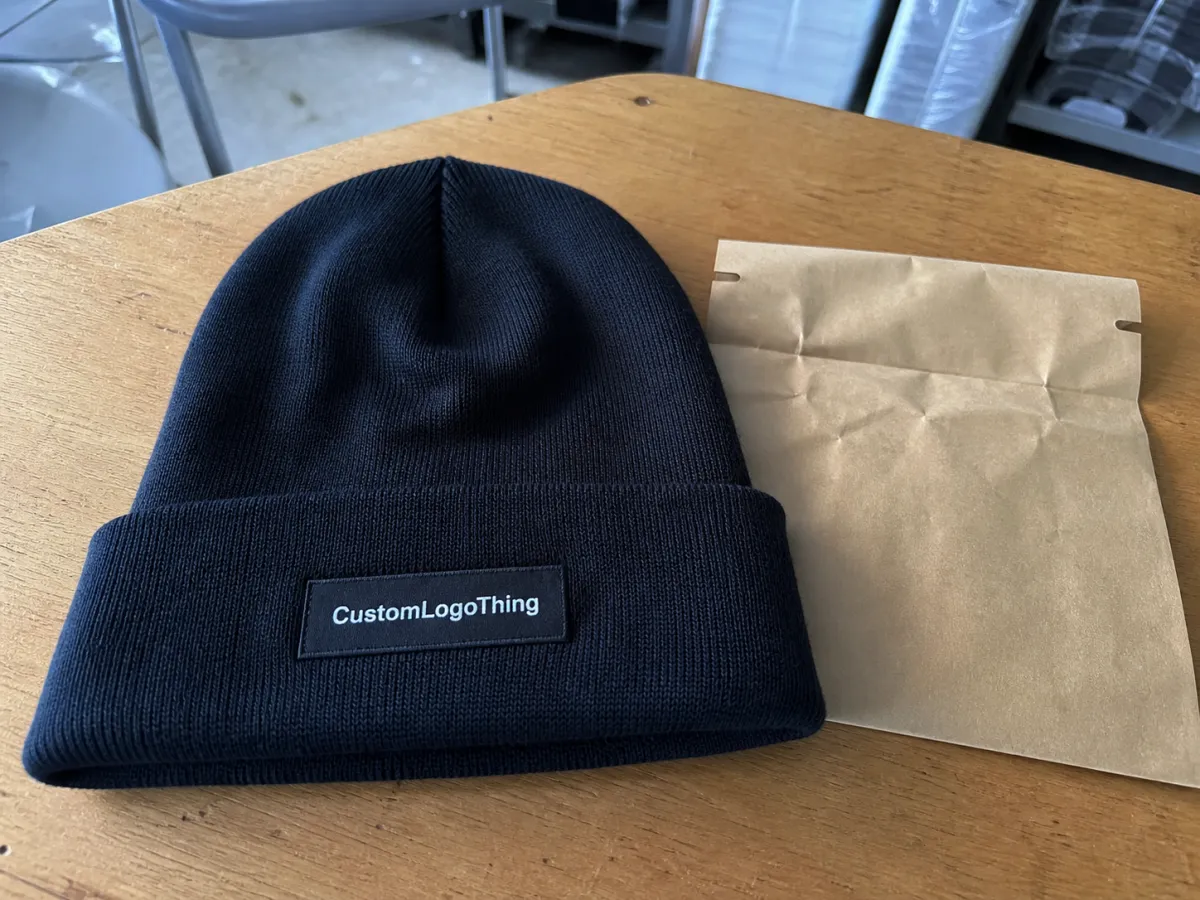
Logo placement should match how the beanie will be seen in use. Center-cuff embroidery is the most common option because it reads clearly and keeps the rest of the knit visually calm. A woven patch can feel more upscale on denser knits, while a stitched label works for properties that want subtle branding rather than a promotional look. Side placement can work when the mark is small and the brand system is restrained.
Size is just as important as placement. A cuff that is too shallow leaves no stable surface; a cuff that is too deep can affect fit and make the hat sit awkwardly. For most adult hotel programs, a logo around 2.5 to 3.5 inches wide is usually readable without stressing the knit. Oversized decoration increases the risk of puckering, stretched thread, and a stiffer hand feel.
A small accessory exposes production mistakes quickly. Uneven cuff depth, off-color yarn, loose trimming, and crooked embroidery are obvious once the item is on the head.
Packaging affects receiving and distribution as much as presentation. A welcome-kit item may only need a polybag and barcode sticker. A retail piece may need tissue, a hang tag, and a more deliberate fold. If the beanies are being kitted with other amenities, the pack sequence should match the rest of the assembly plan so cartons do not need to be reopened later.
Decoration method should be matched to the knit. Embroidery usually holds up well because the thread sits within the structure of the fabric, but overly dense stitching can tighten the knit and create puckering. Woven patches stay legible when they are sized for the surface instead of stretched across it. The safest combination is modest artwork, accurate placement, and a decoration method that respects the fabric.
For hotel groups comparing pack-out options or standardizing across properties, the ordering notes in our FAQ are a practical place to sort out the basics before proofs begin.
Pricing, MOQ, and quote drivers for hotel beanie orders
The unit price is only one part of the total. Fiber content, knit complexity, decoration method, packaging, carton count, and freight all affect the final number. A simple acrylic cuffed beanie with one embroidery location is usually the lowest-cost route. Add a patch, fleece lining, or retail-ready packaging, and the quote increases because each extra step adds labor and approval time.
MOQ is where the economics become obvious. Knit accessories carry setup work that does not disappear on a small run. Embroidery digitizing, yarn matching, sampling, and packing all need to be paid for before the first unit ships, which is why lower quantities generally carry a higher per-unit price.
| Run size | Basic acrylic cuffed beanie | Recycled acrylic or wool blend | Typical quote pressure |
|---|---|---|---|
| 100 pcs | $4.80-$7.20 each | $6.20-$9.80 each | Highest setup share, limited packing options |
| 250 pcs | $3.90-$5.90 each | $5.20-$8.20 each | Better balance between flexibility and cost |
| 500 pcs | $3.10-$4.80 each | $4.30-$6.90 each | Common sweet spot for hotel programs |
| 1,000 pcs | $2.30-$3.80 each | $3.40-$5.90 each | Best unit pricing, strongest freight efficiency |
Those ranges are only useful if the quote shows what sits behind them. Setup fees for embroidery digitizing, pre-production samples, or strike-offs may add $35-$150 depending on the decoration method and the number of revisions. Custom packaging, tissue, hang tags, and kit assembly can add more. Freight is separate and may change materially if the shipment is going to multiple properties.
Order purpose changes the right spec. A guest-gifting program can stay simple: standard acrylic, one logo location, one color, basic polybagging. A retail program may justify a softer yarn, a more polished patch, or better labeling. The key is to pay for details that affect the guest or shopper experience, not for extras that will never be noticed.
A useful quote should show each of those variables clearly. If the estimate gives only a single unit price, ask for setup, packaging, sample, and shipping costs before comparing suppliers. The lowest headline price is not always the lowest total once revisions, freight, and reorders are included.
Production steps, lead time, and approval checkpoints
A sensible production flow starts with artwork review, then moves to a digital proof, sample approval if needed, knitting or sourcing, finishing, packing, and shipment. If the logo file is already vector and the size is clear, the first proof can move quickly. If the file needs cleanup or the color references are vague, everything downstream slows down.
Lead time depends on yarn availability, decoration complexity, order volume, and packaging. In many cases, a simple embroidered beanie can be ready in about 12-18 business days after proof approval. A more customized knit or patch build can move closer to 18-30 business days. If the order requires custom-dyed yarn or retail-ready packaging, the buyer should plan for more time.
Peak cold-weather demand can stretch schedules. An order placed late in the season is more exposed than one approved early, and that is especially true for hotel groups that need staggered deliveries across multiple properties. Splitting the shipment is possible, but it should be planned before cartons are sealed and labels are printed.
Rush work can be done in some cases, but there is usually a tradeoff. Faster production may narrow decoration choices, reduce packaging options, or remove a sample round. That does not make rush orders a bad idea; it just means the buyer should decide which variable matters most before compressing the schedule.
If cartons will move through several handling points, ask how the supplier packs and tests for transit. The International Safe Transit Association publishes packaging test guidance that is useful for shipments that have to survive more than one transfer.
What a reliable supplier does to keep repeat orders consistent
For hospitality buyers, repeatability is the core issue. A reliable supplier keeps the same yarn lots where possible, records stitch counts, saves decoration settings, and retains the pack plan so the next order does not need to be rebuilt from scratch. That matters for multi-property accounts and seasonal reorders, where a small drift can become visible across the rollout.
Quality control should happen at more than one point. Before shipment leaves the floor, someone should check stitch count, logo alignment, trimming, color match, carton counts, and pack accuracy. One crooked logo is easy to catch on a sample; a carton-labeling mistake or count mismatch can create a receiving problem across an entire property group.
The best order records are plain and specific. "Blue beanie with logo" is not enough. The file should identify knit pattern, cuff depth, decoration size, thread colors, PMS references, pack format, and carton quantity. That level of detail makes restocks easier and reduces the chance that a second run arrives slightly different from the first.
Direct communication is part of quality control too. If a logo file needs cleanup, if the chosen yarn can only be matched within a tolerance, or if the selected packaging will slow the schedule, the supplier should say so early. A fast yes followed by a production problem is worse than a careful answer up front.
Buyers should also expect limits. Custom knit colors can shift slightly from lot to lot. Dense embroidery can stiffen the front panel. Recycled or melange yarn can vary more visibly than solid yarns. A trustworthy supplier explains those limits and shows how close the finished piece will be to the approved sample.
Buyers already managing broader sourcing can keep this in the same purchasing rhythm through Wholesale Programs, which helps keep sample history, reorder notes, and internal approvals together.
Next steps for samples, artwork, and a firm order
The cleanest first step is a short spec sheet. Send the logo file, choose cuffed or slouch construction, confirm the color count, and state the quantity band you want to compare. That is usually enough for a meaningful quote. A vague request produces vague pricing, which slows down the buying process.
Add the details that change the final number: packaging requirements, intended use, delivery location, and target arrival date. A beanie for guest gifting may need more polished presentation; a staff rollout can stay simpler; a retail item may need a hang tag or size label that is unnecessary on an amenity piece.
A sample or pre-production mockup is worth requesting whenever the beanie will be seen by guests or used in a visible staff program. One approved sample can settle cuff depth, logo scale, fit, and packaging before the full run begins. That checkpoint often saves more time than it costs.
The best buying approach is to treat the order as a specification exercise, not a casual merch purchase. With the timing, artwork, and use case aligned, the result is a practical winter item that is easy to store, easy to distribute, and useful enough to justify the spend.
FAQ
What is the usual MOQ for hotel beanies bulk orders?
Many custom programs start around 100 to 300 pieces, though the real minimum depends on the knit style, decoration method, and yarn choice. Higher quantities usually lower the per-unit price because setup work is spread across more units. Tiered quotes for 250, 500, and 1,000 pieces make it easier to see where the best break point sits.
Which material works best for hotel promotional beanies in bulk?
Acrylic is the most common choice because it balances warmth, softness, color control, and cost. Recycled acrylic or wool blends can feel more premium, while fleece lining adds warmth for colder markets. The best material depends on whether the beanie is for guests, staff, or retail resale.
Can we add a hotel logo without making the beanie stiff?
Yes, if the logo size is appropriate and the decoration method matches the knit structure. Small embroidery, woven patches, and stitched labels usually keep the beanie more flexible than oversized artwork. A proof should confirm logo size and placement before production starts.
How long does a custom hotel beanie order usually take?
Lead time depends on quantity, yarn availability, decoration complexity, and whether a sample or proof is needed first. A simple embroidered order may be completed in about 12-18 business days after approval, while a more customized build can take 18-30 business days or longer. Seasonal demand can stretch the schedule.
What should we send to get an accurate quote for hotel beanies?
Send a vector logo, target quantity, preferred color, and the beanie style you want to compare. Include packaging needs, delivery location, and whether the order is for guests, staff, or retail. The more complete the request, the faster the quote and proof process usually moves.