Buyer Fit Snapshot
| Best fit | Design Cost Effective Packaging for Better Margins projects where brand print, material claims, artwork control, MOQ, and repeat-order consistency need to be specified before quoting. |
|---|---|
| Quote inputs | Share finished size, material target, print colors, finish, packing count, annual reorder estimate, ship-to region, and any compliance wording. |
| Proofing check | Approve dieline scale, logo placement, barcode or warning zones, color tolerance, closure strength, and carton packing before bulk production. |
| Main risk | Vague material claims, crowded artwork, missing packing details, or unclear freight terms can make a low unit price expensive after revisions. |
Fast answer: Design Cost Effective Packaging for Better Margins: Material, Print, Proofing, and Reorder Risk should be specified like a repeatable production item. The safest quote records material, print method, finish, artwork proof, packing count, and reorder notes in one written spec.
Production checks before approval
Compare the actual filled-product size with the drawing, then confirm tolerance on folds, seals, hang holes, label areas, and retail display edges. Reserve space for logos, QR codes, warning copy, and material claims before decorative graphics fill the panel.
Quote comparison points
Review material grade, print process, finish, sampling route, tooling charges, carton quantity, and freight assumptions side by side. A quote is only useful when the supplier can repeat the same color, closure quality, and packing count on the next order.
If you are trying to figure out how to design cost effective packaging, start with the part most teams try to skip: the box is not just a box. It is protection, freight, labor, shelf presence, and a small pile of decisions that can quietly wreck margin if nobody pays attention. I have watched brands spend five extra cents on a structure and lose dollars in shipping and assembly. That is the kind of math that looks harmless until the invoice lands. A carton that is too large, an insert that does too much, or a finish that looks polished but adds no real value will push costs up fast. In most programs, how to design cost effective packaging is decided long before production. Smarter structure. Cleaner specs. Less waste. That is where the savings usually hide.
From a packaging buyer’s point of view, how to design cost effective packaging is not about making the package feel cheap. It is about matching the format to the product and cutting out anything that does not help the job. Maybe the footprint can shrink. Maybe the insert can get simpler. Maybe the print can lose two unnecessary passes and still look sharp. Maybe, honestly, the product does not need the fancy closure that looked exciting in the mockup. It may also mean choosing custom printed boxes that are engineered with restraint instead of overbuilt boxes that eat budget in materials, labor, and shipping. The goal is practical: fewer steps, lower freight, less waste, and packaging that repeats well in production without turning the line into a circus.
For brands selling retail packaging, ecommerce kits, subscription items, or promotional packs, how to design cost effective packaging should be treated like a margin decision, not a pretty design exercise. Good packaging can still look premium. It just needs to spend money where the spending pays back. No one gets bonus points for paying extra to create a prettier invoice.
How to Design Cost Effective Packaging Without Cheapening the Brand
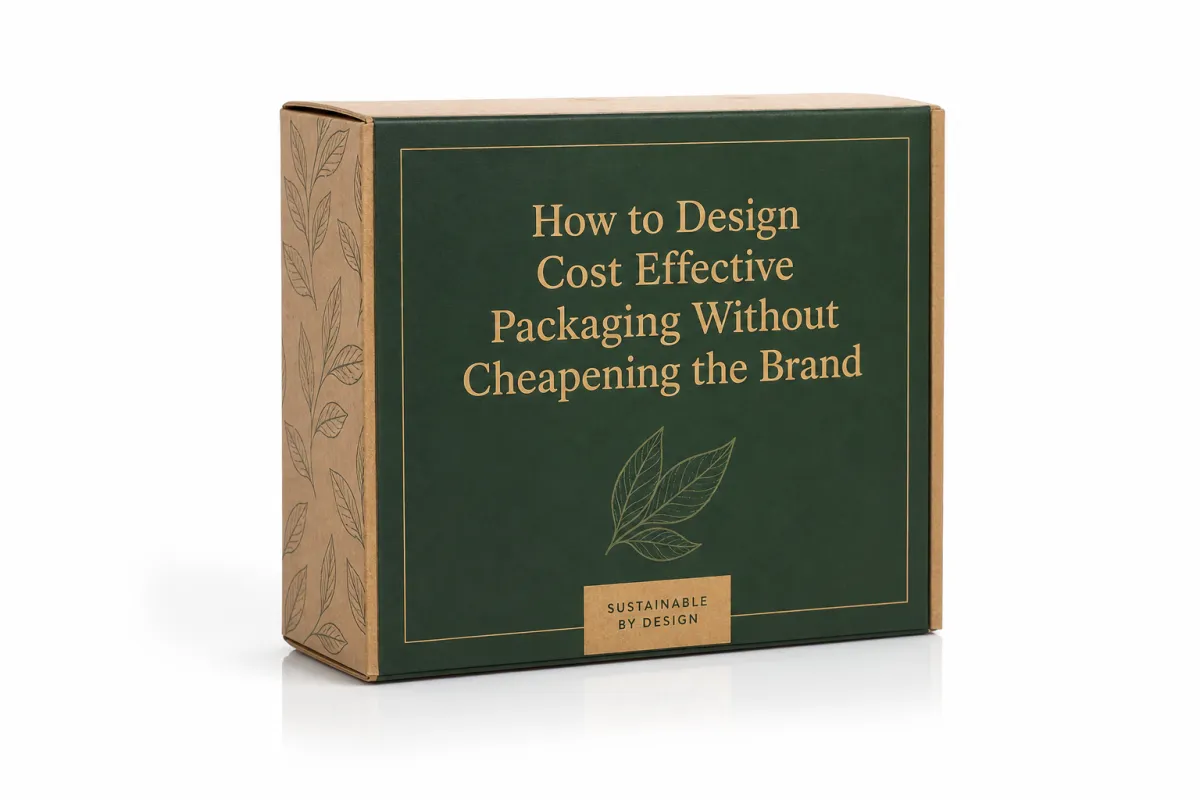
Picture a product shipped in a box that is obviously too big. The carton is safe. The box is ugly. The void fill is doing the work of a small warehouse. Freight costs are climbing because dimensional weight is punishing the oversize. That is a classic failure of how to design cost effective packaging. The package works, technically. The budget does not. Better packaging starts by asking what the box actually has to do, then stopping there instead of dressing it up with extra parts nobody asked for.
In practice, how to design cost effective packaging is won or lost before production starts. Once the structure is fixed, the print method is locked, and the shipping lane is decided, savings get harder to find. A buyer who spends time on size, structure, and assembly logic can usually cut cost without hurting the customer experience. That matters even more for branded packaging, because the box has two jobs: protect the product and represent the brand Without Wasting Money. Simple sounds boring. It also pays the bills.
There is a lazy assumption that lower cost always means lower quality. It does not. Sometimes the cheaper option is just the cleaner one. A folding carton with a precise insert can beat a more elaborate rigid box if the product is light, the presentation is controlled, and the transit route is simple. I have seen that play out more than once. The flashiest option is not always the smartest one, and that difference matters when you are serious about how to design cost effective packaging.
A packaging buyer should judge a box by total cost to serve, not by the first quote alone. A structure that saves five cents but adds labor, freight weight, or damage risk is not a savings. It is a trap with better typography.
One easy way to burn margin is to build around features that sound useful but do not actually move the business. Extra insert layers. Big windows. Heavy coatings. Fancy closures. They all look good in a mockup. They also cost money to build and more money to handle. If a feature does not improve protection, presentation, or packing speed, it deserves a hard look. That is the discipline behind how to design cost effective packaging: keep the parts that do real work and cut the rest.
Retail presentation and shipping performance need to stay separate until the final decision point. A shelf-facing carton may need stronger graphics and a more polished finish. A transit shipper may need more crush resistance and better edge protection. When those jobs get blended together, the design often gets heavier, more expensive, and harder to pack. A better approach is simple. Define the use case first. Build to that job, not to a mood board with a nice font and a lot of opinions.
For teams comparing options, the useful question is not, “What looks most impressive?” It is, “What version protects the product, fits the channel, and keeps the program efficient?” That is how to design cost effective packaging without cheapening the brand. Spend where customers notice. Save where they never will. Never save by creating returns. That part gets expensive in a hurry.
If you want to compare actual structures, browse Custom Packaging Products and look at how different formats affect material use, print area, and packing speed. Real choices beat theory every time.
How to Design Cost Effective Packaging With the Right Materials and Format
The material and format decision is where how to design cost effective packaging gets real. A folding carton, mailer, rigid box, sleeve, insert, and corrugated shipper all solve different problems. They also behave differently on cost. The cheapest structure in one program can be the wrong one in another. A light accessory may be perfect in a paperboard carton with a single-color insert. A fragile kit may need corrugated protection with a simple printed sleeve. The point is to match the format to the failure points, not the fantasies.
Board grade matters more than most teams expect. A slight bump in caliper can improve crush resistance, but it can also raise material cost and shipping weight. Print coverage Changes the Quote too. Full bleed artwork, heavy ink coverage, and specialty finishes all push the price up. If the goal is how to design cost effective packaging, the question is whether the artwork can be simplified without hurting recognition. Usually, yes. Strong typography, a disciplined color palette, and one clean logo placement can do more than a crowded surface with too many things trying to be memorable.
Standardizing sizes is another quiet win. If three SKUs can share one structural platform, the company can reduce tooling complexity, setup changes, and leftover inventory. That helps with storage, assembly, and reorders. Packaging waste often looks small on a single order. Across a product line, it becomes very real. From an operations angle, how to design cost effective packaging usually means designing for a family of products, not one isolated item that happens to be in front of you today.
I also tell teams to think about the line, not just the box. If a format takes two people to pack, needs extra tape, or slows down the shipping station, that labor cost shows up whether anyone planned for it or not. Packaging buyers love a neat unit price until the packout team starts muttering under their breath. Then the “cheap” option gets expensive.
| Format | Best Use | Typical Cost Behavior | Freight Impact | Assembly Labor |
|---|---|---|---|---|
| Folding carton | Light retail items, cosmetics, accessories | Lower tooling and material cost; print-friendly | Usually efficient if sized tightly | Low to moderate |
| Corrugated mailer | Ecommerce, direct-to-consumer shipments | Good balance of protection and cost | Often better than oversized shippers | Low |
| Rigid box | Premium presentation, gift sets, high perceived value | Higher unit cost, but can reduce insert complexity | Heavier than paperboard | Moderate to high |
| Sleeve with tray | Products needing visibility and simple branding | Can be efficient if the tray is standardized | Moderate, depending on tray material | Moderate |
| Corrugated shipper with insert | Fragile goods, multi-piece kits, heavy items | Strong protection, but material use must be controlled | Can rise quickly if oversized | Moderate |
The table makes the point clearly: how to design cost effective packaging is not about finding one universal winner. A rigid box can make sense when it removes multiple internal parts. A folding carton can be the right answer when the product is stable and presentation matters more than crush resistance. A corrugated mailer can save money in the shipping lane even if the unit box itself costs a bit more than paperboard. The right answer is the one that holds up after you count the whole path to the customer.
There is also a hidden cost in overengineering. Oversized boxes increase void fill, eat warehouse cube, and often raise dimensional weight charges. Extra coatings and premium finishes can do the same thing. In many cases, the best way to approach how to design cost effective packaging is to remove unnecessary complexity before asking for quotes. Cut anything that does not improve protection, presentation, or speed. If it only looks expensive, it probably is.
For teams that want a practical benchmark, compare the fully loaded cost of each format: board, print, finishing, labor, storage, and freight. That comparison usually shows that a simpler structure beats a “luxury” alternative once the whole program is counted. If you are building a packaging program from scratch, test a small set of options first. Guessing is a good way to buy regret.
Packaging Specifications That Control Cost Before Production Starts
The fastest way to improve how to design cost effective packaging is to control the specs before a quote becomes a purchase order. Dimensions, board caliper, closure style, print sides, finish choices, tolerances, and insert count all shape the final cost. If those details are vague, the quote will be vague too. The production team may also build in extra margin just to protect themselves from uncertainty. Clear specs keep that from happening.
Dimensions deserve special attention. A box that is only a little too large can trigger extra material use and higher shipping charges. A box that is too tight can slow packing and raise the risk of scuffing or deformation. That is why how to design cost effective packaging depends on exact product measurements, not estimates rounded off because somebody was in a hurry. When a product family shares similar dimensions, a single structural platform can often serve several SKUs with small insert changes.
Print decisions matter too. Each extra color, foil accent, emboss, deboss, spot UV, or soft-touch coating adds cost. Sometimes that spend is worth it because the finish really helps the product sell. A lot of the time it just makes the sample look fancier. A disciplined buyer asks one blunt question: does the finish help sell the product, or is it just there because everyone in the room liked it? That question sits near the center of how to design cost effective packaging.
Repeatability is easy to ignore until it becomes expensive. If a dieline works across multiple products, or if an insert supports more than one configuration, ordering gets easier and restocking gets cleaner. Production prefers predictable specs. Procurement does too. Finance definitely does. A good spec sheet is not paperwork for its own sake. It is a cost control tool that keeps small mistakes from turning into unnecessary runs.
Here is a simple approval checklist that prevents expensive revisions:
- Confirm product dimensions with packaging, not just product development.
- Verify the shipping method: parcel, mailer, retail display, or palletized freight.
- Lock the number of print sides and all finish effects before artwork begins.
- Approve the insert count and hold-down method early.
- Check fold direction, glue tabs, and assembly sequence.
- Confirm whether the packaging must pass a transit test such as ISTA.
That last point matters. If the package is going through parcel shipping, transit testing should not be an afterthought. The ISTA standards are commonly used for transit simulation, and they give buyers a practical way to verify performance under handling and vibration. If the program needs certified fiber sourcing, FSC documentation can matter too. The FSC framework is widely recognized for responsible forest management.
Once those controls are in place, how to design cost effective packaging gets easier to execute. The quote reflects the real job. The sample reflects the real need. The production run is less likely to drift into avoidable rework. That is the difference between a packaging spec and a wish list with a logo on top.
The best spec sheets are boring in the right way. They remove ambiguity. They name the tolerances. They state the finish limit. They define the insert material. They leave less room for mistakes and more room for savings.
Pricing, MOQ, and Where Packaging Budgets Usually Leak
Pricing is where how to design cost effective packaging either becomes a smart buying process or a blind comparison of numbers. A full quote usually includes tooling, setup, materials, print process, finishing, labor, packaging, and freight. If a buyer only looks at unit price, the cheapest box may end up being the most expensive once the rest is counted. Landed cost matters. A low carton price means very little if the box ships poorly, needs more packing time, or creates damage claims. I have seen that mistake turn a “saving” into a headache that lasts all quarter.
MOQ changes the math. Low runs usually carry a higher unit cost because setup is spread across fewer pieces. They also reduce inventory risk. Large runs usually lower unit cost, but they can trap cash in stock that does not move fast. The right MOQ is the lowest quantity that still gives a workable unit price without forcing dead inventory into the warehouse. That is a core rule in how to design cost effective packaging. It sounds obvious. People still mess it up.
Budget leaks usually show up in the same places. Rush changes are one. Last-minute artwork edits are another. Overbuying hurts, especially when dimensions or branding are still moving. Custom features that do not improve conversion or protection are another classic trap. A foil stamp may look premium, but if it adds labor, slows packing, and does nothing for sell-through, the business is paying for decoration instead of value.
Here is a practical comparison of how budget decisions can shift total cost:
| Decision | Lower Initial Cost | Hidden Cost Risk | Better Cost Effective Choice |
|---|---|---|---|
| Oversized box vs tight fit | Easy to spec | Higher freight and void fill | Tight fit with tested protection |
| Four-color print vs two-color print | Lower setup can be tempting | Higher print and ink cost | Strong limited-color branding |
| Foil and emboss vs clean flat print | Perceived premium look | Added finishing cost and lead time | Use special finishes only where they sell |
| High MOQ vs moderate MOQ | Lower unit price | Inventory storage and obsolescence | Quantity matched to demand visibility |
The comparison is blunt on purpose. How to design cost effective packaging is not about dragging the unit price down at any cost. It is about balancing unit cost, labor, freight, and inventory exposure. Sometimes the quote that looks a little higher wins because it removes a second packing step or reduces shipping damage. That is a better trade for the business, and the ledger will agree even if the first glance does not.
When you request pricing, ask for multiple quantity breaks. A quote at 1,000 pieces, 3,000 pieces, and 5,000 pieces usually shows where the unit cost drops in a meaningful way. Those breakpoints help buyers decide whether a larger run is actually efficient or just financially dressed up as a bargain. If a vendor only gives one number, you are missing half the picture. how to design cost effective packaging becomes much clearer once the pricing ladder is visible.
At Custom Logo Things, the useful approach is simple: look beyond the carton price and inspect the whole program. That includes print coverage, finish selection, shipping profile, and how much manual handling the package demands. A packaging plan should be easy to buy, easy to build, and easy to repeat. Anything else gets messy fast.
Process and Timeline: From Quote to Approved Sample
A clean process is one of the most underrated parts of how to design cost effective packaging. The normal workflow is straightforward: discovery, quote, structural review, artwork prep, prototyping, sample approval, production, and shipping. Each step gives the buyer a chance to remove waste before it turns into cost. Every late dieline change, every file fix, and every round of sample revisions costs time. Time is not free just because it does not show up as a line item right away.
Delays usually start with incomplete information. If a team sends a rough size instead of a measured product spec, the first sample may be wrong. If the shipping method is still undecided, the structure may be overbuilt just to be safe. If the artwork arrives without print-ready rules, the prepress team has to rebuild it. In other words, how to design cost effective packaging depends as much on process discipline as on design instincts.
Typical timelines vary, but a simple custom project often moves from proof approval to production in roughly 12 to 15 business days once the structure is locked and materials are available. More complex work takes longer. Custom inserts, specialty finishes, and multiple sample rounds can add several days or more. Buyers who plan early usually avoid rush premiums and extra freight charges, which is why the earlier the packaging team gets involved, the better the outcome usually is.
That early involvement also helps the team make smarter tradeoffs. If the package needs to be shelf-ready, the design can be tuned for display. If it ships direct to consumers, the format can be tuned for parcel efficiency. If the item belongs to a product family, one structure may serve multiple SKUs. This is where how to design cost effective packaging stops being a theory exercise and starts saving money. Small decisions stack up fast. That part is annoying, but it is also the good news.
To keep sample approval from turning into an endless loop, use a practical checklist:
- Check fit with the actual product, not a placeholder sample.
- Inspect closure strength and any glue or tuck behavior.
- Confirm print alignment, logo size, and barcode readability.
- Test assembly time with the people who will pack it.
- Review the package under shipping and shelf lighting.
The assembly-time check is especially useful. A package that saves a penny in materials but adds 20 seconds of handling time can become expensive very quickly at scale. That is why how to design cost effective packaging should always include labor. What feels tiny in a prototype turns serious once thousands of units hit the line.
The best projects also leave room for one honest question: does this version solve the real problem, or does it just look polished in a meeting? That distinction can save weeks. The first sample should be judged against product protection, packing speed, freight efficiency, and brand presentation. Not against how much effort went into making it look impressive.
Why Choose Us for Cost Effective Custom Packaging
For companies that want how to design cost effective packaging handled with discipline, the right partner is one that balances pricing, presentation, and protection instead of pushing the most expensive option. That is the practical value of working with a supplier that understands both manufacturing constraints and brand expectations. Good packaging is rarely about one dramatic feature. It is about the right combination of structure, print, and assembly.
What should a buyer expect from that kind of partner? First, practical material recommendations. If a lighter board grade will hold up just as well, that should be said clearly. If corrugated construction is better for shipping, that should be explained with the cost difference attached. Second, clear dieline guidance. A well-built structure saves more money than a cosmetic upgrade. Third, print optimization. Choosing the right number of colors, the right finish, and the right coverage can keep the design strong without inflating cost.
That level of support matters for branded packaging and retail packaging, where the visual impact has to justify the spend. Some buyers want luxury cues. Others need speed and consistency. Most need a little of both. The point is not to force a premium build when a simpler one works. The point is to match the packaging design to the business model. That is one reason how to design cost effective packaging gets easier when the supplier reviews the whole program instead of staring only at the artwork file.
There is also a trust issue. Packaging buyers want quotes they can compare, timelines they can believe, and samples that reflect the final job. They do not want vague promises. They want predictability. That is where experience matters. A supplier who sees the full process can spot cost savings across the job, including details that never make it onto the quote sheet but still hit the budget. That kind of calm, unglamorous help is worth more than a slick sales deck.
When you compare suppliers, ask what happens before production starts. Do they check fit? Do they flag oversized specs? Do they recommend better material usage? Do they explain how finish choices affect lead time? Those questions separate a transactional vendor from a packaging partner. Once the product line grows, that difference stops being theoretical and starts being expensive.
If the goal is to create custom printed boxes that protect the product, stay on brand, and keep the budget sane, the supplier should be part engineer, part cost analyst, and part translator. That mix is what makes how to design cost effective packaging work in actual operations instead of only in a deck. I would rather have a supplier push back on a bad spec than nod politely and invoice the chaos later.
For teams building out a packaging line, Custom Packaging Products is a practical place to compare formats, finishes, and structural options before locking the final spec. Better comparison means less guesswork. Guesswork has a habit of showing up later with a price tag.
Next Steps to Lock in a Cost Effective Packaging Plan
If you want to turn how to design cost effective packaging into a working plan, start with the inputs that drive every real quote: product dimensions, target quantity, shipping method, artwork status, and budget range. Those five items tell a supplier far more than “we need a box.” They define the structure, the print method, the MOQ, and the likely cost behavior. Without them, pricing is just a rough guess wearing a confident face.
Then ask for two or three quote scenarios. One can focus on the lowest material use. One can include a middle option with improved presentation. One can test a premium finish or alternative insert. Comparing them side by side helps the buyer see where the money is going and which tradeoff actually makes sense. That is a strong way to approach how to design cost effective packaging because it turns a vague request into a decision framework.
The sample review should be equally disciplined. Check fit, protection, appearance, assembly time, and freight efficiency before approving full production. If a sample looks great but takes too long to pack, it is not finished. If it protects the item but bumps up the shipping class, it may need revision. A good packaging buyer respects the whole system, not just the one variable that looks best in a screenshot.
Here is a final planning rule that holds up well: the earlier the packaging team gets involved, the more options there are to simplify the structure and cut cost. Late-stage packaging work tends to be defensive. Early-stage packaging work tends to be strategic. That difference is often the line between a profitable launch and a margin leak.
So the next move is clear. Build a spec that reflects real product risk. Choose the simplest format that does the job. Compare pricing at multiple quantities. Keep the design focused on what the customer actually sees. That is how to design cost effective packaging in a way that protects margin, supports the brand, and keeps the production team out of avoidable trouble. The takeaway is simple: lock dimensions first, simplify finishes second, and price at several quantities before you approve art. Do that in order, and the package stops being a cost mystery.
How do I design cost effective packaging without reducing protection?
Start with the product's real failure points, then build the structure around those risks instead of adding generic padding. Use the smallest practical box size and the right insert so the product stays secure without excess filler. Test samples for drop resistance and shipping fit before approving production. That is the practical side of how to design cost effective packaging. If you skip testing, you are basically guessing with a budget attached.
What packaging specs have the biggest impact on cost effective packaging?
Dimensions, board grade, print coverage, finish choices, and insert count usually drive the biggest cost differences. Reducing oversized packaging often cuts both material use and dimensional shipping charges. Simplifying closure and assembly can also lower labor cost at packing time, which is why how to design cost effective packaging depends on the spec sheet as much as the artwork. A tiny spec change can ripple through the whole job.
What MOQ is best when trying to keep packaging cost effective?
The best MOQ is the lowest quantity that still gives a workable unit price and does not create excess inventory risk. Ask for pricing at several quantity tiers so you can see where per-unit cost drops sharply. If demand is uncertain, a smaller run may be more cost effective than overbuying, especially when learning how to design cost effective packaging for a new product. A warehouse full of old boxes is not a savings account.
How long does the cost effective packaging process usually take?
Most timelines depend on artwork readiness, sample approval speed, and the complexity of the structure. Simple jobs move faster; custom inserts, specialty finishes, and multiple revision rounds add time. Planning early usually avoids rush fees and keeps the project on budget, which is why how to design cost effective packaging is also a scheduling question. A slow approval cycle can cost more than a better box ever would.
Which packaging format is usually the most cost effective for custom products?
The most cost effective format is the one that fits the product with the least material and the fewest production steps. For many items, a well-sized folding carton or corrugated mailer beats a more elaborate box if the brand experience stays intact. The right answer depends on product weight, shipping method, and presentation goals, so how to design cost effective packaging always starts with the use case. There is no magic format that wins every time.

