Buyer Fit Snapshot
| Best fit | Improve Your Packaging Sustainability Score Today projects where brand print, material claims, artwork control, MOQ, and repeat-order consistency need to be specified before quoting. |
|---|---|
| Quote inputs | Share finished size, material target, print colors, finish, packing count, annual reorder estimate, ship-to region, and any compliance wording. |
| Proofing check | Approve dieline scale, logo placement, barcode or warning zones, color tolerance, closure strength, and carton packing before bulk production. |
| Main risk | Vague material claims, crowded artwork, missing packing details, or unclear freight terms can make a low unit price expensive after revisions. |
Fast answer: Improve Your Packaging Sustainability Score Today: Material, Print, Proofing, and Reorder Risk should be specified like a repeatable production item. The safest quote records material, print method, finish, artwork proof, packing count, and reorder notes in one written spec.
Production checks before approval
Compare the actual filled-product size with the drawing, then confirm tolerance on folds, seals, hang holes, label areas, and retail display edges. Reserve space for logos, QR codes, warning copy, and material claims before decorative graphics fill the panel.
Quote comparison points
Review material grade, print process, finish, sampling route, tooling charges, carton quantity, and freight assumptions side by side. A quote is only useful when the supplier can repeat the same color, closure quality, and packing count on the next order.
A better packaging sustainability score usually starts with a less glamorous truth: most packs are carrying extra weight, extra material, or extra complexity that adds little value to the product. Trim a carton by 10%, remove a redundant layer, or simplify a closure, and the score can move faster than a full visual overhaul built on the wrong structure. For anyone figuring out how to Improve Packaging Sustainability score without making the pack fragile or expensive, the quickest gains usually come from the most measurable changes.
That matters because buyers, retailers, and internal review teams rarely respond to vague promises. They respond to evidence. Recycled content, right-sized dimensions, freight weight, verified claims, and a lower carbon footprint all carry more weight when they can be traced back to a spec sheet, a test report, or a supplier declaration. In branded packaging and retail packaging alike, the pack has to protect the product, satisfy the scorecard, and still make financial sense.
Many teams get the sequence backward. They lock in package branding before they map the structure. They approve Custom Printed Boxes before they count inserts, coatings, and closures. That approach costs more and hides the easiest wins. A pack can look premium and still waste fiber, resin, air, and shipping dollars. I have seen more than one pretty concept fall apart the moment the warehouse team asks, quite reasonably, how it is supposed to survive a pallet ride and a cross-country lane.
The real question is not whether eco-friendly packaging sounds good. It is how to improve packaging sustainability score in a way that raises efficiency, improves documentation, and protects performance at the same time. The sections below break down the score, the levers that matter most, and the timelines and costs that usually appear once a team starts making changes that stick.
How to Improve Packaging Sustainability Score: Why Small Changes Matter
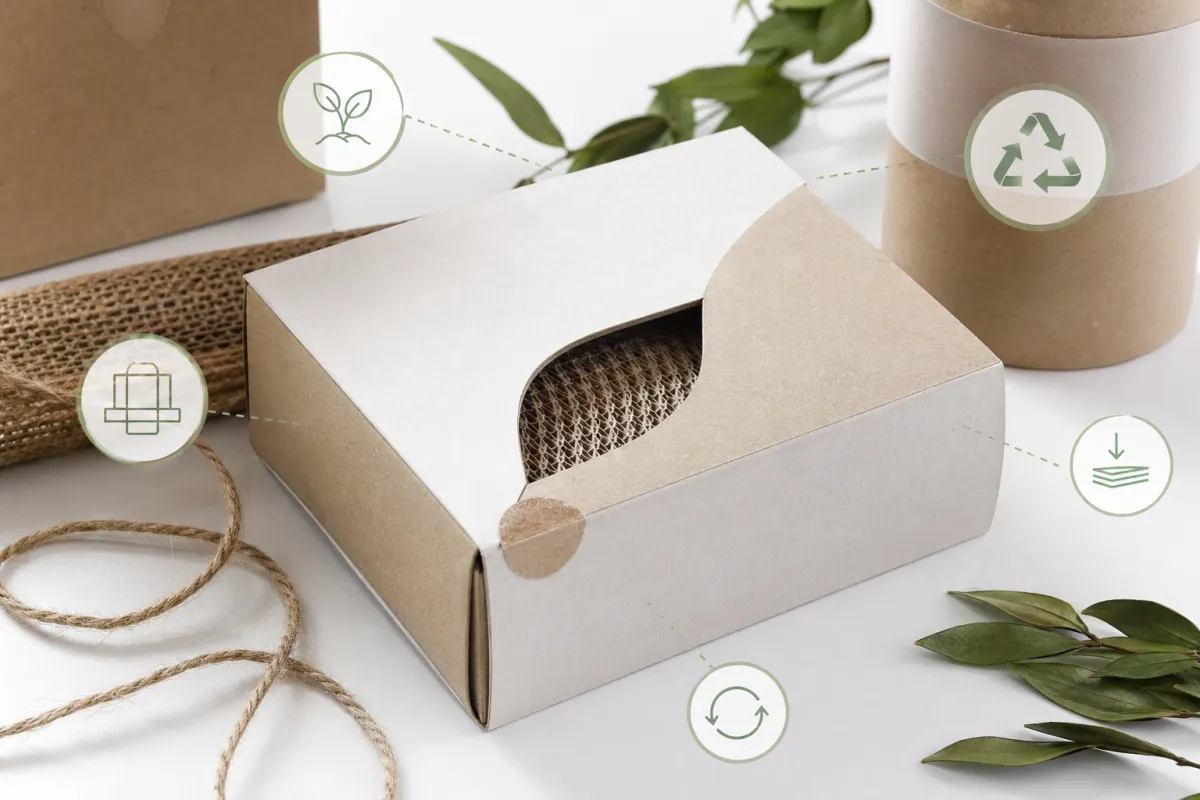
Teams asking how to improve packaging sustainability score often imagine a total redesign. Those projects can help, though the most reliable gains usually come from smaller corrections. A carton that sheds a quarter ounce, a tray that removes a secondary sleeve, or a label stock that is easier to separate can move the metric more than a dramatic visual refresh that keeps the same wasteful structure underneath.
Score systems tend to reward measurable efficiency. Material use per unit, recovery options, recycled or renewable content, and package-to-product fit all factor in. A pack designed around what the product actually needs scores better than one designed around what the design team wanted on the shelf. If the old format used 18% more fiber than necessary, the stronger move may be reducing dimensions by half an inch in each direction rather than switching to a more expensive substrate with the same oversized footprint. How to improve packaging sustainability score is often a math problem before it is a design problem.
A portfolio effect makes the change even more interesting. One SKU with a bulky insert may look harmless on its own, yet if 40 SKUs share the same structure family, one correction can ripple across an entire line. Teams miss easy wins when they judge each pack in isolation. The issue sits in the shared spec, the shared die line, or the shared supplier standard. The same mistake can repeat across Custom Printed Boxes, mailers, folding cartons, and retail packaging displays.
Small changes matter for another reason: the score rarely lives alone. It can affect retailer approval, sustainability reporting, procurement decisions, and internal packaging standards. Once the score improves, the business conversation gets cleaner. The buyer can defend the spec. Procurement can compare suppliers more cleanly. Operations can show lower freight weight or reduced damage. That is a better position than having a beautiful pack that nobody can explain.
Packaging reality: a package that is 10% smaller can reduce corrugated usage, pallet cube, and transport emissions in one move. A package that removes one nonessential component can cut waste and speed assembly. That is why how to improve packaging sustainability score is not an abstract sustainability question. It is a practical packaging efficiency question with direct effects on margin and service levels.
For teams building a roadmap, keep the goal simple: improve score without creating a more expensive or more fragile pack. The strongest designs usually do both because they remove excess structure instead of dressing it up. If you need a starting point, review the structural options in Custom Packaging Products and compare them against the current format rather than against a wish list.
How to Improve Packaging Sustainability Score by Understanding the Scoring Model
You cannot improve what you do not measure. The line sounds obvious, yet it explains why so many teams stall after the first meeting. How to improve packaging sustainability score becomes much easier once the scorecard is clear: material type, recycled or renewable content, source certification, package-to-product ratio, recyclability, compostability, and transport efficiency. Different frameworks weigh those inputs differently, but the core logic stays the same. Less waste, more recoverability, stronger proof.
Most scorecards do not reward claims alone. They want documentation. A pack labeled "eco-friendly" without recycled content data, certification records, or disposal guidance is weak on score and weak on trust. By contrast, a simple FSC-certified paperboard spec, a verified PCR percentage, or a test report tied to the exact SKU can move the number because it can be audited. If you are working through how to improve packaging sustainability score, paperwork belongs in the design process, not in the cleanup phase.
The same pack may score well in one system and poorly in another. One buyer may care most about recycled fiber and recoverability. Another may penalize mixed materials, metallized films, or closures that are difficult to separate. A third may focus on freight density because the carbon footprint shows up in logistics data. A package can look sustainable on the shelf and still miss the mark in a procurement file.
Baseline comparison is the other nonnegotiable piece. A score only improves when there is a before-and-after reference tied to the same SKU or format family. If a team changes packaging and loses track of the original bill of materials, the improvement becomes hard to prove. The best teams keep a simple scorecard: old weight, new weight, recycled content, certification status, damage rate, and disposal path. That gives the packaging design team a clean way to show progress and keeps the discussion grounded in data.
Scorecards also expose where materials are fighting the package. Mixed laminations, thick coatings, unnecessary barriers, and decorative components that cannot be separated usually lose points first. The problem is not always the substrate itself. Sometimes the issue sits in the glue, the ink, or the sealant. If the structure cannot be sorted, pulped, or recovered in a reasonable way, the metric usually reflects that.
A better score usually comes from fewer surprises, not fancier claims. If the structure is simple, the data is clean, and the disposal path is obvious, the rest of the discussion gets much easier.
For teams that want a reference point on test discipline, the ISTA test methods are worth a look. They connect packaging performance to distribution reality, which is where many sustainability claims either hold up or fall apart. The EPA sustainable materials guidance is useful for thinking about waste prevention, recovery, and system-level impact. Some scorecards also reflect life cycle assessment logic, rewarding lower material intensity and better end-of-life outcomes.
Once the scoring model is clear, the next question becomes practical: which changes move the number fastest? Material choice, right-sizing, end-of-life design, freight efficiency, and proof points each play a different role. The answer is usually not one dramatic change. It is a sequence of small, verified moves that build on one another.
Key Factors That Move the Score Faster
The fastest route for how to improve packaging sustainability score usually begins with material selection. Compare virgin resin, recycled content, fiber grade, coatings, and barrier layers before you look at cosmetics. A thinner wall or lower basis weight may improve the score, but only if the structure still protects the product and matches the distribution cycle. Otherwise, damage claims can wipe out the gain. In packaging, a weak pack is not sustainable just because it uses less material.
Right-sizing is often the next major lever. Oversized cartons, extra headspace, and overbuilt inserts create a hidden tax on score and cost. If a product can move from a 14 x 10 x 8 inch shipper to a 12 x 9 x 7 inch shipper without raising transit damage risk, the package-to-product ratio improves, pallet efficiency improves, and freight waste drops. That is cleaner than adding a premium finish that changes nothing underneath. Teams that focus on how to improve packaging sustainability score through right-sizing usually see gains sooner than teams chasing a wholesale material swap.
End-of-life design carries real weight too. Mono-material structures tend to score better than mixed-material packs because they are easier to recover. The same logic applies to labels, adhesives, and closures that can be removed or processed without special handling. A paperboard carton with a plastic window may still work, but if the window is unnecessary, removing it often improves recovery and the score. Clear disposal instructions matter as well, especially in retail packaging where consumers need simple direction at the bin.
Supply chain impact can improve the metric indirectly. Shorter lanes, lighter packs, and fewer damaged shipments cut waste and transport emissions. Carbon footprint discussions should not stop at the material level. A heavy insert that prevents breakage in one lane may still be a poor decision if it adds more emissions and material than the alternative. The right answer depends on the product, the route, and the protection required.
Proof points are the final accelerator. Third-party certifications, chain-of-custody records, and test data can convert a good design into a better-scoring one because the claim becomes auditable. FSC certification for fiber, supplier declarations for recycled content, and test records tied to the exact structure make the score easier to defend. If the claim cannot be verified, many systems treat it as noise. That is a common reason teams think they improved the score while the scorecard says otherwise.
- Material type: rank substrates by recycled content, recyclability, and barrier needs.
- Weight: remove grams where protection still holds.
- Component count: reduce inserts, layers, and mixed parts.
- Certifications: keep proof in one file for audit readiness.
- Damage rate: track returns and transit losses, not just material savings.
If the structure needs a redesign, start with a format family that can be simplified without forcing new machinery or a long qualification process. That is where eco-friendly packaging options can help, especially if the current pack is carrying unnecessary layers or overbuilt board grades. The right option is not always the greenest-sounding one. It is the one that improves score and still performs.
For teams with multiple SKUs, ranking each package by improvement potential is usually the smartest move. A bulky mailer might move the score by 30 points with one change. A highly optimized carton might only move by 4 points no matter how much effort goes into it. That kind of ranking helps packaging design teams spend time where the return is greatest. It also keeps the work from drifting into a pleasant but pointless design exercise, which happens more often than people admit.
How to Improve Packaging Sustainability Score Step by Step
A step-by-step process keeps the work from getting fuzzy. If the goal is how to improve packaging sustainability score across a portfolio, begin with the highest-volume or highest-waste items first. That is usually where the biggest gains live. One carton that ships 2 million units a year deserves more attention than five niche packs that move a few thousand units each.
- Run a portfolio audit. Pull the bill of materials, current pack dimensions, shipping data, complaint history, and material specs for each target SKU.
- Map every component. List board, film, adhesive, coating, ink, label, closure, and insert so nothing stays hidden.
- Choose one primary improvement goal. Decide whether the first pass is about less material, higher recycled content, better recyclability, or lower shipping weight.
- Prototype the new structure. Build samples early enough to test compression, drop performance, moisture resistance, and shelf presentation.
- Document the evidence. Save supplier declarations, recycled content records, test data, and disposal instructions in the same folder.
- Roll out in phases. Convert one SKU, one region, or one customer channel first so the team can watch performance before scaling.
That sequence sounds simple, and it saves time. Teams often reverse it. They buy a new look first, then try to justify the structure later. That is backward. If you want how to improve packaging sustainability score to become a repeatable process, the specification has to lead the artwork, not the other way around. Packaging buyers know this problem well: a pretty structure that cannot be supported by production data is a liability.
Testing deserves a careful note. Do not skip distribution testing because the redesign is "only" a paper change or a minor wall reduction. Small changes can alter compression resistance, seal integrity, and corner crush more than people expect. A lighter carton that fails in transit does not improve sustainability. It creates rework, waste, and delays. That is why many teams use ISTA-style testing and keep the same test profile for both old and new packs so the comparison is fair.
For branded packaging, the temptation is to preserve the visual system at all costs. The better approach is to preserve the brand cues that matter most and cut the rest. Color, typography, and logo hierarchy can survive on a smaller or simpler structure. Embossing, specialty coatings, and multi-step assembly often do not need to. That tradeoff is where product packaging becomes more disciplined and less decorative.
A useful rule: if a component does not protect, inform, or help recovery, question it. That includes hidden layers, oversized inserts, and embellishments that exist mainly because the old spec always had them. The hard part of how to improve packaging sustainability score is not finding ideas. It is deleting the wrong ones. And yes, that can feel a bit awkward the first time a team kills a feature everyone had grown used to.
Process and Timeline: What to Expect From Audit to Rollout
Most teams want to know how long how to improve packaging sustainability score takes in practice. The honest answer is that it depends on the scale of change, the number of stakeholders, and whether tooling is involved. A simple paperboard adjustment can move quickly. A full format change with new inserts, new artwork, and compliance review takes longer.
Week 1 to 2 usually goes into the baseline: bill of materials, artwork files, supplier specs, waste or damage data, and current freight dimensions. That work is not glamorous, but it matters because it shows where the score starts. In week 2 to 4, redesign concepts get reviewed, material quotes get requested, and score impact gets weighed against performance and cost. That is the stage where teams often learn that a lower-weight spec may also reduce pallet count or simplify packing labor.
By week 4 to 8, sample creation and testing tend to take over. Samples need to survive the same distribution conditions as the original structure. If the original pack rides in a hot, humid lane, the new one should be judged there too. If a custom printed box uses a different coating or liner, the sample needs to prove that print quality and durability still hold. This is the point where many teams sharpen their answer to how to improve packaging sustainability score without creating a quality problem.
From week 8 to 12, the project usually moves into approval, artwork updates, compliance review, and production scheduling. That timeline can stretch if tooling is required or if the team has to use existing inventory before switching. Regulatory review, retailer approval, and cross-functional signoff can add more time. The more suppliers involved, the slower the release tends to be. A clean packaging change often spends longer in approvals than in testing.
| Packaging Change Path | Typical Upfront Cost | Score Impact | Timeline | Best Use Case |
|---|---|---|---|---|
| Right-size existing corrugated | $0.05-$0.18 per unit | Moderate to high | 2-6 weeks | Oversized shippers, excess void fill |
| Shift to recycled-content paperboard | $0.03-$0.12 per unit | Moderate | 4-10 weeks | Retail packaging, folding cartons |
| Move to mono-material structure | $0.08-$0.25 per unit | High | 6-12 weeks | Mixed-material packs, hard-to-recycle formats |
| Tooling-led structural redesign | $0.15-$0.40 per unit equivalent | High | 8-16+ weeks | Complex product packaging with custom inserts |
Lead times also depend on inventory. If the warehouse holds eight weeks of old stock, the rollout has to wait or the business risks wasting inventory. That is a hidden cost in many packaging design projects. Teams budget for material and tooling, but they underestimate the conversion drag from old packaging, printed inventory, and old labels. A clean plan accounts for that from the start. Otherwise the project looks finished on paper and stalled in the warehouse, which is a kind of delay everybody notices.
For buyers sourcing custom printed boxes or branded packaging at scale, this is where the supplier conversation turns strategic. Ask for proof of recycled content, request the test standard used, and confirm whether the production line can hold the same spec consistently across all runs. If the supplier cannot document the structure, the score improvement may not survive audit. Custom printed boxes for sustainable packaging goals only help when the specs are repeatable.
The timeline lesson is simple: speed comes from clarity. Clear baseline, clear target, clear test method, clear signoff path. That is how to improve packaging sustainability score without turning the project into a six-month argument about ownership.
Cost and Pricing: What Better Scores Usually Change
Cost is where good intentions get tested. Teams often ask how to improve packaging sustainability score and assume the answer will be expensive. Sometimes it is. Often it is not. A slightly pricier material can lower freight, damage, and disposal costs enough to improve the business case. In other cases, the more sustainable option is cheaper because it removes excess board, simplifies assembly, or ships flatter.
The key is to compare total cost, not just material cost. A carton that saves two cents on board but raises damage by 1.5% is probably a bad trade. A carton that costs four cents more but cuts returns, repacking, and freight waste can be the right move. Packaging buyers know this better than most: the invoice price rarely tells the whole story. Landed cost, labor, waste, and customer experience all belong in the same calculation.
MOQs, print changes, and tooling can affect the first quote even when the long-term unit cost looks better. That is common in custom packaging. If a design needs a new die, a new plate, or a new cut path, the first run will carry setup charges that make the unit price look worse than it really is. The real question is what happens after changeover. Once volumes normalize, the unit economics may improve significantly.
Here is a practical way to think about the price conversation for how to improve packaging sustainability score: break the business case into procurement savings, freight savings, waste reduction, and brand value. Not every retailer cares about the same proof, and not every channel values the same improvements. For some businesses, a better score helps with supplier qualification. For others, it reduces customer complaints or supports an internal ESG target that leadership already tracks.
There is also a category effect. Premium branded packaging often tolerates a small cost increase if the structure simplifies the experience or reduces damage. Commodity product packaging usually needs the savings to show up immediately. That is why packaging design should be tied to the sales channel. Retail packaging, direct-to-consumer packaging, and wholesale shippers do not share the same cost logic.
To make the comparison easier, here is a simple model often used in sourcing reviews:
| Option | Typical Unit Change | Score Effect | Commercial Upside | Commercial Risk |
|---|---|---|---|---|
| Remove unnecessary insert | -$0.03 to -$0.10 | High | Lower material and labor cost | Possible product movement if testing is weak |
| Upgrade to verified recycled content | +$0.02 to +$0.12 | Moderate to high | Better audit trail and buyer acceptance | Quote variation by supplier and region |
| Switch to mono-material pack | -$0.01 to +$0.15 | High | Cleaner recovery story and simpler claims | May require resealing or requalification |
| Right-size shipping carton | -$0.04 to -$0.20 | High | Freight efficiency and lower void fill | Needs careful product fit validation |
For leadership teams, frame the discussion around margin, risk, and operational simplicity rather than sustainability alone. That is not cynical. It is effective. If the redesign lowers waste, reduces freight, and improves the score, it becomes easier to defend. If it only sounds greener, approval gets much harder. That is especially true when the change touches multiple SKUs or requires suppliers to rework the line.
If you need a more flexible starting point, compare standard structures and formats before you commit to a custom build. The right box or mailer family can often be tuned to improve the score without inflating cost. A practical supplier comparison should answer three questions: what is the unit cost, what is the test result, and what claim can be documented?
Common Mistakes, Expert Tips, and Next Steps
The biggest mistake is chasing a greener-looking material without checking recoverability. A glossy change can sound impressive and still score poorly if the material mix is harder to recycle than the original. Another common error is increasing weight to improve protection without asking whether the added material actually prevents damage. If it does not, the extra grams are just dead weight in the system. That is why how to improve packaging sustainability score should always include functional testing.
Unverified claims are another trap. If a supplier says a pack contains recycled content but cannot support the percentage with declarations or traceable paperwork, the scorecard may treat that claim as unusable. The same issue comes up with compostable or recyclable claims that do not match local recovery systems. A pack can be theoretically recoverable and still fail in practice because the region cannot process it. Trust the system, but verify the path. That approach saves a lot of awkward meetings later.
Expert tip: score the full package, not just the substrate. Labels, closures, inserts, coatings, adhesives, and finish choices often decide whether the pack is actually recoverable. A recycled paperboard carton with a difficult laminate can lose ground quickly. A simpler design with clean adhesives and straightforward disposal instructions can outperform a more expensive-looking structure. That is one of the easiest ways to improve score without making the customer experience worse.
Expert tip: pilot one high-volume SKU before changing the whole line. That lets the team learn from actual production, shipping, and customer feedback. If the new structure passes, the data becomes a sales tool for the next phase. If it fails, the correction is contained. You avoid spreading one bad assumption across the entire portfolio. That approach is especially useful in custom packaging programs where every SKU can tempt the team to make a different exception.
Next step: build a one-page scorecard that tracks material efficiency, recycled content, damage rate, freight weight, and claim documentation for each key package. Keep it simple enough that procurement, operations, and marketing can all read it. If a metric cannot be understood in five minutes, it will not get used consistently. That scorecard becomes the operating tool for how to improve packaging sustainability score over time.
Next step: set a 30-day action plan. Pick the top three packaging changes that most improve packaging sustainability score and assign an owner to each one. One person should own structural fit, one should own supplier data, and one should own testing and rollout. That division reduces confusion and speeds decisions. It also keeps the work tied to real output instead of loose intentions.
Finally, do not assume the most visible change is the most effective one. Sometimes the best win sits inside a wall thickness, a label adhesive, or a shipping dimension nobody questioned for years. That is the odd part of packaging work. The biggest sustainability gains often come from the least glamorous corrections. Kinda annoying, yes, but useful.
If you are mapping the next revision, use the current structure as your benchmark, not a theoretical ideal. Then compare it against the actual performance requirements, the available materials, and the documentation you can support. That is how to improve packaging sustainability score in a way that holds up with retailers, procurement teams, and internal review. The practical takeaway is simple: start with the highest-volume SKU, remove one nonessential component, test it under the same conditions as the original, document the result, and roll that lesson into the next pack.
How do you improve packaging sustainability score?
The simplest path is to start with source reduction, right-sizing, and verified documentation. Remove unnecessary material, simplify mixed components, and confirm recycled content or recovery claims with supplier records. Then test the new pack against the same distribution conditions as the old one so the score improvement is real, not just theoretical. That is the clearest answer to how to improve packaging sustainability score.
How do I improve my packaging sustainability score without raising costs too much?
Start with right-sizing and source reduction, because removing unused material often improves the score and lowers freight at the same time. Compare total cost, not just material cost, since damage reduction and easier fulfillment can offset a slightly higher unit price. Pilot the change on a high-volume SKU first so you can prove savings before rolling out across the full line. That is usually the fastest answer to how to improve packaging sustainability score without creating budget friction.
What packaging changes usually improve sustainability score the fastest?
Reducing package size, removing extra layers, and switching to mono-material structures are often the quickest wins. Using verified recycled content and cleaner adhesives can improve the score without changing the product experience much. The fastest gains usually come from formats with obvious excess material or mixed components, especially in retail packaging and shipping cartons. In many cases, how to improve packaging sustainability score is mostly about removing complexity.
How long does it take to improve packaging sustainability score?
A basic audit can take one to two weeks if your specs and supplier data are organized. Design, testing, and approval often take four to twelve weeks depending on tooling, inventory, and compliance checks. If a change needs new tooling or a full artwork update, plan for a longer rollout. The answer to how to improve packaging sustainability score gets faster when the baseline is already documented.
Does better sustainability packaging always cost more?
No. Many changes save money by removing material, reducing freight weight, or cutting damage claims. Some formats do cost more upfront because of recycled inputs, certifications, or tooling, but the long-term economics can still improve. The real question is whether the redesign lowers total landed cost and improves the score at the same time. That is why how to improve packaging sustainability score should be evaluated as both a sustainability and sourcing decision.
What proof do I need to support a higher sustainability score?
Keep supplier declarations, recycled content data, test reports, and certification records in one place. Document the before-and-after package structure so the score improvement is easy to verify. If your claim depends on recyclability or compostability, match it to the specific recovery system and region. Clear proof is what makes how to improve packaging sustainability score credible to buyers, auditors, and internal stakeholders.


