Buyer Fit Snapshot
| Best fit | Optimize Corrugated Box Nesting for Lower Costs projects where brand print, material claims, artwork control, MOQ, and repeat-order consistency need to be specified before quoting. |
|---|---|
| Quote inputs | Share finished size, material target, print colors, finish, packing count, annual reorder estimate, ship-to region, and any compliance wording. |
| Proofing check | Approve dieline scale, logo placement, barcode or warning zones, color tolerance, closure strength, and carton packing before bulk production. |
| Main risk | Vague material claims, crowded artwork, missing packing details, or unclear freight terms can make a low unit price expensive after revisions. |
Fast answer: Optimize Corrugated Box Nesting for Lower Costs: Board, Finish, Dieline, and Unit Cost should be specified like a repeatable production item. The safest quote records material, print method, finish, artwork proof, packing count, and reorder notes in one written spec.
Production checks before approval
Compare the actual filled-product size with the drawing, then confirm tolerance on folds, seals, hang holes, label areas, and retail display edges. Reserve space for logos, QR codes, warning copy, and material claims before decorative graphics fill the panel.
Quote comparison points
Review material grade, print process, finish, sampling route, tooling charges, carton quantity, and freight assumptions side by side. A quote is only useful when the supplier can repeat the same color, closure quality, and packing count on the next order.
How to Optimize Corrugated Box Nesting for Lower Costs
After years of working with cartoning programs that run through freight spikes and supplier changes, I keep seeing one truth repeat itself: a tiny geometric correction can beat a polished finishing upgrade any day. A one-inch shift in a corrugated blank can save more board than a new print treatment, which is why how to optimize corrugated box nesting sits at the center of smart packaging decisions. In practice, the best layouts are the ones that protect structural strength, run cleanly on the folder-gluer, and keep scrap moving down by pallet bay instead of by hour. If your catalog mixes multiple sizes, the upside compounds because a strong pattern can improve yield across SKU families instead of helping only one carton.
For teams placing recurring freight orders, I’ve seen nesting checked only after artwork sign-off, and that timing usually creates avoidable churn. A layout that looks elegant on CAD can underperform against Custom Shipping Boxes, common board stock, and actual pick-and-pack motion. The value of how to optimize corrugated box nesting appears where design intent, stock behavior, and conversion reality collide. Board utilization, die-cut tolerance, and flute direction all affect the result in ways a spreadsheet rarely captures fully.
Most teams fight the marketing layer first and ask production questions later. I like to flip that order because blank geometry, flap strategy, and how many cartons can share one sheet without compromising fold quality usually decide the final cost outcome. A small structural tweak can lift yield by several percentage points on high-volume runs, and then finance notices it almost immediately once output goes beyond five digits.
What Does How to Optimize Corrugated Box Nesting Mean?
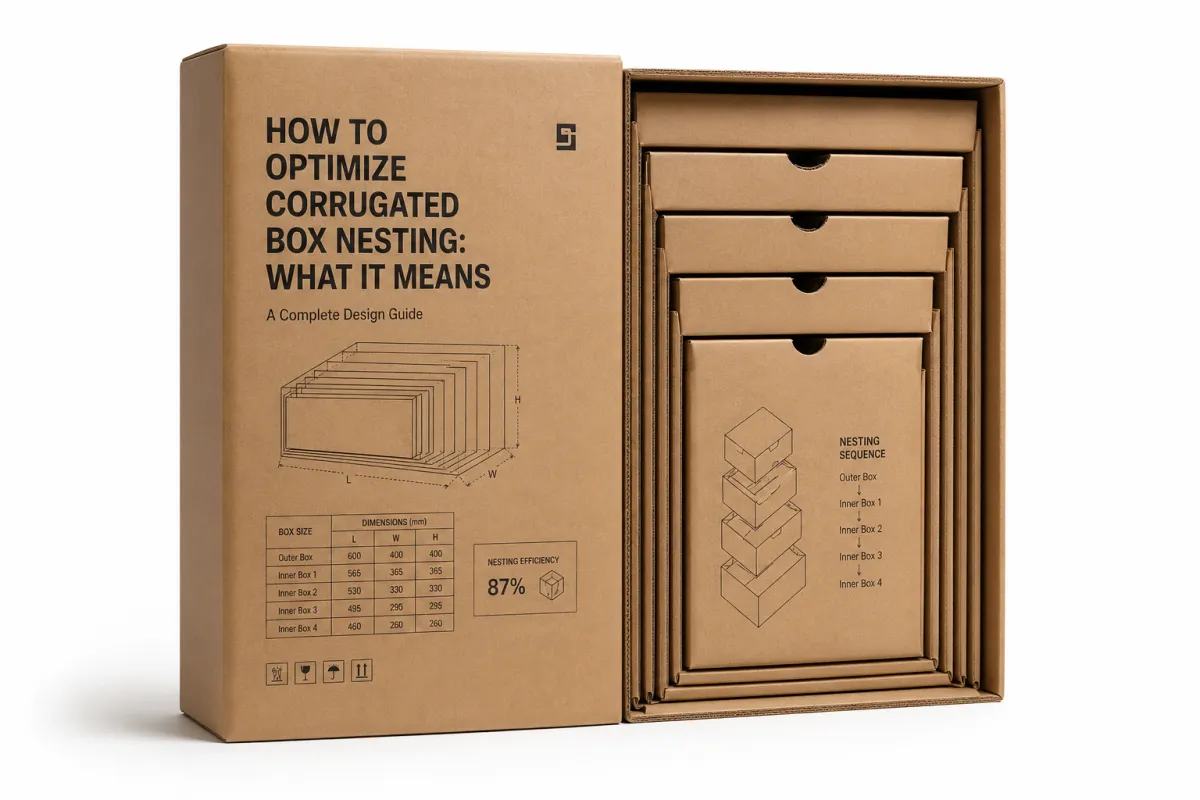
How to optimize corrugated box nesting is not just a digital puzzle of packing shapes; it is Choosing the Right relationships so the final nested sheet still converts predictably at volume. At its core, it means placing multiple box blanks on one parent sheet to maximize usable area while preserving conversion quality. Rotation, mirroring, spacing, and clearances are set on paper first, but the real test begins when the die first bites into corrugated.
Here is a practical example from the floor. A team I worked with shifted a tuck location by only a few millimeters on a recurring carton family. The box looked identical to customers, yet two additional blanks fit on the same sheet and trim strips dropped enough to improve yield by roughly 2% to 5%. In a 10,000-sheet pilot it looked like a small correction; by the time the rerun hit 250,000 units, that small correction covered multiple shifts of waste.
Nesting carries consequences far beyond density:
- Waste, because every square inch left unused on board is either scrap or money in waiting.
- Sheet yield, which determines blanks delivered per sheet and directly affects procurement forecasts.
- Die layout, where bridge spacing, pin access, and clearance define what is actually buildable.
- Stacking, because a sheet that packs cleanly in software can misbehave once folded and palletized.
- Economics, since material, make-ready, labor, and freight all move when layout strategy changes.
A dense look can fool people into thinking it is the best solution. A tight arrangement may save board on paper yet increase risk where it matters: score integrity, edge crush path, and flute orientation. Packaging teams that treat how to optimize corrugated box nesting as “board first, then process” usually get stronger outcomes than teams who optimize the drawing only.
There is also a portfolio layer that matters a lot and gets overlooked. A group of cartons with matching panel proportions can transform one strong layout into a reusable standard across programs. That consistency reduces setup drift, prevents late redesign loops, and keeps demand planning more stable during seasonal swings. In my experience, teams that include nesting rules in specification writing are the ones who get calmer supplier conversations later.
For an industry baseline on terminology and conversions basics, Packaging School and industry resources at packaging.org is a reliable place to verify sheet yield language, flute behavior, and process constraints before proposing changes internally.
How to Optimize Corrugated Box Nesting on the Shop Floor
How to optimize corrugated box nesting starts before the board even reaches the die cutter. Design defines the blank, and manufacturing confirms whether that geometry can be arranged efficiently on the selected sheet under real tolerances. A CAD-clean pattern is a milestone, not a pass; production behavior is the real gate. You’re gonna see this difference quickly when the first run starts.
The usual strategies are still the same, but each one is context-specific:
- Interlocking pairs irregular geometries in negative spaces and can remove waste islands that linear grids leave behind.
- Rotating turns blanks by 90 degrees for a better fit, but only if grain direction and fold stability remain acceptable.
- Mirroring creates left-right pairings so spacing can tighten without unbalancing panel pressure.
- Gang-up layouts repeat one blank across the sheet; they are rarely the cleverest pattern but often the most stable in real production.
Not every family responds the same. A straight regular slotted carton can tolerate aggressive rotation, while a mailer, tray, or deep flap variant may fail if the same strategy is forced. For odd shapes, I’ve repeatedly seen 3 mm flap edits outperform broad redesigns because they preserve structure while unlocking layout freedom.
Grain direction is often the silent winner or killer. A long score line running against preferred grain might pass visual review but create noisy folds, noisy edges, and crush issues after conversion. Glue flap placement has a similar punch: if neighboring blanks crowd the fold path, the layout can look efficient yet cost more in labor and setup than the scrap savings ever deliver.
Machine mechanics can outrank theoretical math every time. A die cutter needs strict gripper-edge clearance and reliable pin access; a folder-gluer needs registration room and predictable stack behavior. If a layout pushes movement, the line slows, and the paper savings vanish into overtime and rework. How to optimize corrugated box nesting becomes real only when the selected nest is repeatable in machine timing windows.
For me, the cleanest winning layout is usually the one that keeps the line calm. A slightly less compact sheet can preserve fold integrity and uptime, which usually beats an ultra-dense version that requires babysitting at every shift change. That is not cautious behavior; it is margin protection.
Distribution-ready packaging adds one more layer of reality. If a nest increases utilization but weakens transit durability, returns and failures will erase any theoretical gain. A practical touchpoint is ISTA test standards; they keep design discussions tied to actual handling, not just post-cut aesthetics.
Key Factors That Change Nesting Efficiency
Most high-performing layouts are built from straightforward variables: blank size, panel ratio, flap depth, and edge tolerance. Tiny adjustments—often under a quarter inch—are usually invisible to buyers and easy to approve, yet meaningful to layout math. The right panel shift can either unlock repeatable patterning or remove trim strips across the entire monthly volume curve.
Board grade and flute choice shift the rules too. A 32 ECT singlewall behaves differently than a heavier doublewall, and B flute will not respond the same way as C or E flute under identical spacing. Heavier grades absorb compression better, but they do not forgive overly tight radii or dense score lines. If sheet size is fixed, grade defines how aggressively you can chase waste reduction before conversion instability appears.
Fiber direction deserves more than a checkbox. Corrugated board has preferred grain behavior, and rotating a layup can invert that relationship in ways that are hard to detect visually but easy to detect in defects. A rotated arrangement might improve theoretical yield while increasing edge cracking on vulnerable folds. One defect pattern on repeat production can erase a 1% to 2% waste gain in a few weeks, which is why how to optimize corrugated box nesting is always checked against post-cut outcomes.
Finishing decisions also redraw the constraints. Coatings, windows, embossing, labels, varnish, and heavy ink areas can reduce your spacing freedom because contact points and rub behavior become stricter. I’ve watched premium packaging become scuffed or marked simply because a dense pattern ignored surface handling risk. If the finish can’t survive, the yield math has already failed.
Tooling limits matter in practical ways. Steel-rule dies do not bend to idealized spacing assumptions; bridge widths, knife spacing, and ejector or pin access define what is actually maintainable. On certain lines, setup reliability is influenced more by tool-room practicality than by pure material math. In those cases, how to optimize corrugated box nesting often means a little more breathing room and much better run consistency.
SKU mix is the multiplier I see most teams underestimating. One size may optimize nicely alone, but a nearby family can create stronger gains together. If one carton is 8 x 6 x 4 and another is 8.5 x 6 x 4, a shared panel logic and minor shift can improve both run efficiency without changing external functionality. That is where portfolio design and nesting planning should meet early.
Practical rule: when two cartons differ by only a few millimeters, test whether the smaller one saves money at the sheet stage or quietly adds scoring, handling, or shipping penalties that show up later.
Channel mix can also change what “good” means. A die-cut-friendly carton that is hard to pack on a mixed channel line can reduce downstream productivity and erase your material advantage. Teams handling DTC and wholesale from one carton family often run the nested options through Custom Shipping Boxes to ensure program behavior stays sane across fulfillment paths. How to optimize corrugated box nesting should support the entire program, not just the first operation.
How to Optimize Corrugated Box Nesting: Step-by-Step Process and Timeline
Consistency is the difference between optimization and random trial-and-error. The goal is to capture meaningful savings fast while testing for the constraints that protect yield and throughput. Teams that iterate quickly, record results, and decide early usually end up with better outcomes than teams waiting for perfect certainty and then missing procurement windows.
- Gather complete specs. Collect dielines, inside/outside dimensions, board grade, flute type, print coverage, coating notes, and pallet or case-packing constraints.
- Review the blank footprint. Map panel proportions, flap lengths, glue-flap positions, and symmetry to validate rotation and mirror options safely.
- Build 2 to 4 layout variants. Compare gang-up, rotated, mirrored, and interlocked patterns using one scoring framework.
- Check machine limits. Verify die clearance, gripper edge behavior, folder-gluer guidance, stack height, and equipment restrictions before final approval.
- Score each variant. Evaluate board usage, make-ready impact, waste percentage, expected speed, and defect risk side by side.
- Document the decision. Capture the rationale so purchasing, planning, and production all run the same logic on reruns.
A one-SKU program can often move through initial comparison in a day if the drawing and board profile are stable. The first pass catches most low-hanging waste and quickly proves if deeper changes are warranted. Complex cartons with special coatings, heavy print, or new equipment usually need live sampling and cross-functional sign-off before lock.
Most teams follow a practical production timeline:
- Same day: basic review and approval for mature specs with an existing board profile.
- 2 to 5 business days: revisions, sample checks, and internal review for moderate complexity.
- 1 to 2 weeks: tooling edits, new plates, or validations tied to higher-risk or regulated programs.
- Longer than 2 weeks: multi-SKU redesigns, supplier transitions, or process redesign projects.
Timeline velocity depends on how much of your design-tooling-machine ecosystem is changing. Keep board, die, and machine settings stable and how to optimize corrugated box nesting can move fast. If you are also changing score lines, print fields, and structure simultaneously, this is no longer a nesting project—it is a full packaging redesign cycle.
Documentation preserves progress and prevents “we did this once” from becoming another argument six months later. A clean decision record explains why a slightly pricier sheet can still produce better total economics and which score direction, speed, and approved sheet format apply to reruns. I have seen teams use that archive to avoid expensive relaunch confusion when the same family returns after supplier changes.
Cost, Pricing, and Waste Impacts of Nesting
Most buyers start with the obvious math: lower board usage, less trim loss, fewer rejects per finished unit. A practical place to start how to optimize corrugated box nesting is tracking sheet yield and the share of finished blanks versus waste in each campaign. It is a clear signal because it does not hide behind fancy storytelling.
Total cost, though, has more dimensions. A high-yield layout can demand longer setup, slower throughput, or harder-to-run dies. Print complexity, tooling charges, labor effectiveness, make-ready cycles, and freight all influence actual cost-to-deliver. That is why an arrangement with lower board usage can still beat a cheaper option on paper while another looks great in layout software yet lands in the red after conversion time is included.
Use a simple compounding lens: a 4% board reduction across 10,000 sheets sounds modest, but over monthly and annual volume, it can generate real savings. The actual dollars vary by grade, print profile, and wall construction, yet in many operations one successful layout change can pay for its own effort before the campaign closes. That’s not theory; it is typical when production discipline is in place.
| Layout Option | Typical Board Yield | Setup Complexity | Risk Profile | Best Use Case |
|---|---|---|---|---|
| Simple gang-up | Moderate | Low | Low risk, but can waste space on odd sizes | Standard cartons with clean, repeatable dimensions |
| Rotated layout | Higher | Medium | Needs grain and fold checks | Jobs where panel proportions allow a 90-degree turn |
| Mirrored layout | Higher | Medium | Requires careful die and print review | Custom die-cut cartons and paired left/right shapes |
| Interlocked layout | Often highest | Higher | Can be harder to run if clearances are tight | Irregular blanks where shape nesting creates extra yield |
The table shows the pattern: extra yield usually adds operational complexity somewhere else. On high-volume, tighter margin programs, even a 2% to 3% board gain can justify added setup and training. On low-volume jobs with complex print, a safer nest can be the better business choice because it protects throughput and keeps defect risk predictable.
Waste can also be generated in less obvious places. Trim loss, misfeeds, startup rejects, and recurring defects can erase a neat theoretical gain if the line does not hold. A layout that looks 97% efficient on screen can drop in live operation if the folder-gluer slows to stabilize feeding. If machine speed falls by 8% to preserve that extra yield, material savings may disappear when you include full conversion cost.
Split pricing into three buckets: material, conversion, freight. Nesting directly changes material. Conversion controls whether setup, handling, and labor rise. Freight is tied to pallet count, stackability, and cube. A nest can improve sheet use but increase pallet count, and freight may then erase material gains. The stronger approach ties blank geometry to finished pack form and downstream loading behavior at the same time.
If your portfolio mixes custom and catalog stock, compare options through Custom Shipping Boxes during sourcing and validation. In real programs, a small structural edit can cut board and simplify fulfillment enough to outweigh small die utilization differences. When this happens, nesting did not fail; it simply exposed the true tradeoffs at program level.
Common Mistakes That Quietly Reduce Nesting Yield
The most common mistake in how to optimize corrugated box nesting is chasing maximum geometric density and ignoring real performance. A compact pattern can pass review and still fail under compression, score strength, or pallet handling. In short, savings become a false economy the moment defects rise.
Grain direction mistakes remain expensive and stubbornly common. A fold repeatedly made against grain may weaken score lines, reduce crease retention, and crack over time, even in premium stocks. No amount of aesthetic “optimization” changes that. Ignoring grain is not an efficiency shortcut; it is a decision with a short shelf life.
Glue flap conflicts create another steady leakage point. A neat drawing can hide adhesive crowding once folding motion and operator handling are added. That leads to interference, uneven glue spread, and workaround behavior on the floor. Score lines too close to a cut edge weaken panel quality, while score lines pushed too far from the edge waste board without structural benefit. These are precisely the practical constraints that separate a technically neat nest from an operationally valid one.
I keep seeing the same recurring mistakes, and they nearly always repeat for reasons no one intends:
- One-SKU thinking: treating each carton as an isolated case and missing shared efficiency across a family.
- Screen-only approval: signing off a layout before on-line validation and setup reality prove it.
- Over-tight spacing: improving immediate sheet yield while increasing die wear, misfeeds, and instability.
- Ignoring pallet logic: reducing sheet waste but driving up handling and shipping cost.
- Skipping operator feedback: leaving startup workaround habits undocumented and then repeating pain in reruns.
Portfolio thinking resolves many of these errors. A small shared panel adjustment can turn several cartons into a coherent nesting group, even when each SKU looked “solved” by itself. You see this only when you compare related designs together instead of auditing single sheets one at a time.
Final verification on live equipment is non-negotiable. Live runs reveal sheet drift, registration drift, and stack instability that software cannot capture. The practical rule is simple: test, review run data, and lock a nest only after it sustains stability across shift change conditions.
Expert Tips and Next Steps for Better Nesting
Reliable teams run how to optimize corrugated box nesting as a routine system, not a one-off fire drill. They check three things each cycle: yield gain, run stability, and repeatability across SKU families. The biggest gains show up from disciplined repetition, not occasional cleverness. I’ll be blunt: if you can’t reproduce the result, it’s not optimization—it’s an experiment.
Use this pre-production checklist before committing to a layout:
- Is the dieline stable enough for a meaningful nesting review?
- Does board grade match both strength requirements and machine-path realities?
- Can rotation or mirroring improve yield without reducing score quality?
- Will the improvement hold at the actual order volume and cadence?
- Does the layout protect pallet stacking, freight cube, and packing speed?
This review usually prevents late-stage conflict, especially when artwork gets approved before conversion checks are done. Moving these discussions earlier—before plate and tooling commits—saves both money and schedule stress. In how to optimize corrugated box nesting, timing matters as much as geometry.
Build a yield log by SKU family and use it as your working memory, not someone’s recollection. Record sheet size, blanks per sheet, waste ratio, run volume, and make-ready observations each time. Patterns emerge quickly: some families become reliable neighbors; others demand small flap edits or a different flute before they behave. That record becomes a practical advantage in sourcing and reorder cycles.
A controlled rollout beats a full portfolio rewrite almost every time. Start with highest-volume SKUs, compare three viable variants, and validate against current run economics. Once one approach proves stable, extend the same method to adjacent SKUs. The playbook gets easier to execute because operators recognize a clear, repeated pattern and quality outcomes improve faster.
For mixed-channel operations, tie nest-ready carton designs to a standard shipper strategy and supplier base. The right structure can reduce stock complexity, cut waste, and lower fulfillment friction right at launch. That is one reason Custom Shipping Boxes remain central in these decisions.
Two external references can keep programs better anchored: ISTA for distribution-grade durability assumptions, and FSC for material sourcing alignment. These sources do not replace production judgment, but they do help keep nesting choices consistent with shipping and sustainability commitments.
The most effective move is often boring in a good way: choose one live SKU, measure current performance, run two alternatives, and document everything clearly. Repeat the same process across the next family, then the next. Over time, how to optimize corrugated box nesting becomes a reliable routine that protects quality, throughput, and margin together.
That is the operational truth: begin with the blank, respect the board, verify on real machinery, and choose the layout that lowers material waste without creating downstream bottlenecks. Teams that hold this line usually see better outcomes in waste, conversion stability, and confidence across the full order lifecycle.
FAQ
What does how to optimize corrugated box nesting mean in packaging?
It means arranging box blanks on a corrugated sheet to maximize usable area while preserving convertibility, fold quality, and run strength. The result should be stronger sheet yield, lower scrap generation, and a production path that remains stable from die-cutting through shipping.
How do you optimize corrugated box nesting without redesigning the box?
Start with rotation, mirroring, and alternate blank orientations that fit the existing geometry. Then test small edits—such as slight flap, score, or panel shifts—before changing external dimensions, so customer-facing size and function remain intact.
Does better corrugated box nesting always lower total packaging cost?
Not always. Material savings can be offset by higher tooling complexity, longer setup, labor penalties, or adverse freight outcomes. The best result is lower total conversion cost with no loss in quality or line stability.
How long does a corrugated box nesting optimization usually take?
A simple single-SKU review can complete in a day when dieline and board data are complete. Complex prints, sampling, or tooling changes often extend the effort to several weeks.
What is the biggest mistake when trying to optimize corrugated box nesting?
The biggest mistake is optimizing sheet utilization alone while ignoring grain direction, stacking behavior, and machine limits. A layout that looks efficient in software can still increase defects and slow production if it is not validated on real equipment.


