Buyer Fit Snapshot
| Best fit | Packaging Budget Manufacturer projects where brand print, material claims, artwork control, MOQ, and repeat-order consistency need to be specified before quoting. |
|---|---|
| Quote inputs | Share finished size, material target, print colors, finish, packing count, annual reorder estimate, ship-to region, and any compliance wording. |
| Proofing check | Approve dieline scale, logo placement, barcode or warning zones, color tolerance, closure strength, and carton packing before bulk production. |
| Main risk | Vague material claims, crowded artwork, missing packing details, or unclear freight terms can make a low unit price expensive after revisions. |
Fast answer: Packaging Budget Manufacturer: Cut Costs Without Surprises should be specified like a repeatable production item. The safest quote records material, print method, finish, artwork proof, packing count, and reorder notes in one written spec.
Production checks before approval
Compare the actual filled-product size with the drawing, then confirm tolerance on folds, seals, hang holes, label areas, and retail display edges. Reserve space for logos, QR codes, warning copy, and material claims before decorative graphics fill the panel.
Quote comparison points
Review material grade, print process, finish, sampling route, tooling charges, carton quantity, and freight assumptions side by side. A quote is only useful when the supplier can repeat the same color, closure quality, and packing count on the next order.
Packaging Budget Manufacturer: Cut Costs Without Surprises
Most brands do not overspend on packaging because they enjoy overspending; they overspend because packaging decisions get stacked on top of branding ideas, rushed approvals, and one-off upgrades that look harmless individually and then blow the budget wide open when they land together. I learned this the hard way on a refillable glass skincare launch where a “simple” sleeve change became three rounds of rework and a delayed retail ship date because no one had locked structural priorities early. A packaging budget manufacturer keeps that cost picture visible, and in the right project it can improve margins by stripping internal waste, removing overengineered structures, and aligning production to exactly what needs to be built.
Why a Packaging Budget Manufacturer Can Be the Smartest Cost Choice
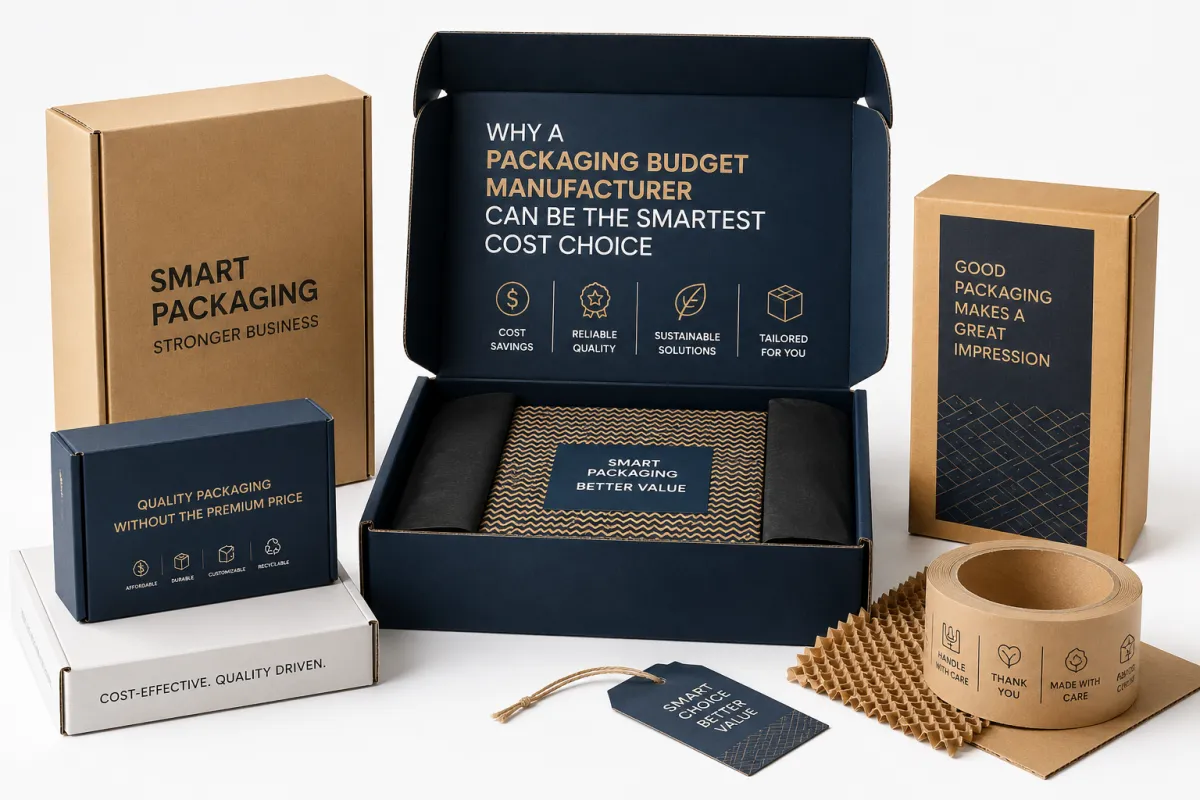
A packaging budget manufacturer is not a shortcut to lower quality. It is a production discipline built around controlled process, repeatable approvals, and cost visibility. That is very different from a supplier who looks cheap on a quote, then exposes hidden compromises once the dieline is locked and launch week is near.
That distinction matters because package cost is mostly a control problem, not a craftsmanship problem. Unit costs usually fall when the design nests efficiently on standard sheet sizes, setup logic is reduced, batch planning is cleaner, and approval cycles run without long stalls. In short, value is made at decision points, not by inventing magic in the press room.
From the buyer side, the biggest savings sit in the areas you already touch: artwork readiness, structural complexity, color count, substrate choice, and internal signoff speed. I keep seeing brands pay for specialized folds, extra coatings, oversized inserts, and additional color builds that do nothing for either conversion, safety, or shelf impact. A shift to a packaging budget manufacturer lets you keep brand intent and remove packaging debt from hidden corners of the file.
What should you expect in practice? You should expect steadier unit economics and fewer fire drills. Randomly dropping print quality is not a strategy; it usually creates returns, damaged reviews, and stock write-offs. Savings usually come from tooling logic, board selection, nesting efficiency, and fewer revision loops before production. A good packaging budget manufacturer explains those levers in plain language instead of sending you a spreadsheet you can’t defend in procurement.
That mindset changes the way teams evaluate suppliers. A packaging budget manufacturer is not a lesser version of premium shops; it is often a more disciplined version that can expose where costs hide before money leaves the account. If your program includes branded packaging, retail packaging, or Custom Printed Boxes, this matters as much as design taste.
“The cheapest quote is rarely the cheapest job once rework, freight changes, and late approvals show up. The cleanest quote is the one you can actually execute.”
The sections below show how a packaging budget manufacturer works, how to compare bids, where cost hides, how timeline assumptions are built, and where teams usually get trapped by a low headline price that later turns into expensive execution. If you are also defining your broader Custom Packaging Products, this is a practical baseline for making decisions across your full packaging budget instead of chasing one SKU at a time.
What Should You Ask a Packaging Budget Manufacturer Before You Sign?
The fastest way to separate a capable packaging budget manufacturer from a risky one is to ask operational questions before the purchase order is placed. How are setup fees structured? What happens if artwork changes after proofing? Which material substitutions are permitted without re-approval? Their answers show whether the supplier controls packaging economics or simply hopes friction stays unmentioned.
A solid question set covers five areas: price structure, sample quality, change control, inspection standards, and replenishment behavior. A strong packaging budget manufacturer can explain all five without hand-waving. Packaging teams usually fail from a chain of tiny assumptions, not one giant mistake.
Ask for a scenario, not a slogan. If the run grows from 5,000 to 12,000 units, where does the unit cost move? If one spot color moves to CMYK, what does that do to consistency and proof approval time? If the format changes from folding cartons to corrugated mailers, how does the timeline shift? A dependable packaging budget manufacturer responds with mechanics, not branding language.
How a Packaging Budget Manufacturer Works in Real Projects
A typical path with a packaging budget manufacturer starts at RFQ, then goes through technical pre-check, structure review, sample scheduling, proofing, pre-production signoff, and production release. Each stage exists to reduce risk before materials are bought. It becomes far smoother when the buyer arrives with complete, consistent inputs.
Role clarity is where projects either move or loop forever. The buyer owns brand intent, compliance boundaries, and final approvals. The manufacturer owns process setup, print efficiency, and production risk control. Overlap in these lanes usually creates “we thought you meant” deadlocks. A packaging budget manufacturer is built to reduce that by enforcing clear handoffs.
Technical handoff quality determines whether the project saves money or burns it. A reliable package brief includes CAD or dieline files, exact color specs, spot color references or CMYK equivalents, substrate options, barrier requirements, adhesive strategy, closure behavior, and label placement limits. For food, cosmetics, and health-related packaging, include compliance scope, shelf-life requirements, and migration or food-contact specifics from the start. A packaging budget manufacturer only accelerates when these inputs stay stable.
Where the value is created early
Most savings appear before ink even hits the press. File checks, dieline validation, and first-article planning keep expensive edits out of late stages. On custom packaging, a small tuck change can trigger expensive downstream effects in die cutting, gluing, and filling, so this stage is worth more than just paperwork.
Quality checks need visible checkpoints, not hidden assumptions. Materials should be inspected on arrival. Press setup should include an approved trial. In-process verification should check registration, density, fold behavior, and tolerance against the approved sample. Final release should depend on measurable criteria—not a vague “looks okay” check. For high-volume retail packaging, that often determines whether launch is clean or if returns and freight charges go through the roof.
Communication style also reveals maturity. Mature suppliers avoid approvals scattered across chat threads and disconnected email chains. A disciplined packaging budget manufacturer uses structured updates, a written change log, and regular review cadence, often daily for complex jobs and weekly for standard work. That unglamorous method is where most of the savings are born.
In branded packaging comparisons, this is where low-looking quotes often lose steam. If a manufacturer cannot clearly describe how artwork is validated, structural fit is checked, and change requests are managed, then the quote is not truly known. It is an estimate without the risk tax disclosed.
Think of a packaging budget manufacturer as a process architect for packaging design decisions. They are not replacing your brand team; they are making sure design decisions survive production without hidden waste. Questions like number of colors, number of folds, board caliper, glue placement, line tolerances, and off-spec behavior under stress are the practical questions that protect both quality and budget.
Cost and Pricing of a Packaging Budget Manufacturer: What to Audit First
People reviewing a packaging budget manufacturer quote often anchor on unit price and miss the composition. That is where most mistakes begin. A realistic structure usually includes setup or tooling, plates/cylinders, color count, substrate grade, coating and finishing, labor blocks, waste allowance, freight, and taxes or duties where applicable. Missing pieces cause fake savings.
The proper benchmark is total landed cost. Including handling, storage risk, sample iteration, expedited freight, and rework contingency turns disconnected bids into apples-to-apples comparisons. A packaging budget manufacturer can win even with a higher unit number if it is honest about waste and dependable on approvals and replenishment timing.
Price traps repeat. Post-approval per-color surcharges are common. Unlisted rush surcharges are common. Hidden minimum carton-to-board counts are common. Weak nesting assumptions are common. All of them quietly convert standard jobs into bigger bills. A trustworthy packaging-budget manufacturer surfaces these risks before the PO.
Buyers usually control several major levers. Lowering color count helps. Cleaner geometry helps. Artwork that respects grain flow helps. Consolidated SKUs helps. Standardizing inner labels, tapes, and inserts helps too. These are unsexy changes, but they are what keep packaging spend predictable and avoid reactive budget moves.
Short production runs deserve separate math. One-off jobs carry high setup overhead, so unit price can look expensive while manufacturing execution can still be efficient. That is not necessarily a failure; it is a quantity equation. The useful question is break-even volume: at what run size does unit cost hit the target your sales and inventory model can support?
| Quote Type | Typical Upfront Cost | What It Usually Includes | Main Risk | Best Use Case |
|---|---|---|---|---|
| Lowest-number quote | $0.18-$0.24 per unit at 5,000 pieces | Basic materials, limited revision support, minimal waste explanation | Hidden fees for changes, freight, or rework | Simple packaging with stable files and very few approvals |
| Balanced quote from a packaging budget manufacturer | $0.22-$0.30 per unit at 5,000 pieces | Clear setup terms, defined waste allowance, practical revision window | Requires accurate brief and timely sign-off | Most branded packaging, custom printed boxes, and retail packaging runs |
| Premium-service quote | $0.30-$0.45+ per unit at 5,000 pieces | More design support, broader finishing options, stronger hand-holding | Higher spend without guaranteed operational savings | Complex launches, high-precision finishes, or highly regulated product packaging |
A practical scorecard usually has three columns: base price, variable risk, and service reliability. That framework prevents teams from choosing by first-line cost alone, which is where weak plans break down. A packaging budget manufacturer should expose those trade-offs clearly instead of burying them.
Sustainability planning should be part of the same cost logic, not a separate conversation added at the end. Ask about board sourcing, water-based ink capability, and FSC-related support. For context, the EPA sustainable materials page offers practical benchmarks, and the FSC site helps separate material claims from marketing language. A reliable packaging budget manufacturer should be able to speak cost and compliance without choosing between the two.
Trust disclaimer: percentages above vary by country, substrate market volatility, and commodity pricing cycles. Ask for a written landed-cost example using your exact lead times before you commit.
Key Factors for Choosing the Right Packaging Budget Manufacturer
Price alone can mislead, while capability match determines whether a launch is healthy. A packaging budget manufacturer should fit your substrate mix, print technology, finishing capacity, and order-size profile for your package form. If you need flexible packaging and the supplier lives in folding cartons, or you need high registration on a run they barely manage on broad tolerance, the bargain evaporates at first scale-up.
Sample quality is often the clearest indicator. Ask for two or three recent jobs of comparable complexity and ask how defects were handled. Reliable suppliers can explain reject thresholds with tolerance bands, visible criteria, or process-control logs. A packaging budget manufacturer that discusses revision behavior with context tends to be far more dependable than one that speaks only in price points.
Responsiveness is useful only if paired with precision. A fast reply without trade-off, cost, and timing impact just shifts debate into the next quarter. Better is a reply that says: what changed, what it costs, and what it does to schedule. That is what a production partner sounds like, not a quote-only bidder.
Consistency metrics deserve a formal audit: lot-to-lot color stability, adhesion logs, carton tolerance tracking, and documented corrective actions. These details may feel operational, yet they prevent packaging drift in repeated runs. Suppliers that monitor these points are easier to scale when brand teams demand the same look month after month.
Sustainability and compliance readiness should pass a reality check, not an intent check. For food contact, migration concerns, recyclable claims, or regulated packaging documentation, the packaging budget manufacturer should already have a support flow in place. If distribution abuse is expected, ask about ISTA-style testing understanding and whether they can validate shipping profile internally or through a verified partner. Methods from ISTA are still more reliable than guessing.
Relationship quality shows up in problem moments. The right partner identifies practical substitutions, raises trade-offs early, and flags mismatches before they become delays. These behaviors matter because they keep the team focused on execution instead of debate. A good packaging budget manufacturer spends meeting time on continuity, not self-defense.
If your portfolio spans multiple structures, start with Custom Packaging Products and compare supplier fit against the narrative on About Custom Logo Things. That comparison quickly shows whether the manufacturer understands package branding as an integrated system or only as isolated print execution.
Step-by-Step Guide to Working with a Packaging Budget Manufacturer
Reliable projects begin with a disciplined brief: product protection requirements, unit volume range, channel forecast, budget floor and ceiling, required certifications, and non-negotiables for finish, legal text, and shelf-life conditions. A packaging budget manufacturer moves quickly when objectives are clear, and can protect costs when those objectives are realistic.
Keep file control tight before the first quote. Lock dieline dimensions, bleed, glue zones, barcode placement, and print-safe areas once; then version-control changes so every stakeholder shares the same source. Three teams uploading near-identical files often force a supplier to choose between uncertainty and delay. A packaging budget manufacturer handles execution better when a single source of truth exists.
Build the quote set the same way
Collect three to five quotes using identical assumptions. Ask each supplier to break setup, materials, labor, rush fees, and disposal/rework policy in the same format. When a packaging budget manufacturer can interpret the same comparison sheet, the true performers stand out from those hiding behind low first-line rates.
After bids are compared, score samples with a grid rather than instinct. Structural strength, print fidelity, registration consistency, fold behavior, and unboxing durability belong on that grid, especially if the package must travel, display, or protect fragile items. Test against real conditions, not only on-screen previews. I have seen “looks fine” files fail the first freight drop even when the digital proof was clean.
Then lock negotiation around cost-linked decisions: approval windows, decision gates, change fees, and revision limits. A clearly defined change scope protects the job from endless re-runs and keeps the budget from drifting into a correction cycle. A packaging budget manufacturer usually becomes more competitive when scope and variation controls are explicit.
Launch protection starts with a controlled pilot. Measure first-article results, then scale to full volume only after dimensional and weight tolerances stabilize. Custom packaging is highly sensitive to tiny shifts; one loose fold and a heavy insert can disrupt fulfillment and damage the next wave of replenishment.
Not every package needs every feature. Some products require intricate finishes and complex inserts. Others can drop complexity while preserving customer experience. A practical packaging budget manufacturer helps you make that distinction, so packaging stays branded, stable, and less expensive at the same time.
Packaging Budget Manufacturer Process and Timeline: Realistic Expectations
Timeline pressure can turn from confidence to stress when assumptions are optimistic and process discipline is weak. A common rhythm for a packaging budget manufacturer is: discovery in 1-3 business days, quote review in 2-5 days, sample development in 5-12 days, artwork approvals in 2-7 days depending on response speed, production setup in 1-3 days, then full run time based on complexity and quantity. That schedule is not slow. It reflects checks before irreversible commitment.
Simple jobs run faster than complex ones. A flat pouch, sleeve, or basic folding carton generally moves quickly compared with a deep, multi-material rigid structure needing tooling adjustments, adhesive validation, and cure checks. A packaging budget manufacturer should forecast that difference accurately when the brief is complete, which is why “rush” often means “skipping validation” and not true speed.
Review speed shapes outcome. A late change can double delay if it lands after proofing or tooling approval. A staged freeze date gives the team a clear threshold where changes are controlled and billed. That protects both timing and budget, and it tells you where governance needs to be stronger.
Delivery accuracy depends on external variables too: freight mode, customs documents, holiday calendars, material lead times, and warehouse cutoffs. In tight packaging budgets, one late air freight shift can erase manufacturing savings quickly. A dependable packaging budget manufacturer should plan these variables before release, not after loading docks begin to slip.
Risk planning is not optional. Teams often preserve 10-20% buffer for supplier-response uncertainty and at least one extra proof correction pass in high-contrast color or strict shade control runs. That reserve is not delay theater. It is the difference between a controlled launch and a remediation sprint that costs twice as much.
One practical rule: if promised lead time is shorter than the approval proof cycle, stop and demand a staged timeline before order confirmation. A good packaging budget manufacturer can split work into transparent steps and avoid unrealistic promises.
Common Mistakes When Choosing a Packaging Budget Manufacturer-and How to Fix Them
First, treating lowest unit cost as final is a weak selection method. Total goods cost, revision cost, and delay cost must all be assessed before a decision. A packaging budget manufacturer should support that full-stack view and avoid arguing that lower initial pricing is automatically superior.
Second, shipping incomplete specs creates predictable tax. Missing dimensions, finish detail, or weak compliance notes drive avoidable rework. A stronger process uses a pre-submission checklist and one version-controlled file structure. That gives the packaging budget manufacturer room to execute instead of perform detective work.
Third, assuming sample quality guarantees full-run quality creates a false sense of security. Samples help, but process capability and in-run verification matter more. If launch risk is real, demand random inspections in PO terms and explicit acceptance criteria before full execution. A packaging budget manufacturer with this mindset is usually safer over time.
Fourth, separating finish and structure decisions creates expensive mismatches. A premium finish can still fail if geometry and fold profile clash; a clean fold can still look weak if the finish process does not match board and ink chemistry. A mature packaging budget manufacturer evaluates structure, print, and finish as one system, not as independent checkboxes.
Fifth, keeping decisions only in verbal threads invites expensive ambiguity. Verbal alignment is useful, but not a control mechanism. Keep written change logs, timestamps, and one named project owner through every phase. That reduces confusion and reduces friction for the supplier, which improves responsiveness and quality.
Sixth, ignoring repeat-order behavior can erase first-run savings. If the package is re-ordered, test restart speed, approval archival workflow, and setup memory retention. A packaging budget manufacturer that handles repeat production cleanly usually delivers the largest annual gains.
Last but critical, do not ignore regional compliance nuance. If your package spans EU, US, or APAC markets, standards and documentation expectations can shift. I have seen teams assume one spec works everywhere and end up with costly relabeling. Build legal and compliance review into your timeline, not at the finish line.
Expert Tips + Action Plan: What to Do Next
To make this practical, use a 30-day plan. Week one: lock packaging requirements and internal budget guardrails. Week two: collect and normalize at least three bids from a packaging budget manufacturer or candidates that can prove they operate at that standard. Week three: run focused sample trials against a structured scoring grid. Week four: approve the best-fit partner and lock a pilot batch.
A scorecard filters noise. Weight quality, timing confidence, communication clarity, risk response, and pricing transparency by project priority. For a retail launch, timing confidence and print consistency often outscore small unit differences. For replenishment runs, repeatability and response speed usually outrank one-off discount optics.
Before final PO signoff, force a short decision checkpoint. Ask three direct questions: what is included in base cost, where do change fees begin, and what triggers timeline risk? If answers are vague or conditional, pause approval and get them in writing. A mature packaging budget manufacturer should provide that without drama.
Protect pilot management with rhythm. Every shipment should include a post-run review within 48 hours, covering defects, waste, repeatability, and action items before full replenishment approval. That habit surfaces drift early and gives evidence instead of opinions. It keeps your packaging budget tied to outcomes, not hopes.
The most forward-looking buyers treat a packaging budget manufacturer as a disciplined partner with governed options. Once requirements are clear and review loops stay tight, budget performance improves without sacrificing reliability. The same principle applies to branded packaging, retail packaging, and Custom Printed Boxes that have to look sharp while shipping safely.
If you are starting a new run, go no-brainer practical this week: create a one-page RFQ brief, run a controlled short trial, compare scorecards line by line, and set a 90-day quality review checkpoint before the next quarterly re-order. That process keeps supplier performance anchored to production results and keeps your packaging budget from becoming a fiction.
How much can a packaging budget manufacturer really lower my packaging costs?
Cost reductions are strongest when designs are stable, quantities are bundled logically, and setup charges are negotiated with realistic revision limits. In many well-defined runs, 20-40% total landed-cost improvement is achievable. A packaging budget manufacturer achieves this by removing waste, tightening workflow, and reducing rework, not by cutting corners.
What should I compare when evaluating a packaging budget manufacturer quote?
Review the full cost stack: setup, materials, production labor, revision policy, freight, expected waste, and inspection terms. Normalize every bid against the same SKU, quantity, substrate, and finish assumptions. A packaging budget manufacturer should split the proposal into these components so the comparison reflects actual execution cost.
Can a packaging budget manufacturer handle custom packaging shapes reliably?
Yes, if structural validation happens early with representative samples. Flat or low-complexity shapes are usually efficient, while deep-draw forms, inserts, and intricate closures raise tolerance risk and setup cost. The right packaging budget manufacturer explains where shape complexity adds risk before release and helps you decide where to simplify.
How fast can a packaging budget manufacturer deliver sample and production runs?
Simple sample cycles often run in one to two weeks. Full production timing depends on artwork maturity, substrate lead times, and approval speed. A realistic schedule is always stage-by-stage, not a single date pulled from an isolated quote field. A packaging budget manufacturer that gives staged timing is usually safer than one offering a vague rush claim.
When is a budget manufacturer the wrong choice for packaging?
Choose a specialist when strict finish consistency, heavy regulatory documentation, or high-precision micro-details drive the risk profile. A packaging budget manufacturer can still handle lower-risk variants while mission-critical variants go to a higher-control partner. The winning choice aligns with package risk, not simply with the shortest line in the quote.
How do I know whether a packaging budget manufacturer is the right fit for my brand?
Fit shows up in the first conversation: clear answers, realistic trade-offs, and a quote that separates setup, materials, labor, and risk. If the supplier understands your substrate, order size, and required print finish, a packaging budget manufacturer can grow into a long-term packaging partner rather than a one-off bidder.


