Buyer Fit Snapshot
| Best fit | Order Custom Labels for Your Brand The Right Way projects where brand print, material claims, artwork control, MOQ, and repeat-order consistency need to be specified before quoting. |
|---|---|
| Quote inputs | Share finished size, material target, print colors, finish, packing count, annual reorder estimate, ship-to region, and any compliance wording. |
| Proofing check | Approve dieline scale, logo placement, barcode or warning zones, color tolerance, closure strength, and carton packing before bulk production. |
| Main risk | Vague material claims, crowded artwork, missing packing details, or unclear freight terms can make a low unit price expensive after revisions. |
Fast answer: Order Custom Labels for Your Brand The Right Way: Material, Adhesive, Artwork, and MOQ should be specified like a repeatable production item. The safest quote records material, print method, finish, artwork proof, packing count, and reorder notes in one written spec.
Production checks before approval
Compare the actual filled-product size with the drawing, then confirm tolerance on folds, seals, hang holes, label areas, and retail display edges. Reserve space for logos, QR codes, warning copy, and material claims before decorative graphics fill the panel.
Quote comparison points
Review material grade, print process, finish, sampling route, tooling charges, carton quantity, and freight assumptions side by side. A quote is only useful when the supplier can repeat the same color, closure quality, and packing count on the next order.
How to Order Custom Labels for Your Brand the Right Way
If you are trying to figure out how to order custom labels, start with the thing people love to ignore: the package itself. Not the artwork. Not the mood board. The actual bottle, jar, carton, pouch, or mailer the label has to live on. A label can look gorgeous on a screen and still fail in real life if the size, stock, adhesive, or format does not fit the surface. That is how you end up paying twice. Pretty file. Wrong spec. Annoying outcome.
From the buyer's side, the job sounds easy. It is not. You Need to Know where the label will sit, whether the surface is flat or curved, and whether it will face moisture, refrigeration, oil, abrasion, or outdoor handling. You also need to know whether the labels will be applied by hand or by machine. Once those details are clear, how to order custom labels stops being a guessing game and starts looking like a real production process.
That approach also makes quoting cleaner. A supplier can price accurately only when the request includes dimensions, material, finish, quantity, adhesive, roll or sheet format, and any special handling requirements. Fewer gaps mean fewer proof rounds and less scrap on press. If you are also building out Custom Labels & Tags, broader Custom Packaging Products, or a retail launch that includes custom printed boxes, the label should be part of the whole package branding system, not a side quest.
The practical path is simple enough: define the use case, pick the substrate, confirm the adhesive, lock the size and shape, then request a proof and a quote that shows exactly what is included. Do that, and the order has a much better shot at arriving ready to use instead of half-right and irritating.
How to Order Custom Labels Without Rework
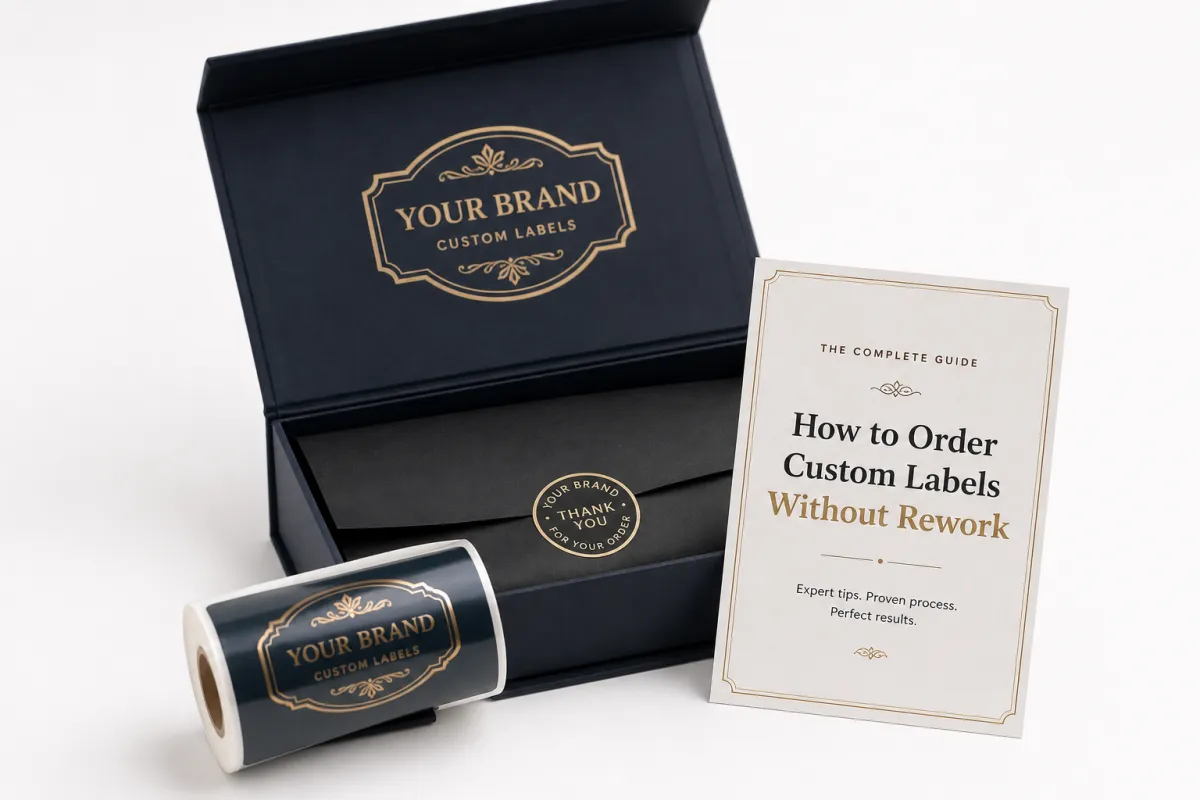
The cleanest way to think about how to order custom labels is to treat the label like a working part of the package, not just a graphic. The label has to survive the same handling as the product itself. A hand lotion label may need to stay neat after repeated touching. A refrigerated sauce label may need to hold up against condensation. A shipping label may need to stay readable after conveyor bumps, dust, and abrasion. The artwork can be spotless and the order can still fail if the spec ignores the real environment.
The first question is not, "What do you want it to look like?" The first question is, "Where will it live?" A label on a flat folding carton behaves differently from one on a tapered bottle or a curved cosmetic jar. A label on kraft paperboard needs different adhesive behavior than one on glass, coated plastic, or a low-energy pouch surface. If you are learning how to order custom labels, begin with the package surface and build from there.
Think like a packaging buyer and the rework starts shrinking. Set the use case first, then choose stock, adhesive, finish, and application format around that use case. That same logic shows up in branded packaging and retail packaging decisions: function first, presentation second. A label that fails the line is both a branding problem and a waste problem. No one needs more of those.
Good orders start with clean input. If the quote request includes exact dimensions, a container photo, the application method, and the quantity range, the proof gets tighter and production moves faster. If the details are vague, the job drifts into prepress limbo, where missing pieces get chased down one by one before the file can be released. That is why how to order custom labels is really a specification exercise.
A label that fits the container, survives the environment, and scans or reads the way it should usually comes from careful spec work, not luck.
One more practical point: if the project includes both labels and custom printed boxes, keep the visual system aligned from the start. Color consistency, font choices, panel placement, and brand hierarchy need to work across the full product packaging set. It is easier to tune one coordinated package branding plan than to rescue a label that was built in a vacuum.
That is the real foundation of how to order custom labels without rework: define the performance requirement first, then build the design around it.
Choose the Right Label Material and Finish
Material choice shapes both the look and the job performance, so how to order custom labels correctly depends on matching the stock to the package environment. Paper labels are a solid fit for dry indoor use, especially on cartons, paper tubes, and short-run retail items that will not see much moisture. Paper has a familiar, natural appearance, which works well for brands that want a clean product packaging look without overcomplicating the spec.
BOPP is the workhorse for moisture resistance. It handles bathrooms, kitchens, refrigerated displays, and warehouse handling better than paper, which can wrinkle or soften when humidity shows up. Clear BOPP gives a lower-profile look on glass or smooth plastic. White BOPP gives a brighter print base and stronger contrast for branding. Vinyl is the tougher choice if the label has to tolerate heavier wear, rough handling, or outdoor exposure. If your team is sorting through how to order custom labels for a product that moves between cold storage and shelf display, BOPP usually deserves a hard look first.
Finish matters just as much. Matte gives a softer, less reflective surface, which can help with handwritten notes, scan readability, and a restrained premium feel. Gloss pushes color harder and often makes graphics pop from a distance, which helps on crowded shelves. Specialty finishes, such as foil accents or selective varnish, can add shelf presence, but they should earn their place. Looking expensive in a sample image is not the same thing as solving a packaging problem. For retail packaging, I usually push the finish to support the product, not fight it.
The right choice depends on where the label sits in the supply chain. A jar that lives on a bathroom shelf needs different performance than a pouch that ships through fulfillment centers. A label on a subscription box insert may need less moisture resistance but more visual polish. A label on a shipping pack may need a more durable adhesive and a finish that does not glare under warehouse lighting. Those tradeoffs matter more than whatever looks nice in a mockup.
| Material | Best Use | Finish Notes | Typical Cost Impact |
|---|---|---|---|
| Paper | Dry indoor products, cartons, tubes, short-run branding | Works well in matte or gloss; best for simple handling | Lowest baseline |
| BOPP | Bottles, jars, refrigerated goods, bath and body items | Matte or gloss; strong moisture resistance | Moderate, often 10% to 25% above paper |
| Clear BOPP | Glass and clear packaging with a low-profile look | Best for a "no-label" effect and strong shelf branding | Moderate to higher, often 15% to 30% above paper |
| Vinyl | Rough handling, outdoor exposure, higher abrasion risk | Durability first, appearance second | Highest of the common options |
Price is not the only variable. If a brand wants FSC-certified paper for an eco policy or retail requirement, say so early in the quote request. You can review chain-of-custody standards at FSC and then ask whether the paper stock you want is available with that certification. Details like that belong in the first conversation, not after the proof is already built.
Finish also affects readability. Gloss can reflect light around barcodes, small type, and ingredient copy, while matte usually cuts glare. If the label needs to be written on by hand, matte is usually the safer choice. For barcodes, keep the quiet zone clear and make sure the contrast is strong enough for the scanner and the light conditions where the product will be read. If you are working through how to order custom labels for a fulfillment-heavy line, scan quality is not decoration. It is part of the job.
For brands still refining the product line, material choice should stay flexible until the end use is proven. A low-cost paper label can be a smart test run for dry goods, while a moisture-resistant BOPP label may be the better permanent choice for bath and body or refrigerated products. Match the stock to the real environment, then let the finish carry the brand story.
Specify Size, Shape, Adhesive, and Roll Details
Once the material is chosen, how to order custom labels depends on geometry. Exact dimensions matter more than rough estimates because even a small miss in width, height, corner radius, or bleed can cause wrinkles, edge lift, or a label that looks cramped on the container. A label that is one-eighth of an inch too tall can run into a cap seam. A shape that looks balanced on screen can leave too little margin on a curved jar. In production, those tiny errors turn into reprints.
Shape should follow the container panel as much as the brand art. Square, rectangle, circle, oval, and custom die-cut formats all have a place, but the best shape is usually the one that fits the panel cleanly and leaves enough breathing room around the edges. A long, narrow bottle may need a vertical label to keep the logo legible. A short, wide jar may need a wrap panel or a front-and-back pair. If you are sorting through how to order custom labels for a line with multiple SKUs, keep the shape consistent wherever possible so the family looks intentional on shelf.
Adhesive choice is another spot where the spec has to match the environment. Permanent adhesive is the standard for most product packaging because it is built to stay put. Removable adhesive helps with temporary promotions, sample packs, and surfaces where clean removal matters more than long-term hold. Freezer-grade adhesive is made for cold conditions and helps with refrigerated or frozen goods, while moisture-resistant adhesives are useful where condensation or damp surfaces may show up. If the container material is textured, curved, or low-energy, adhesive selection gets even more important. In plain terms, how to order custom labels well means asking how the label will behave on the actual substrate, not on some generic bottle in a sales sheet.
If the labels are ordered on rolls, the mechanics matter too. Core size, roll diameter, gap between labels, rewind direction, and unwind orientation all matter if the labels are going through an applicator or semi-automatic machine. Common core sizes are often 3 inches for many label applicators, though smaller desktop systems may need other sizes. Roll direction can determine whether the label feeds face-in or face-out, and the wrong choice can stop production cold. That is why how to order custom labels for automated application should always include the machine model or at least a photo of the setup.
Sheet labels are often simpler for short runs and hand application, but they still need accuracy. Sheets work well for office use, small inventory batches, or manual packing stations where the team is applying labels one at a time. If the team is moving fast, the margins and cut spacing should still be planned so the labels separate cleanly without tearing.
Here is a practical way to reduce errors before the quote is finalized:
- Measure the usable panel on the container, not just the full circumference.
- Leave enough clearance around seams, curves, and cap transitions.
- Specify whether the label needs a full wrap, front panel, or back panel.
- Confirm whether the order will be hand-applied or machine-applied.
- Tell the supplier the core size, unwind direction, and roll spacing if rolls are required.
For most buyers, how to order custom labels correctly is less about choosing a fancy spec and more about getting the working dimensions right the first time. That is what keeps production moving.
How to Order Custom Labels and Compare Pricing
Price gets a lot of attention, but how to order custom labels wisely means looking at the whole quote, not only the lowest number at the bottom. The main cost drivers are pretty easy to spot: material choice, size, quantity, finish, die-cut complexity, number of printed colors, adhesive type, and whether the order needs special converting steps. A simple rectangle on paper stock costs less than a clear BOPP label with a custom die, strong adhesive, and heavy ink coverage. No surprise there.
Quantity matters because setup gets spread over more units as the run grows. A small test order may land in a higher per-label range, while a larger production run often lowers the unit price. Many buyers see rough pricing like this in the market: short runs of 250 to 500 labels may land around $0.20 to $0.75 per label depending on coverage and stock, mid-size runs of 1,000 to 5,000 labels may fall closer to $0.05 to $0.20, and larger quantities can go lower still. Those are only guideposts, but they show why how to order custom labels starts with quantity planning as much as design planning.
The smart comparison is apples to apples. Ask whether artwork setup is included, whether proofing is included, whether shipping is included, and whether there are die or plate charges that show up later. A quote that looks cheaper at first glance can become more expensive once freight, setup, or revision charges are added. If you are comparing vendors, request the same quantity, size, material, finish, and adhesive so the numbers can actually be compared.
For projects still in development, short runs are often the safest move. A test batch lets you check fit, color, barcode performance, adhesive hold, and shelf appearance without locking yourself into too much inventory. That is a practical answer to how to order custom labels on a new product line, because the label can be corrected before full production scales up.
Below is a simple way to compare common label options:
| Option | Typical Strength | Typical Limitation | Best Use Case |
|---|---|---|---|
| Paper label | Lowest cost, fast for dry indoor use | Weak in moisture and abrasion | Cartons, tubes, sample packs |
| Matte BOPP | Moisture resistant with a cleaner, softer look | Costs more than paper | Bottles, jars, refrigerated products |
| Gloss BOPP | Strong shelf presence and color pop | More glare under bright lighting | Retail packaging with bold graphics |
| Clear film label | Low-profile look on glass or clear plastic | Needs careful design for readability | Premium cosmetics, beverage branding |
If your project includes shipping or distribution, ask whether the label needs to survive parcel handling criteria aligned with ISTA testing methods. That is not necessary for every job, but it matters for products moving through rough carrier networks, warehouse sorting, or multi-stop fulfillment flows. The point is simple: how to order custom labels depends on how hard the package gets handled after it leaves the plant.
Transparency matters as much as price. A good quote should show the levers you can change if you need to lower cost: reduce print coverage, simplify the die shape, switch from gloss to matte, move from vinyl to BOPP, or adjust quantity to a more efficient run size. If a quote does not explain the cost drivers, it is hard to make a real decision. Buyers who understand how to order custom labels well can usually balance budget and performance without guessing.
Process and Timeline: From Quote to Delivery
The order flow is straightforward once the spec is clear. You submit the request, review the quote, send artwork, approve the proof, release production, and confirm shipping. That sounds basic, and it is. The delays show up when the details are not ready. If you are learning how to order custom labels with fewer headaches, the main thing to understand is where the clock starts and where it stops.
The proof stage is where a lot of pain can be avoided. Check spelling, barcode placement, legal text, label dimensions, color intent, and finishing details. If the product carries a UPC, QR code, batch code, or ingredient panel, verify the quiet zones and placement before approval. If the color matters, reference a prior approved sample or give Pantone numbers instead of trusting a monitor image, because screen color drifts from press output. A careful proof review is a core part of how to order custom labels because it protects the production slot and the launch date.
Turnaround time depends on quantity, complexity, material availability, and proof approval speed. Simple digital label orders often move faster than more complex runs, especially when the artwork is final and the specs are locked. In many cases, 5 to 10 business days after proof approval is realistic for simpler orders, while more involved projects can land in the 10 to 15 business day range or longer if specialty materials are involved. Rush service can happen, but only if the artwork is ready, the proof is approved quickly, and there are no late changes. That is the honest answer to how to order custom labels on a tight deadline.
Shipping needs attention too. Ask how the labels will be packed, how many rolls or sheets will be in each carton, and whether the cartons will be labeled by SKU. On arrival, check the carton count, inspect the first roll or sheet, and verify that the labels match the approved proof. If the labels will sit in storage before use, keep them in a cool, dry place, ideally around normal warehouse conditions rather than a hot loading dock or a damp floor. Many label stocks behave best when stored around 65 to 75 F with moderate humidity, though the exact recommendation depends on the construction. Small details like that matter if you want the adhesive and print quality to stay stable.
If your product launch includes custom printed boxes or multiple packaging components, align the delivery dates so the labels and cartons arrive together. Nothing complicates a launch faster than one package component sitting around while another is still in transit. That is another place where how to order custom labels intersects with broader package branding decisions.
The best timeline is the one with fewer surprises: clean artwork, clear proof notes, fast approval, and a shipping plan that matches the launch calendar.
For teams that buy across several SKUs, that kind of process discipline saves real time. It also lowers the risk of reprints caused by late changes, which is one of the most common and avoidable costs in labeling work.
Why Order Custom Labels From Custom Logo Things
Custom Logo Things is a good fit for buyers who want a packaging partner, not just a printer. That distinction matters because how to order custom labels gets much easier when the vendor understands stock selection, adhesive behavior, finish choices, and application method instead of only pushing a generic quote. A real packaging partner helps the buyer Choose the Right construction for bottles, jars, cartons, pouches, or shipping packs so the label performs in the environment it was built for.
That kind of guidance matters in product packaging where branding and function need to work together. A cosmetic line may need a clean, premium label with strong color consistency across reorders. A food brand may need moisture resistance and a barcode that reads cleanly at the register. A fulfillment-heavy e-commerce line may need roll labels with the right core and unwind orientation so packing does not grind to a halt. If you are deciding how to order custom labels across several product families, consistency becomes a production advantage as well as a design advantage.
Color control and repeat ordering are part of the value too. Once a label is approved, the next run should match the approved standard as closely as possible so the brand does not drift from batch to batch. That matters for package branding because customers notice small changes, especially on shelf-facing products. The goal is not only to print a good label once, but to make sure the next order behaves the same way. That is one of the most practical reasons businesses care about how to order custom labels through a supplier that pays attention to repeatability.
A strong vendor should also catch issues before production. Missing bleed, soft artwork, unclear die lines, tiny barcode type, or an overlooked adhesive requirement can create delays that are much more expensive than a careful prepress review. This is where buying experience saves money. A supplier that understands the real production environment can flag problems before they turn into scrap. For buyers comparing options, how to order custom labels is easier when the quote includes technical feedback, not just a price.
That same thinking carries into broader product lines. If you are coordinating labels with Wholesale Programs or building a wider launch with coordinated custom printed boxes, one source for the packaging pieces can keep the art, dimensions, and production timing aligned. The result is cleaner approvals, better launch coordination, and a package that feels intentional from one component to the next.
Honestly, that is what most buyers want: fewer surprises, a clean proof, a label that fits the container, and an order that arrives ready to use. That is also the simplest answer to how to order custom labels with confidence.
How to Order Custom Labels: Next Steps Before You Request a Quote
If you want the fastest path through how to order custom labels, gather the project details before you ask for pricing. That makes the quote more accurate and shortens the back-and-forth that usually slows a label order. I would prepare the following before reaching out:
- Exact label dimensions, including width, height, and any corner radius.
- Photos of the container from the front, side, and top.
- Material preference, such as paper, BOPP, clear film, or vinyl.
- Finish preference, such as matte, gloss, or a specialty look.
- Quantity range, not just a guess, so pricing can be tied to a real run size.
- Application method, including hand apply or machine apply.
- Target ship date or launch date, so lead time can be measured correctly.
Artwork should be ready as early as possible. Editable vector files are ideal because they keep edges clean and let the prepress team adjust the layout without losing quality. If you have logos, fonts, barcode data, ingredient copy, warnings, or regulatory text, put those details in one place. A complete file set speeds up how to order custom labels because the proof can be built from a solid starting point instead of patched together from missing pieces.
It also helps to identify which details are fixed and which can move if the price or lead time needs adjustment. Maybe the size cannot change because it is tied to the bottle shape, but the finish could move from gloss to matte if that lowers glare and saves cost. Maybe the adhesive is fixed because the product is refrigerated, but the material could shift between paper and BOPP depending on the final shelf plan. When buyers are clear about the non-negotiables, how to order custom labels gets much faster.
If the use case is sensitive, ask for a proof review and a sample before full production. That matters for refrigerated products, oily surfaces, high-touch retail packaging, or any label that must stay readable under wear. A sample can catch fit or adhesion issues that are hard to see in an electronic proof. For reference material and common ordering questions, review the FAQ before you send the request.
One last note: if your project sits inside a larger buying program, ask whether volume pricing or repeat-order support is available. Wholesale planning makes more sense once you know how the label behaves in the field, and that is where a structured ordering process pays off. The smoother the information on the front end, the cleaner the proof, the more accurate the quote, and the faster the final labels move through production.
Frequently Asked Questions
How do I order custom labels if I only know the container shape?
Send clear photos of the container from the front, side, and top, and note whether the label will sit on a flat panel or wrap around a curve. A supplier can usually recommend a size range from that information, then refine the spec once the usable panel is measured. That is a normal starting point for how to order custom labels when the package is still in development.
What information do I need to order custom labels accurately?
At minimum, provide the label size, shape, material, finish, quantity, and whether the labels should be supplied on sheets or rolls. Include the artwork files, barcode data if needed, the expected application surface, and any special requirements such as freezer use, moisture resistance, or removable adhesive. The more complete the input, the easier how to order custom labels becomes for both the buyer and the production team.
How much do custom labels usually cost to order?
Cost depends on size, quantity, material, finish, die-cut complexity, and adhesive type. Small test runs often carry a higher per-label cost because setup is spread across fewer pieces, while larger orders usually lower the unit price. A good quote should show setup, proofing, and shipping clearly so you can compare vendors fairly while learning how to order custom labels.
How long does it take to order custom labels after I approve the proof?
Production time depends on quantity, material availability, and the complexity of the order. Simple orders can move in about 5 to 10 business days after proof approval, while more complex jobs can take 10 to 15 business days or more if specialty materials or finishing steps are involved. Shipping time should be added separately, which is why how to order custom labels should always include the delivery date as part of the request.
Can I order custom labels in a small quantity first?
Yes, a small test run is often a smart choice if you are checking fit, color, adhesion, or barcode performance. Short runs reduce inventory risk and give you real feedback before a larger order is placed. If you are still refining the product, ask about a sample pack or prototype before deciding on the final version of how to order custom labels.
If you are ready to move, send the dimensions, photos, material preference, finish preference, quantity, and timeline together so the first quote is accurate and the proof is clean. That is the most reliable way to approach how to order custom labels, and it is usually the difference between a smooth launch and a production delay. Better input, better label. Simple enough.

