Buyer Fit Snapshot
| Best fit | Packaging Supplier Manufacturer projects where brand print, material claims, artwork control, MOQ, and repeat-order consistency need to be specified before quoting. |
|---|---|
| Quote inputs | Share finished size, material target, print colors, finish, packing count, annual reorder estimate, ship-to region, and any compliance wording. |
| Proofing check | Approve dieline scale, logo placement, barcode or warning zones, color tolerance, closure strength, and carton packing before bulk production. |
| Main risk | Vague material claims, crowded artwork, missing packing details, or unclear freight terms can make a low unit price expensive after revisions. |
Fast answer: Packaging Supplier Manufacturer: Production Spec, Color Control, and Delivery Risk should be specified like a repeatable production item. The safest quote records material, print method, finish, artwork proof, packing count, and reorder notes in one written spec.
Production checks before approval
Compare the actual filled-product size with the drawing, then confirm tolerance on folds, seals, hang holes, label areas, and retail display edges. Reserve space for logos, QR codes, warning copy, and material claims before decorative graphics fill the panel.
Quote comparison points
Review material grade, print process, finish, sampling route, tooling charges, carton quantity, and freight assumptions side by side. A quote is only useful when the supplier can repeat the same color, closure quality, and packing count on the next order.
Custom Logo Things
Packaging Supplier Manufacturer: How to Choose the Right One
If you are buying packaging, the cheapest quote is often the one with the most expensive surprises hiding behind it. I have watched launches get delayed because a carton looked fine on paper, then failed once the insert, coating, freight carton, and barcode all had to work together. A packaging supplier manufacturer can look cheap at first, then add tooling, print setup, sampling, freight, and rework until the number stops making sense. That is why the real job is not just finding a packaging supplier manufacturer. It is finding one that protects your margin, your timeline, and your patience.
Packaging is not decoration. It sits inside product packaging, retail packaging, and package branding all at once. If the box cracks, the insert shifts, the finish scuffs, or the artwork prints off-color, the customer sees the failure before they ever touch the product. That kind of failure is loud. Usually expensive. Always annoying. And yes, it can sink a launch if nobody spots it early enough.
The stakes climb fast for branded packaging, seasonal launches, subscription kits, and custom printed boxes that need to land together and look like they belong to the same program. A good packaging supplier manufacturer does more than print cardboard. They take an idea with a few missing pieces and turn it into packaging that fits the product, survives shipping, and still looks like your brand meant it.
The practical version: how the process works, what pricing is really made of, what to compare, and how to avoid the mistakes that eat time and money.
What a Packaging Supplier Manufacturer Really Does
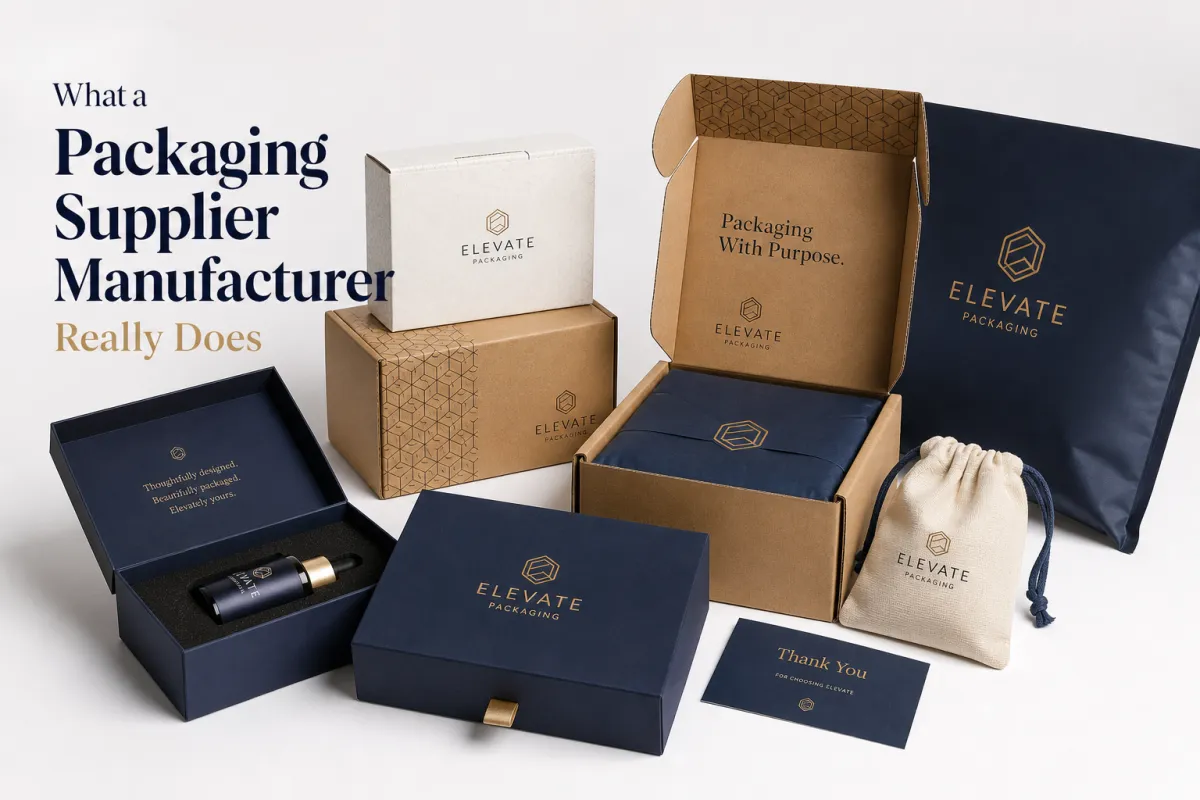
A packaging supplier manufacturer can handle the full chain, or only one part of it. Some design, source, print, convert, assemble, and ship. Others only manufacture the physical packaging after someone else has finished the design and prepress work. That difference matters because the group controlling the process usually controls the final quality, the lead time, and a good chunk of the price.
One trap catches buyers all the time: the lowest quote usually leaves out the things that hit the budget hardest. Tooling might be separate. Print prep might be separate. Freight might be separate. A reprint because the barcode landed in the wrong place? Also separate. That is how a “cheap” quote turns into a pricey lesson.
A real packaging supplier manufacturer usually works across one or more of these steps:
- Structural packaging design and dieline setup
- Material sourcing for board, paper, corrugate, inserts, or specialty finishes
- Printing, converting, die-cutting, folding, gluing, and assembly
- Quality checks, packing, and outbound shipping
Not every packaging supplier manufacturer does all of this in-house. Some outsource parts and manage the job through partners. That is fine if they are honest about it. Trouble starts when a buyer thinks they are talking to the factory and is really talking to a middle layer that cannot answer simple production questions.
There is a clean distinction between a broker, a distributor, and a manufacturer. A broker sells access and coordination. A distributor stocks or resells packaging from other sources. A packaging supplier manufacturer makes the item, or at least controls the run. If you care about color, spec, repeatability, and fewer surprises, the last option is usually the safer bet.
| Partner Type | Who Controls Production | Typical Strength | Common Weak Point | Best Fit |
|---|---|---|---|---|
| Broker | Usually not the factory | Can source multiple options quickly | Less visibility into actual production | Fast quoting and broad sourcing |
| Distributor | No direct manufacturing control | Convenient for standard stock items | Limited customization | Simple, repeatable packaging needs |
| Packaging supplier manufacturer | Directly or through managed production | Better control over quality and spec | May require more setup time | Custom printed boxes, branded packaging, repeat runs |
For brand launches and seasonal packaging, control matters. You do not want the box arriving one shade off, the insert out of tolerance, or the coating changed without notice. If the outer carton, inner tray, and printed sleeve have to land together, the packaging supplier manufacturer should be able to explain exactly how they will keep the build consistent.
For broader context on packaging standards and industry language, the Institute of Packaging Professionals is a useful reference. If your packaging needs certification or responsible sourcing, the FSC site is worth a look too.
The decision usually comes down to fit, speed, consistency, and total landed cost. Not unit price. Not vibes. A good packaging supplier manufacturer should make the launch easier, not turn it into a scavenger hunt.
How a Packaging Supplier Manufacturer Process and Timeline Works
The process usually starts with a brief, then a quote, then artwork and proofing, then sampling, then production, then inspection, then shipping. That sounds neat. Real jobs are messier because every small ambiguity adds time. A missing dimension can stall structural design. A vague finish note can trigger another sample round. A late barcode change can push a run by several days. That is normal, which is why a packaging supplier manufacturer should ask better questions than “how many pieces do you need?”
A realistic timeline depends on complexity, order size, and how clean your files are. For a simple folded carton, a digital proof might come back in one to three business days. A structural sample can take five to ten business days. Production can run anywhere from seven to twenty business days, sometimes longer if the job needs special coatings, foil stamping, or multiple components. Freight adds its own clock on top. If you are launching in retail, that clock is not decorative.
Proofing does more than check spelling. It catches fit, fold direction, barcode placement, panel order, and whether the product packaging actually holds the product. Physical samples are slower, yes, but they usually cost less than fixing a full run of bad custom printed boxes. I have seen a sample save a whole quarter’s budget because it exposed a 3 mm insert error before production. Tiny number. Huge headache.
Common things that quietly add days or weeks:
- Unclear dielines or missing measurements
- Artwork changes after proof approval
- Low-resolution images or wrong color profiles
- Barcodes, legal copy, or compliance text added late
- Material substitutions because the original spec was not confirmed
If the packaging has to pass drop or transit testing, ask about ISTA methods early. The ISTA standards exist because shipping systems are not gentle. If your packaging supplier manufacturer knows test requirements from the start, you avoid the lovely surprise of a carton that looks good and fails in distribution.
Planning backward from your launch date is the safest move. Start with the ship-to date, then subtract transit time, then subtract production, then subtract sample approval, then leave room for one revision. That is not pessimism. That is packaging math. A packaging supplier manufacturer with a real calendar should be able to map that with you in writing.
Practical timeline example: if your launch date is fixed, a clean custom packaging program may need 4-8 weeks from final brief to warehouse arrival. Complex builds with inserts, multiple finishes, or imported freight can run longer. A packaging supplier manufacturer that promises instant turnaround on a complex job is either overconfident or skipping details. Neither helps you, and both tend to get expensive.
Cost and Pricing Factors for a Packaging Supplier Manufacturer
Pricing is where buyers get distracted. Everyone looks at unit price first. That is understandable. It is also incomplete. A packaging supplier manufacturer prices a job based on material, size, print method, finish, order quantity, setup complexity, and shipping distance. Change one of those, and the quote changes too. That is not shady. That is manufacturing.
For example, a small run of custom printed boxes might cost $1.25 to $3.50 per unit, while a larger run could fall to $0.45 to $1.10 per unit depending on board grade, ink coverage, and finishing. Inserts, specialty coatings, foil, embossing, or rigid structures push the number up fast. A premium finish can cost less than a bad return rate, though, and that is the tradeoff buyers should actually be evaluating.
The gap between quoted unit price and true landed cost is where many budgets go sideways. Landed cost includes tooling, sample charges, freight, storage, carton packing, customs, and rush fees if you need them. A packaging supplier manufacturer that gives you only a per-piece number is not giving you the full story. They are giving you the easy line item.
Low-volume pricing is almost always less efficient. Setup costs get spread over fewer pieces. If a run of 500 units takes nearly the same prep as a run of 5,000, the small run naturally costs more per piece. For a new product packaging concept, though, a smaller run can be the smarter move because it limits the damage if the design needs a fix.
If a quote looks suspiciously low, the missing line item is usually the problem. Sometimes the hidden cost shows up in freight. Sometimes it shows up in rework. Sometimes it shows up in defective packaging that never should have left the plant.
Where do real savings come from? Better file prep. Consistent dimensions. Standard board sizes that actually fit the product. Less unnecessary finishing. Order volume that matches sell-through instead of wishful thinking. Where are fake savings? Thinner material that crushes in transit, finish choices that rub off on shelf, or a structure that saves pennies but drives returns. That is not savings. That is future expense with better branding.
A packaging supplier manufacturer should be able to explain the tradeoff between value and premium builds. A kraft mailer with one-color print may be economical and still strong enough for e-commerce. A rigid retail box with soft-touch lamination, foil, and a custom insert can create stronger shelf impact but carry a much higher unit cost. Both can be right. It depends on the channel, the margin, and the product itself.
Here is a practical pricing lens:
- Material: C1S paperboard, corrugate, rigid greyboard, specialty stocks
- Print: one-color, four-color process, spot colors, inside print
- Finish: aqueous coating, matte lamination, soft-touch, foil, embossing
- Quantity: setup amortization gets better as volume rises
- Shipping: carton count, pallet count, distance, and freight class matter
If your packaging supports a retail program, ask the packaging supplier manufacturer whether the price includes retailer requirements like shelf-ready packs, barcode placement, or special carton counts. Those details like to appear late and cost more than the artwork itself.
Key Factors to Compare in a Packaging Supplier Manufacturer
Once you have two or three candidates, the real comparison starts. Do not stop at quote math. Compare material capability, print quality, structural engineering, and finishing options first. If a packaging supplier manufacturer cannot build the structure you need, the rest of the conversation is just decoration.
Communication quality matters more than people admit. Fast replies are nice. Clear replies are better. A strong packaging supplier manufacturer should be able to explain tolerances, file setup, minimum order quantities, and how they handle defects without making you decode jargon like it is a tax form.
Ask for sample photos and finished examples from similar product categories. If you sell cosmetics, you want to see cosmetic packaging. If you sell food, you want to see food-safe packaging or at least related compliance experience. If you sell electronics, then insert fit and crush resistance should be part of the discussion. Similar categories matter because different products stress packaging in different ways.
Capacity and flexibility are another filter. Can the packaging supplier manufacturer handle repeat orders without the quality drifting? Can they absorb a seasonal spike? Can they run multiple SKUs at once without mixing art files or confusing carton counts? If the answer is vague, that is your answer.
Useful comparison questions:
- What materials and finishes do you run regularly, not just occasionally?
- How do you handle print approval and color matching?
- What happens if a run arrives out of spec?
- Can you support reorder consistency across multiple batches?
- Do you have experience with FSC or other sourcing requirements?
Sustainability is not a side note anymore. If your brand needs recycled content, FSC-certified board, or a lower-impact material plan, ask before quoting starts. The right packaging supplier manufacturer should be able to discuss options without slipping into greenwash. If they cannot explain the tradeoff between recycled content, durability, and cost, they probably do not have much real experience with it.
Compliance matters too if the packaging touches food, pharmaceuticals, or regulated retail channels. You do not want to discover a missing material statement after the run is complete. That kind of oversight is annoying in a showroom and brutal in a recall.
Step-by-Step Guide to Choosing a Packaging Supplier Manufacturer
Start with a clean spec sheet. Keep it short, but make it useful. Include dimensions, product weight, print needs, target quantity, budget range, launch date, and any non-negotiables such as FSC paper, a specific coating, or a retail compliance requirement. A packaging supplier manufacturer can only quote accurately if the brief is accurate. Guessing is not a strategy.
Then shortlist based on capability first, price second. If one supplier cannot make rigid boxes and another cannot manage inserts, do not waste time asking both to quote the same job. Compare like for like. Otherwise you end up staring at apples, oranges, and a few grapes someone labeled “innovation.”
Once you have matched candidates, request samples or comparable past work and review them against a real-use checklist. Fit matters. Strength matters. Print accuracy matters. Shelf appearance matters. Assembly speed matters if your team has to pack items by hand. A packaging supplier manufacturer that understands those factors is usually easier to work with in production too.
Sample review checklist:
- Does the product fit without forcing the structure?
- Do folds, corners, and edges hold cleanly?
- Are colors close to the approved proof?
- Does the finish show scuffing, streaking, or gloss variation?
- Can the packaging be assembled without slowing your team down?
Ask structured questions before you choose. What are the revision limits? What is the minimum order quantity? What happens if the first run misses spec? What counts as an approved proof? A good packaging supplier manufacturer answers these plainly. A weak one answers with fog.
Many teams make the same costly mistake: they pick the supplier who sounds easiest, not the one who explains tradeoffs best. In packaging, the person who can tell you why a material choice adds cost, saves time, or improves durability is usually worth more than the person who says yes to everything. Yes is cheap. Competence is the expensive part, and the useful part.
If your catalog includes multiple products, ask whether the packaging supplier manufacturer can support your broader Custom Packaging Products needs across sizes, materials, and finishes. That can simplify reorders and keep your branded packaging consistent across the line. It also keeps package branding from drifting every time someone on your team launches a new SKU.
For company background, process, and what Custom Logo Things focuses on, the About Custom Logo Things page gives helpful context. The right partner is not just a factory. It is a team that can read your brief without turning it into a game of telephone.
Common Mistakes Buyers Make With a Packaging Supplier Manufacturer
The biggest mistake is buying on unit price alone. I know, shocking. Someone sees a lower number and assumes they found the winner. Then freight arrives separately, rework gets billed later, storage gets charged quietly, or damaged packaging starts showing up in the warehouse. The original quote looked great. The actual outcome did not.
Another common mistake is submitting incomplete artwork or vague specs. If the box size is approximate, the product weight is estimated, and the finish is described as “nice,” the packaging supplier manufacturer has to fill in the blanks. That is not precision. That is a setup for revisions. It is also how teams end up arguing over a quote that was never tied to a real spec in the first place.
Skipping physical samples is another expensive habit. A screen cannot show how paper feels, how a coating reflects light, how a fold holds, or how a box behaves when packed. You may approve a design that looks fine digitally and behaves badly in real life. That gap is exactly why packaging sampling exists.
Other mistakes worth avoiding:
- Ignoring reorder consistency and only checking the first run
- Forgetting to confirm barcodes, legal copy, and retail rules
- Choosing a supplier that cannot scale with your sales
- Leaving no time for fixes before a launch date
Late timing causes its own mess. If you wait until the last minute, you force rush production, expensive shipping, and zero room for correction. A packaging supplier manufacturer can move quickly, but there is a difference between speed and panic. One is a process. The other is a bill.
There is also a softer mistake that still hurts: treating packaging like an afterthought. It is part of the product experience. It affects shelf appeal, shipping performance, and how polished the brand feels. Weak packaging design can make a good product look bargain-bin before anyone even opens it. That is not great news if your margins depend on perceived value.
One more thing buyers often miss: a packaging supplier manufacturer may be excellent at one format and average at another. Great at corrugated mailers? Maybe. Great at rigid luxury packaging? Maybe not. Great at retail cartons but weak on assembly instructions? Also possible. Match the supplier to the job, not to the pitch.
Expert Tips and Next Steps After You Shortlist a Packaging Supplier Manufacturer
Once you have narrowed the field, send a one-page brief that includes dimensions, volume, target margin, finish preference, and deadline. Do not make the packaging supplier manufacturer dig through a scattered email chain to figure out whether you want kraft mailers or Rigid Gift Boxes. The cleaner the brief, the more comparable the quotes.
Ask for a sample schedule and a production timeline in writing before approval. That should include proof turnaround, sample delivery, production days, inspection window, and shipping estimate. If a packaging supplier manufacturer cannot provide that, they probably are not ready for a serious launch schedule. And if they can only speak in generalities, you should hear that as a warning, not a personality quirk.
Request two options if possible: a value version and a premium version. That gives you a real cost tradeoff instead of guessing where the money goes. Sometimes the premium option is worth it because the shelf impact is stronger. Sometimes the value version is smarter because your channel does not reward fancy finishes. Either way, you get a cleaner decision.
Check references from buyers with similar packaging needs, not just similar industries. A cosmetics brand and a food brand may both use custom printed boxes, but the risk profile is different. What you want to know is whether the packaging supplier manufacturer can repeat quality, communicate clearly, and recover quickly if something changes.
Good final questions to ask before you commit:
- What is included in the quote, and what is not?
- How do you handle approval changes after proof sign-off?
- What is your defect policy?
- Can you keep color and structure consistent on reorder?
- Which part of this job usually causes delays?
If you want a practical next move, shortlist two or three packaging supplier manufacturer partners, request matched quotes, and compare them on cost, timeline, and risk instead of guesswork. That approach saves more money than shaving a few cents off a unit price ever will. It also leads to better retail packaging, fewer production surprises, and a brand presentation that does not wobble the moment real shipping begins.
Packaging supplier manufacturer choices shape everything from launch timing to customer perception, so take the comparison seriously. The right partner makes branded packaging look intentional, keeps product packaging reliable, and helps package branding feel consistent across every shipment. The wrong one gives you stories you did not want to collect. The smart move is simple: lock the spec, confirm the timeline, and compare total landed cost before you sign anything.
What should I ask a packaging supplier manufacturer before getting a quote?
Ask what materials, print methods, and finishes they actually produce in-house, because that tells you whether they control the job or only coordinate it. Confirm minimum order quantities, sample timing, and whether setup fees are separate. Ask for a timeline that includes proofing, sampling, production, and shipping so the schedule is real, not wishful thinking. If they cannot answer those basics clearly, the relationship is gonna get bumpy once the order starts moving.
Is a packaging supplier manufacturer cheaper than a broker?
Sometimes yes, because you remove a middle layer and speak closer to production. Not always, because some manufacturers price higher but include tighter quality control, better repeatability, or faster turnaround. Compare total landed cost, not just the unit price line, or you may save a dollar and lose ten. A broker can be useful for sourcing, but if your artwork, color, and tolerances matter, direct manufacturing usually gives you better control.
How long does a packaging supplier manufacturer usually need for samples and production?
Simple digital proofs can move quickly, often in a few business days. Physical samples usually take longer because they require setup, material handling, and sometimes structural adjustments. Production time depends on material, print complexity, and order size, so build in buffer time for revisions, approval, and shipping delays. If a supplier promises a complex build in an unrealistically short window, treat that promise kinda carefully.
What files should I send to a packaging supplier manufacturer?
Send dielines, artwork files, brand colors, barcode details, and exact product dimensions. Include notes on finish, fold style, inserts, and any compliance requirements. If the spec is not final, say so clearly. A packaging supplier manufacturer can quote around uncertainty, but only if the uncertainty is named. The faster they understand the unknowns, the less likely you are to eat a redesign later.
How do I know if a packaging supplier manufacturer can handle my order size?
Ask for examples of similar runs and whether they handle reorders or seasonal spikes. Check whether they have the equipment and staff for your expected volume, then ask how they keep quality steady across small and large production batches. A supplier that can only perform at one volume is not a good long-term fit. You want capacity, yes, but you also want consistency when the order count climbs.

