Buyer Fit Snapshot
| Best fit | Start Sustainable Packaging Transition for Brands projects where brand print, material claims, artwork control, MOQ, and repeat-order consistency need to be specified before quoting. |
|---|---|
| Quote inputs | Share finished size, material target, print colors, finish, packing count, annual reorder estimate, ship-to region, and any compliance wording. |
| Proofing check | Approve dieline scale, logo placement, barcode or warning zones, color tolerance, closure strength, and carton packing before bulk production. |
| Main risk | Vague material claims, crowded artwork, missing packing details, or unclear freight terms can make a low unit price expensive after revisions. |
Fast answer: Start Sustainable Packaging Transition for Brands: Material, Print, Proofing, and Reorder Risk should be specified like a repeatable production item. The safest quote records material, print method, finish, artwork proof, packing count, and reorder notes in one written spec.
Production checks before approval
Compare the actual filled-product size with the drawing, then confirm tolerance on folds, seals, hang holes, label areas, and retail display edges. Reserve space for logos, QR codes, warning copy, and material claims before decorative graphics fill the panel.
Quote comparison points
Review material grade, print process, finish, sampling route, tooling charges, carton quantity, and freight assumptions side by side. A quote is only useful when the supplier can repeat the same color, closure quality, and packing count on the next order.
How to Start Sustainable Packaging Transition for Brands
If you are trying to figure out how to start sustainable packaging transition without blowing up costs or turning fulfillment into a daily headache, begin with the least glamorous task in the room: measure what you already ship. In packaging audits, the biggest wins are often boring on paper and impressive in practice. Trim a carton by an inch, and you can change board usage, void fill, freight charges, and the customer’s first impression all at once. The real question behind how to start sustainable packaging transition is not how to sound greener. It is how to build product packaging that uses less material, protects better, and still carries the brand well.
How do you start a sustainable packaging transition?
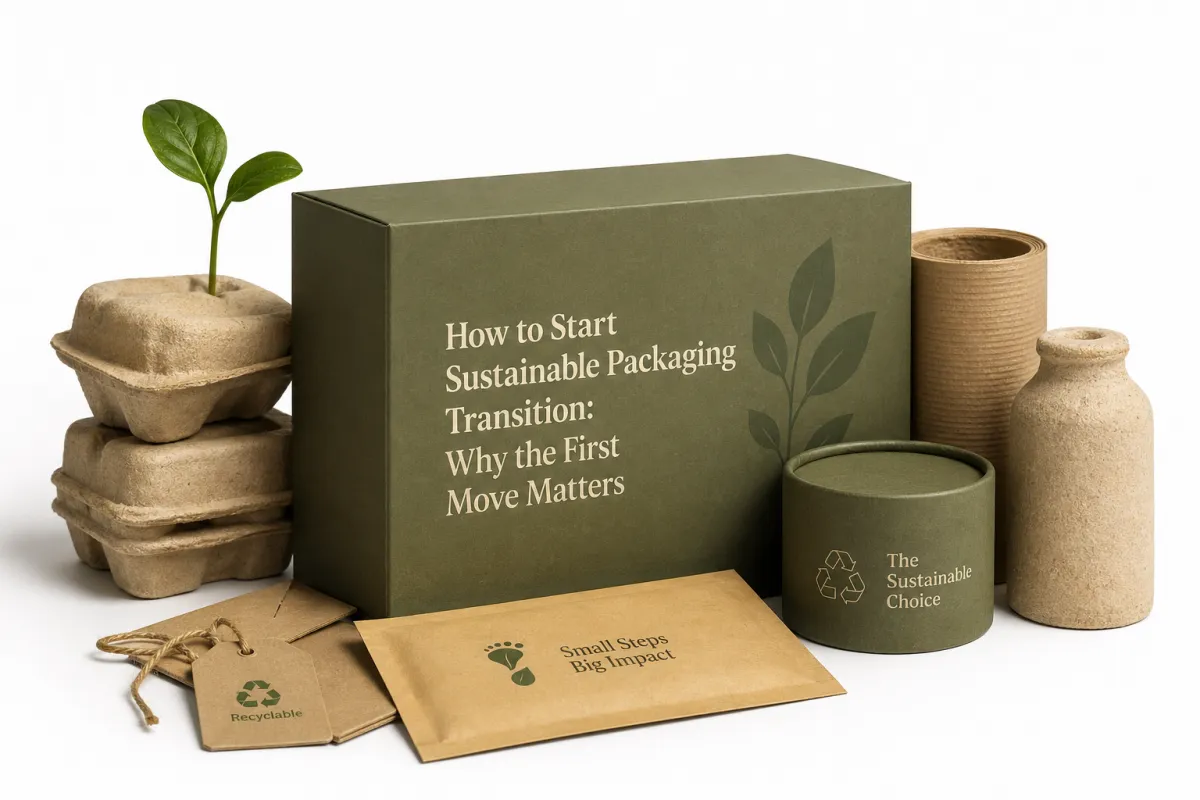
The shortest answer is also the least flashy: audit the current pack, identify the biggest source of packaging waste, and test one better option before changing everything. For most brands, how to start sustainable packaging transition means reducing material first, then checking whether the new structure still protects the product and fits the fulfillment process.
A good first pass usually focuses on right-sizing, filler reduction, and choosing a format that fits real shipping conditions. If the package is oversized, too complex to assemble, or built from mixed materials that confuse disposal, that is where the transition should start. A practical first move often looks like this:
- Measure the current carton, insert, mailer, and closure system.
- Compare weight, cube efficiency, and damage history.
- Request one lower-impact alternative with the same function.
- Test the option in real transit, not only in a lab.
- Launch in one SKU or one channel before expanding.
That is the simplest version of how to start sustainable packaging transition. It keeps the work grounded in operations, not slogans, and it gives the team something measurable to improve.
How to Start Sustainable Packaging Transition: Why the First Move Matters
Packaging waste tends to hide in plain sight. Teams can spend weeks comparing paper grades, compostable coatings, and recycled-content claims while the biggest win sits right in front of them: remove unused space, remove an extra insert, or replace a heavy secondary pack with a leaner structure. That is why how to start sustainable packaging transition should start with the package itself, not the language wrapped around it.
From a packaging buyer’s point of view, the problem is not only visual. Material waste matters. So does end-of-life confusion. Product damage matters most of all. A shipment that arrives intact in a right-sized carton is more sustainable than a polished package that bursts open in transit and gets replaced. The carbon cost of a return can swallow the small gains from a nicer-looking substrate. I have seen brands spend months on a fancy material swap, then discover that the new pack was costing more in replacements than it saved in board. That is a messy lesson, but a useful one.
Picture a brand shipping a lightweight product in an oversized mailer stuffed with too much filler. The box is larger than it needs to be, dimensional weight pushes the parcel into a more expensive rate band, and the customer has to dig through a mountain of paper before finding the item. In that case, how to start sustainable packaging transition is not a puzzle. Resize the mailer, reduce the filler, and test whether a slimmer structure still passes transit checks. The best branded packaging move is often the least flashy one.
Think of the transition as a sequence:
- Audit what is already in use.
- Identify the biggest waste points.
- Prototype one or two alternatives.
- Price them honestly, including freight and damage risk.
- Validate with real shipping conditions.
- Roll out in stages, not all at once.
The sequence sounds simple because it is simple. The difficulty lives in the details. A carton that saves 12% in board weight but fails stack tests is not a win. A polished insert that slows assembly is not a win. A glossy claim about package branding means little if the package cannot survive the route from warehouse to customer.
Useful rule: if a packaging change lowers material but increases damage, it is not a sustainable improvement. It is only a relocation of the problem.
For brands comparing Custom Printed Boxes with other custom packaging options, the first question should be simple: where is the waste? Not every pack needs a full redesign. Some need a trim. Some need a material change. Some need a different closure system. That is the practical core of how to start sustainable packaging transition.
If you need a place to compare structural options, the Custom Packaging Products page is a useful starting point for matching format to function. The best transition usually solves three things at once: less waste, lower shipping cost, and fewer fulfillment headaches.
What Sustainable Packaging Transition Actually Means
How to start sustainable packaging transition becomes easier once the terms stop sounding interchangeable. A package can be recyclable, recycled-content, compostable, reusable, or source-reduced, and those are not the same thing. A recycled paperboard sleeve does not automatically mean the entire pack is recyclable. A compostable mailer is not a universal solution if local collection systems do not accept it. A reusable box only works if the reverse logistics are realistic. The label matters, but the system matters more.
In practical terms, a sustainable packaging transition touches the whole packaging system:
- Materials: paperboard, corrugated, molded fiber, mono-material plastics, paper-based wraps, and closures.
- Size: right-sizing, wall thickness, headspace, and insert geometry.
- Print: ink coverage, coatings, varnishes, and whether artwork blocks recyclability or adds unnecessary mass.
- Closures: tapes, adhesives, labels, tamper-evident seals, and whether they interfere with recovery.
- Logistics: pallet patterns, cube efficiency, warehouse handling, and parcel dimensional weight.
- Disposal guidance: clear instructions that a real person can follow without a materials science degree.
The same material can behave differently depending on local infrastructure. A fiber-based carton may be easy to recycle in one region and awkward in another if it is coated, laminated, or contaminated with food or grease. That is why how to start sustainable packaging transition should include the pack itself and the waste stream it enters. The EPA’s recycling resources help explain how packaging fits into the broader system, especially for brands serving multiple regions: EPA recycling guidance.
One thing brands often miss is that sustainability is a balance, not a single attribute. A package that lowers carbon impact but increases damage may be worse overall. A pack that is easy to recycle but uses too much material may still be inefficient. A format that looks premium on shelf but creates confusing disposal steps can frustrate customers and hurt repeat purchase intent. That tension is normal. Good packaging design lives inside it.
From a technical standpoint, it helps to separate the claims:
- Recyclable: the material can enter a recycling stream where accepted.
- Recycled content: the package includes recovered fiber or resin.
- Compostable: the material is designed to break down under specific composting conditions, often backed by ASTM D6400 or similar standards.
- Reusable: the package is intended for more than one use, with a system that supports that reuse.
- Source-reduced: the package uses less material than the previous version.
That distinction is the backbone of how to start sustainable packaging transition. Without it, brands end up mixing claims that sound good in a pitch deck but collapse under scrutiny. For fiber sourcing, FSC certification can support chain-of-custody expectations; for shipping performance, ISTA test methods such as ISTA 3A are often the right place to begin. Standards matter because they turn packaging from opinion into evidence.
How to Start Sustainable Packaging Transition: Process and Timeline
If one mistake slows everything down, it is treating the transition like a one-week design exercise. How to start sustainable packaging transition works better as a phased program. A simple secondary packaging change might move quickly. A primary package for a regulated product, or a format with custom print and strict shelf-life requirements, usually needs more time for testing, supplier sourcing, and approvals.
Here is the practical sequence most brands can follow:
- Audit the current pack. List every component, weight, supplier, printed area, adhesive, and disposal path for each SKU.
- Set target outcomes. Decide whether the priority is material reduction, lower freight cost, easier recycling, better shelf presentation, or all four.
- Build alternatives. Ask for two or three options with different structures, not just the same structure in a greener substrate.
- Prototype. Review fit, assembly, print quality, and protection before ordering at scale.
- Test. Use real shipping, storage, and customer-use conditions instead of only bench assumptions.
- Launch in stages. Roll out by SKU, region, or channel so issues stay contained.
- Review results. Compare damage rate, returns, material use, and freight behavior against the baseline.
That phased approach is the safest way to handle how to start sustainable packaging transition. It also helps with supplier lead times. Many packaging vendors can move faster on plain structures than on heavily printed or custom-engineered formats, but minimum order quantities still matter. A design that needs a new cutting die, a new plate set, or a different coating can add weeks. In some cases, a 12- to 15-business-day print window starts after proof approval, but larger jobs or more complex formats can take longer. The answer depends on the exact structure and volume.
Timeline expectations should stay realistic:
- Simple secondary packaging changes: often a few weeks if approvals are straightforward and the substrate is stocked.
- Custom printed boxes: often longer because artwork, proofing, and plate changes add steps.
- Primary packaging: more time, especially if it touches barrier, shelf-life, or product compatibility.
- Regulated goods: longest timelines, because compliance review can slow the process even when the design is ready.
There is a smart sequencing rule here. Start with the component that is easiest to change and most clearly wasteful. In many e-commerce programs, that means the outer carton or filler. In retail packaging, it may be the sleeve, tray, or insert. In food or personal care, the primary pack may need more caution, so the outer system becomes the first win. That is how how to start sustainable packaging transition avoids a big-bang conversion that creates more risk than progress.
A phased rollout by SKU is usually better than changing everything at once. One product line gives you cleaner data. One region keeps logistics simpler. One channel, such as direct-to-consumer, lets you learn from a controlled customer base before expanding to retail. That matters because sustainability programs fail less often from bad ideas than from weak rollout discipline.
For brands comparing retail packaging updates with shipping packaging updates, the phased model has another advantage: it helps design, operations, and procurement speak the same language. Packaging design is never just a creative exercise. It is a production system, a freight system, and a customer experience system all at once.
Key Factors That Decide the Right Sustainable Packaging Path
There is no single material that solves every packaging problem, which is why how to start sustainable packaging transition works best as a decision tree. Start with product protection. Always. A package that fails in transit creates extra emissions through re-ships, refunds, and replacement inventory. That hidden waste does not show up in a material quote, but it shows up fast in customer service logs.
Then compare the pack against the actual stresses it will face:
- Moisture exposure: humidity, condensation, and accidental wetting during transit or storage.
- Barrier needs: oxygen, aroma, light, or grease control if the product needs it.
- Stacking strength: especially important for warehouse storage and palletized freight.
- Tamper evidence: critical for food, personal care, supplements, and other trust-sensitive categories.
- Temperature sensitivity: heat or cold can affect adhesives, films, and seal performance.
Customer behavior is the other major variable. A technically recyclable package still fails if the customer cannot sort it correctly. A compostable format still fails if there is no local access to composting. A reusable pack still fails if the return path is confusing or expensive. That is why how to start sustainable packaging transition should include disposal instructions printed in plain language, not just a logo or a recycling icon.
The brand side matters too. Good package branding can support sustainability instead of fighting it. Minimal print coverage, strong typography, and a clean structure often feel more premium than a crowded surface packed with claims. The challenge is not to make the box look empty; it is to make it look intentional. That distinction matters for branded packaging, especially in categories where perception influences price tolerance.
Here is a quick way to weigh the options:
| Option | Best Use | Typical Unit Cost at 5,000 Units | Strengths | Watch-Outs |
|---|---|---|---|---|
| Right-sized corrugated mailer | E-commerce shipping, subscription goods | $0.68-$1.25 | Strong protection, easier cube efficiency, often lower void fill | Needs careful die sizing and print planning |
| Molded pulp insert | Electronics, personal care, fragile goods | $0.18-$0.45 | Good cushioning, fiber-based feel, can replace plastic trays | Tooling and lead time can be higher at lower volumes |
| Recycled paperboard sleeve | Retail packaging, light primary or secondary wraps | $0.08-$0.22 | Low material use, strong shelf presentation, easy branding surface | Not enough protection on its own for shipping |
| Compostable mailer | Soft goods, low-risk parcels, narrow distribution areas | $0.35-$0.90 | Useful in specific disposal systems, lighter than some rigid formats | End-of-life claims need local verification |
Those numbers are directional, not universal. Print coverage, finish, board grade, and order quantity can move them quickly. Still, the table shows a useful truth about how to start sustainable packaging transition: the cheapest-looking option is not always the cheapest after freight, damage, and customer handling are included.
For shipping validation, standards matter. ISTA methods help compare package performance under transport stress, while FSC can support responsible fiber sourcing. Neither one is a magic stamp, but they give procurement and operations something stronger than a marketing promise. If a supplier cannot explain the testing or sourcing chain clearly, that is usually a warning sign.
Cost and Pricing: What Sustainable Packaging Really Adds
People often ask whether Sustainable Packaging Costs more. The honest answer is: sometimes yes, sometimes no, and often the quote is missing half the picture. How to start sustainable packaging transition becomes easier financially when the conversation moves from unit price to total cost of ownership. That means looking at material cost, tooling, testing, freight, damage, returns, labor, and inventory risk together.
Break the cost into parts:
- Material: board, fiber, resin, coatings, closures, inks, and adhesives.
- Tooling: dies, plates, molds, or setup charges.
- Design labor: packaging design, structural revisions, artwork changes, and proofing.
- Testing: transit validation, fit checks, shelf-life reviews, and quality sign-off.
- Freight: cube efficiency, pallet density, and parcel billing weight.
- Operations: assembly speed, packing errors, and warehouse handling.
The reason a lower-material design can cost less overall is simple. A right-sized box can reduce dimensional shipping charges, lower filler consumption, and improve pallet utilization. A better insert can reduce breakage and return rates. A lighter mailer can save enough freight cost to offset a slightly higher substrate price. That is the practical math behind how to start sustainable packaging transition.
Minimum order quantities matter as well. Small-volume runs tend to cost more because setup cost gets spread over fewer units. Larger programs usually improve pricing, especially if the design is stable and the supplier can repeat production without new tooling. If a brand is unsure about demand, it is often smarter to test one component first than to lock into a full redesign too early.
There is a trap here. Some brands compare a standard stock box with a custom sustainable option and stop at the unit quote. That misses the hidden savings from right-sizing and damage reduction. In one common scenario, a pack that costs $0.12 more per unit can still save money if it cuts shipping waste by a few percent and reduces replacement orders. That is why how to start sustainable packaging transition should use a spreadsheet, not a slogan.
Another hidden factor is inventory risk. If a design change forces the old packaging to sit in storage while the new one is approved, carrying cost goes up. If the new sustainable substrate has a longer lead time, stockouts become possible. Both issues can be managed, but only if procurement and operations are involved early. Packaging is not just a purchase; it is a supply chain decision.
For brands building out Custom Printed Boxes or other custom packaging elements, the best pricing conversations are comparative. Ask for the current version, a right-sized version, and one lower-impact alternative with the same structural function. Then compare the quotes against freight, labor, and damage. That is usually where the truth shows up.
If you are sourcing decorative or retail-facing solutions, the Custom Packaging Products catalog can help narrow structural choices before you invest in a full redesign. It is easier to control cost when the format is chosen for the job instead of forcing the job into a favorite format.
Step-by-Step Guide to the Sustainable Packaging Transition
Here is the most practical way to approach how to start sustainable packaging transition without drifting into endless debate. Keep the first project narrow. One SKU. One packaging component. One scorecard. One review date. That discipline cuts noise and makes the results easy to read.
1. Run a packaging audit. Build a simple inventory for each SKU: outer carton, inner insert, wrap, tape, labels, print coverage, supplier, dimensions, and weight. Then document how each component is disposed of or recovered. This audit is where how to start sustainable packaging transition gets concrete, because paper claims disappear when the actual materials are listed side by side.
2. Rank opportunities by impact and effort. The easiest win is often removal, not replacement. Extra inserts, oversized mailers, duplicate layers, and decorative fill are common candidates. After that comes right-sizing. Only then should the team move to substrate changes, coating changes, or more complex structural redesigns. The order matters because it avoids spending money on a new material while leaving the real waste untouched.
3. Build two or three alternatives. One should be the conservative option. One should be the ambitious option. One should be a cost-control fallback. A good comparison might include a lighter corrugated mailer, a recycled paperboard sleeve, and a molded pulp insert. That gives the team a real spread instead of a yes-or-no argument. It also helps with package branding, because you can see how each option behaves visually, not just technically.
4. Prototype and test in real conditions. Lab tests are useful, but they do not replace actual handling. Run the pack through warehouse handling, ship it on your normal route, expose it to the stacking and vibration it actually sees, and inspect the results. ISTA 3A is often a sensible starting point for parcel shipping, but the exact method should match the product and distribution path. If the pack is temperature-sensitive or fragile, add more conditions, not fewer.
5. Check the business case honestly. Compare the old and new versions using total cost, not only unit price. Look at material reduction, freight cube, damage rate, assembly time, and customer feedback. The transition should be judged like any other operational change: by measurable results, not by a presentation deck.
6. Plan the rollout. Use a checklist that includes artwork approval, supplier sign-off, quality control, regulatory review, and training for packing staff. If multiple teams touch the pack, make sure each one knows what changed and why. A transition can fail because the warehouse keeps using the old insert or customer service has not been briefed on disposal questions.
7. Measure after launch. Track material reduction in grams or ounces per unit, damage rate, return rate, freight savings, and customer comments. If the transition is working, the numbers should show it. If they do not, revise the design. Sustainable packaging is not a single decision; it is a controlled series of improvements.
That is the backbone of how to start sustainable packaging transition. It is not glamorous. It is effective.
A simple internal rule helps here: do not roll out a second SKU until the first one has a clean scorecard. The temptation is to move quickly once the design looks good. Resist that urge. One successful pilot is worth more than five partly finished conversions.
Keep the language plain, too. If a pack is recyclable, say recyclable and explain where. If it includes recycled content, say how much. If it is compostable, say which standard it meets and what disposal route applies. Clear language builds trust. Vague claims do the opposite.
Common Mistakes, Expert Tips, and Next Steps
The biggest mistake is greenwashing through vague language. Words like eco-friendly or planet-safe do not tell a customer what to do with the package, and they do not prove anything to a procurement team. How to start sustainable packaging transition should be grounded in specifics: material composition, recovery path, certification, and performance data. If a supplier cannot provide those details, keep asking.
The second mistake is picking a sustainable material before checking whether the package still performs. A more responsible substrate cannot fix a weak design. If the seams split, the corners crush, or the adhesive fails, the product will create more waste through returns and replacements. The package has to earn its place.
Here are a few expert tips that save time:
- Start with one SKU that has enough volume to make results visible.
- Choose one metric to improve first, such as material weight or damage rate.
- Ask suppliers for exact board grades, fiber content, coating details, and lead times.
- Test disposal instructions with a real customer sample, not just internally.
- Keep the first redesign narrow so the team can learn quickly.
That narrow scope is especially useful for how to start sustainable packaging transition in companies with limited internal resources. A focused pilot proves value faster than a broad program that never reaches launch. It also keeps budget control tighter, which matters when leadership is watching the numbers closely.
Another practical tip: compare formats, not just materials. A recycled paperboard sleeve may be better than a heavier box for retail packaging. A molded pulp insert may outperform a plastic tray for fragile goods. A smaller carton may eliminate filler altogether. Those choices often matter more than the exact recycled percentage on the spec sheet.
If you need to connect sustainability to brand presentation, remember that branded packaging can feel premium without being excessive. Clean typography, restrained ink coverage, and a well-proportioned structure often say more than a crowded surface of claims. For many brands, that is the sweet spot: Packaging Design That looks intentional, protects the product, and keeps material use under control.
For the next step, keep it practical. Choose one product. Collect the current packaging specs. Request two alternative quotes. Ask for one option that reduces material and one option that improves recovery or recycled content. Then schedule a pilot test inside a defined window. That sequence is the clearest answer to how to start sustainable packaging transition without getting lost in theory.
If you are building from a packaging catalog or comparing Custom Packaging Products, the goal is not to find a perfect box on the first try. The goal is to find a package that performs, costs sensibly, and moves the brand in the right direction.
Bottom line: how to start sustainable packaging transition is really about sequencing. Audit first, trim waste next, test under real conditions, and only then scale. Brands that move this way usually spend less time fixing mistakes and more time building a package system that supports both operations and brand value. Start with the SKU that wastes the most or ships the most, gather the numbers, and make one change that can be measured in the next cycle.
FAQ
How do I start a sustainable packaging transition with one product line?
Pick the highest-volume or most wasteful SKU first so the result is visible and measurable. Then audit the current pack, target the easiest win, such as removing filler or resizing the carton, and test one alternative before a wider rollout. That is the simplest version of how to start sustainable packaging transition without overwhelming the team.
What is the fastest way to begin a sustainable packaging transition without a big budget?
Reduce material before replacing material: right-size, remove extra layers, and simplify inserts. Use existing supplier relationships to source a lower-impact option that fits current equipment. For many brands, that is the lowest-risk version of how to start sustainable packaging transition because it improves efficiency before it increases complexity.
How long does a sustainable packaging transition usually take?
Simple secondary packaging updates can move in a few weeks if suppliers and approvals are straightforward. Primary packaging, custom print, or regulated products often take longer because testing and compliance reviews add time. A phased rollout is usually faster overall than a full conversion done all at once, and it is usually the better way to handle how to start sustainable packaging transition.
Does sustainable packaging cost more than standard packaging?
Sometimes the unit price is higher, but total cost can fall if you use less material or cut shipping waste. Performance, damage reduction, and freight savings often matter more than the quoted material price. Small-volume runs tend to cost more, while larger programs usually improve pricing, so the answer to how to start sustainable packaging transition depends on volume and design efficiency.
How do I know if a packaging option is truly sustainable?
Ask for proof: material composition, certifications, recyclability or compostability claims, and disposal guidance. Check whether the option fits local waste systems, because a good claim on paper may fail in practice. Compare the full life cycle, not just one attribute like recycled content or biodegradability, and you will be much closer to a trustworthy answer to how to start sustainable packaging transition.


