Jacquard Beanies Wholesale for Ecommerce works when the hat reads clearly in a thumbnail and still looks credible in hand. Knit texture adds depth, color blocking adds shape, and the logo becomes part of the fabric instead of a separate add-on. That usually helps a listing Stand Out Without depending on heavy decoration.
The real value is control over what the buyer sees and what the factory has to make. A jacquard build can reduce assembly steps and keep the brand mark integrated, but only if the artwork is simple enough for stitch construction. If the graphic depends on tiny type, gradients, or fragile lines, it needs to be simplified before sampling.
For ecommerce buyers, the key question is whether the design still holds up at small size, in folded packing, and on different head shapes. If it does, the style has a practical case for sell-through. If it does not, the specification needs work before a quote becomes useful.
A beanie that reads clearly at thumbnail size usually has a better chance of selling than one that only looks good in a close-up studio shot.
Why jacquard beanies wholesale for ecommerce changes sell-through
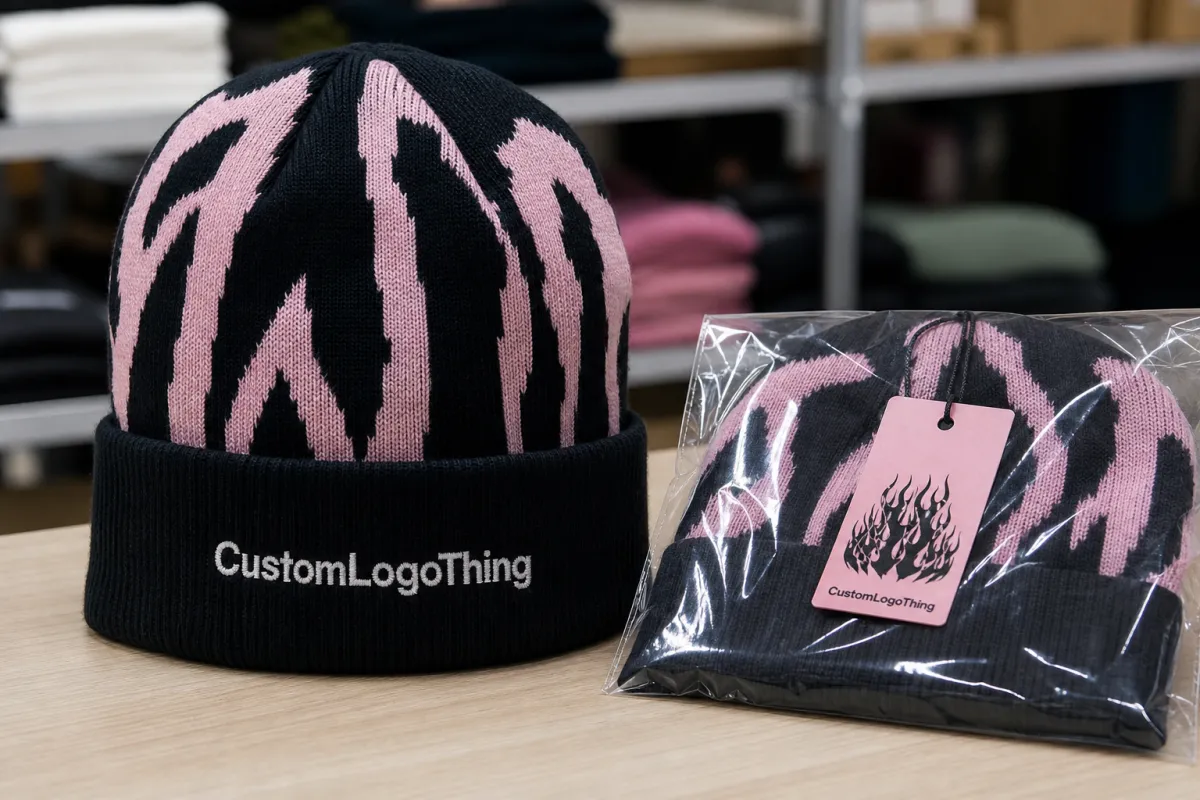
Knitted texture gives a shopper immediate proof that the product has structure. You can see stitch depth and contrast before touching the fabric, which helps the item feel more substantial than a blank hat with added decoration. In crowded category pages, that visible texture can improve click-through and reduce the need for a long explanation.
Jacquard also photographs well across multiple assets. The pattern can carry in a hero image, a short video, and a carousel without depending on one exact angle. That is useful when the same product has to work on a product page, a social post, and a promotional email.
For repeat ecommerce programs, consistency matters more than novelty. A simple silhouette with a clear pattern can support seasonal colors, launch drops, and restocks without forcing a redesign each time. If the design needs to change every season just to stay readable, the knit probably carries too much visual noise.
A quick screen test helps: if the design loses its shape at about 120 pixels wide, it is probably too busy. Thin text, tight outlines, and low-contrast details tend to disappear once the stitch structure takes over.
Pattern depth, color limits, and knit quality buyers should spec
Jacquard knitting builds the image into the fabric, so the artwork has to respect stitch size, yarn thickness, and machine limits. Fine detail gets heavier, gradients soften, and small text often becomes unreadable. Buyers usually get better results when the design is treated as knitwear first and artwork second.
Color count is one of the biggest drivers of both appearance and cost. Two colors are usually the cleanest and easiest to control. Three or four can still work, but each added color raises setup effort and increases the risk of contrast problems. If the design depends on shading or soft transitions, jacquard is usually the wrong method.
Construction details should be specified with the artwork. Cuff height changes how the hat frames the face and photographs on a model. Crown depth affects fit. Stretch recovery affects whether the beanie keeps its shape after packing and wear. These details influence reviews and returns more than most teams expect.
Material choice matters as well. Acrylic is common because it keeps cost stable and repeatable. Wool blends usually improve warmth and drape, but they can raise price and require more careful care instructions. A tighter gauge can sharpen the knit, though it may reduce stretch if the design is too dense.
The inside finish matters too. If the fabric feels scratchy, the product can read cheap even when the outside looks clean. Ask about yarn softness, pilling resistance, and whether the inside will be brushed, lined, or left raw. Those choices affect comfort and margin.
Fit, finishing, and packaging specifications that reduce returns
Fit is where a promising beanie can turn into a return issue. A hat may look right in photos and still feel shallow, tight, or oddly shaped on the head. One size normally fits knitwear, but that does not remove the need for measurements. Relaxed circumference, stretch range, crown depth, and cuff height should all be included in the spec.
Finishing details carry more weight than teams usually assume. Seams should sit flat and feel smooth on first wear. Labels should remain readable and not curl. If there is a pom-pom, the attachment needs to survive packing, sorting, and try-ons. Small finish issues show up quickly in reviews.
Packaging should be planned at the same time as the knit. Polybag size, hang tag placement, barcode location, carton count, and fold direction all affect fulfillment. A factory can make a technically correct product that still ships poorly if those details are left open.
A useful spec sheet should include PMS color references, artwork placement, stitch map, sample photos, final fold direction, and packing instructions. Add care labeling if the product will move through multiple channels. For transit testing, standards from ISTA are worth referencing if cartons will move through multiple touchpoints before fulfillment. If inserts or hang tags are part of the presentation, sourcing claims are easier to support when the paper stock aligns with FSC guidance.
When comparing samples, check the measurements that affect resale, not just the neat-looking ones on paper. A beanie can sit within tolerance and still wear differently because of stitch density or yarn spring. Flat-laid measurements help, but they do not replace a test on a real head.
Pricing, MOQ, and unit cost factors behind the quote
Price depends on a few variables that stack quickly: color count, knit complexity, fiber blend, labels, packaging, sample revisions, and freight method. Quantity matters too. A 500-piece test run and a 5,000-piece reorder do not sit in the same cost range, even if the artwork stays the same.
MOQ is usually tied to setup efficiency. A simple two-color beanie with a woven label may allow a lower minimum. A denser multi-color build, lining, and custom packaging usually push the minimum higher. Reorders are often cheaper because the stitch file, color record, and sample history already exist.
The quote is only useful if the assumptions are consistent. Check whether sampling is included, whether packaging is part of unit price or billed separately, and what shipping term is being used. EXW, FOB, and delivered pricing are not interchangeable. A low headline number can climb fast once cartons, labels, freight, and duty are added back in.
| Build type | Typical MOQ | Typical unit cost | Best use case |
|---|---|---|---|
| Simple 2-color jacquard, woven label, polybag | 300-500 pcs | $2.10-$3.40 | Launches, test drops, fast-moving basics |
| 3-4 color jacquard, custom hang tag, barcode label | 500-1,000 pcs | $3.25-$4.90 | Brand launches, seasonal collections, giftable retail |
| Premium blend, lining, custom packaging | 1,000+ pcs | $4.75-$6.50 | Higher AOV, colder-weather retail, premium positioning |
The cleanest pricing check is simple: knit colors, label type, packaging format, sample cost, freight method, and lead time. If those six items are unclear, the quote is not ready yet.
Production process and lead time checkpoints from proof to ship
Production should start with artwork review, not optimism. The factory needs to confirm that the design can be translated into stitches without losing the important parts. After that comes a technical proof or simulated sample, then sample approval, bulk knitting, quality control, packing, and shipment.
Lead time is shaped by more than knitting speed. Artwork revisions add days. Color matching can add another round. Peak season slows the queue even when the sample is approved. Freight method also changes the calendar. Air freight protects a launch date, but it compresses margin. Ocean freight is better for replenishment and less useful when timing is tight.
Buyers get better results when the brief is complete on the first pass. Send final artwork, target quantity, color references, packaging needs, and the launch date together. Fragmented instructions usually create fragmented output. Factories do not infer missing details because the deadline is tight; they usually guess.
A practical planning window is often 12-20 business days from sample approval to bulk completion, plus transit time. Complex patterns, holiday backlog, and late revisions can stretch that. If the beanies need to arrive before campaign assets go live, build a buffer into the schedule instead of betting the launch on the fastest estimate.
What to compare in a supplier before you place repeat orders
Low pricing does not protect margin if the supplier cannot repeat the same result twice. A better comparison is proof quality, response speed, and sample accuracy. If the simulated proof looks sharp and the sample matches it closely, the supplier is already reducing risk before bulk knitting starts.
Repeat orders depend on records as much as machinery. A reliable partner keeps color references, size notes, and production files so the second run does not need to be rebuilt from scratch. That matters when an ecommerce team wants to restock a winner quickly or launch a new colorway without re-litigating the same details.
Packaging capability is another filter. Some suppliers knit well but struggle with barcode placement, split shipments, or case packing for DTC operations. Others understand fulfillment better than knit structure. The right partner either handles both or knows exactly where the handoff should happen.
For a brand scaling knit accessories, the supplier should make consistency easier, not harder. If the team has to explain the same spec from scratch every time, the relationship is still too manual. Good sourcing reduces back-and-forth, protects the visual standard, and keeps reorder costs from drifting without a clear reason.
Common ecommerce mistakes with custom knit beanies
The biggest mistake is overcrowded artwork. Too many thin lines, tiny words, or soft gradients can look fine on screen and muddy in knit form. Once yarn becomes stitches, detail gets heavier. A logo that looks refined in Illustrator can come out blunt on the hat, especially after blocking and folding.
Fit mistakes come next. A shallow crown or overly tight cuff can trigger returns even when the design looks fine in photos. The fix is straightforward: request measurements, review a sample on a real head, and compare front and side views. Flat-lays are useful for color and layout, but they are poor at showing how a product behaves when worn.
Skipping the sample stage is usually a false economy. Yarn tone, texture, stretch, and visual scale all change once the beanie is actually knitted. A swatch is not a finished product. The sample is where the business case gets honest, and it is usually cheaper to revise a stitch map than to sit on inventory that looked better in a mockup than in a cart.
Logistics errors hurt just as much. Carton weight, packing density, barcode placement, and fold consistency all affect receiving and fulfillment. If a box is packed too tightly, goods arrive with pressure marks. If a barcode is tucked where scanners miss it, the warehouse pays for the mistake.
Next steps for a faster quote and cleaner launch plan
Start with one hero design, one backup colorway, and a target quantity. That gives the supplier enough information to price the order without turning the brief into a list of half-decided options. If you want flexibility, quote the variations clearly instead of burying them in one vague request.
Send one organized file set. Include final artwork, preferred yarn feel, packaging needs, and the launch date. Add label standards if they already exist. A complete brief usually saves at least one revision cycle, which is where many timelines quietly get longer than expected.
Then ask for a sample, confirm the spec sheet, and review the production calendar before bulk approval. That sequence protects timing and margin. It also creates a clean reference for the next drop, which is exactly what repeat ecommerce programs need. Reorders should feel like reorders, not like reopening the same argument with a new invoice.
Knit Hats for Ecommerce work best when the design, fit, packaging, and shipping plan all match the same level of discipline. If one of those pieces is loose, the product usually shows it somewhere, whether in conversion, returns, or fulfillment headaches.
FAQ
What is the MOQ for jacquard beanies wholesale for ecommerce?
MOQ usually depends on color count, stitch complexity, and whether the order uses custom labels or packaging. Simpler patterns can sometimes start around 300-500 pieces, while more detailed builds often need 500-1,000 pieces or more. Ask for MOQ by colorway so you can compare launch scenarios accurately.
How long does jacquard beanies wholesale production usually take?
Lead time usually includes artwork review, sample approval, bulk knitting, finishing, and shipping. A straightforward order can often move in 12-20 business days after sample approval, but complex patterns, rush requests, and seasonal demand can extend the schedule. The fastest path is to submit final artwork and quantity together at the start.
Can ecommerce brands use multiple colors in one jacquard beanie design?
Yes, but every added color can affect knit clarity, production time, and cost. The strongest results usually come from a controlled palette with strong contrast and simple shapes. Ask for a knit simulation before approving fine details so the final hat does not lose definition.
What artwork files work best for wholesale jacquard beanies?
Vector files are preferred because they preserve clean edges and make stitch mapping easier. Simple logos, bold icons, and repeat patterns translate better than thin text or tiny gradients. Include PMS or clear color references so the factory can match the design consistently.
How do I choose the right fit for ecommerce beanies?
Start with your target customer and decide whether the beanie should fit snug, relaxed, or oversized. Request the exact crown depth, cuff height, and stretch range before sampling. Use sample photos on a real person, not just flat-lay images, to confirm proportion.

