For beauty brands, launch kits live or die on presentation. The cosmetics woven label beanies Unit Cost Review usually starts with a simple question: does the hat feel premium enough to justify the spend? A tidy woven label can do more than decorate. It can turn a basic knit into something that looks intentional in a PR box, on a retail shelf, or in a staff welcome kit.
The mistake is treating the beanie like a pure apparel buy. It is not. For cosmetic programs, this is part merchandise, part packaging, part brand proof. The right spec protects margin, but it also avoids the sloppy look that makes a launch feel underfunded. Nobody buys a beanie because the logo is heroic. They buy it because the whole object looks considered.
That is why buyers should read the quote like a production document, not a mood board. A clear brand mark, a knit that holds shape, and a price sheet that separates setup from landed cost will tell you more than polished mockups ever will.
"A small woven label changes how a beanie is judged. In cosmetic kits, that is often the difference between a filler item and something people actually keep."
What drives first-order value in branded beanies
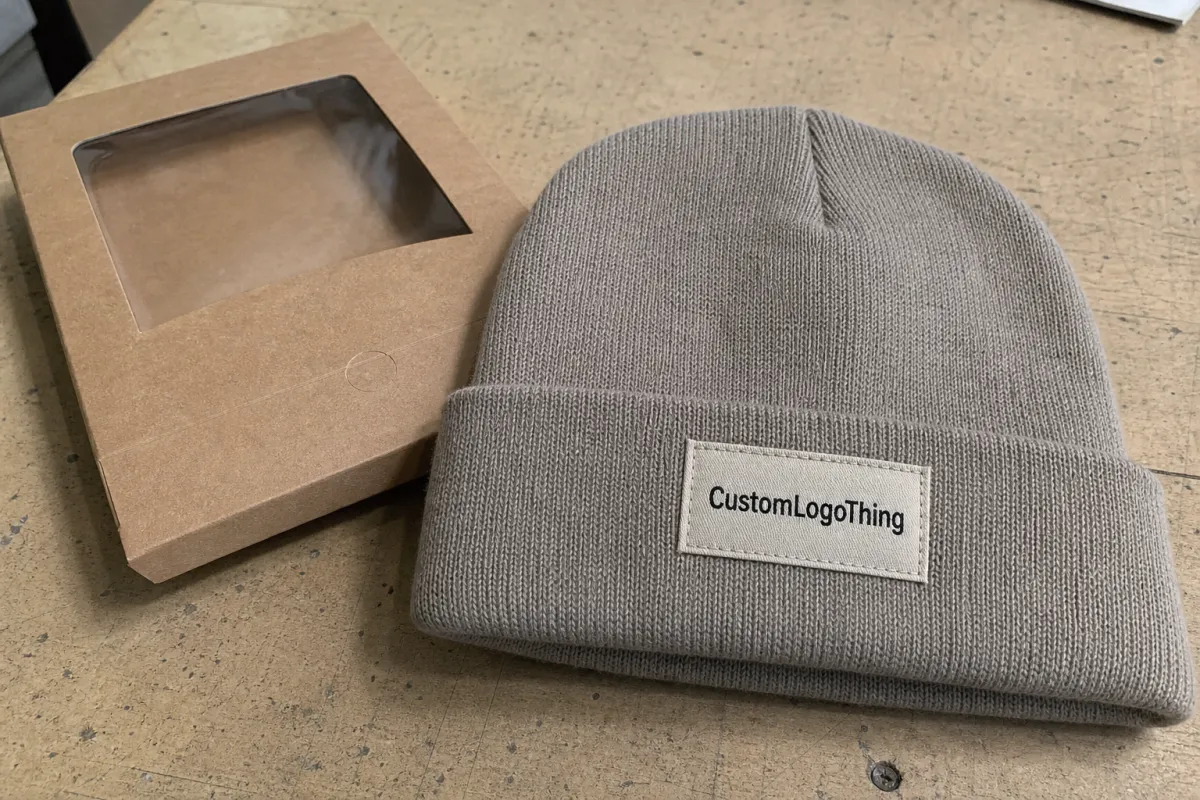
First-order value comes down to perception speed. How fast does the piece signal quality? For cosmetic launches, that matters because the beanie often sits inside a larger box with candles, minis, samples, or print materials. The hat has to pull its weight without demanding much budget. A woven label helps because it adds texture, permanence, and a cleaner brand read than a loose print hit.
The best results are usually simple. A solid-color cuff, a label that sits flat, and a thread palette that matches the brand without trying too hard. The more restrained the layout, the more premium it tends to look. That is not a rule carved into stone, but it shows up often enough in sampling to be useful. Over-designed labels tend to look noisy on a knit surface. Clean branding looks more expensive than it is.
Cosmetic buyers use these beanies in a few predictable ways: influencer mailers, event giveaways, employee kits, seasonal merchandising, and gift-with-purchase programs. Each use case has a different spend ceiling. The item may be worn once or fifty times. Either way, the client will judge it in the first two seconds. That is why the quote has to account for the full unit economics, not just the headline factory price.
Factory pricing should separate the pieces that matter: artwork prep, label weaving, sewing labor, knit construction, packing, and freight. If those numbers are bundled into a single line, you lose the ability to compare suppliers honestly. A cheap quote that hides setup fees is not cheaper. It is just less honest.
If the beanie is part of a broader branded package, a paired item like Custom Labels & Tags can help the kit feel coordinated without forcing the hat itself to carry every visual cue. That matters more than it sounds. Cohesion makes a modest budget look deliberate.
Beanie construction, label placement, and finish options
The base construction affects both feel and pricing. Cuffed beanies are the easiest to brand because they give you a stable, visible area for the woven label. They also tend to photograph better. Uncuffed styles can feel lighter and more casual, but the label zone is less controlled, and that usually means more sampling back-and-forth.
Gauge and knit structure matter too. A tighter rib knit usually holds the label flatter and keeps the hat’s silhouette cleaner. Softer, looser knits can look cozy, but they may stretch more and show slight shape differences between batches. If the same style will be reordered across seasons, that consistency issue is more than a footnote. It is the thing that keeps a replenishment run from looking like a different product.
Label placement is where most buyers get opinionated, and for good reason. Cuff placement reads fastest and is usually the easiest to approve. Side-seam placement feels quieter and suits premium cosmetic sets that want restraint. Hem-fold placement can hide the brand mark neatly, but only if the fold depth stays consistent. If it shifts even a little, the label can disappear into the cuff or sit awkwardly high.
Ask the supplier exactly how the label will be finished. Folded edges usually look cleaner than raw edges. Heat-cut labels can be thin and neat, but they depend on good handling so they do not fray. Merrowed borders are more visible and can look sporty, though they are not always the best fit for a polished beauty program. Backing also matters. A label stitched through the cuff will behave differently from one tucked into a seam or folded under.
Thread count changes the look more than many buyers expect. A two-color damask label with crisp text usually outperforms a busy four-color version that tries to say too much. Woven labels are not tiny billboards. They work best when the message is sharp and the contrast is strong enough to read at arm’s length.
How finish changes price perception
Finish details affect value perception immediately. A label that sits flush and aligns with the cuff edge suggests control. A label that tilts, bubbles, or rides too high makes the whole item look cheaper, even if the factory did everything else right. That is why sampling is not a formality. It is the only way to see how the label actually behaves on the knit surface.
Placement and production effort
More precise placement usually adds labor. If the label has to land at a specific fold point, the sewing team needs extra handling time. If a brand asks for left-right symmetry across multiple styles, the factory may need another inspection step. Those are small costs, but they show up in bulk pricing and in the odds of a mispack.
Specs that affect fit, feel, and reorder consistency
Before asking for a quote, lock the spec sheet. A cosmetics woven label beanies Unit Cost Review is only useful if the supplier is pricing the same product you plan to reorder. That means confirming yarn composition, knit weight, stretch range, cuff depth, folded height, label size, and the acceptable color tolerance for both the knit and the woven label.
Yarn composition is one of the biggest cost and feel drivers. Acrylic is common because it is predictable, warm enough for general promo use, and usually the most cost-efficient. Acrylic blends can soften the handfeel or improve drape, but they can also change dye behavior. Recycled polyester, where available, may help with sustainability claims, but buyers should verify whether it affects texture, price, or minimums. A denser knit often costs more, yet it can hold the label better and look cleaner on shelf.
Fit is another hidden variable. A beanie that is too shallow rides up. One that is too tall slouches in a way that may look trendy on a mood board and awkward in a real launch box. For cosmetic programs, the most reliable option is usually the one that fits a broad range of heads without requiring explanation. If the style is meant for gifting, that matters more than chasing a fashion silhouette.
Reorders are where sloppy specs become expensive. If the first run uses a slightly different yarn blend or gauge, the second run may match the artwork and still feel off. That is why a spec card with measured tolerances beats a pretty product description. Keep a record of cuff depth, relaxed width, label dimensions, and approved Pantone references. Future-you will be grateful.
Color matching deserves its own caution. Woven label threads and knit yarns do not behave like printed packaging. Pantone references help, but they are not magic. Thread libraries, dye lots, and fiber content all introduce variation. A label that looks right against a neutral desk can look muddy next to a blush carton or metallic cosmetic jar. Review the beanie alongside the rest of the kit, not on a blank background.
Packaging details can create avoidable messes. If the hats will ship folded for retail display, specify the fold direction and the label orientation. Otherwise, one carton may arrive with the branding facing out and another may bury it under the cuff. That does not sound catastrophic until you are opening 1,000 units and sorting them by hand.
For paper inserts, swing tags, or retail slips, FSC-certified paper is still a practical procurement standard. The Forest Stewardship Council reference point is here: fsc.org.
Unit cost, MOQ, and quote variables buyers should compare
This is the part buyers ask about first. Fair enough. A cosmetics woven label beanies Unit Cost Review should show how MOQ, setup charges, and finishing choices affect the final number. The lowest sticker price is rarely the real price. What matters is the landed cost after sampling, revision fees, freight, and any packaging add-ons are included.
Quantity is the biggest lever. At low volume, the factory spreads artwork prep, label weaving, and sewing time across fewer units, so the cost per piece rises. Once the order grows, the unit rate usually drops. But only if the spec stays simple. Extra label colors, more complex stitching, custom yarn matching, or retail packaging will keep the quote elevated. Factories are not charities, despite what some quote sheets imply.
Here is a practical range buyers often use as a sanity check:
| Order tier | Typical cost per piece | Setup or tooling fees | Best use case |
|---|---|---|---|
| 100-300 pcs | $5.80-$9.50 | $35-$120 | Sample runs, launch tests, small staff kits |
| 500-1,000 pcs | $4.10-$6.80 | $25-$85 | Regional campaigns, influencer mailers, gift-with-purchase programs |
| 2,000+ pcs | $3.20-$5.40 | Often reduced or absorbed | Replenishment, retail support, seasonal rollouts |
Those numbers are directional. A dense rib knit with a larger woven label may sit near the top of the range. A simpler acrylic build with one label placement may come in lower. Freight can move the final answer more than buyers expect, especially if the shipment is split, rushed, or packed for multiple destinations. Sampling also matters. A quote that looks cheap but charges for every revision can end up more expensive than the supplier with the cleaner process.
Always compare quotes on the same basis: factory unit price, sample cost, freight, revision fees, packing method, and what is included in the carton. If one supplier includes individual polybags and another does not, the numbers are not equivalent. If one assumes a blank beanie and the other assumes a folded retail presentation, the spread is misleading. The devil is not just in the details. The details are the price.
A tiered quote request helps more than most buyers realize. Ask for pricing at a test quantity, a mid-size run, and a production volume. The spread shows whether the supplier is pricing for a one-off or a repeat program. It also reveals whether their minimum is real or just the number they prefer to say out loud.
For shipping and packaging handling, the International Safe Transit Association is a useful reference: ista.org.
Process, timeline, and production steps from proof to shipment
The cleanest orders follow the same sequence. Brief and artwork intake. Label proof. Sample approval. Bulk knitting. Label attachment. Final finishing. Packing. Dispatch. That sounds orderly because it is. The delays usually happen in the handoffs, where the buyer assumes something is obvious and the factory assumes it is not their problem.
First-time programs need more time because the spec is still being confirmed. Repeat orders move faster because the production notes already exist. For a straightforward run, a realistic lead time is often 12-20 business days after proof approval. Add buffer if the order includes special packaging, multiple colorways, heavyweight knits, or a label that needs extra stitching precision. Seasonal production pressure can stretch that further. Beanies compete with other knit goods for machine time, and factories are rarely sentimental about your deadline.
The review gates matter. Digital proof approval should confirm artwork, label size, and placement. A pre-production sample should confirm the handfeel, cuff behavior, and how the label sits on the knit. Color approval should happen before bulk knitting if the brand needs a tight match. Carton-level checks should confirm fold orientation, unit packing, and shipping marks. Miss one of those steps and the order can still ship on time while arriving wrong.
One practical note: ask whether the supplier does photo approval at the label stage or only after bulk sewing. That distinction matters. Once a large batch is attached, a mistake is no longer a proofing issue. It is a rework issue. Rework is where margins go to die.
What to approve before bulk starts
- Artwork file with small text that still reads at label size
- Label dimension, edge finish, and stitching position
- Knit color reference, Pantone guidance, or physical swatch match
- Fold direction and retail-facing label orientation
- Packing method, carton quantity, and shipping marks
How to protect the schedule
Ask for a production calendar that names the checkpoints. If the supplier cannot tell you when label weaving starts, when knitting begins, and when final packing happens, you have less control than you think. A clear calendar is usually a sign that the factory understands sequencing, not just invoicing.
How to reduce defects, delays, and costly rework
The best suppliers prevent problems early. They catch artwork issues before weaving, check stitch placement before bulk sewing, and verify fold orientation before cartons are sealed. That discipline is easy to miss when you are staring at a quote sheet, but it is often the difference between a clean launch and a pile of avoidable complaints.
Ask for proof of control. A pre-production sample gives you a physical reference. Photo approval at the label stage confirms the mark before large quantities are affected. Written inspection criteria show what the factory will check and what it will allow through. That matters more for cosmetic programs than for random promo items, because beauty buyers are judged on presentation as much as function.
The common failure points are not dramatic. The label is too small to read from a normal viewing distance. The thread shade is close but not close enough. The seam creates a bump under the label. One carton has folded hats with the branding facing out, while the next carton has the same style facing inward. None of that is exciting. All of it is expensive if it reaches the customer.
There is a reason experienced buyers accept a slightly higher quote when the factory documents checks properly. That premium can be cheaper than a missed launch window, a return shipment, or a second production run. A few cents spent on control often saves dollars on correction. Not glamorous. Extremely useful.
Ask how the supplier handles rework thresholds, label inspection, and carton sampling. The answer should be specific. If the response is just reassurance and smiling punctuation, keep asking.
"The real measure of a cosmetic beanie program is not whether the logo looks good in a mockup. It is whether the first sample, the first carton, and the third reorder still look like the same product."
Next steps for a faster quote and cleaner approval
If you want an accurate quote quickly, send the supplier one clean brief: logo file, target quantity, preferred beanie color, label dimensions, shipping destination, and delivery window. Add packaging requirements if the beanies need to arrive retail-ready or gift-boxed. The clearer the brief, the fewer assumptions the factory has to make, and the fewer revisions you will pay for later.
Ask for a side-by-side quote that separates sample cost, bulk unit cost, and freight. That is the simplest way to see whether the proposal protects margin or just looks tidy in the inbox. If the order is still early, request two scenarios: one low-risk sample run and one production volume. Comparing them makes the MOQ effect obvious. Sometimes the unit price drops enough to justify a slightly larger run. Sometimes it does not, and that is fine too.
The smartest buying approach is usually practical rather than dramatic. Lock the spec, review label placement, confirm the landed number, and choose the version that gives the best mix of value and presentation. If the beanie is doing its job, it should support the brand without making the sourcing process feel like a scavenger hunt.
That is the real purpose of a cosmetics woven label beanies unit cost review: not to chase the lowest quote, but to find the most defensible one. The right answer balances MOQ, bulk pricing, process control, and a finish that still looks credible when the box is opened and nobody is posing for a mockup.
Frequently asked questions
What affects cosmetics woven label beanies unit cost the most?
Quantity is usually the biggest driver because setup and labor spread out as the order grows. Label size, thread count, knit density, and packaging choices also move the price up or down. Freight and sampling can change the landed cost even when the factory unit price stays stable.
What MOQ is typical for woven label beanies for cosmetic brands?
Many factories quote lower minimums for plain blanks and higher minimums for custom knit and label combinations. A practical MOQ range is often 100-300 pieces, but the exact floor depends on color count, finishing steps, and whether the order is per color or per artwork version.
How long does production usually take after approval?
Simple repeat orders can move faster because the artwork and spec are already locked. First-time programs usually need time for proofing, sample approval, bulk knitting, and finishing. Build in extra time if the beanies are tied to a launch date, event, or seasonal promotion.
Can woven labels match cosmetic brand colors exactly?
They can usually be matched closely, but thread and yarn do not behave like print ink. Ask for Pantone references and a physical or photo proof before bulk production. Expect small variation across dye lots and check the colors against the full packaging palette.
What should I send to get an accurate quote fast?
Send artwork, quantity, size targets, label dimensions, preferred beanie color, and delivery location. Include any packaging requirements if the beanies will be retail-ready or gift-boxed. A clear deadline helps the supplier recommend a production path that fits budget and timing.


