Buyer Fit Snapshot
| Best fit | Kraft Box Supplier Quote projects where brand print, material claims, artwork control, MOQ, and repeat-order consistency need to be specified before quoting. |
|---|---|
| Quote inputs | Share finished size, material target, print colors, finish, packing count, annual reorder estimate, ship-to region, and any compliance wording. |
| Proofing check | Approve dieline scale, logo placement, barcode or warning zones, color tolerance, closure strength, and carton packing before bulk production. |
| Main risk | Vague material claims, crowded artwork, missing packing details, or unclear freight terms can make a low unit price expensive after revisions. |
Fast answer: Kraft Box Supplier Quote: Pricing, Specs, and Lead Times should be specified like a repeatable production item. The safest quote records material, print method, finish, artwork proof, packing count, and reorder notes in one written spec.
Production checks before approval
Compare the actual filled-product size with the drawing, then confirm tolerance on folds, seals, hang holes, label areas, and retail display edges. Reserve space for logos, QR codes, warning copy, and material claims before decorative graphics fill the panel.
Quote comparison points
Review material grade, print process, finish, sampling route, tooling charges, carton quantity, and freight assumptions side by side. A quote is only useful when the supplier can repeat the same color, closure quality, and packing count on the next order.
Kraft box supplier quote requests get messy fast. The cheapest number is usually the one that forgot the die fee, the freight, or the finish. That is not savings. That is a surprise invoice with nicer typography.
For a packaging buyer, the job is simple enough on paper: get a kraft box supplier quote that shows what the box is, what it is made from, what it costs landed, and how long it will take to arrive in usable shape. If those details are fuzzy, the quote is not doing its job. It is just a headline pretending to be useful.
Custom Logo Things works with buyers who need custom kraft packaging that survives real use, not just a neat line in a spec sheet. If you need a custom packaging quote, start with exact dimensions and a real use case. That alone cuts a lot of nonsense out of the process. I have seen a 2 mm dimension mistake turn into a week of revisions, and nobody was thrilled about it.
Low numbers can be expensive in disguise. A low kraft box supplier quote still turns into a bad deal if the box ships wrong, prints wrong, or needs a reorder because the fit was off by 2 mm. That tiny miss can change board usage, tighten the tuck, weaken stacking, and push freight up if the cartons no longer nest well. So yes, the number matters. The box That Actually Works matters more.
What a Kraft Box Supplier Quote Should Show First
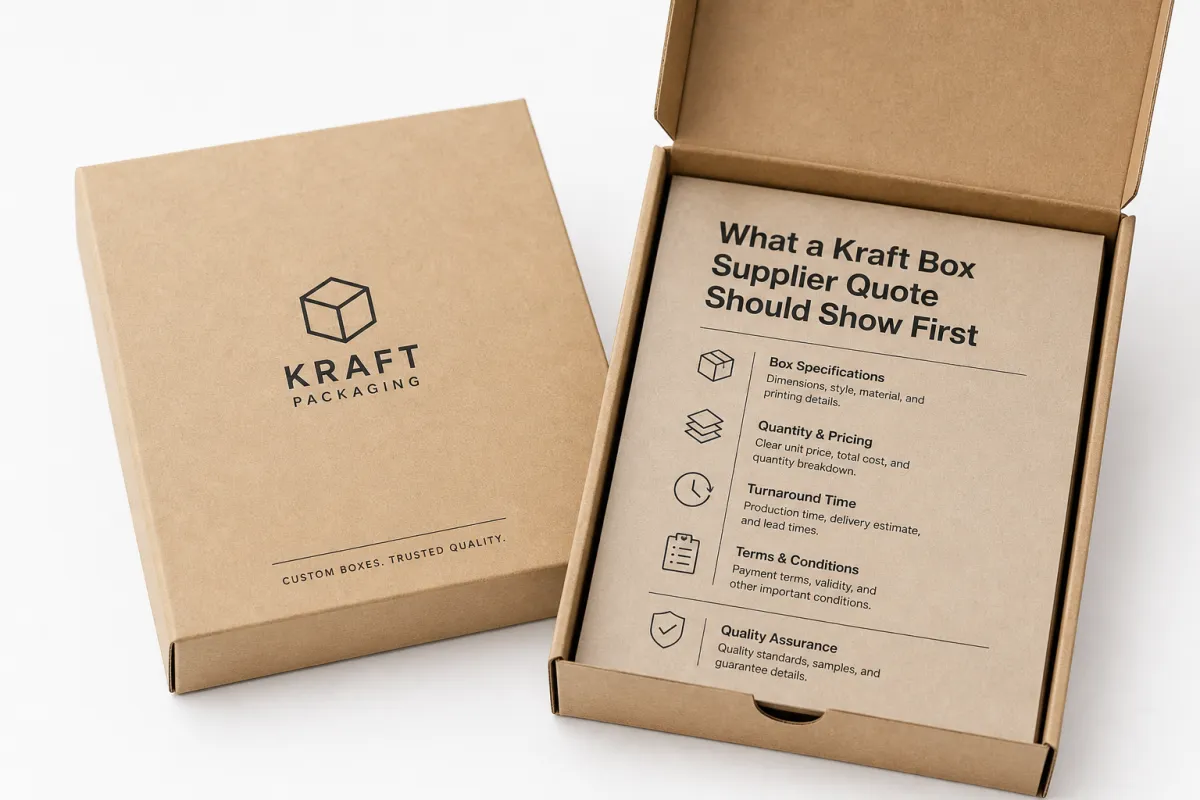
A serious kraft box supplier quote should open with the basics: box style, inside dimensions, board grade, print method, quantity break, and delivery terms. Leave any of those out and the quote is incomplete. No drama. Just incomplete.
I check inside size first, not outside size. Inside dimensions tell you whether the product fits. Outside dimensions help with packing and freight, but the box has to work before it can travel anywhere. A 2 mm mistake on each side sounds small until you are dealing with filler, lid fit, or a box that bows during shipment.
That matters even more for ecommerce brands comparing mailer boxes. A box that is slightly too big can raise shipping costs because dimensional weight creeps up. A box that is too tight can crush inserts, scuff print, or slow down fulfillment because the packer has to wrestle the structure into submission. A good kraft box supplier quote should expose that tradeoff before the order goes live, not after 8,000 units are already on the water.
A quote only helps if it compares the same thing. Different size, different board, different freight term, different result. That is packaging math, not opinion.
The delivery term needs to be clear too. EXW, FOB, and DDP are not interchangeable. EXW looks cheap until pickup, export handling, and freight show up. DDP looks higher until you realize the supplier already packed more of the logistics into the number. That is why a kraft box supplier quote should be judged as landed cost, not just factory price.
Do not treat the quote like design approval. It is a pricing snapshot built on assumptions. The real job of a kraft box supplier quote is to tell you whether your target style, material, and quantity make sense together. If the supplier cannot explain the assumptions clearly, keep asking. Vague quotes are how people pay for rework later.
For buyers building a comparison sheet, these fields keep the conversation honest:
- Box style and locking method
- Inside dimensions in length, width, and depth
- Board grade or flute type
- Print method and ink count
- Quantity break and price tiers
- Tooling, sample, and freight charges
- Delivery term and destination
That list looks basic because it is basic. Basic is good. It keeps the kraft box supplier quote honest.
Kraft Box Supplier Quote: Box Styles, Materials, and Uses
A proper kraft box supplier quote should match the box style you actually need, not the one the factory prefers to run this week. Structure changes material usage, setup time, print area, and assembly cost. Two boxes that look similar on screen can still come back with very different pricing.
Common styles include mailer boxes, tuck top cartons, folding cartons, shipping cartons, trays, and lid-and-base sets. Mailer boxes work well for ecommerce because they fold flat, ship well, and feel premium enough for unboxing. Tuck top cartons fit lightweight retail products nicely. Folding cartons are often the cheapest route for shelf presentation when the product does not need heavy transit protection. Shipping cartons and trays are more about utility than theatre, which is fine. Boxes are supposed to protect things, not audition for attention.
Material choice changes the kraft box supplier quote just as much as structure. A recycled kraft liner on corrugated board gives a natural look and decent strength. A heavier board can take more compression and usually gives a cleaner print surface. For retail and gift packaging, buyers often move toward smoother kraft paperboard because the print edges look sharper. For transit-heavy use, flute selection matters more than a pretty surface. I have had projects where the "nicer" board looked better but cracked under pallet pressure. Pretty is not a load spec.
The practical split looks like this:
- Mailer boxes: good for subscription kits, ecommerce orders, and branded delivery
- Tuck top cartons: good for cosmetics, accessories, candles, and light retail goods
- Shipping cartons: good for warehouse fulfillment and multi-item protection
- Trays: good for display packaging, inserts, and food service applications
- Lid bases: good for gifts, premium sets, and presentation boxes
Print and finish options also move the kraft box supplier quote up or down. No print is cheapest. One-color logo print usually comes next. Full-color print costs more because registration and coverage matter more. Matte and gloss coatings add another layer of labor and material. Embossing, foil, and custom inserts add even more. Nothing mystical there. Just extra process.
If structure confidence matters, ask whether the box is being designed for shelf display, ecommerce shipping, or both. A box can do both, but not always at the lowest price. If the order needs rough handling or outdoor transit, ask for testing against a relevant protocol such as ISTA procedures or the supplier's closest equivalent to ASTM distribution testing. That is not overkill. That is common sense with paperwork attached.
If the fiber story matters to your brand, ask for certified sourcing options. A kraft box supplier quote can include FSC-certified board, and that choice should be stated clearly instead of buried in a note nobody reads. For brands that care about recycled content or responsible sourcing, the label matters. So does the documentation. See FSC for the standard reference, then ask your supplier what paperwork they can actually provide.
Assembly method gets ignored more often than it should. A self-locking mailer runs differently from a glued folding carton. If the box needs manual assembly, the labor cost may show up in the quote or it may show up later in your pack-out time. Either way, somebody pays for it. A good kraft box supplier quote should say that out loud.
| Option | Typical MOQ | Common Unit Range | Setup Cost | Best For |
|---|---|---|---|---|
| No-print kraft mailer | 500-1,000 | $0.18-$0.35 | Low to moderate | Basic ecommerce shipping and test launches |
| One-color logo mailer | 1,000-3,000 | $0.28-$0.55 | Moderate | Branded subscription boxes and retail-ready packs |
| Full-color retail carton | 3,000-5,000+ | $0.40-$0.95 | Higher | Shelf display, premium gifts, and strong brand visuals |
| Rigid or reinforced kraft set | 1,000-3,000 | $0.90-$2.50+ | Higher | Presentation packaging and heavier products |
Those numbers are typical, not universal. A kraft box supplier quote can swing a lot depending on print coverage, board grade, inside fit, inserts, and freight terms. Still, the table gives you a sensible starting range so nonsense stands out quickly.
Specifications That Move a Kraft Box Supplier Quote Up or Down
The fastest way to improve a kraft box supplier quote is to supply the right specs the first time. The fastest way to wreck it is to say "something around this size" and hope the supplier can read your mind. They cannot. Good suppliers price from measurable details, not vibes.
Inside dimensions come first. Then board caliper or flute grade. Then print coverage. Then any structural extras. Skip any of those and the supplier has to pad the quote with assumptions. Assumptions cost money. That is not a flaw in the system. It is the system protecting itself from a fuzzy brief.
Board grade changes the kraft box supplier quote because not all kraft board behaves the same. A lighter stock may be fine for small retail items. A heavier stock or corrugated flute is better if the box needs stacking strength or transit protection. If the product is fragile, dense, or oddly shaped, ask for a spec that matches the actual load, not just a pretty sample. I am gonna say this plainly: a box that looks nice and fails in transit is not premium. It is expensive trash.
Print coverage has a direct effect too. One logo on one panel is cheaper than full-wrap art across every surface. Spot color can be simpler than four-color process if the design allows it. A lot of brands love the idea of full coverage until they see the production costs. Then the kraft box supplier quote becomes a budgeting lesson.
Features that add labor or tooling include:
- Windows for product visibility
- Custom inserts for fit and presentation
- Tape strips for shipping or tamper evidence
- Perforations for easy opening
- Reinforced walls for better compression resistance
- Special coatings for moisture resistance or surface feel
Every one of those features can raise the kraft box supplier quote. Sometimes a little. Sometimes enough to make the project look silly. The buyer's job is not to strip away every upgrade. The job is to decide which ones are actually earning their keep.
Before approval, ask for confirmation on a few things that sound boring and save money later:
- Bleed and safe area on the dieline
- Panel orientation so artwork lands correctly
- Stacking strength if cartons will be palletized
- Shipping orientation if labels or graphics have a front side
- Assembly direction if your team packs the box by hand
I also tell buyers to ask for a signed dieline before production starts. A clean dieline cuts down revision loops, and fewer loops usually mean a cleaner kraft box supplier quote. Not glamorous. Very effective.
Kraft Box Supplier Quote Pricing, MOQ, and Sample Costs
The pricing logic behind a kraft box supplier quote is not mysterious, but it is easy to miss if you only stare at the unit price. Material cost, setup or plate fees, conversion labor, finishing, packing, and freight all sit somewhere in the final number. The supplier may separate them or bundle them. Either way, they are there.
MOQ, or minimum order quantity, matters because setup time has to be spread over enough units to make the run sensible. A small order usually costs more per unit. That is normal. A 500-piece job and a 5,000-piece job are not built on the same economics, even if the box looks identical from the outside.
Ask these questions before comparing two kraft box supplier quote numbers:
- Are tooling and dies included?
- Are samples included or separate?
- Is freight charged ex-works, FOB, or delivered?
- Does the quote include inner packing and export cartons?
- Are taxes, duties, or destination charges excluded?
If any answer is unclear, the quote is incomplete. A low number with missing terms is not a good deal. It is a trap with nice typography.
Sample costs vary. A plain pre-production sample might be a modest charge. A fully printed prototype with custom inserts and a special finish costs more because the supplier is doing real work for a single unit or a tiny run. A smart kraft box supplier quote should show whether the sample fee is refundable, credited, or separate. Ask directly. Nobody enjoys guessing games in procurement, and the guessers always seem shocked when the bill shows up.
To compare quotes properly, use identical inputs. Same inside dimensions. Same board grade. Same print method. Same delivery term. Same quantity. If those do not match, you are not comparing prices. You are comparing fiction.
Cheaper board can raise hidden costs if the box arrives crushed, warped, or hard to assemble. I have seen buyers save a fraction of a cent on the kraft box supplier quote and lose far more on packing time and damage claims. That is the kind of savings accountants love for about 48 hours.
Typical price drivers include:
- Run size: larger runs lower unit cost
- Artwork coverage: more print, more cost
- Structure: simple folds cost less than complex builds
- Finish: coatings and specialty effects add labor
- Freight: distance and Incoterms change the landed number
If you want a cleaner answer, ask the supplier to separate the kraft box supplier quote into product, tooling, sample, and freight. That makes the tradeoffs visible. Hidden costs hate daylight.
How the Quote Process and Lead Times Work
The quote process should begin with a clean brief. Send the inside dimensions, quantity, box style, artwork, shipping destination, and target use case. If you know the product weight, include that too. A kraft box supplier quote built from partial information usually comes back with more questions, and every question adds time.
Proofing comes next. That is where the supplier checks the dieline, confirms panel layout, and flags anything that will fail in production. Most delays happen here, not on the machine. Files are incomplete. Logos are the wrong size. Bleed is missing. A branding team wants one more color adjustment. Suddenly the kraft box supplier quote timeline stretches because the approval chain got wobbly.
Realistic timing ranges look like this:
- Quote turnaround: often 1-3 business days for a clear brief
- Dieline and proof review: 2-5 business days depending on revisions
- Sample production: about 5-10 business days for most custom builds
- Mass production: often 10-20 business days after approval
- Freight and delivery: anywhere from 3-30 days depending on route and mode
Those are practical ranges, not promises. A custom kraft box supplier quote with complex finishes, busy-season demand, or imported material can run longer. A standard unprinted mailer may move faster. Ask what the lead time starts from: PO receipt, artwork approval, or sample sign-off. If that date is fuzzy, the timeline is fuzzy too.
Rush jobs usually fail for three reasons. First, the artwork is not ready. Second, the material is not available in the needed spec. Third, the final approval comes late and everyone pretends the factory can teleport. It cannot. Fast does not mean careless, unless someone is trying to sell you a headache in a hurry.
For transit-heavy orders, ask whether the supplier can support packaging test expectations that line up with ISTA methods or similar distribution testing. That helps protect the order if your boxes are moving through warehouses, parcel networks, or multi-stop fulfillment channels. A kraft box supplier quote that ignores real shipping conditions is not really a production plan. It is a hope.
One practical tip: build the schedule backward from your launch date. Leave room for proofing, sample approval, production, and freight. Then add one buffer week. Packaging schedules love to punish optimism. They really do.
Why Choose Us for a Kraft Box Supplier Quote
Buyers do not need hype. They need a kraft box supplier quote that clearly separates box cost, tooling, samples, and shipping so the real number is visible. That is where Custom Logo Things aims to be useful. Clear pricing beats clever wording every time.
We focus on tradeoffs that actually matter. If a box can be simplified without hurting protection, we will say so. If the print can be tightened to one or two colors and still look strong, that is usually the smarter move. If a heavier board is necessary because the product will get beaten up in transit, we will say that too. No drama. Just the right spec for the job.
A good kraft box supplier quote should help you protect margin without turning your packaging into a cardboard apology. Sometimes that means changing the structure. Sometimes it means reducing print coverage. Sometimes it means adjusting the quantity so setup cost spreads better. The best quote is not the cheapest one on paper. It is the one That Holds Up in production and still makes sense after freight.
Quality control matters more than people like to admit. Material consistency, print alignment, folding accuracy, glue strength, and pack-out fit all affect whether the boxes actually work. A quote is useless if the finished cartons arrive warped or misregistered. That is why we care about confirmation steps before release. It saves time, and it saves conversations nobody wants to have twice.
Reorders matter too. If the first run went well, the next kraft box supplier quote should not require a full detective report. Buyers should be able to reference the prior spec, confirm any changes, and move on. Continuity is a real advantage because it cuts friction. Nobody wants to explain the same carton five times to three different people.
If you need help sorting through options, send the specs over through Contact Us. Include the box style, inside size, quantity, artwork, and destination. The cleaner the brief, the cleaner the kraft box supplier quote. That is not marketing fluff. It is how packaging quoting actually works.
What many buyers get wrong is asking for "the best price" before they define what good looks like. Best for what? Lowest landed cost? Best print? Best stack strength? Best unboxing? A kraft box supplier quote cannot answer a vague question with a smart number. It needs a target.
Next Steps After Your Kraft Box Supplier Quote
Once you have a kraft box supplier quote, do not compare it against another quote line by line unless the specs match. Build a simple sheet with the same dimensions, board grade, print method, quantity, freight term, and sample status. Then judge the landed cost, lead time, and practical quality together. That is the grown-up way to do it.
I also recommend one revision round on every serious quote. Use it to tighten the weak spots: unclear freight, missing sample fees, vague board descriptions, or incomplete print notes. A cleaner kraft box supplier quote after revision usually means fewer surprises later. If the supplier cannot improve clarity, that tells you something too.
If the box is new, place a small pilot order first. Test the fit, the print, and the packing speed. Check whether the box survives the actual shipping path. Measure the time it takes your team to assemble and fill it. A pilot may feel slower, but it often saves more money than chasing a large batch through a bad spec.
Then lock the details. Finalize dimensions. Approve the dieline. Confirm delivery terms. Decide your reorder threshold so the next kraft box supplier quote is faster and more predictable. That is how packaging becomes boring in the best possible way: repeatable, priced correctly, and not a monthly fire drill.
Practical takeaway: send a brief with inside dimensions, box style, quantity, print scope, board grade, shipping destination, and whether you need samples or testing. If those six things are clear, the kraft box supplier quote will be far more useful, and you will spend less time untangling the usual nonsense.
What should I send before asking for a kraft box supplier quote?
Send inside dimensions, quantity, box style, and the product's use case so the supplier can price the right structure. If print is involved, attach artwork or at least a rough logo file, plus the shipping destination and delivery deadline. Include any must-haves like food contact, recycled content, inserts, or special coatings so the kraft box supplier quote comes back complete instead of half-built.
Why do two kraft box supplier quotes look so different?
One quote may include tooling, samples, freight, or finishing while the other leaves them out and makes the number look lower. Material grade, print coverage, and MOQ can also change the unit cost a lot, even when the boxes seem similar. Delivery terms matter too, because EXW, FOB, and delivered pricing do not mean the same thing. That is usually where the gap hides in a kraft box supplier quote.
Can I get a sample before approving a kraft box supplier quote?
Yes, and you usually should if the size, print, or structure is custom and the order matters to your launch or inventory. Expect either a flat sample or a pre-production sample, with a small fee that may or may not be credited later. Sampling adds time, but it is cheaper than finding out the fit is wrong after a full run is already in production. A sample-backed kraft box supplier quote is usually the safer move.
What MOQ is normal for a kraft box supplier quote?
There is no universal MOQ, but simple unprinted or lightly printed boxes usually start lower than complex custom builds. Custom print, special finishes, and structural inserts usually raise the MOQ because setup costs need more units to make sense. If your order is small, ask for a standard size or simpler print to keep the price from getting silly. That usually improves the kraft box supplier quote without gutting the design.
How do I lower the price without hurting quality?
Simplify the design first: fewer print colors, fewer finishes, and fewer custom add-ons usually save more than people expect. Standardize box sizes across products so you can order larger runs and spread setup cost more efficiently. If the product allows it, choose the lightest board or simplest structure that still protects the item in transit. That is how you make a kraft box supplier quote leaner without turning the box into a liability.
What is the final thing I should check before ordering?
Check the landed cost, the approved dieline, the sample status, and the delivery term one more time. Then make sure the box still fits the product after you account for inserts, tissue, or any other packing material. If those details are locked and the timeline works, you are ready to move. A clean kraft box supplier quote only matters if you turn it into a box that performs the way you need it to.